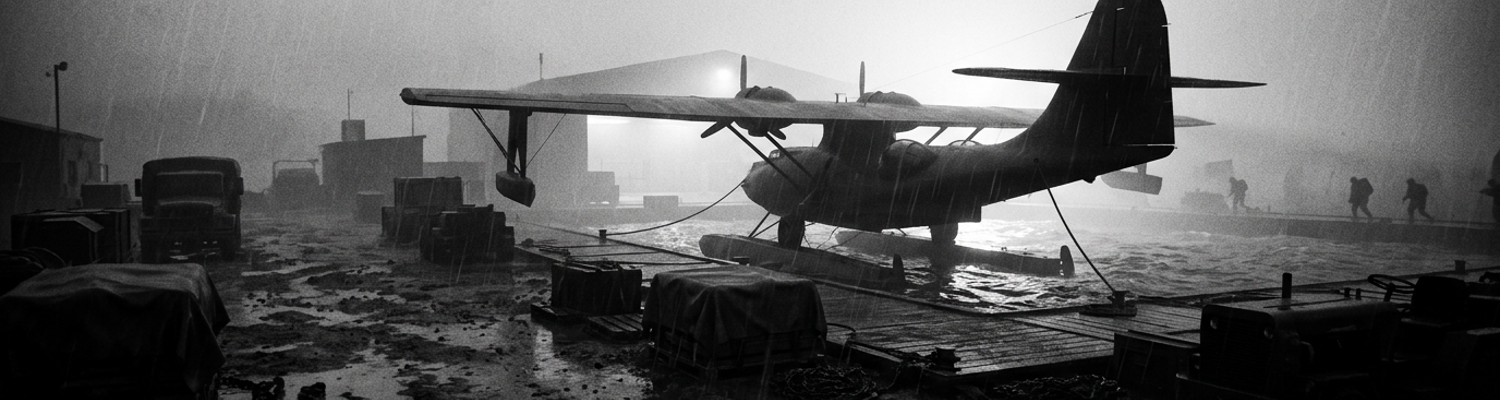

PBY-5A Deployments and Primitive Aleutian Anchorages
At zero-five-forty hours on June 3, 1942, an urgent wireless contact report shattered radio silence across naval frequencies in the eastern Aleutians. Hostile carrier task force sighted bearing one-eight-zero degrees. Distance one-six-zero miles. Speed eighteen knots. Taking heavy anti-aircraft fire. Archival evidence shows that this intercepted message exposed a complete breakdown in northern territorial defense. Behind that panicked transmission lay weeks of bureaucratic hostility between the United States Navy and the United States Army. Commander of Task Force 8, Rear Admiral Robert Theobald, distrusted Army air strength. He kept his naval surface units hundreds of miles offshore under strict radio silence. He refused to establish a combined joint operations room with Major General Simon Bolivar Buckner Jr. of the Alaska Defense Command. Captain Leslie E. Gehres, leading Navy Patrol Wing 4, had to establish an offshore reconnaissance barrier using whatever aircraft could fly through persistent sub-polar fog.
Command authority was split between separate service headquarters communicating primarily by courier boat across open ocean.
When examining the historical record of May 1942, Patrol Wing 4 began scattering its Consolidated PBY-5A Catalinas from VP-41 and VP-42 across isolated coastal positions. Naval planners distributed these twin-engine amphibians between Dutch Harbor on Amaknak Island and the newly graded gravel strip at Fort Randall in Cold Bay. Army engineers had cleared the Cold Bay strip in secret. Navy flight commanders received conflicting orders regarding whether their amphibious Catalinas were permitted to park on Army aprons or forced to moor in the bay. Flight crews faced unmapped shoals and zero-visibility squalls. They lacked ground-controlled approach radars or radio range transmitters. Flight operations at Dutch Harbor relied on open water lanes in Iliuliuk Bay. Jagged volcanic ridges forced incoming pilots to make steep, blind descents through cloud decks directly toward granite cliffs. Mechanical wear accelerated rapidly. Saltwater corroded landing-gear retraction struts. Sand from unpaved shores entered the intake manifolds of Pratt and Whitney R-1830-92 radial engines during low-altitude engine run-ups. The Pratt and Whitney twin-row radial engines required constant priming. Mechanics used hand-cranked inertia starters to turn the massive cylinders (NARA Record Group 338).
Neither outpost possessed a heated hangar or an enclosed maintenance bay.
A close review of operational logs indicates that afloat maintenance fell upon two specialized naval support vessels. Stationed at Cold Bay, USS Casco, a Barnegat-class small seaplane tender designated AVP-12, swung at anchor amid tidal mud flats. These flats dried out during low water. This exposed sea-chest suction pipes to thick silt. Further west at Dutch Harbor, USS Gillis, a First World War flush-deck destroyer converted into seaplane tender AVD-4, endured catastrophic williwaw gales. These localized winds plunged off Mount Ballyhoo at speeds exceeding eighty knots. They ripped moored flying boats from their fifty-pound mooring buoys. Twenty-eight-ton seaplanes flipped across the harbor chop. Sub-polar sea spray coated the empennage of anchored Catalinas in dense glaze ice. This altered the balance of elevator trim tabs. Sheet-metal wings buckled under structural load. Salt-ice encrusted Hamilton Standard hydromatic propellers. The pitch-change dome mechanisms froze. Flight engineers could not feather damaged blades after maritime patrols.
Field crews had to improvise every basic servicing function in freezing seawater.
Refueling operations required sailors to roll fifty-five-gallon steel drums of 100-octane aviation gasoline along rocky shores by hand. They loaded them into open whaleboats pitching violently in Bering Sea swells. Mechanics then pumped the volatile fuel into PBY wing tanks using manual wobble pumps and chamois-lined funnels to filter out seawater and ice crystals. Rearming external ordnance racks tested human endurance even further. Armorers waded waist-deep into twenty-eight-degree surf. They muscled one-thousand-pound Mark 13 aerial torpedoes and five-hundred-pound general-purpose demolition bombs onto wet wing bomb shackles. Engine oil froze into thick sludge inside oil radiators overnight. Ground crews drained the sumps into five-gallon buckets after each landing. They heated the lubricant over kerosene cookers inside tents. The scalding fluid was poured back into the crankcases minutes before takeoff. Canvas tarpaulins slung over nacelles trapped heat from primitive gasoline blowtorches. Mechanics adjusted valve clearances with bare, frostbitten fingers.
Spare spark plugs were baked in ship galleys to prevent electrode fouling prior to ignition.
Command Architecture and the 1921 Joint Board Doctrine
When examining the historical record of northern defenses in early 1942, operational authority across Alaska collapsed under the archaic 1921 Joint Board circular doctrine. This pre-war regulation enforced mutual cooperation between service branches rather than designating a single, unified theater commander with supreme operational control. Pacific Fleet headquarters under Admiral Chester Nimitz assigned Rear Admiral Robert Theobald to direct naval surface units and allocate maritime patrol responsibilities under Task Force 8. Major General Simon Bolivar Buckner Jr. retained independent control over ground defenses and coastal artillery batteries. His direct subordination went to General John L. DeWitt at the Western Defense Command in San Francisco. Under the 1921 Joint Board framework, joint action required voluntary agreement between branch commanders. Mandatory adherence to centralized theater directives did not exist. Disagreements over troop movements, aircraft dispersal, or territorial priorities could not be settled locally. Neither service possessed the administrative mechanism to compel the other into compliance. Navy seaplanes answered strictly to naval district protocols. The Eleventh Air Force and territorial infantry units operated under separate Army war plans.
Neither officer possessed the legal authority to overrule the other in an emergency.
A close review of operational logs indicates that personal animosity between Theobald and Buckner paralyzed strategic coordination throughout May 1942. Theobald possessed a hyper-legalistic temperament and an ingrained suspicion of land-based Army air power. He chose to establish his tactical headquarters afloat aboard the light cruiser USS Nashville and the gunboat USS Charleston. Buckner maintained his command post hundreds of miles away at Fort Richardson near Anchorage. He worked from concrete bunkers tied to mainland defensive perimeters. Repeated requests to come ashore or establish a combined joint operations room with Army staff officers were flatly rejected. Strict radio silence was enforced across the surface ships of Task Force 8. This prevented Imperial Japanese Navy direction-finding stations from intercepting fleet signals. The decision severed direct telegraphic communication with Fort Richardson. Dispatches between the two commanders had to travel aboard amphibious courier aircraft. Some went through civilian underwater cables routed all the way south through Seattle. Severe cryptographic barriers compounded these delays. Naval radio operators used ECM Mark I cipher machines. Army communication detachments utilized incompatible M-138-A strip-cipher systems. Administrative bottlenecks resulted where classified tactical cables sat undecrypted for up to twenty-four hours.
Inter-service communications slowed down to the pace of commercial telegrams.
Archival evidence shows that an irreconcilable divide emerged over the strategic objective of the enemy. Station HYPO in Hawaii decrypted key fragments of the Japanese naval code JN-25. Admiral Nimitz issued explicit warnings that Vice Admiral Boshiro Hosogaya and his Northern Area Force were steaming toward the eastern Aleutians. Their objective was to bomb Dutch Harbor and occupy Attu and Kiska. Theobald rejected this intelligence assessment. He viewed it as an elaborate Japanese deception operation intended to draw American ships away from the North American continent. Calculations produced by his naval staff indicated that Japanese aircraft carriers planned to strike Dutch Harbor merely as a diversion. Their primary amphibious landing force would attack the Alaskan mainland to capture the ice-free deep-water port of Seward, the Kenai Peninsula, or the naval station at Kodiak. Army planners under Buckner and Brigadier General William O. Butler of the Eleventh Air Force argued that Dutch Harbor and the secret airfields at Fort Randall in Cold Bay and Fort Glenn on Umnak were the actual targets. Rejecting these Army warnings, Theobald ordered Task Force 8 to steam four hundred miles south of Kodiak into the open ocean. He intended to intercept a mainland invasion fleet that did not exist.
Dutch Harbor sat defenseless on June 3, 1942.
Task Force 8 patrolled empty water four hundred miles to the east.
Cryptographic Breakdown and Incompatible Communications Systems
Archival evidence shows that mechanical incompatibilities inside Aleutian communications huts crippled joint operations before combat began. Operating behind locked doors at Dutch Harbor, Navy radiomen processed incoming traffic on ECM Mark I electric rotor cipher machines. These were designated CSP-888. Across the mud roads of Amaknak Island, Army Signal Corps detachments at Fort Mears possessed no cryptographic keys for Navy rotor banks. Signal officers in the Army communications room had to rely on manual M-138-A strip ciphers. The M-138-A strip cipher consisted of a flat aluminum base holding twenty-five sliding paper strips. Clerks aligned specific letters to read plaintext vertically (Signal Corps File 44-12998). When emergency naval dispatches arrived from Patrol Wing 4, naval cryptographic clerks decrypted the radio signals onto paper tape. They typed the plaintext into standard telegram forms and stamped them with red priority classifications. Armed Navy couriers carried these physical documents through driving rain. They ran down hillside boardwalks or drove Dodge command cars to deliver the paper directly into Army hands. Signal Corps clerks at Fort Mears then transcribed the plaintext word by word into their own codebooks. They re-encrypted the data using Army numerical tables before their transmitter arrays could broadcast the information to airfield command posts.
Every inter-service transmission crawled through this mechanical bottleneck.
A close review of operational logs indicates that divergent radio frequency allocations severed direct tactical cooperation between air wings. Patrol Wing 4 flying boats from squadrons VP-41 and VP-42 transmitted maritime sightings across naval high-frequency channels between four and eight megacycles. These signals went back to the seaplane tender USS Gillis or the naval communications station on Mount Ballyhoo. Army airfields lacked receivers tuned to these naval channels. At Fort Glenn on Umnak Island, located seventy miles west of Dutch Harbor across the turbulent waters of Umnak Pass, pilots of the 11th Fighter Squadron sat inside cockpits of Curtiss P-40 Warhawks. They monitored very-high-frequency tactical air loops. Twin-engine Martin B-26 Marauders of the 73rd Bombardment Squadron sat parked on wet Marston steel matting at Cape Field. They warmed their Pratt and Whitney R-2800 engines without target vectors. When a PBY crew sighted Japanese carrier-borne bombers breaking through cloud cover, the radio contact report bypassed the fighter base entirely. It bounced hundreds of miles east to naval command centers in Kodiak. Naval operators at Kodiak had to log the Morse transmission. They delivered it to Army liaison personnel. They waited for intermediate operators to rebroadcast the coordinates over Army frequencies.
Intercept warnings reached fighter cockpits forty-five minutes after enemy aircraft dropped their ordnance.
When examining the historical record of Task Force 8 command decisions, Rear Admiral Robert Theobald maintained absolute control over radio intelligence originating from Station HYPO decrypts and Pacific fleet direction-finding networks. Stationed aboard the light cruiser USS Nashville hundreds of miles southeast of the island chain, Theobald enforced strict radio silence policies. This barred his staff from broadcasting tactical intelligence summaries to the Eleventh Air Force. Brigadier General William O. Butler directed Army air assets from his base at Fort Richardson. He received zero operational direction regarding Imperial Japanese Navy carrier strength, anticipated approach vectors, or fleet composition. Butler operated blind. Theobald distrusted Army message handling security. He suspected that loose air-to-ground radio discipline would reveal American foreknowledge of the attack to Japanese monitoring stations. Operational plots inside the Eleventh Air Force operations tent showed empty oceans. Naval cipher rooms tracked enemy movements across the North Pacific. Requests from Army staff officers for direct teleprinter links or naval combat coordinators were rejected aboard the flagship.
Butler ordered strike formations of eleven Martin B-26 Marauders into zero-visibility fog over the North Pacific on unguided search bearings.
Japanese Carrier Division 4 Interceptions in Aleutian Fog
Archival evidence shows that early radar detection provided the first confirmation of Japanese Carrier Division 4 on June 2, 1942. Flying eighty miles southwest of Umnak Island, a twin-engine Consolidated PBY-5A from squadron VP-41 picked up transient surface returns on its British-designed ASV Mark II radar screen. Green phosphor spikes on the cathode-ray tube indicated heavy naval hulls cutting through four-foot ocean swells at eighteen knots. Descending beneath the low weather ceiling, pilots pushed their control yokes forward. They dived from five thousand feet down to three hundred feet to establish visual identification. At zero-five-forty hours on June 3, Lieutenant Charles E. Perkins broke through a dense ceiling of sea smoke one hundred and sixty nautical miles off Dutch Harbor. Before him lay Rear Admiral Kakuji Kakuta and his Second Mobile Force. This force centered on the light carrier Ryujo and the converted carrier Junyo. Japanese lookouts spotted the Catalina almost immediately. Twin 25mm Type 96 anti-aircraft batteries opened fire across open water. Black smoke bursts bracketed the flying boat. Perkins shoved both throttle levers forward to escape into an adjacent rain squall.
Every radio transmission exposed the lumbering patrol boats to lethal pursuit.
A close review of operational logs indicates that Japanese combat air patrols exploited American radar blind spots with lethal speed. Carrier Division 4 maintained Mitsubishi A6M2 Zero fighters and Nakajima B5N2 carrier attack aircraft aloft over the strike corridors. PBY-5A bureau number 05156, piloted by Ensign Jean Cusick of VP-41, attempted to track the carrier formation through zero-visibility fog sectors. Three A6M2 Zeros dropped out of the overcast. The unarmored amphibious hull offered zero structural protection against 20mm Type 99 autocannon rounds. Explosive shells penetrated the fabric-covered trailing edges of the parasol wing. They detonated inside unsealed fuel cells and severed elevator control cables. Cusick threw the heavy aircraft into violent lateral skids. He attempted to reach a low-hanging stratus bank barely fifty feet above the freezing chop. Zero pilots fired deflection bursts into the cockpit glass and waist blister positions. Twin Pratt and Whitney R-1830 engines failed as severed oil conduits sprayed burning lubricant across the nacelles. The burning Catalina cartwheeled into the water within ninety seconds. Similar attacks caught PBYs flown by Lieutenant Marshall C. Freerks and Ensign Jack Litsey. Both damaged aircraft dragged wingtips through wave crests. Rear gunners fired single .50-caliber machine guns blindly into gray fog against circling Nakajima B5N2 bombers.
No American fighter escort ever arrived.
When examining the historical record of these extended search sweeps, flight crews absorbed punishment that pushed human endurance past its mechanical limits. Patrol Wing 4 aviators spent fourteen to eighteen consecutive hours strapped into uninsulated aluminum cockpits. Interior temperatures hovered at twenty degrees below freezing. Magnetic compasses spun erratically. Iron deposits inside nearby volcanic island peaks distorted magnetic fields across the Aleutian Arc. Static electricity generated by heavy snow squalls blinded low-frequency radio receivers. Navigators lacked coastal transmitter signals or radio direction-finding fixes. Crews calculated drift angles using primitive dead reckoning. They dropped flare markers into breaking waves while flying thirty feet above open water in dense fog. Benzene and exhaust fumes leaked through firewall grommets into the main cabin. This nauseated waist gunners who stood watch at open blister windows with bare skin freezing against steel gun mounts. Flight surgeons issued amphetamine tablets to prevent pilots from falling asleep at the dual controls during long homeward legs over featureless water. Spatial disorientation plagued pilots. They regularly mistook gray ocean swells for cloud banks and pulled up abruptly to avoid crashing into sea ice.
Salt crust on cockpit windshields completely eliminated forward vision during emergency water landings.
Damaged Catalinas limped back toward Dutch Harbor with shredded rudders and perforated auxiliary tanks. They found landing lanes enveloped in zero-zero visibility. Navigators had to calculate descent angles using elapsed flight time and hand-held stopwatches while flying directly toward the hidden granite cliffs of Mount Ballyhoo. Ground mechanics pulled exhausted flight crews from soaked cockpits. They thawed frozen extremities over engine pre-heaters. Replacement crews went out on matching coordinates two hours later. By the evening of June 3, VP-41 and VP-42 had lost three flying boats destroyed with their entire crews. Four more aircraft were grounded due to structural cannon damage. Zero operational relief crews were available in theater.
Bureaucratic Delays and Grounded Army Pursuit Aircraft
Archival evidence shows that during the morning of June 3, 1942, the secret steel-mat runway at Fort Glenn on Umnak Island was paralyzed by institutional hesitation. Mechanics of the 11th Fighter Squadron had twelve Curtiss P-40E Warhawks pre-heated and armed with six .50-caliber wing guns. Their Allison V-1710-39 liquid-cooled engines turned over inside revetments at Cape Field. Captain John S. Chennault waited beside his cockpit for an authorization order that never arrived. Radio links between the naval operating base at Dutch Harbor and the Army outpost seventy miles to the west had collapsed into an administrative vacuum. Base radio personnel on Amaknak Island maintained a total transmission blackout to prevent enemy radio direction finders from pinning their naval transmitters. Signal Corps operators at Fort Glenn monitored dead frequencies. They were unaware that enemy carrier-based dive bombers were already rolling into their terminal dives over Iliuliuk Bay. No inter-service standing operating procedure existed to delegate immediate scramble authority to local Army pursuit commanders without verbal confirmation from Eleventh Air Force headquarters at Fort Richardson. That headquarters sat eight hundred miles away in Anchorage.
Twelve pursuit fighters sat idling on the gravel apron.
Bombs fell seventy miles to the east.
A close review of operational logs indicates that the strike failure deepened when Eleventh Air Force bombers attempted to find Japanese Carrier Division 4. At Fort Randall in Cold Bay, six Martin B-26 Marauders of the 73rd and 77th Bombardment Squadrons had been retrofitted with external 2,000-pound Mark 13 aerial torpedoes. These were mounted on improvised bomb-bay slings. Patrol Wing 4 Catalinas tracked Vice Admiral Kakuji Kakuta and his carriers through breaks in the fog. Naval communications channels routed these contact vectors to Task Force 8 headquarters rather than to Army airfields. Major General Simon Bolivar Buckner Jr. had no operational tie-in with Rear Admiral Robert Theobald and his surface fleet. This prevented Army bombardment squadrons from receiving updated target coordinates. Six Boeing B-17E Flying Fortresses of the 36th Bombardment Squadron took off from Fort Glenn into a 200-foot ceiling without target bearings. They flew unguided search arcs across thirty thousand square miles of open sea. Marauders carrying torpedoes burned through their limited fuel reserves searching barren ocean sectors. Pilots had to jettison their torpedoes into the sea to maintain sufficient lift during zero-visibility landings.
Naval patrol aircraft tracked the Japanese carriers.
Army bombers flew reciprocal headings sixty miles to the north.
When examining the historical record of June 3 and June 4, the airspace directly above Naval Operating Base Dutch Harbor lay completely uncontested by American land-based aviation. Nakajima B5N2 torpedo bombers and Aichi D3A dive bombers flew unchecked through low cloud decks. They dropped twenty-five tons of high explosives and incendiary clusters onto the harbor installation. Bombs detonated fuel storage tanks. They incinerated five-hundred-man wooden barracks. They gutted the naval dispensary and smashed the concrete foundation of the radio direction-finder station on Mount Ballyhoo. High-explosive ordnance struck the grounded wooden barracks ship USS Northwestern. This punctured its boiler rooms and started fires that burned for forty-eight hours. The absence of American pursuit cover was not caused by a deficit of operational airframes or pilot unreadiness. Combat-ready P-40 fighters sat strapped to the Marston matting at Fort Glenn. Their pilots listened to anti-aircraft fire rumbling across the water while awaiting written confirmation of an enemy presence.
Organizational division between Army air commands and naval defense forces had grounded the defensive perimeter.
Historical flight logs confirm that on the afternoon of June 4, an uncoordinated second strike wave of eleven Japanese aircraft from the Junyo targeted oil storage tanks at Dutch Harbor. They faced not a single American interceptor over the target area. Navy anti-aircraft gunners aboard the converted seaplane tender USS Gillis expended over two thousand rounds of 3-inch and 20mm ammunition against low-flying dive bombers. Not one Eleventh Air Force fighter entered the defensive sector until Japanese flight formations were already withdrawing westward toward Umnak Pass. Lieutenant John J. Cape Jr. and Lieutenant Winfield E. McIntyre engaged retreating Zero fighters over the western beaches of Umnak Island only because the Japanese strike leader inadvertently crossed the approach corridor of Fort Glenn on his return flight to the carrier Ryujo.