
Initial Tactical Package and Control Illusion
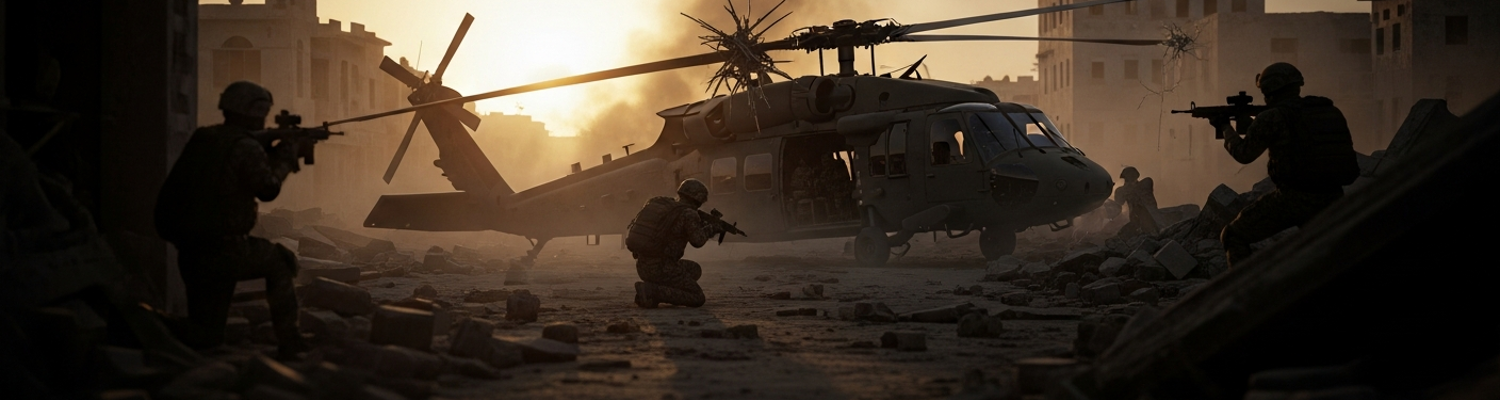
At 16:20 local time, a transmission sliced through the command channel. Super 6-1 was going down.
This message marked the failure point of a mission built on speed and technological overmatch. A review of operational logs for Operation Gothic Serpent indicates the tactical package was selected for a surgical, short-duration raid, not a sustained urban fight. The assault element, composed of C Squadron, 1st SFOD-D (Delta Force) and Bravo Company, 3rd Battalion, 75th Ranger Regiment, carried customized CAR-15 carbines and M16A2 rifles. Many were fitted with underslung M203 40mm grenade launchers. Support came from M60 and M249 machine guns. The mission’s backbone was the aerial component from the 160th Special Operations Aviation Regiment (SOAR). This was a combination of MH-60L Black Hawks for insertion and fire support, alongside both AH-6 and MH-6 Little Birds. The Black Hawks provided transport and suppressive fire from door-mounted 7.62mm miniguns. The AH-6 attack variants delivered fire from miniguns and 2.75-inch rocket pods. This force was designed to overwhelm a specific target in minutes, a task it had successfully accomplished on six prior missions.
The entire plan rested on a swift exfiltration. A ground convoy of unarmored Humvees and five-ton trucks was staged for this purpose. The core assumption was that this application of overwhelming, precise firepower would prevent any significant organized resistance from forming.
Radio Saturation and Ground Unit Isolation
The downing of the first Black Hawk, Super 6-1, triggered an instantaneous saturation of the radio networks. Task Force Ranger operated across several nets: a command net for overall control by Major General William F. Garrison, an air net for the 160th SOAR, and separate nets for the ground elements. The sudden crisis caused every echelon to transmit at once. Pilots in the air reported the crash location. The crew of the downed helicopter attempted to report their status. Ground units, particularly the Ranger chalks establishing a perimeter, began reporting heavy, converging enemy fire. At the Joint Operations Center, the command net became a cacophony of unintelligible noise, filled with static, clipped transmissions, and operators talking over one another.
Archival evidence shows the urban canyon environment of Mogadishu severely degraded the single-channel ground and airborne radio systems (SINCGARS). This led to fragmented reports that painted a confusing and contradictory picture for commanders. The reliance on a limited number of satellite radios, primarily held by team leaders, created information bottlenecks as the situation deteriorated. This communications breakdown led directly to the physical isolation of the assault teams. Without clear guidance from the overhead MH-6 reconnaissance helicopters or the command element, ground units were cut off.
The Ranger chalks were intended to form a secure four-corner perimeter around the target building. They found themselves pinned down in a rapidly expanding firefight. Staff Sergeant Matt Eversmann’s Chalk Four, inserted a block away by mistake, was unable to get clear instructions and was almost immediately separated from the main body. The ground convoy, commanded by Lieutenant Colonel Danny McKnight, could not get accurate vectors to the crash site from the JOC. The JOC itself lacked a clear picture of the streets. The convoy was forced to navigate a labyrinth of barricaded alleys, receiving a storm of fire, with its only guidance coming from intermittent and garbled radio calls. This left the Delta operators and Rangers at the first crash site stranded, forced to establish a hasty defense with dwindling ammunition and growing casualties.
A Fractured Command Architecture by Design
The operational architecture in Mogadishu was fractured. A forensic analysis of the command structure reveals two distinct, parallel, and unequal entities. Major General William F. Garrison commanded Task Force Ranger, a combination of operators from 1st SFOD-D, Rangers from B Company, 3rd Battalion, 75th Ranger Regiment, and pilots from the 160th SOAR. This force answered directly to the Joint Special Operations Command (JSOC), a structure intended to provide operational security and rapid, unilateral action.
Operating separately was the United Nations Operation in Somalia II (UNOSOM II). This was a multinational force commanded by Turkish Lieutenant General Cevik Bir, with U.S. Major General Thomas M. Montgomery as his deputy. While Montgomery commanded the U.S. Quick Reaction Force (QRF) from the 10th Mountain Division, he had no direct authority over Garrison’s JSOC elements. Garrison was required to coordinate with, but not answer to, Montgomery. This arrangement firewalled the U.S. military’s most lethal assets from its largest conventional force in-country. The separation was intended to protect the secrecy of high-tempo raids but proved catastrophic when one of those raids disintegrated.
This division was not a flaw; it was a feature. The structural separation guaranteed that any request for support would be a negotiation, not an order. An ego-driven culture within the special operations community prioritized secrecy and self-reliance, viewing external coordination as a potential compromise and a sign of weakness. Garrison’s initial requests for heavier assets like AC-130 gunships and armor before the operation had been denied. This reinforced a mindset within TF Ranger that they were on their own. This professional pride and institutional separation meant there were no pre-established protocols, integrated communication plans, or joint training exercises between the Rangers and the UN armored units.
Bureaucratic Paralysis and Delayed Reinforcement
When Super 6-1 was struck by a rocket-propelled grenade at 16:20, General Garrison could not simply command the 10th Mountain Division’s QRF into action. That request had to pass through General Montgomery, who in turn had to coordinate with the multi-national UNOSOM II leadership. The most effective assets for a rescue in the dense urban environment, armored vehicles, belonged to the Pakistani and Malaysian UN contingents. The Pakistanis possessed M48 tanks and the Malaysians were equipped with German-made Condor armored personnel carriers. These units, however, had been deliberately kept unaware of the specifics of Task Force Ranger’s mission for operational security reasons. Activating them required navigating different national chains of command, disparate rules of engagement, and language barriers. There was no integrated communication system linking the Pakistani tankers to the American infantrymen they were supposed to rescue.
The result was a crippling delay. A small, emergency QRF convoy attempted a rescue around 17:03 but was quickly repulsed by the sheer volume of fire. For the soldiers trapped at the crash sites, this command friction translated into hours of metallic radio silence. Calls for fire support, ammunition resupply, and extraction went up the chain of command but yielded no immediate response. The men of C Squadron, 1st SFOD-D, and 3rd Battalion, 75th Ranger Regiment, were holding their own, but they were in a rapidly shrinking bubble with finite resources. They had planned and equipped for a raid lasting no more than an hour.
As afternoon bled into evening, the promised support remained a phantom. The effort to assemble the rescue column was a study in logistical paralysis. A review of after-action reports (AAR, TF-Ranger, 19 OCT 93) shows that commanders spent hours devising a workable plan to integrate the Pakistani tanks, Malaysian APCs, and American infantry from the 10th Mountain Division. The column did not begin its push into the city until 23:24, more than seven hours after the first Black Hawk was shot down.
The Collapse of Civil-Military Strategy
A review of historical records from Mogadishu in 1993 reveals an almost complete absence of a unified civil affairs strategy. The operational environment was split between two entities with conflicting missions. On one hand, the United Nations Operation in Somalia II (UNOSOM II) was engaged in a broad nation-building and humanitarian relief effort. Its civil affairs teams and attached elements from the 96th Civil Affairs Battalion were focused on interacting with aid organizations, assessing local infrastructure, and theoretically winning public support. On the other hand, Task Force Ranger was a unilateral American special operations element whose sole purpose was to hunt and capture Mohamed Farrah Aidid and his lieutenants.
No effective mechanism existed to deconflict these two opposing objectives. This led to a state of strategic confusion on the streets of Mogadishu. Elements of the 4th Psychological Operations Group would disseminate leaflets and broadcast radio messages promoting peace and cooperation, part of the UNOSOM nation-building mandate. In some cases, these messages were broadcast in the very same districts where Task Force Ranger was executing high-tempo kinetic raids. This created a perception of deep hypocrisy among the Somali populace. The population was simultaneously being told by one American-supported entity to trust the intervention while another American-only entity conducted aggressive military actions.
Because no unified civil-military plan existed, there was no coherent effort to engage with the complex web of clan elders and neutral power brokers who held sway in the city. The Civil-Military Operations Center, which should have been a hub for coordinating with local leaders and non-governmental organizations, was effectively firewalled from TF Ranger’s activities due to the extreme operational security surrounding the JSOC mission. Clan elders, who possessed the influence to either calm or inflame their neighborhoods, were not cultivated as potential allies or sources of intelligence. After-action reports show they were largely ignored or alienated by the aggressive posture of the anti-Aidid operations. UNOSOM civil affairs personnel might attempt to negotiate with a specific clan leader for humanitarian access, completely unaware that Task Force Ranger was planning a raid in that same leader’s territory. This operational disconnect destroyed any possibility of building trust or gathering the granular human terrain intelligence needed to operate in a dense urban area.
An Ambiguous Battlefield and Point-Blank Engagements
The lack of a functioning civil affairs program to build pockets of neutrality or support, combined with alienated local leaders, meant the entire city became a threat. The Somali population, angered by the perceived duplicity and collateral damage from military operations, transformed from a neutral audience into an active participant in the opposition. Every street corner became a potential firing point, and every alleyway an ambush site. Operational logs and soldier testimonies from October 3rd detail how women and children acted as an intelligence network for Aidid’s militia, reporting on the movements of the Ranger chalks and ground convoy. They actively assisted in erecting the barricades of burning tires, cars, and debris that channeled the Humvee convoy into kill zones.
The Somali National Alliance militia wore no uniforms, melting seamlessly into the civilian population. Fighters, often young men high on the amphetamine-like khat leaf, would appear from doorways or crowds, fire an AK-47 or an RPG-7, and then discard the weapon to become a non-combatant once more. This created an impossible tactical and ethical problem for the Rangers and Delta operators. The standing Rules of Engagement required positive identification of a weapon before firing, a standard that was nearly impossible to meet when a threat could materialize and vanish in the space of a heartbeat. Every person on the street was a potential enemy, forcing soldiers to make life-or-death decisions based on a flicker of movement or a momentary glint of metal.
The situational ambiguity and the compressed urban terrain forced combat into what was effectively knife-fighting distance. At the crash site of Super 6-1, Rangers and Delta operators took cover in the pockmarked mud-brick houses and rubble, engaging militia fighters who were just across the narrow street. The fight was not one of over-the-horizon strikes, but of grenades thrown from one alley to another and rifle barrels firing from opposing windows. The technological superiority of Task Force Ranger’s weapon systems was severely blunted when targets were only meters away and indistinguishable from the civilian population until the moment they opened fire. The battle devolved into a brutal test of individual soldiering skills, where survival depended on the rapid acquisition of targets and the violent suppression of threats appearing from every direction with almost no warning.