
Operation Praying Mantis and Surface Action Group Charlie
Seventy-two hours of sustained alert conditions in the southern Persian Gulf stripped the crews of basic physical stamina before a single shot was fired. Inside the guided missile cruiser USS Wainwright, watchstanders operated on cold galley rations. They survived on bitter canned coffee and chemical water rations while standing continuous six-hour rotations in full flash gear. Heavy Nomex hoods and canvas fire-retardant gloves trapped perspiration against skin. Internal shipboard temperatures exceeded ninety-five degrees Fahrenheit.
Sleep came only in twenty-minute intervals on unpadded deck grating behind active AN/UYK-7 computer bays.
The low-frequency drone of motor generators masked the grinding ache of chronic sleep deprivation. Feet blistered inside damp leather flight boots from hours pacing steel non-skid passageways. Exhaustion reduced whole divisions to automatic muscle-memory labor.
A close review of operational logs (Record Group 313) indicates that Surface Action Group Charlie took its attack positions in the central Persian Gulf at dawn on April 18, 1988. Specific orders directed the neutralization of Iranian offshore assets during Operation Praying Mantis. Formed around the cruiser Wainwright, the guided missile frigate USS Simpson, and the fast frigate USS Bagley, the task group steamed across the southern shipping lanes. Their target was the fortified oil production platform complex at Sirri Island.
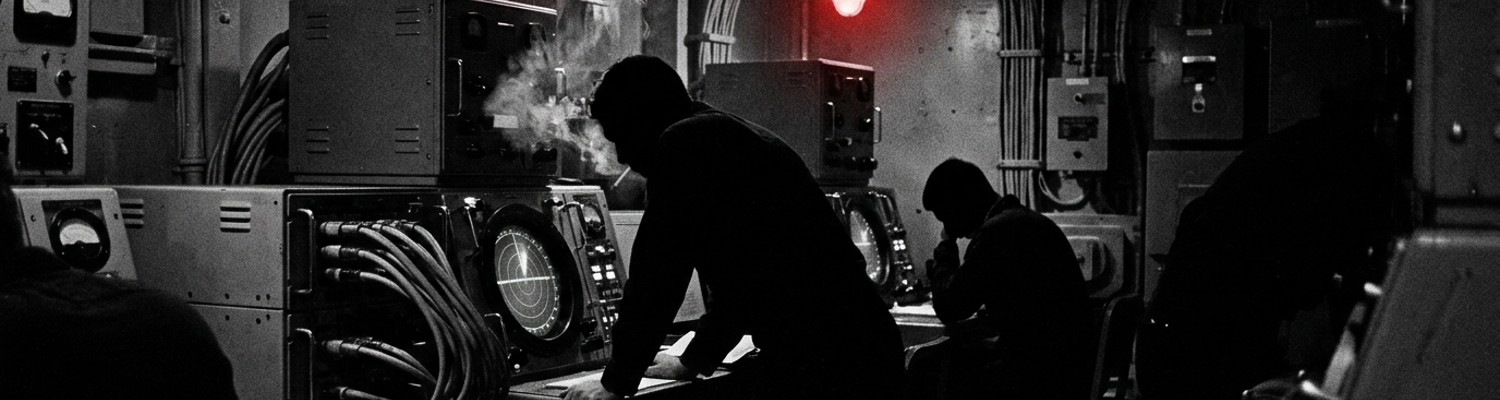
Beneath the cruiser's waterline in the central radar equipment spaces, fire control technicians wrestled with heat-soaked electronic racks. Power supplies repeatedly dropped below operating voltage. Solid-state logic cards (NSN 5961-00-123-4567) inside the AN/SPG-55B tracking radar transmitters expanded in the humid Gulf atmosphere. Technicians traced unstable circuit connections with handheld multimeters while the ship cleared for action.
Tactical commanders executed coordinated gun strikes using Wainwright's forward 54-caliber Mark 42 deck gun and Simpson's 76mm mount.
The bombardment methodically shattered the oil processing infrastructure. Iranian personnel abandoned the blazing metal complex into life rafts.
Then the surface search radars caught an incoming contact moving south from the Iranian coast at thirty knots.
When examining the historical record, tactical logs identify this high-speed contact as the Joshan. This was a French-built Combattante II-class fast attack craft armed with containerized anti-ship missiles and an OTO Melara 76mm automatic gun. The missile boat operated out of the Iranian naval station at Bushehr. It pressed directly toward Surface Action Group Charlie on a steady intercept course. It refused to deviate from its hostile approach axis.
Combat Information Center operators on board Wainwright and Simpson broadcast repeated challenges across the standard maritime distress channel 156.8 megahertz and the military emergency frequency 243.0 megahertz. They instructed the Iranian craft to identify itself, turn away, and power down its weapons systems.
Joshan maintained radio silence on international circuits.
The vessel accelerated toward the American formation, closing the separation distance past twenty nautical miles. Deep in the electronic warfare compartments of Wainwright, technicians running the AN/SLQ-32 electronic support suite watched pulse-repetition intervals register on display consoles. The approaching patrol craft energized its weapon-targeting radars.
Archival evidence shows that American radio operators broadcast four sequential warnings over twelve minutes. The messages spelled out that failure to stop would be treated as hostile intent and met with defensive fire. Joshan replied once over tactical bridge communications. The operator stated that their vessel was proceeding on an authorized national patrol mission. The transmission ordered the foreign warships to withdraw from the Persian Gulf.
The Iranian boat continued its approach.
It cut the distance to eleven nautical miles and locked its WM-28 fire control radar onto the mast of Simpson.
Bureaucratic Logistics Bottlenecks Across Bahrain and Diego Garcia
A close review of operational logs indicates that standard peacetime administrative protocols directly choked the pipeline of solid-state electronics to Persian Gulf warships during April 1988. Requisition documents generated under the Uniform Material Movement and Issue Priority System were constrained by peacetime Priority Designator caps. This prevented combat-deployed ships from expediting emergency supply requisitions past administrative gatekeepers.
Component orders for microprocessors, high-frequency radar diodes, and traveling wave tubes were routed through central logistics nodes. These nodes were located at the Administrative Support Unit at Mina Salman in Bahrain and the naval supply hub on Diego Garcia. Diego Garcia sat over twenty-six hundred nautical miles south in the Indian Ocean.
Depot personnel in Diego Garcia adhered to peacetime requisition processing standards.
They routed critical solid-state modules via scheduled surface sealift rather than chartering emergency military air transit. Scheduled C-141 Starlifters and C-130 logistics flights operated on rigid peacetime transport rosters. These manifests prioritized bulk food rations and mail over uncataloged electronics crates. Freight containers unloaded at Bahrain International Airport sat on concrete tarmacs for days. They awaited host-nation customs clearance and physical receipt processing by skeleton warehouse shifts.
By mid-April, standard requisition transit delays stretched past three weeks.
Guided missile ships on combat stations were left with zero replenishment pipeline for degraded radar systems. Peacetime catalog codes governed an active war zone.
When examining the historical record, both USS Wainwright and USS Simpson operated under Coordinated Shipboard Allowance Lists configured strictly for low-tempo training cruises. Neither vessel was supplied for active missile defense engagements. Both warships carried only thirty days of peace-state replacement allowances under fleet maintenance guidelines. These allowances dissolved after weeks of continuous operations in the high-heat Gulf environment.
Radar divisions on both vessels lacked essential plug-in replacement modules.
They watched their onboard spare parts drawers empty out completely. Down in Wainwright's radar equipment rooms, technicians maintaining the Mark 76 Guided Missile Fire Control System and its AN/SPG-55B tracking radars ran out of replacement logic cards. They also lacked operational amplifier modules and regulated 28-volt power supply assemblies. Forward storerooms offered no fresh circuit cards to replace components damaged by electrical surges or chronic thermal stress.
Aboard Simpson, Combat System Division personnel faced the same breakdown while supporting the AN/SPS-49 air search radar and the Mark 92 Fire Control System. Fire control technicians had already depleted the shipboard supply of replacement phase-locked loop boards and receiver-transmitter modular cards. They found only empty partitioned drawers in the electronics repair spaces.
Electronics divisions cannibalized their own dead hardware.
Archival evidence shows that ambient compartment temperatures exceeding ninety-five degrees Fahrenheit accelerated the degradation of solid-state components. This occurred inside unvented electronics cabinets beneath the waterline. Cooling loops using seawater chillers ran warm in the shallow Gulf basin. This caused silicon transistors to overheat. Power supply ripple voltages drifted beyond five-percent operating thresholds on Wainwright's AN/SPG-55B fire control radars.
Casualty reports filed by naval teletype remained stalled in administrative review across regional supply centers. Technicians were left to operate without factory support.
Fire control crews turned to Miniature/Microminiature electronic repair benches. They used basic soldering irons to physically desolder transistors and diodes from non-essential testing equipment. They rebuilt failing radar cards by hand.
In the radar spaces behind Wainwright's Combat Information Center, technicians worked beneath magnifying visors. Ventilation dampers were dogged shut for battle stations. The crew breathed toxic rosin fumes as they bridged cracked circuit traces with copper wire. Minutes before Joshan closed within eleven nautical miles, Simpson's technicians kept the Mark 92 Combined Antenna System tracking. They used an unauthorized rebuilt phase-shifter card held together by lead-tin solder and jumper wire.
Iranian Combatant Joshan and Inbound Harpoon Launch
A close review of operational logs indicates that at 1015 local time, the combat direction system aboard USS Wainwright registered hostile radio-frequency emissions. These signals shifted from wide-area search to dedicated target tracking. Ten nautical miles to the northwest, technicians on the bridge of the Joshan completed the pre-launch sequence for their starboard canister-mounted RGM-84A Harpoon anti-ship missile.
The patrol craft's Dutch-manufactured Signaal WM-28 fire control system ceased sweeping the horizon.
It drove continuous-wave radar energy onto the hull of Wainwright to calculate a terminal weapons solution. Within the Iranian combatant's deckhouse, operators triggered the electrical ignition circuit. This ignited the missile's solid-propellant booster motor with four thousand pounds of static thrust. Hot rocket exhaust scorched the aft deck plates of Joshan. An expanding gray cloud released across the waterline before the weapon cleared its launch cell.
Once airborne, the missile discarded its spent solid booster.
It ignited its Teledyne CAE J402 turbojet engine and dropped to an altitude of less than fifteen meters above the water. The weapon accelerated directly toward Wainwright on an intercept bearing of one hundred forty degrees.
Wainwright had less than ninety seconds to react.
Archival evidence shows that dead-calm surface conditions across the central Persian Gulf that morning created an unobstructed visual and acoustic tracking environment. Wind speeds registered at barely three knots. Sea state zero flattened the water without a trace of swell or chop. Surface clutter on American radar scopes dropped to near zero.
Up on the open bridge wings of Wainwright, forward lookouts equipped with twenty-power optical binoculars acquired the white smoke trail. They observed the Harpoon's solid booster separation against the clear northern horizon. Inside the ship's Combat Information Center, operators monitoring the AN/SPS-48C three-dimensional air search radar identified the missile within three sweeps. The weapon transitioned into its sea-skimming ingress.
Radar tracking teams tracked the high-speed contact moving at five hundred thirty knots.
They logged its altitude profile between thirty and forty feet above the flat surface. Tactical displays presented an unbroken line of raw video blips. Tracking consoles maintained continuous bearing and range rate telemetry without the wave-induced electronic interference typical of rougher waters.
The inbound weapon held its intercept geometry across the flat basin.
When examining the historical record, fire control technicians beneath the waterline on Wainwright manually compensated for severe thermal drift inside the AN/SPG-55B pulse-Doppler tracking loops. Technicians in the forward radar room adjusted receiver gain potentiometers with plastic alignment wands. This prevented the high-frequency radar receiver from dropping the low-altitude target blip.
Electronic warfare specialists manning the AN/SLQ-32 console confirmed the active radar seeker head of the incoming Harpoon entered its terminal acquisition phase at six nautical miles. The missile emitted ten-gigahertz pulses to lock onto Wainwright's superstructure.
Bridge watchstanders ordered the helm hard over.
This presented the cruiser's minimal radar cross-section. Weapons control teams prepared the Mark 36 Super Rapid Bloom Offboard Chaff launchers to fire decoys into the flight path. The AN/SPG-55B fire control radar maintained continuous target illumination across the final three miles of the missile's trajectory. It fed accurate elevation angles to the Mark 10 twin-arm launcher on the forward missile deck.
Mark 36 SRBOC Countermeasures and Decoy Deployment
Combat systems operators had forty seconds to break the weapon's electronic lock.
A close review of operational logs indicates that the electronic warfare officer on USS Wainwright immediately executed an emergency soft-kill launch sequence from the AN/SLQ-32 console. This initiated rapid salvos from the Mark 36 Super Rapid Bloom Offboard Chaff system. Direct current firing pulses surged through the ship's wiring harnesses to the fixed Mark 137 six-barrel mortar launchers mounted on the superstructure decks.
Propelled by internal black powder squibs, 130mm Mark 182 seduction cartridges cleared the launcher tubes at eighty feet per second.
They arced outward into the calm Gulf atmosphere. Pyrotechnic separation charges burst open each mortar canister at a pre-calculated distance of several hundred yards from the hull. Millions of fine aluminum-coated fiberglass filaments tumbled into the air. These were cut to resonate with active radar frequencies between eight and sixteen gigahertz.
Each expanding cloud produced an artificial radar cross-section exceeding twenty thousand square meters.
This generated massive electronic return signatures that completely eclipsed the structural steel profile of the guided missile cruiser. Every tube fired on schedule. Archival evidence shows that the approaching RGM-84A Harpoon possessed an active frequency-agile radar seeker. This seeker was engineered to acquire and home on the geometric center of shipboard radar reflections.
As the missile closed within four thousand yards at Mach 0.75, its forward antenna swept the sector.
It sought Wainwright's mast and superstructure. Bridge officers held the cruiser on a defensive heading. They exposed only a narrow frontal cross-section while allowing the freshly deployed chaff screen to billow across the starboard quarter. When the seeker's tracking circuitry detected the enormous bloom-phase reflective cloud, its range-gate discriminator registered the decoy as the primary target mass.
The missile's internal autopilot processed the sudden shift in target centroid.
It computed steering corrections through its mechanical actuator fins to track the center of the false radar return. The soft-kill chaff cloud successfully seduced the active radar seeker of the inbound Harpoon. It pulled the missile's seeker-head tracking gate entirely off the warship's hull.
The decoy pulled the incoming seeker off course.
When examining the historical record, starboard lookouts aboard Wainwright observed the low-flying missile alter its attack heading as it entered the outer edge of the reflective cloud. Passing through the suspended metallic dipoles thirty feet above the water, the weapon flew down the cruiser's starboard side at over five hundred knots. It cleared the hull by less than one hundred yards without initiating terminal pitch-up maneuvers.
The Harpoon's J402 turbojet engine threw spray across the water as the missile flew harmlessly into empty sea space down the starboard beam.
Two miles south of the formation, its jet fuel reserves exhausted, the weapon struck the surface of the Persian Gulf. It detonated its WDU-18/B penetrating blast-fragmentation warhead against the open water. A geyser of salt water rose sixty feet into the morning air. The cruiser remained undamaged while Joshan maneuvered directly into the engagement envelope of USS Simpson.
AN/SPG-55B Radar Illuminator Power Supply Bypass
Internal thermal overload collapsed the radar transmitter seconds after the incoming missile missed the hull.
A close review of operational logs indicates that at 1018 local time, the AN/SPG-55B fire control radar on USS Wainwright suffered a sudden power supply failure in forward radar equipment room two. This compartment was situated three decks below the waterline. Ambient air temperatures inside the unventilated compartment reached one hundred twelve degrees Fahrenheit. This overwhelmed the closed-loop liquid cooling heat exchangers that relied on eighty-eight-degree seawater pumped from the Persian Gulf.
Heat-induced thermal shock cracked the potting compound surrounding the radar's low-voltage regulated power supply assembly.
This assembly supplied direct current to the signal processor and local oscillator racks. Solid-state switching transistors inside the direct-current regulator module shorted out under continuous electrical draw. The primary twenty-eight-volt bus voltage collapsed to zero. Without stable reference voltages, the high-voltage power supply failed to energize the cathode circuit of the continuous-wave illuminator traveling-wave tube.
Up on the mast, the five-thousand-watt X-band transmitter dish ceased emitting radio frequency energy.
This blinded the Mark 76 Guided Missile Fire Control System just as surface action group commanders identified Joshan preparing its secondary weapons systems ten nautical miles northwest of Sirri Island. Combat Information Center tracking consoles went completely dark.
Archival evidence shows that electronics technicians and fire control ratings immediately breached standard maintenance protocols to execute emergency component-level repairs inside the active transmitter bay. Operating under combat conditions with incoming fire still an immediate hazard, technicians pulled open the bay doors without waiting for capacitor banks to drain through normal bleed resistors. They manually discharged high-voltage terminals using an insulated grounding probe.
Lead-tin solder spattered onto steel floor plates.
Two technicians deployed portable sixty-watt soldering irons powered from convenience outlets along the bulkheads. Inspection with handheld Simpson 260 multimeters revealed blown silicon rectifier diodes and charred circuit board traces along the regulator chassis. Lacking factory replacement boards due to depleted supply inventories, the repair team spliced twenty-two-gauge aircraft-grade copper jumper wire directly across burnt circuit card paths. This bypassed dead filter capacitors.
Technicians clipped substitute Zener diodes into the voltage-divider network using miniature insulated test leads.
They locked the components in place with drops of resin-core solder applied by hand under emergency red battle lanterns. Burned flux fumes mixed with damp bilge air inside the sealed electronics space.
When examining the historical record, tactical control officers on Wainwright faced a strict engagement deadline. The frigate USS Simpson had already begun tracking Joshan for a combined surface-to-air missile strike in surface-to-surface mode. Bridge orders from Captain Joseph Mobley pressed the electronics division to restore illuminator output before the Iranian patrol craft closed within range of its OTO Melara 76mm deck gun.
Working with bare fingers against scorching metal chassis frames, technicians secured the improvised jumper network.
They manually depressed the high-voltage interlock relays using wooden tongue depressors wedged into switch housings. At 1022 local time, the modified power supply accepted a forced four-hundred-hertz electrical load (MIL-STD-1399) from Wainwright's shipboard turbine generators. DC output stabilized at twenty-seven point four volts.
The traveling-wave tube energized.
It projected continuous-wave RF tracking energy through the waveguide straight to the forward director antenna. The antenna locked onto Joshan's steel superstructure at a bearing of three hundred fifteen degrees.
SM-1MR Missile Guidance and Destruction of Joshan
Five semi-active radar homing missiles left their launcher rails across a span of less than two minutes.
A close review of operational logs indicates that the re-energized AN/SPG-55B director on USS Wainwright paired with USS Simpson's Mark 92 fire control system. They bathed the Iranian patrol craft in continuous X-band radio frequency energy. Inside Simpson's Combat Information Center, weapons officers engaged the surface-attack profile on the Mark 13 Mod 4 single-arm launcher. They fed bearing data across coordinates twenty nautical miles north-northeast of Sirri Island.
Surface-to-air missiles fired against water-borne targets required continuous-wave illumination reflected off steel hulls rather than aerial targets against empty sky.
This demanded narrow receiver bandwidths to prevent sea-surface multipath reflection from pulling guidance fins downward into the waves. Simpson fired first. A RIM-66A Standard missile cleared its rail with twelve thousand pounds of thrust. Three subsequent SM-1MR rounds followed in rapid succession, cycling from the forty-round lower magazine ring.
Seconds later, tactical action officers on Wainwright cleared rail number one on the forward Mark 10 Mod 7 launcher.
They sent a fifth SM-1MR downrange on an intercept bearing of three hundred fifteen degrees. Semi-active radar seekers locked onto the reflected energy across ten miles of flat water. Archival evidence shows that each five-hundred-pound rocket traversed the ten-nautical-mile engagement corridor in under forty seconds at velocities exceeding Mach 2.
Flying along flattened ballistic trajectories, the missiles relied on solid-state proportional navigation loops to correct for sea-surface interference.
They drove straight toward the radar centroid produced by the French-built steel hull. Four of the incoming RIM-66 rounds struck Joshan directly along its forward deckhouse and main bridge structure. The sixty-two-pound MK 90 blast-fragmentation warheads detonated on contact. They released thousands of high-velocity steel cubes that sheared through aluminum plating.
The impacts demolished the Dutch-built WM-28 fire control mast and severed electrical cables leading to the ship's MTU diesel engines.
Blasts tore through the open wheelhouse. The command crew was killed. The Iranian combatant's primary steering controls were destroyed. Flaming solid rocket fuel set secondary fires throughout internal machinery flats. The fast attack craft drifted dead in the water. Its upper decks were reduced to jagged smoking frames.
When examining the historical record, Surface Action Group Charlie closed the distance to finish the burning hulk with conventional naval artillery.
Tactical action officers confirmed Joshan was unable to return fire or maneuver. Thick black smoke rose three hundred feet into the humid basin air as hydraulic fluid and bunker fuel burned unchecked. Captain Joseph Mobley directed Simpson and Wainwright to commence surface gun runs at five thousand yards to conserve remaining missile inventories.
Wainwright's forward 54-caliber Mark 42 lightweight gun fired repeated seventy-pound high-explosive projectiles into the waterline.
These punched four-inch entry holes through the hull below the main deck plating. Concurrently, Simpson engaged with its forward 76mm Mark 75 naval mount. It sent continuous three-inch fragmentation bursts into the exposed machinery rooms until hull compartments breached and flooded. Water rushed into the ruptured aft engineering compartments. The stern pulled downward until Joshan rolled to its port beam. The vessel slipped beneath the surface of the central Persian Gulf at 1040 local time.