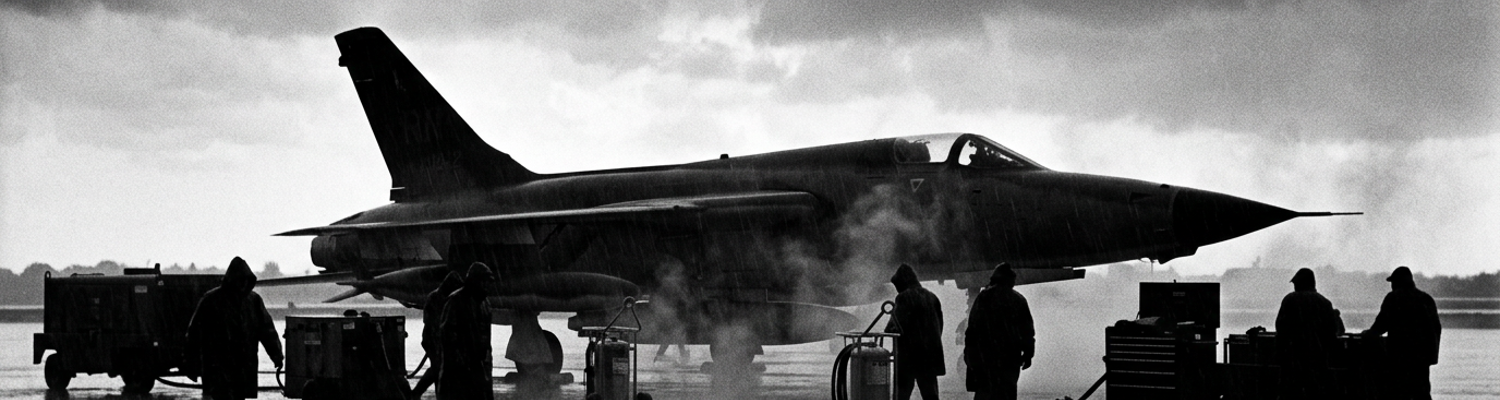

Deployment of the 354th Tactical Fighter Squadron
Standing pools of red laterite mud steamed beneath saturated air across the central plains of Thailand. Ambient humidity hovered near one hundred percent throughout the monsoon season. This moisture rotted canvas equipment covers. It corroded exposed wiring harnesses before airframes ever left the parking aprons. Heavy solar radiation superheated unshaded concrete parking areas. Ground temperatures surpassed 130 degrees Fahrenheit.
Metal burnt bare skin through standard issue leather work gloves.
Archival evidence shows that this severe microclimate greeted the operational arrival of modified two seat F-105F airframes at Takhli Royal Thai Air Force Base in mid 1966. Assigned to the 354th Tactical Fighter Squadron (under the 355th Tactical Fighter Wing), these heavily rebuilt airframes represented the combat deployment of Project Wild Weasel III. Unlike the single seat Thunderchief strike aircraft already flying combat sorties across Indochina, these two place variants incorporated an aft cockpit dedicated to an Electronic Warfare Officer. Specialized equipment packages occupied spaces previously used for internal fuel cells. These included the Applied Technology APR-25 radar homing and warning system, the Bendix APS-107 receiver, and the ER-142 panoramic receiver. Enlisted technicians working inside open revetments performed continuous recalibration. The complex electronic receivers detected threat radar pulses. They analyzed frequencies and determined the azimuth of target tracking sites before the strike package entered the kill zone.
Damp tropical air degraded delicate vacuum tubes and solid state circuit cards between maintenance shifts.
When examining the historical record of pre flight operations during August 1966, maintenance crews encountered cockpit heat exceeding 110 degrees Fahrenheit on the tarmac. This occurred before canopy seal and engine spool up for sorties into Route Package 6A. Direct solar radiation passed through thick Plexiglas canopies onto the instrument panels. The Pratt and Whitney J75-P-19W turbojet engine remained unstarted during the lengthy pre flight weapon inspection. The onboard environmental control system could not supply bleed air to cool the crew or the electronic indicators. Pilots and back seat Electronic Warfare Officers waited strapped into their seats. Sweat soaked through flight suits. It pooled inside heavy anti G garments. High temperatures within the cockpits frequently caused warning indicators to display false alarms before the aircraft ever taxied toward the active runway. Route Package 6A encompassed the upper Red River valley and the rail lines connecting Hanoi to China. This sector presented an array of active SA-2 Guideline missile battalions and radar directed anti aircraft artillery batteries around Yen Bai.
Enlisted ground crews routinely pushed portable air cooling trailers against the open fuselages.
A close review of operational logs from the 355th Tactical Fighter Wing indicates that technicians had to service the liquid oxygen converters on the flight line immediately before taxi. The tarmac heat boiled off liquid oxygen at twice the normal rate. Armorers worked beneath wings reaching surface temperatures of 140 degrees Fahrenheit. They manually hoisted 800 pound AGM-45A Shrike anti radiation missiles onto LAU-34 launchers mounted on the inboard wing stations. Sweat dripping into unsealed cannon plugs caused recurring short circuits in the fire control radar systems. Engine spool up finally drove the aircraft cooling turbines. Cockpit temperatures rarely dropped below 90 degrees Fahrenheit until the aircraft climbed past ten thousand feet over the mountains of Laos. At that altitude, sweat soaked flight clothing chilled rapidly against the metal seat pans.
Low Altitude Ingress Along North Vietnamese Flak Corridors
Limestone karst ridges sheared straight up into low cloud cover along the banks of the Song Chay.
A close review of operational logs indicates that flight leads from the 354th Tactical Fighter Squadron dropped their four ship formations down to five hundred feet above the valley floor. This happened upon crossing the Laotian border into Route Package 6A. Entering these river corridors was an attempt to break line of sight tracking from North Vietnamese early warning radar arrays situated near Hanoi. Pilots throttled their single Pratt and Whitney engines forward to military power. They raced at 540 knots through narrow gaps between towering limestone towers. These rock formations rose out of the jungle canopy. Razor sharp karst formations flanked the approach to the newly expanded Yen Bai airfield and the industrial rail marshalling yards at Thai Nguyen. Flying this low produced intense cockpit violence. Turbulent air bouncing off rock faces slammed the heavy airframes sideways. The turbulence repeatedly triggered stability augmentation pitch limiters. It bruised crew members against their harness straps. Electronic Warfare Officers in the rear seats worked blind. They stared directly into the green phosphor trace of the APR-25 radar warning display while the pilot maneuvered around blind rock walls. G suit bladders inflated and deflated continuously with each tight turn along the twisting watercourses. At five hundred feet, any sudden mechanical pitch trim runaway meant immediate collision with a stone face.
The valleys acted as funnels.
When examining the historical record of 1966 air strikes, American mission planners confronted a combined air defense network engineered by Soviet military advisors. North Vietnamese engineers had ringed the approaches to the Thai Nguyen rail corridors with overlapping rings of anti aircraft artillery. Batteries of optical 37mm M1939 guns occupied elevated earthen revetments along the high ridgelines. This placement allowed crews to fire downward into the cockpits of low flying Thunderchiefs. Below them on the flat valley floors, radar directed 57mm S-60 cannons tied to SON-9 Fire Can fire control radars pumped high explosive fragmentation rounds into designated flight paths. They fired at a rate of one hundred twenty rounds per minute per barrel. Heavier 85mm KS-12 guns (firing V-361 fragmentation shells) fired proximity fused shells into the higher approach levels between three thousand and twelve thousand feet. This layered deployment formed an interlocking trap with North Vietnamese SA-2 Guideline missile units. If an F-105 climbed to avoid the blanket of automatic cannon fire, early warning radar handed the flight off to a Fan Song radar. This initiated an immediate SA-2 surface to air missile launch. Descending back toward the deck meant diving directly into the crosshairs of rapid firing light artillery.
Metal fragments repeatedly pierced the pressurized fuselages.
Archival evidence shows that during the August 1966 sweeps toward the Yen Bai complex, incoming Wild Weasel crews flew through dense concentrations of exploding ordnance. The smell of cordite bled into cockpit oxygen supplies. Gunners positioned along the rail yards fired tracking lines of green and orange tracer rounds. These bracketed the aircraft from three sides. The AN/APR-25 azimuth display strobed continuously as multiple SON-9 radars swept the strike cells simultaneously. This produced an ear piercing audio PRF whine in the back seater headset. Shrapnel from 57mm airbursts shredded hydraulic lines housed in the unarmored aft fuselages of the F-105Fs. This dumped flammable 3,000 psi hydraulic fluid across glowing afterburner tailpipes. In several aircraft, primary hydraulic pressure dropped to zero in seconds. Pilots had to fight manual cable controls while banking through jagged rock defiles. Ground fire blew away external communications antennas and shattered fiberglass radomes. Crews could see North Vietnamese gunners loading five round clips into smoking 37mm breeches without using binoculars. One strike aircraft from the 354th took multiple hits directly through the forward fuel cell. Volatile aviation fuel bathed the cockpit floor before the pilot could jettison his external wing tanks over the Yen Bai perimeter.
The remaining aircraft cleared the final ridge at three hundred feet with flak holes through both titanium tail surfaces.
Target Correlation Mandates Under Restrictive Rules of Engagement
White House political rules dictated the exact terms of engagement over the Red River valley.
Archival evidence shows that theater directives issued directly through the Joint Chiefs of Staff and Pacific Command placed severe operational restrictions on every strike flight entering Route Package 6A. Tactical aircrews from the 355th Tactical Fighter Wing routinely spotted newly cleared, hexagonal dirt revetments containing uncamouflaged SA-2 Guideline missiles. They saw these while flying reconnaissance and strike support across the Yen Bai sector. Ground crews had not draped camouflage netting over the twenty foot missile bodies or the transport trailers parked along access roads. American pilots could not release ordnance against them despite having these high value targets clearly visible through cockpit windscreens at three thousand feet. Strict rules of engagement drafted in Washington prohibited preemptive attacks on surface to air missile installations. Onboard sensors had to record a verified electronic emission from an associated target tracking radar first. The defense establishment maintained this rule to avoid striking Soviet technical personnel or hitting unverified installations in non combat zones. Front line crews had to carry AGM-45 Shrike missiles and high explosive cluster ordnance directly over functional missile launch rails without pressing the weapon release switch. Flight leaders logged precise geographic coordinates for active missile revetments positioned along rail arteries. They then received orders turning their flights back toward secondary targets because no electronic signature had appeared on the receiver scopes.
Visual confirmation counted for nothing.
A close review of operational logs indicates that this prohibition forced Wild Weasel crews to establish predictable racetrack loitering patterns. They flew directly inside the nominal 17 nautical mile engagement envelope of North Vietnamese Fan Song fire control radars. With strike cells inbound toward railway bridges and supply depots around Yen Bai, the F-105F crews deliberately turned their airframes into flying targets. The AGM-45A Shrike missile (Bureau of Naval Weapons designation Texas Instruments Mark 4) possessed no onboard navigation computer or memory unit. Its seeker required an active, continuous radar signal from an enemy transmitter to calculate proportional guidance commands. North Vietnamese operators from the 236th Missile Regiment adopted strict electronic emission discipline. They often restricted radar transmission bursts to three seconds or relied on optical periscopes for initial target acquisition. American aircrews could not engage them cold. F-105F pilots throttled back to four hundred knots. They carved wide, level figure eight turns at nine thousand feet directly within range of the missile batteries. Back seat Electronic Warfare Officers sat motionless in forty degree cockpit heat. They stared through rubber hoods into the pulsing amber sweeps of the ER-142 panoramic receiver. They waited for the Fan Song ten centimeter dish to illuminate their aircraft. This loitering exposed the heavy fighters to accurate radar directed anti aircraft fire from surrounding 57mm batteries while crews waited for the missile site to commit.
Survival depended on provoking a launch.
When examining the historical record of these August missions, the radar warning equipment often registered the trap only seconds before weapon impact. The back seat Electronic Warfare Officer listened to a low frequency hum in his headset. This instantly jumped into a shrill, rapid pulse buzz as the Fan Song shifted from wide sector surveillance into high pulse repetition target tracking mode. An orange warning light labeled SAM flickered on the primary instrument bezel. This signaled that the ground site had initiated terminal missile lock. At that precise range, an SA-2 accelerating off its launcher reached Mach 3.5 within four seconds. It left a thick column of white smoke that rose out of the jungle below the karst peaks. Pilots could not bank away immediately. Releasing the Shrike missile required the F-105F to be pointed directly at the emitter. The nose had to be held within a narrow fifteen degree launch cone for several seconds while the seeker head correlated the signal frequency. Pulling heavy evasive maneuvers too early broke seeker correlation. This caused the Shrike to fly ballistic into the valley floor. Crew members endured severe sustained G forces. Pilots pulled five positive Gs to align the nose. They fought control column flutter caused by external ordnance drag. They waited for the back seater to confirm electronic lock before shoving the stick forward into a terminal dive toward the deck. A failure in the launch rail relay on station three often forced crews to cycle the arming breakers manually while descending through bursting flak.
Radar Warning Receiver Display Degradation
Archival evidence shows that early production AN/APR-25 receiver chassis delivered by Applied Technology Incorporated were never sealed against tropical field conditions. Receiver housings occupied unpressurized avionics compartments positioned behind the nose radome and along the lower forward fuselage of the F-105F Thunderchief. Neoprene gaskets around access panels quickly hardened and cracked. The combined assault of persistent 95 degree heat and standing 100 percent relative humidity at Takhli destroyed the seals. Saturated air penetrated the chassis covers during pre flight waits on the ramp. Moisture coated sensitive printed circuit boards. Aircraft dropped from cold transit altitudes over Laos to skim five hundred feet above the Song Chay river basin near Yen Bai at coordinates 21 degrees 42 minutes North, 104 degrees 52 minutes East. Internal avionics temperatures surged beyond 135 degrees Fahrenheit. Germanium crystal video detector diodes (part number 1N23) and analog band pass filter inductors suffered severe thermal drift. Electrical resistance drifted unpredictably across the tuning loops. Frequency alignment wandered outside specified operational tolerances. Enlisted avionics technicians from the 355th Tactical Fighter Wing routinely logged frequency drift shifts of more than twelve decibels within fifteen minutes of engine spool up. Maintenance crews had to dry damp chassis in improvised electric heating boxes between sorties.
Condensed water pooled across terminal strip pins inside the avionics bay before flights reached Route Package 6A.
A close review of operational logs indicates that this electronic instability crippled the three inch cathode ray tube vector display mounted on the aft cockpit instrument panel. The instrument was designed to present narrow, razor sharp radial strobes. These strobes indicated the precise azimuth and signal classification of hostile radar systems. North Vietnamese radar operators switched their Fan Song transmitters into high power target tracking modes. The uncalibrated video amplifier stages could not handle the input amplitude. Frequency bleed spread unchecked across adjacent discriminator channels in the receiver. Deflection yoke voltages fluctuated wildly. This transformed what should have been a tight, directional strobe into an illegible green smear spanning forty five degrees of arc across the phosphor screen. Electronic Warfare Officers stared into an unfocused glowing smudge rather than a crisp vector line. The display washed out entirely. Back seat crews were blinded to the precise bearing of the emitting antenna. It became impossible to separate the tracking strobe of an SA-2 missile battery from the overlapping emissions of nearby SON-9 Fire Can radars directing 57mm batteries along the rail sidings.
Phosphor blooming masked the center of the display screen.
When examining the historical record of 354th Tactical Fighter Squadron sorties over Yen Bai during August 1966, this sensor degradation disrupted the execution of anti radiation strikes. Back seat Electronic Warfare Officers tapped the aluminum display bezels with flight gloves. They tried to free sticking CRT deflection components while pilots pulled five sustained Gs through karst defiles. The onboard audio synthesizer suffered similar frequency distortion. It converted the sharp audio pulse repetition frequency whine of a terminal Fan Song lock into irregular, low pitched static hiss in flight helmets. Back seaters had to manually adjust receiver threshold knobs on the front control panel while fighting heavy buffeting. They hoped to attenuate the signal enough to reduce the visual smear. Air Force tactical doctrine required the crew to hold the target radar within a fifteen degree boresight corridor to achieve an AGM-45 Shrike lock. The blurred green smear on the cathode ray tube left an azimuth ambiguity exceeding fifty degrees. Pilots committed to high speed dives toward suspected missile revetments without knowing if the Shrike seeker had locked onto the Fan Song or an irrelevant anti aircraft gun radar two miles away.
Terminal Evasion Dynamics Against Active Launches
Electronic warning systems failed to solve the closing geometry of an accelerating missile.
Archival evidence shows that flight crews from the 354th Tactical Fighter Squadron relied on raw eyesight through scratched Plexiglas canopies to detect SA-2 launches across the Yen Bai sector. Ground revetments holding Soviet designed V-750 missiles lay concealed beneath thick bamboo and teak canopies along the Red River basin. A North Vietnamese launch crew closed the firing circuit. The PR-14 solid propellant booster motor (burning a mixture of nitrocellulose and nitroglycerin) ignited with explosive violence. It produced over sixty thousand pounds of initial thrust. This ignition blast instantly stripped foliage from surrounding trees. It blasted hundreds of cubic feet of pulverized topsoil into the air. A massive blowout crater of red dust tore upward through the forest ceiling. A dense column of ochre orange smoke followed fractions of a second later. This smoke was generated by burning hypergolic nitric acid and kerosene propellants from the sustainer stage. Wild Weasel pilots cruising between eight and twelve thousand feet scanned the uniform green expanse for this sudden rupture. The thirty five foot missile punched clear of the smoke cloud at five hundred miles per hour. It trailed a dirty orange exhaust plume as the booster accelerated the airframe toward Mach 3 within three seconds. Spotting that boiling column of smoke gave crews their only warning of an inbound intercept.
Solid propellants left a persistent stain against the morning haze.
A close review of operational logs indicates that the presence of an airborne V-750 required instant, violent physical maneuvers. These maneuvers pushed the F-105F airframe to its design limits. The AN/APR-25 azimuth display screen presented an illegible green smear across forty five degrees of arc. The Electronic Warfare Officer could not provide an exact heading to the tracking radar. Pilots could not verify the missile slant range or flight trajectory through instruments. Survival required an immediate six G downward slicing maneuver into the valley floor. Pushing the flight control stick hard over, the pilot rolled the heavy fighter past ninety degrees of bank. He then hauled the nose straight down through the vertical plane.
Six positive Gs instantly drained arterial blood from the pilots retinas.
When examining the historical record of these encounters, this violent pitch down slammed aircrews into their ejection seats with crushing downward force. Anti G suit bladders inflated across calves, thighs, and abdomens with explosive pneumatic pressure. Peripheral vision collapsed into greyout within two seconds. Heavy ordnance racks carrying unexpended AGM-45 Shrikes and two thousand pound fuel tanks grooved the humid air. They generated violent buffet across the wing roots as airspeed surged past 550 knots. Crews aimed the nose directly into the limestone karst valleys along the Song Chay river. They used physical terrain clutter to break the Fan Song guidance radar lock. North Vietnamese guidance commands struggled to resolve the fighter radar echo once the Thunderchief dropped below the surrounding ridge peaks. This forced the missile guidance computer into ballistic coast. Pilots leveled the airframes at three hundred feet above the trees. Tailpipes scraped thermal downdrafts. They pulled out of the vertical dive while drawing heavy automatic fire from 37mm gun emplacements positioned along the valley floor.
Engine instruments registered maximum allowable tailpipe temperatures as afterburners pushed fuel through scorched turbine nozzles.
Physical Toll on Electronic Warfare Officers
The rear cockpit of the F-105F functioned as an isolation chamber.
Archival evidence shows that Electronic Warfare Officers operating over Route Package 6A endured extreme sensory and physical demands. The aft station lacked forward visibility. A massive instrument panel housing the radar warning receivers and countermeasures control boxes blocked the forward canopy view. Back seaters stared at glowing cathode ray tubes in near darkness. Heavy rubber viewing hoods strapped to their helmets blocked out ambient sunlight. This setup forced their eyes to constantly adjust between the bright green phosphor sweeps of the APR-25 and the dim red backlighting of analog flight instruments. The physical environment inside the unpressurized cockpit deteriorated rapidly during low altitude evasion. Cabin air conditioning systems failed to process the dense, humid air at five hundred feet. Cockpit temperatures spiked back above 110 degrees Fahrenheit during high speed ingress. Sweat pooled inside oxygen masks. It caused microphones to short out and disrupted intercom communications between the front and rear seats.
Navigation required manual dead reckoning.
A close review of operational logs indicates that the Electronic Warfare Officer managed a massive workload while enduring severe physical punishment. The F-105F lacked an integrated tactical computer. The back seater manually correlated audio warning tones, visual strobe flashes, and paper map coordinates. They operated the ER-142 panoramic receiver by physically turning mechanical tuning dials to sweep specific frequency bands. They listened for the distinct audio signatures of Fan Song and Fire Can radars. Every violent evasive maneuver initiated by the pilot threw the back seater against the canopy glass or down into the seat pan. They had no visual horizon to anticipate the motion. This constant, unexpected buffeting caused severe spatial disorientation and motion sickness. They had to keep their hands locked onto the receiver tuning knobs and countermeasures switches while pulling six positive Gs. A momentary slip of the hand during a high G roll could accidentally trigger the chaff dispensers or switch the radar warning receiver to the wrong frequency band.
They fought the aircraft as much as the enemy.
When examining the historical record of the 354th Tactical Fighter Squadron, the physical toll of these August 1966 missions became evident in the flight surgeons logs. Electronic Warfare Officers returned to Takhli with ruptured blood vessels in their eyes from sustained G forces. Dehydration caused severe muscle cramping in their hands and legs. The continuous blare of the radar warning receiver audio tones left many with temporary threshold shifts in their hearing. They spent up to four hours strapped into the ejection seats. The constant vibration of the J75 engine and the heavy aerodynamic buffet of the external ordnance racks bruised their spines. They operated complex electronic equipment in an environment that actively tried to destroy the hardware and the operator. The survival of the strike package depended entirely on their ability to interpret a degraded green smear on a three inch screen while plummeting toward the jungle floor at Mach 1.2.
The aircraft landed with dry fuel tanks and overheated brakes.