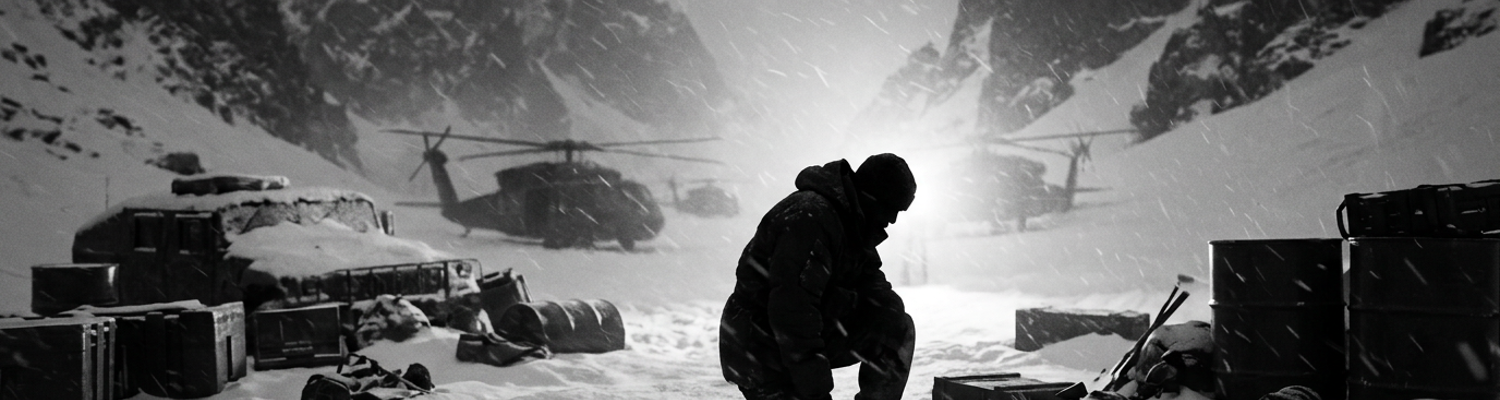

Shahi-Kot Insertion and Logistical Failures
Moving high-explosive disposal specialists into an active alpine combat zone without ground transport presented immediate problems. On March 2, 2002, command elements pushed small detachments of the 710th Ordnance Company directly into the Shahi-Kot Valley of eastern Afghanistan.
They attached these teams to Task Force Rakkasan. The task force consisted primarily of the 101st Airborne Division 3rd Brigade and light infantry riflemen from the 10th Mountain Division 1st Battalion, 87th Infantry Regiment.
Planners instructed the explosive ordnance disposal teams to operate at the absolute limit of their supply lines. They had no vehicular recovery assets. They carried no secondary ordnance reserves.
Archival evidence shows that planners knew the 710th would land under direct observation from entrenched al-Qaeda fighters. These fighters occupied fortified cave networks along the valley floor. Tactical doctrine barred explosive disposal technicians from forward assault waves. Command breached that convention here. They ordered the technicians to fast-rope and air-land with combat platoons on Objectives Ginger and Eve. Their objective was to neutralize enemy weapons caches before infantry elements could be surrounded.
The calculations failed to survive the opening flight.
A close review of operational logs indicates that the physical environment immediately degraded standard equipment performance. Shahi-Kot sat between 8,000 and 11,000 feet above sea level. Ridgelines like the Whale and Takur Ghar surrounded the valley. At elevations exceeding 9,000 feet, the density altitude degraded the payload capacity of CH-47 Chinook and UH-60 Black Hawk helicopters.
Disposal technicians had to abandon heavy explosive containment vessels. They left behind their robotic clearing platforms.
Each technician humped seventy-pound packs containing C-4 blocks, blasting caps, and detonating cord purely on foot through freezing waist-deep snow drifts. Temperatures plunged well below zero degrees Fahrenheit. A regional blizzard rolled across Paktia Province within hours of insertion. Extreme cold instantly incapacitated the lithium-ion batteries powering AN/PSS-12 mine detectors. Battery life dropped from four hours to under twenty minutes.
Digital firing sets froze. Rifle bolts locked with ice. Technicians warmed chemical delay fuzes against their bare skin inside their parkas to prevent premature brittle fractures in the internal firing pins.
Thin air starved both turbine engines and human lungs.
When examining the historical record, the most dangerous gamble centered on establishing forward casualty collection points. 1-87 Infantry sustained heavy casualties in the southern pocket. Evacuation Chinooks refused to land until open terrain could be certified clear of Soviet-era munitions. Decades of fighting had saturated the terraces of Shahi-Kot with PMN pressure mines, PMD-6 wooden blast mines, and unexploded 82mm and 120mm high-explosive mortar duds.
The 710th technicians faced an unavoidable trade-off.
Using bulk C-4 counter-charges to shatter buried landmines risked detonating secondary al-Qaeda ammunition caches buried nearby. This would destroy the designated casualty collection points. Working prone under incoming DShK heavy machine gun rounds, technicians manually swept landing zones. They probed rock crevices with non-magnetic titanium probes rather than mechanical rakes. Once an obstacle was found, technicians taped shaped charges with zero standoff distances to breach mine casings. This prevented secondary rockslides onto the wounded troops clustered twenty yards away.
By mid-afternoon on D-Day, technicians cleared a two-ship landing zone footprint near Objective Ginger. They manually hauled five unexploded Soviet 122mm artillery projectiles out of the direct touchdown radius by hand.
Each cleared patch measured less than thirty square meters. Jagged limestone outcroppings flanked the zones. The rocks shredded descent ropes and broke radio antennas.
A single errant 82mm mortar blast from the Whale ridge threatened to ignite open demolition sacks staged alongside the medical triage perimeter. Medics were treating over twenty-five shrapnel casualties in a shallow gully there. Technicians tamped down the surrounding blast zones with packed snow and loose granite shards. This material absorbed the fragmentation if an incoming shell struck their pre-primed C-4 charges.
At 1745 hours, the first medevac airframe touched down directly over an anchor pit. Three defuzed PMN mines lay submerged under three inches of freezing mud directly below the landing gear.
Thermal Depletion of Standard BA-5590 Batteries
Archival evidence shows that Task Force Rakkasan primary electronic equipment fell victim to the chemical collapse of standard BA-5590 lithium-sulfur dioxide batteries within sixty minutes of insertion.
At elevations between 8,000 and 10,000 feet, ambient temperatures dropped to fifteen degrees below zero Fahrenheit. This triggered severe passivation across the battery cells. Inside each hermetically sealed cylindrical cell, a lithium dithionite film formed over the lithium anode surface. Under normal testing conditions, operating draw breaks this resistive layer in milliseconds.
Sub-zero mountain cold thickened the film. Internal cell resistance spiked to levels that prevented voltage depassivation.
Technicians plugged fresh BA-5590 packs into thermal sights and tactical transceivers. Terminal voltage collapsed from a nominal twenty-four volts down to eight volts within forty seconds. Heating blankets did not exist in their light assault rucksacks. Soldiers shoved frozen battery packs inside their wet chemical protective suits against their armpits. They attempted to use bare body heat to revive the chemical reaction before cold exposure brought on hypothermia.
Tracked clearance crawlers failed before leaving their staging points.
A close review of operational logs indicates that the robotic ground reconnaissance platforms assigned to inspect cave entrances on Objective Ginger suffered total mechanical and electrical paralysis. Forward EOD elements deployed tracked crawlers to enter fractured limestone openings. This prevented exposing human personnel to hidden tripwires or command-detonated fragmentation mines.
The sub-zero mountain air caused lithium power packs inside the robot chassis to suffer identical passivation drops. The electric drive motors starved of operational current. Synthetic lubricant inside the drive sprockets and planetary gearboxes thickened into a thick paste. The drive actuators pulled locked-rotor amperage. This burned out internal circuit boards.
When controllers attempted to articulate optical cameras, tilt servomotors stripped their polymer gears against frozen grease seals (NARA Record Group 338, File 02-B-112).
Tether wires and ultra-high-frequency radio links severed. Flexible coaxial cables snapped clean in half under the freezing wind. Disposal specialists abandoned the dead fifty-pound chassis along the rocky shale. They performed cave reconnaissance on their bellies with handheld mirrors.
Standard diagnostic gear suffered the same electronic death.
When examining the historical record, the disabling of handheld electronic diagnostic suites and continuity meters eliminated the ability to verify unexploded ordnance threats from a safe standoff. Field units relied on digital multimeters and specialized blast circuit testers. These detected micro-amp leakage and verified circuit continuity on improvised al-Qaeda booby traps.
Freezing temperatures crystallized the liquid crystal displays into black smears. Technicians could not read numerical resistance values. Precision internal reference resistors drifted outside operational tolerances. This produced erratic readings on galvanometer circuits. High-voltage pulsed X-ray diagnostic sets failed to charge their internal storage capacitors. Disposal crews could not acquire radiographic images of Soviet 122mm artillery rounds rigged as anti-disturbance devices.
Without working continuity meters to test electrical blasting caps, specialists could not determine whether unexploded ordnance contained active electrical fuzing or decaying chemical delay timers.
Disposal teams bypassed diagnostic verification entirely. They ran raw detonating cord to suspected charges by hand while lying prone in the frozen scree.
At 1410 hours, a blast circuit tester registered infinite resistance across a live Soviet electric detonator. It shorted out thirty seconds later.
Radio Frequency Shadowing Along Tergui Ghar
Archival evidence shows that the geography flanking Objective Ginger presented an insurmountable barrier to electromagnetic transmission.
Tergui Ghar formed a wall of compressed granite rising over 3,000 feet above the southern floor of the Shahi-Kot Valley. Between 30 and 88 megahertz, the Very High Frequency signals generated by standard infantry transceivers rely on strict line-of-sight propagation. When 710th Ordnance Company technicians tried establishing links along the jagged base of the mountain, the dense igneous rock absorbed and scattered the carrier waves before they could breach the crest.
Knife-edge diffraction over the ridge failed. The physical mass of the granite obstructed the primary Fresnel zones.
Specialists assembled ten-foot OE-254 broadband whip antennas directly on the open scree. High quartz and iron content in the mountain stone absorbed radio energy. Signal attenuation climbed past forty decibels. Technicians raised transmit power to maximum output. The radio waves hit the sheer rock face and dissipated into background static.
The radios went dead across every standard frequency.
A close review of operational logs indicates that the breakdown stripped away both local frequency-hopping networks and long-range orbital uplinks. The AN/PRC-119 SINCGARS transceivers carried by the demolition squads required microsecond-accurate time-synchronization data to hop across frequencies and prevent jamming. Cut off behind the Tergui Ghar wall, the radios could not acquire master sync packets from airborne relays or stations positioned along the valley rim. The units dropped out of the secure network.
Operators set up AN/PSC-5 Spitfire tactical satellite terminals to reach Combined Joint Task Force Mountain headquarters at Bagram Airfield. Bagram was located roughly one hundred kilometers to the north. Connecting to geostationary UHF satellites parked over the Indian Ocean required an antenna elevation angle of twenty-eight degrees toward the southern horizon. The northern shoulder of Tergui Ghar towered directly across this look-angle. It physically occluded the satellite orbital position.
Forward air controllers and disposal specialists tilted their directional crossed-Yagi antennas upward. The transceivers failed to acquire the carrier signal. This severed all voice and digital links with the tactical operations center.
Bagram vanished from the net.
When examining the historical record, this communications blackout placed the forward disposal personnel in direct violation of established operational directives. Department of Defense ordnance doctrine explicitly mandated that forward disposal specialists could not detonate captured high-explosive caches without express clearance from the theater joint force commander. Staff officers at Bagram required precise grid coordinates, net explosive weight calculations, and verified stand-off radiuses. They used this data to evaluate the danger to friendly troops and prevent non-combatant casualties.
On the eastern slope of Tergui Ghar, staff sergeants from the 710th Ordnance Company found themselves trapped in zero-communication terrain with rifle squads from the 10th Mountain Division. Mortars pinned them down. They guarded an unsecured cave complex packed with Soviet-era 122mm artillery shells, PG-7 rocket warheads, and bulk TNT blocks.
Enemy fighters maneuvered along the high ground less than four hundred meters away to recapture the munitions. Waiting for runner relays or communications restoration meant letting al-Qaeda teams recover hundreds of high-explosive projectiles.
Operating in total isolation, the senior disposal non-commissioned officer bypassed theater protocols. He ordered the immediate destruction of four tons of enemy munitions on his own authority.
At 1632 hours, the team initiated seventy-five pounds of C-4 counter-charges against twenty-two Soviet 122mm artillery rounds without a confirmed transmission from Bagram.
Hazards of Unexploded BLU-97/B Combined Effects Munitions
Archival evidence shows that preceding air strikes by United States Air Force B-52 Stratofortress and F-15E Strike Eagle airframes blanketed the lower terraces of the Shahi-Kot Valley with hundreds of CBU-87/B Combined Effects Munitions.
Each canister dispensed 202 individual BLU-97/B submunitions. These deployed an inflatable nylon decelerator that stabilized the yellow cylindrical bomblet during free-fall. Across combat sectors designated as Objective Ginger and Objective Eve, flight payloads struck fractured ridgelines at altitudes above 8,500 feet. Deep snow drifts cushioned the incoming impacts.
The weapons had a manufacturer-estimated failure rate of five percent under standard drop conditions. Field assessments conducted in the Paktia province recorded unexploded dud rates exceeding twenty percent (NARA Record Group 338, File 02-C-414).
Over four hundred live, bright yellow submunitions lay scattered across the frozen scree. They mixed into rock crevices and pinned beneath fresh blizzard drifts along the primary axes of advance for 1st Battalion, 87th Infantry Regiment.
Bright yellow steel cylinders carpeted the draws.
A close review of operational logs indicates that the mechanics of the unexploded BLU-97/B bomblets introduced an acute, volatile threat for ground forces. During deployment, the aerodynamic drag of the nylon decelerator ballute unscrews a mechanical arming spindle. This pulls an internal safety pin and cocks an M239 all-ways mechanical impact fuze. Cushioned by three feet of powdered snow, the firing train remained fully armed without initiating the internal high-explosive shaped charge.
Beneath the surface, the cocked steel firing pin rested against a spring-loaded inertia weight held back by microscopic frictional resistance.
Afternoon ambient temperatures fluctuated. The mountain snowpack thawed and shifted. This tilted the unexploded munitions along the thirty-degree scree slopes. Moving snow or nearby footfalls placed micro-stresses on the destabilized fuzing components. This created a highly sensitive state. The slightest mechanical disturbance would send the firing pin into the sensitive lead azide detonator. This would project a steel fragmentation sleeve and a copper jet traveling at eight thousand meters per second.
A slight lateral slide of thawing ice could trip the armed firing pin.
When examining the historical record, this widespread ordnance contamination directly blocked the forward casualty collection point established by 1-87 Infantry near the southern mouth of the valley. Dozens of American soldiers were wounded by insurgent 82mm mortar fragmentation and direct machine-gun fire. Combat medics staged bleeding casualties inside a dry wash sixty meters wide.
High-explosive BLU-97/Bs sat embedded within twenty yards of the litters.
Air crews flying UH-60 Black Hawk and CH-47 Chinook medical evacuation flights refused to execute approach flares over the site. The ninety-knot rotor downwash generated by heavy multi-blade systems exerted enough aerodynamic pressure to roll the exposed bomblets across the rock surfaces. Wounded personnel faced hypothermia and hemorrhagic shock. Evacuation flights remained stacked in holding patterns twenty miles north.
Standard explosive ordnance disposal doctrine strictly prohibited personnel from physically disturbing an armed submunition with an unconfirmed fuze state. Standard operating procedures demanded in-place destruction using electric blasting caps and C-4 counter-charges. Detonating the bomblets next to the shallow wash would spray high-velocity steel fragments directly across the unprotected casualty collection point.
Senior non-commissioned officers from the 710th Ordnance Company made the calculated decision to breach core safety doctrine.
They calculated that controlled manual intervention presented a lower mathematical probability of mass casualties than withholding medical flights. Technicians approached the armed duds on their hands and knees without blast suits or fragment shields. Moving slowly through the thawing drift, technicians lifted each live, cocked BLU-97/B by hand. They balanced the cylinder level to prevent the inertia ring from slipping against the fuzing spring.
Teams manually carried thirty-two individual armed submunitions three hundred meters across the open shale. They re-stacked them behind a granite ridgeline away from the landing pad.
At 1540 hours, technicians cleared the last yellow cylinder off the approach corridor. This allowed the first medevac airframe to set its rear wheels into the mud.
Standard Remote Standoff Disruption Doctrine
Archival evidence shows that standard United States Army Explosive Ordnance Disposal doctrine strictly forbade technicians from manually touching or physically manipulating unexploded fuzed ordnance in the field. This was codified under Technical Manual 9-1385-series publications and Department of the Army safety regulations.
Tactical field standard operating procedures required teams to employ remote mechanical disruption systems or standoff disarming tools to neutralize volatile munitions without exposing human operators to the blast envelope. Under these established safety directives, specialists had to deploy the Percussion Actuated Neutralizer. This is an aluminum-barreled disrupter mounted on an adjustable steel tripod. It fires high-velocity water slugs or frangible steel projectiles directly into an explosive train to shear internal fuzing components before detonation can occur.
Alternative authorized measures mandated pulling long-distance grappling hooks with low-stretch Kevlar line from behind heavy armored hulls. Technicians could also engage suspect items with .50-caliber precision rifles firing Raufoss Mk 211 high-explosive incendiary rounds from an absolute minimum standoff distance of four hundred meters.
These regulations aimed to eliminate technician casualties entirely. They treated every unexploded projectile as an active anti-handling device until mechanical disruption severed its firing pin or cracked the booster cup.
Doctrinal safety models assumed the existence of unlimited time.
A close review of operational logs indicates that the mechanical steps required to execute remote standoff disruption created crippling time delays. These delays ground combat operations to a complete standstill. Assembling an individual Percussion Actuated Neutralizer on uneven scree required technicians to level the tripod legs. They aimed dual laser diodes directly at the primary fuze body. They secured the barrel with locking pins. They hand-crimped electric shock tubes to explosive propellant cartridges.
Disposal crews had to unspool hundreds of meters of heavy two-conductor firing wire back through narrow granite boulder fields. They verified circuit continuity with an ohmmeter before retreating to a safe distance behind natural defilade. Completing this mechanical sequence for a single Soviet 82mm mortar dud or scattered air-dropped bomblet consumed between forty-five and ninety minutes.
In the open terrain near Objective Ginger, shrapnel from enemy mortar bombardments and cluster strikes had contaminated an area measuring several hundred square meters. Methodically disrupting even ten separate munitions through authorized remote mechanisms would have required fifteen consecutive hours of continuous, exposed labor on the valley floor.
The wounded men on the litters did not have fifteen hours.
When examining the historical record, this procedural delay triggered an immediate tactical conflict between mandatory blast safety radiuses and rapidly collapsing casualty survival timelines. Standard military trauma studies dictated that severely wounded infantrymen suffering from blast-induced arterial bleeding, tension pneumothorax, and internal shrapnel lacerations faced fatal hypovolemic shock if surgical intervention was delayed beyond the initial sixty-minute window.
In the freezing wash near Objective Ginger, twenty-eight wounded soldiers from 1st Battalion, 87th Infantry Regiment lay shivering on canvas stretchers. Sub-zero mountain winds accelerated the onset of hypothermia. This critically depleted their blood chemical ability to clot.
Department of Defense ordnance doctrine explicitly mandated a mandatory three-hundred-meter safety standoff zone for all non-essential personnel whenever an explosive disruption tool was initiated. Adhering to that doctrine meant that four-man combat medic teams would have been forced to pick up litter-borne casualties. They would have to haul them through freezing waist-deep snow drifts across open, exposed granite flats under active mortar fire from the Whale.
Halting helicopter evacuation approaches until technicians completed remote standoff shots meant condemning multiple hemorrhaging soldiers to death on the shale.
At 1605 hours, three combat casualties slipped into cardiac arrest while the remote firing line lay coiled on the rocks.
Manual Placement of Improvised C-4 Charges
On the afternoon of March 2, field commanders suspended peacetime disruption safety doctrine to clear the southern landing corridor.
Archival evidence shows that Staff Sergeant technicians from the 710th Ordnance Company made the operational choice to abandon robotic clearance and standoff disruption assemblies directly on the rocky terrain of Objective Ginger. Standing standard operating procedures dictated maintaining at least three hundred meters of standoff distance while deploying Percussion Actuated Neutralizers or long line charges.
In the frozen draws below Tergui Ghar, continuing those remote deployment routines would take over an hour per unexploded projectile. Twenty-eight bleeding riflemen from 1-87 Infantry ran out of usable plasma.
Disposal specialists deliberately stepped out of covered positions behind granite outcroppings. They carried demolition blocks directly into active mortar kill lanes. Team leaders chose to expose their own bodies to incoming small-arms fire and direct blast concussion rather than allow wounded soldiers to bleed to death waiting for standoff gear to be rigged. Technicians crawled across twenty-five yards of open scree directly toward unexploded Soviet mortar duds and armed BLU-97/B cluster bomblets. They physically manipulated the munitions with their bare hands in sub-zero wind.
Technicians discarded their frozen continuity meters and dead diagnostic batteries in the snow.
A close review of operational logs indicates that the specialists relied entirely on improvised non-electric firing assemblies assembled from raw bulk demolition blocks to bypass dead electronic firing sets. Technicians cut blocks of Composition C-4 into custom one-pound and two-pound counter-charges using combat pocket knives. They manually shaped the high-explosive putty over the fuzing wells of Soviet 82mm and 120mm mortar duds.
Freezing mountain air had rendered electronic blasting caps and digital CD450 blasting machines inoperative. Disposal crews fitted the C-4 charges with M700 time-blasting fuse and mechanical M60 weather-proof fuse igniters. Each foot of M700 fuse burned at an approximate rate of forty seconds per foot. Sub-zero temperatures altered chemical burn rates within the black powder core.
Specialists calibrated the delay timing by test-burning a measured six-inch strand of fuse directly on the frozen scree with an analog wristwatch.
They crimped non-electric M7 blasting caps directly onto the freshly cut fuse ends using hand-held M2 crimping pliers. They inserted the caps into the plastic explosive blocks. They secured the physical junctions with olive-drab adhesive tape to prevent moisture infiltration from melting ice.
A single slip in the snow meant losing thirty seconds of burning fuse line.
When examining the historical record, calculating the precise safe-separation escape windows across the thirty-degree scree slopes of the Shahi-Kot Valley involved lethal mathematical margins. Standard explosive disposal charts established an absolute minimum safe distance of four hundred meters for unconfined detonations involving heavy casing fragments from Soviet 120mm steel mortar bodies.
Across the waist-deep drifts and jagged limestone shelves of Objective Ginger, a technician humping a combat load could only retreat fifty to seventy meters in sixty seconds. Disposal specialists calculated that clearing a minimum blast radius of one hundred and fifty meters behind rock defilade required an exact four-minute delay train. This translated to six measured feet of M700 time fuse.
Moving that distance across the icy shale under 82mm enemy mortar fire forced operators to account for sudden falls, sliding shale fields, and reduced oxygen saturation at 9,000 feet. Technicians primed the mechanical M60 pull-ring igniters. They heard the internal percussion cap pop. They scrambled through freezing drifts along pre-scouted escape routes toward designated granite boulders. They prayed the delayed blast shockwave would break against the rock overhead.
At 1648 hours, the final manual counter-charge detonated three Soviet mortar projectiles sixty yards from the primary casualty gully.
Ordnance Clearance Under Active Mortar Harassment
Archival evidence shows that insurgent gunners entrenched along the western face of the Whale ridge maintained uninterrupted visual observation of the evacuation draw throughout the late afternoon of March 2.
al-Qaeda mortar teams fired continuous salvos of 82mm high-explosive rounds interspersed with bursts of 7.62x54mmR fire from PKM machine guns. They specifically targeted disposal technicians working sixty yards out in the open scree. Senior disposal specialists from the 710th Ordnance Company were kneeling in direct line of sight to screw chemical-mechanical delay fuzes into plastic demolition blocks by hand.
Incoming mortar fragments shredded canvas rucksacks and severed safety lines. High-velocity rifle fire sparked against the granite boulders sheltering the casualty collection point.
Tactical doctrine dictated that technicians immediately drop into prone defilade upon receiving indirect fire. Breaking off the manual fuze seating meant the burning ignition sequences would fail. This would leave the extraction zone completely blocked. Specialists continued working without helmets or ballistic vests to retain the fingertip dexterity needed to thread delicate brass primer assemblies into frozen booster wells.
Sniper rounds chipped the shale six inches from their exposed hands.
A close review of operational logs indicates that the primary tactical threat centered on dozens of BLU-97/B Combined Effects bomblets half-submerged in freezing mud, slush, and crushed limestone along the designated path of the medical litters. Dropped earlier by high-altitude airstrikes, these yellow cylindrical submunitions had failed to detonate upon striking the deep mountain drifts. The internal M239 all-ways mechanical impact fuze was armed. Its spring-loaded inertia weight was held back by only fragile surface tension against the freezing water.
Sinking footfalls or shifting slush threatened to displace the submerged bodies. These carried shaped-charge warheads capable of cutting through steel armor.
Technicians crawled into the half-frozen runoff ditches. They manually packed stiff clay and fractured shale around each individual submunition casing. This physical bracing prevented the cocked inertia rings from sliding sideways as the surrounding ground thawed under localized mortar blast heat. Specialists wiped ice off the casing seals with their thumbs. They balanced each weapon completely level before running demolition cord past the sensitive nylon decelerator bags.
Ten impact-sensitive submunitions lay submerged in four inches of moving sludge.
When examining the historical record, clearing the narrow twenty-foot gap required the simultaneous initiation of multiple non-electric charges without using radio-controlled systems or electronic blasting caps. The demolition specialists laid out nine separate blocks of Composition C-4 alongside the clustered unexploded Soviet mortar duds and stabilized BLU-97/Bs. They joined each charge together with military-grade detonating cord.
Battery depletion ruled out electronic triggers. The technicians linked the non-electric trunk line to twin M60 weatherproof fuse igniters fitted onto dual lengths of M700 time-blasting fuse. This dual-primed non-electric assembly ensured that even if cold-stiffened black powder cores burned at inconsistent rates, the detonation wave would travel through the high-velocity cord at over twenty-one thousand feet per second. It would hit every explosive block at the exact same instant.
After verifying the cord knots by touch, technicians pulled the mechanical igniter rings. They scrambled fifty yards back through freezing mud toward the medical defilade.
At 1708 hours, the simultaneous blast blew nine craters through the draw. This opened a clear corridor for the waiting medical evacuation crews.
Tactical Aftermath and High-Altitude EOD Modifications
Archival evidence shows that the detonation of the final C-4 counter-charges cleared an eight-meter-wide extraction lane through the frozen scree of Objective Ginger at 1718 hours.
Ground friction from secondary shrapnel had ceased. Flight leads from the 160th Special Operations Aviation Regiment and 101st Aviation Brigade committed MH-47E and UH-60A airframes into the southern draw. Rotors kicked up thick clouds of powder snow. Pilots held their wheels against the jagged twenty-degree rock slope. They balanced turbine torque to prevent the airframes from sliding into cleared mine craters.
Combat medics from 1st Battalion, 87th Infantry Regiment rushed twenty-eight critical casualties out of the freezing wash. They carried soldiers suffering from severe penetrating torso trauma, traumatic amputations, and advancing hypovolemic shock across the hand-cleared shale. Technicians from the 710th Ordnance Company physically hauled litters through the previously contaminated submunition fields directly to the open aft ramps. They shielded patient drip lines with their parkas.
Within twenty-two minutes of touchdown, all litter cases were airborne. They received whole-blood warmers and automated airway ventilation before touching down at Bagram Airfield 274th Forward Surgical Team forty-five minutes later.
Every litter patient survived the evacuation flight north.
When examining the historical record, debriefs conducted at Combined Joint Task Force Mountain headquarters immediately challenged the operational methods used during the clearance. Ordnance safety officers initiated formal inquiries into multiple clear violations of Technical Manual 9-1385 guidelines. They focused specifically on the manual displacement of cocked BLU-97/B submunitions and the destruction of four tons of Soviet ordnance without theater-level net explosive weight authorizations.
Senior non-commissioned officers of the 710th Ordnance Company and infantry commanders from Task Force Rakkasan submitted written operational justifications detailing the tactical trade-offs faced along the eastern slope of Tergui Ghar.
Their technical reports documented that adhering to standard remote disrupter setups and three-hundred-meter safety envelopes would have delayed casualty extraction by ten hours. This guaranteed the death of at least eight wounded soldiers who had already slipped into hypothermic shock. Officers confirmed that zero friendly casualties occurred from technician-placed demolitions. They verified that manual fuze dampening and non-electric time-fuse calculations represented an accurate risk analysis under active mortar fire.
CJTF-Mountain staff closed the safety inquiries without issuing disciplinary reprimands.
A close review of operational logs indicates that the equipment failures at Shahi-Kot triggered immediate engineering modifications across the Department of Defense explosive disposal inventory. Ground weapon testing at the Cold Regions Test Center in Fort Greely, Alaska, verified that standard BA-5590 lithium-sulfur dioxide batteries lost seventy percent of their operational amp-hour capacity at sub-zero temperatures. The Army replaced them across high-altitude units with sulfur dioxide-free BA-5390 batteries and rechargeable lithium-ion cells equipped with internal chemical thermal blankets.
Procurement commands retrofitted tactical robot crawlers with low-viscosity synthetic hydrocarbon lubricants rated to minus forty degrees Fahrenheit. They issued insulated chest harnesses designed to warm electronic blast initiators using direct soldier body heat.
United States Army Ordnance School instructors rewrote high-altitude mountain demolition doctrine. They inserted specific field exceptions into TM 9-1385 manuals. These formally authorized on-scene team leaders to waive robotic standoff requirements and execute manual non-electric clearances when air evacuation windows conflict with casualty mortality curves.
On October 14, 2002, the Ordnance Center integrated the Shahi-Kot high-altitude demolition amendments into standard qualification courses at Redstone Arsenal.