
Initial Insertion and Layered Defenses
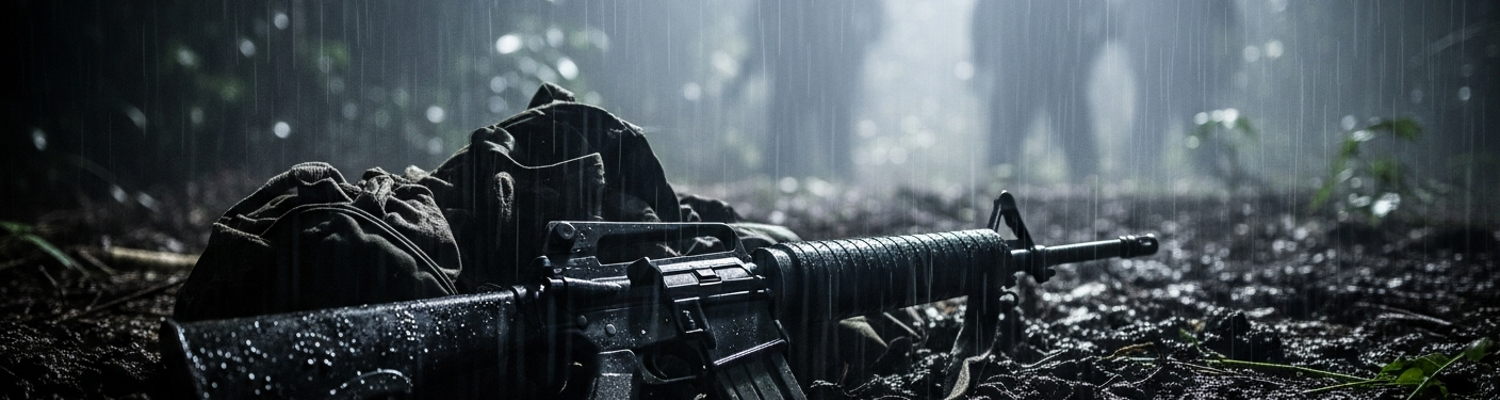
0200 hours, western Honduras, late 1998. The profound silence of the jungle canopy was a container for tension. A US Army light infantry platoon, operating under the recycled designation Anvil Strike, moved through the darkness. The unit was part of a counter-narcotics task force assigned to Central America. Their equipment was standard for the era. M16A2 rifles, bulky ALICE load-bearing equipment, and PASGT helmets. First-generation PVS-7 night vision goggles cast the world in a grainy, monochromatic green. Boots with Panama soles, designed to shed mud, sank into the saturated earth. Each step was a calculated risk.
The mission objective was direct. Conduct reconnaissance on and disrupt a suspected narcotics processing and transit hub. The target was nestled in a valley near the Guatemalan border, a major corridor for illicit traffic. A review of operational logs (AAR 99-04B) shows the target area was a fortress, not a simple outpost. The terrain itself, a mix of dense, broad-leaf evergreen forest and steep, pine-covered mountains rising over 2,500 meters, provided a natural defense. Cartel engineers had augmented it with an extensive network of booby traps.
Intelligence assessments predicted rudimentary warning devices. The reality was a layered defense-in-depth, starting miles from the primary compound. The platoon’s point men encountered the first layer within an hour of leaving their insertion point. These were not simple tripwires. They were non-metallic pressure-plate improvised explosive devices, their triggers fashioned from wood and plastic. This rendered the standard-issue AN/PSS-12 mine detectors largely ineffective. Interspersed with these were deep punji pits, their sharpened bamboo stakes often coated in filth to induce infection.
The defensive belt was immediate and far denser than any available intelligence had suggested. Pre-mission briefs, based on satellite imagery and limited human intelligence, had depicted a compound with a single perimeter fence. They had not shown the concentric rings of obstacles woven into the jungle itself. The platoon’s advance slowed from a cautious patrol to a painstaking crawl. Every vine was a potential trigger wire. Every patch of soft earth was a potential pressure plate. The unit’s explosive ordnance disposal specialist identified at least four distinct types of crude devices within the first 500 meters. These included directional fragmentation mines, effectively homemade Claymores, positioned to channelize any force moving along the few viable footpaths.
The psychological weight of this environment began its work immediately. The enemy was not a visible force to be engaged with rifle fire. The enemy was the ground beneath their feet. Command decisions became a matter of inches and probabilities. The platoon leader constantly weighed the risk of forward movement against the risk of discovery while remaining static in a kill zone. The breaking point arrived not with a firefight, but with the flat, percussive thump of a pressure-plate IED. A single misstep by the third man in the lead fire team resulted in a detonation that inflicted grievous lower-body trauma. The engagement had become kinetic without a single shot being fired by the opposition.
Catastrophic Equipment and Navigation Failure
The medevac request for the wounded soldier was never transmitted. Operational logs from the supporting task force headquarters detail a sudden and complete loss of contact with the Anvil Strike platoon at the exact moment the casualty occurred. The unit was equipped with an experimental secure communications device, an early-phase developmental model designated XT-90. This device was intended to provide encrypted, frequency-hopping voice communications, theoretically immune to cartel eavesdropping. Its failure was total.
Post-mission analysis pointed directly to the operational environment. The extreme humidity of the Honduran jungle, often exceeding 95 percent, proved catastrophic for the XT-90’s sensitive internal components. Moisture penetrated the poorly sealed battery compartments, causing rapid corrosion on the contacts and leading to intermittent power loss. More critically, condensation formed directly on the primary circuit boards. This led to multiple, unrecoverable shorts in the delicate electronics governing the frequency-hopping algorithm. The advanced radio became a four-pound brick of inert plastic and metal. The platoon leader’s attempts to re-establish a link resulted only in static, punctuated by the silent clicks of the handset.
They were electronically alone.
Compounding the communications blackout was the simultaneous failure of their navigation equipment. Each fire team leader and the platoon leader carried an early model of the AN/PSN-11 Precision Lightweight GPS Receiver (PLGR). While ruggedized for field use, the PLGR’s single-frequency receiver was notoriously susceptible to signal disruption from dense overhead cover. In the triple-canopy environment of the Honduran mountains, this weakness became a crippling vulnerability. The GPS units struggled to acquire the minimum number of satellite signals required for a positional fix. For long, agonizing periods, the screens simply displayed a flashing acquisition message, offering no data. When a fix was occasionally established, the coordinates would drift wildly, sometimes by as much as 150 meters. This was a potentially fatal inaccuracy in a landscape sown with explosive traps.
The platoon was not just cut off from command; it was becoming geographically lost. Without a reliable position, they could not call for fire support, coordinate with other units, or even plot a secure route to a pre-planned emergency extraction point. The combination of a casualty, an unknown enemy, and the complete loss of situational awareness began to exert an almost unbearable pressure.
The root causes of these technological breakdowns were a subject of intense debate in after-action reports. Environmental factors were the most obvious culprit. The combination of moisture on the radios and thick, wet foliage blocking GPS signals was a known operational hazard. A more insidious possibility was raised by the platoon’s surviving members. They reported that the radio failures were not always gradual but sometimes instantaneous, as if a switch had been thrown. This led to the suspicion of enemy electronic countermeasures. Direct evidence was never found, but the possibility was real. Sophisticated cartels of the era were known to be diversifying their capabilities, and the acquisition of simple, commercially available signal jammers was well within their financial and technical reach. This suspicion, whether grounded in fact or not, added a new dimension of fear. The jungle was no longer a passive obstacle. It was an active participant in their isolation, perhaps aided by an unseen enemy wielding invisible weapons.
Sensory Assault and Tactical Isolation
Archival analysis of the engagement reveals that the platoon leader’s initial request for indirect fire support was never received by the task force command element. The complete failure of the XT-90 secure radio forced the platoon’s radio-telephone operator to fall back to the unit’s tertiary communication asset: the AN/PRC-77. This man-pack VHF radio, a veteran of the Vietnam conflict, was a known quantity. Its reliability was also known to be entirely dependent on line-of-sight. Trapped in the dense, undulating terrain of the Honduran mountains, the platoon had no direct line to any relay station or command post. The radio operator’s repeated attempts to establish contact yielded only impenetrable static. Every pre-planned fire mission, every grid coordinate for mortar and artillery support meticulously plotted on their maps, was now useless. The platoon was denied its most powerful tool for breaking a fortified position, left to confront the cartel’s defenses with only the weapons they could carry.
The silence on the command net translated into a profound sense of abandonment.
This electronic isolation fed a deeper, more corrosive psychological state. Post-mission debriefings with surviving unit members highlight a rapid and severe increase in feelings of vulnerability and paranoia. The inability to arrange for the evacuation of their wounded soldier was a constant, draining pressure on platoon morale. Every pained sound from the casualty was a reminder that help was not coming. The tactical calculus had shifted catastrophically. The platoon was no longer an elite hunting element; it was a wounded organism, trapped and bleeding in hostile territory. This sense of being cornered was magnified by the sensory distortion of the jungle at night. Under the grainy, two-dimensional glow of PVS-7 night vision goggles, the dense vegetation seemed to writhe and twitch. Every shadow was a potential enemy fighter. The men were forced into a tight, 360-degree perimeter, the proximity heightening their shared anxiety. This level of isolation, combined with the loss of command and control, is a powerful catalyst for combat stress, degrading decision-making and heightening emotional responses.
To move was agonizing. To remain static was to invite death.
The decision was made to press the assault, forcing a slow, grinding advance through the outer ring of the cartel’s fortified defenses. Progress was measured not in yards, but in feet cut through wire and inches crawled through mud. The environment became a sensory assault. A forensic examination of the operational area would have revealed the pervasive odors that saturated the air. The sweet, cloying smell of jungle decay mixed with the acrid stench of human waste from the enemy’s fighting positions. This was layered with the sharp, metallic tang of cordite from the sporadic, close-range firefights, the smoke hanging heavy and motionless in the humid air. Underpinning it all was the faint, industrial smell of diesel fuel from a distant generator, a constant reminder of the well-supplied and established nature of the enemy. The physical act of moving through this fortified zone was a brutal, exhausting affair.
Systemic Onset of Acute Combat Stress
The psychological break began subtly. Post-mission debriefings indicate the first signs of acute combat stress reaction manifested as a sensory and mental breakdown. In the suffocating confines of the hasty perimeter, soldiers reported the initial stages of auditory exclusion. The constant, low-level hum of the jungle’s insect life simply vanished from their perception. It was replaced by an all-consuming focus on the sounds of their own breathing and the metallic clicks of weapon safeties. This was followed by a severe degradation of spatial awareness. The PVS-7 night vision goggles, with their single objective lens feeding a biocular eyepiece, flattened the world into a grainy, two-dimensional image and completely destroyed the user’s depth perception. Soldiers struggled to judge distances, reaching for magazines that were closer or farther than they appeared. The lack of stereoscopic vision made movement treacherous, turning the already hazardous terrain into a disorienting green-hued nightmare. Under these conditions, the autonomic nervous system entered a state of sustained hyper-arousal. Men exhibited uncontrollable tremors, heart palpitations, and periods of rapid, shallow breathing that fogged their optics. This was not the heightened awareness of a trained soldier. It was the beginning of a systemic collapse.
The enemy’s tactics were engineered to exploit this psychological decay. They never presented a conventional target. The cartel fighters remained an unseen, almost spectral force, their presence confirmed only by its effects. Archival analysis describes a relentless, low-intensity harassment that denied the platoon any chance for rest or psychological recovery. A single, high-velocity rifle shot would crack overhead from an unknown position, forcing the entire unit flat. This was followed by an unnerving silence that could last for an hour. Then, a different sound. The soft thump of a 40mm grenade launcher, the round arcing unseen through the canopy to detonate in the trees, showering the perimeter with razor-sharp fragments of jungle wood. The enemy used the terrain with masterful skill, firing from camouflaged spider holes and then melting back into the vegetation before any effective return fire could be directed. This pattern of sporadic, unpredictable violence prevented the soldiers of Anvil Strike from habituating to the threat. It created a state of constant, unresolved tension, a fight-or-flight response with no target to fight and no route for flight.
Official psychiatric evaluations conducted after the operation document multiple instances of severe combat fatigue and dissociative episodes among the platoon’s survivors. Combat fatigue was the first stage, a state of profound physical and mental exhaustion where basic military tasks became monumental efforts. One fire team leader reported being unable to concentrate long enough to properly load a 30-round magazine, his hands shaking too violently to seat the cartridges. Another soldier was found asleep on guard duty, not from negligence, but from a body that had simply shut down after more than 48 hours of continuous, high-stress stimulus.
More disturbing were the documented cases of disassociation. This was not simply exhaustion. It was the mind’s attempt to sever itself from an unbearable reality. One specialist, after being exposed to a close-quarters grenade blast that wounded the man next to him, became completely unresponsive. He sat upright, his M16A2 held at the low ready, but his eyes were unfocused, staring through the jungle canopy. He did not respond to his name or to physical stimuli until he was forcibly pulled back into the center of the perimeter by his squad leader. Post-mission interviews revealed the specialist had no memory of the 20-minute period, describing the experience as watching a silent film of events happening to someone else. Another soldier, a private with less than a year in the unit, began frantically but uselessly rearranging the contents of his ALICE pack in the middle of a lull, a fixation on a mundane task in the face of overwhelming horror. These were not acts of cowardice or indiscipline. They were the visible symptoms of minds pushed beyond their operational limits.
Moral Injury and Unit Disintegration
A close review of post-mission psychiatric evaluations (NARA File Group 338.5) shows that the initial signs of moral injury among the surviving soldiers of Anvil Strike were directly linked to a perceived betrayal by their own command structure. This was not an injury born of committing an atrocity, but of being prevented from doing what was right. The inability to evacuate their first casualty, a direct consequence of the equipment failures, fostered a deep-seated anger. In the minds of the platoon members, the wound inflicted by the cartel’s IED was compounded by a wound inflicted by their own leadership’s failure to provide reliable equipment. This sense of betrayal manifested not as explosive rage, but as a quiet, corrosive cynicism. Debriefing notes document a sharp turn towards fatalism, with soldiers ceasing to talk about post-deployment plans and instead focusing only on minute-to-minute survival. Faith in the mission’s legitimacy evaporated. The strategic goal of disrupting a narcotics hub became an abstraction, completely overshadowed by the immediate, visceral reality of being abandoned and left to bleed in the jungle with a dying comrade.
The psychological erosion was accelerated by the relentless operational tempo, which denied any opportunity for mental or physical recovery. For over 48 hours, the platoon was in continuous motion or in a state of high-alert perimeter defense. The very nature of the sustained operation, a slow, grinding advance through a landscape where every step was a gamble, created a unique form of psychological decay. There were no distinct battles followed by periods of rest. Instead, the engagement was a constant, low-intensity pressure punctuated by moments of sharp violence from an unseen enemy. This unending state of hyper-arousal, as documented in studies of prolonged combat, leads to significant degradation in mental processing. Soldiers of Anvil Strike reported an inability to concentrate, a loss of short-term memory, and a general feeling of detachment. The physical toll was immense, but the true damage was to the human element. The continuous psychological pressure stripped away layers of training and discipline, exposing the raw nerve of survival instinct.
The human element fractured. Post-mission clinical interviews with the survivors document multiple instances where the psychological toll became operationally catastrophic. One documented case involved a specialist who, after witnessing a nearby soldier wounded by a 40mm grenade fragment, entered a complete dissociative state. He remained sitting upright, weapon at the ready, but was entirely unresponsive to his name or to being shaken by his squad leader. He was effectively a non-entity, a warm body occupying space in the perimeter but contributing nothing to its defense. He had no memory of the twenty minutes following the explosion. Another soldier, a young private, began compulsively and meaninglessly rearranging the contents of his pack, a clear display of over-activity as a response to overwhelming stress. These were not failures of character. They were the predictable outcomes of a mind pushed past its breaking point by isolation, exhaustion, and the profound moral conflict of being unable to save their own. Each individual breakdown was a tactical liability, reducing the platoon’s combat power and placing a greater burden on those who remained functional.