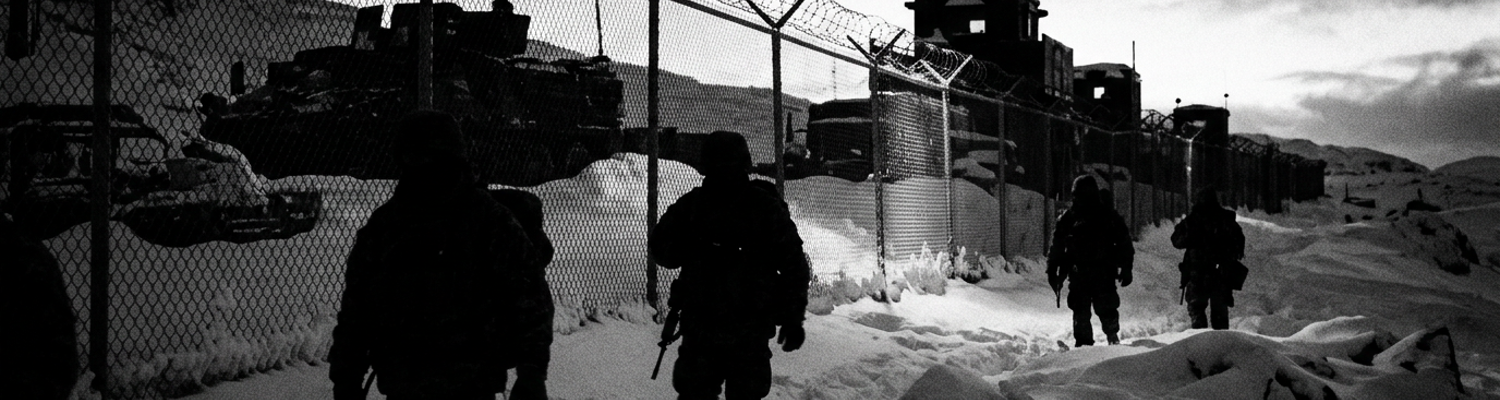

Bavarian Border Surveillance and the 1977 Deep Freeze
At 0418 hours on January 28, 1977, static abruptly replaced the voice traffic on the AN/VRC-46 transceiver inside an armored cavalry command track. This severed all contact between border surveillance outposts and the regimental tactical operations center in Nuremberg. High winds blowing across the Thuringian Ridge coated whip antennas in three centimeters of glaze ice. The weight snapped copper lead wires. The high-frequency radio net grounded out across the entire divisional sector. Ten patrol teams operating along the boundary line found themselves entirely cut off from their chain of command.
Radio silence meant total isolation.
Archival evidence shows that the 2nd Armored Cavalry Regiment held sole responsibility for motorized screening along this 360-kilometer stretch of the Bavarian-Thuringian frontier. Squadrons operated out of forward installations near Coburg, Kronach, and Hof. They dispersed armored reconnaissance platoons directly opposite the East German 11th Motorized Rifle Division. Platoons rotated between static border observation towers and active vehicle patrols. These patrols pushed through narrow logging tracks in the Franconian Forest. Daily logs from the 2nd Squadron describe teams in M113A1 personnel carriers and modified M151A2 utility trucks driving within fifty meters of the concrete border fence. They watched for signs of Soviet troop movements through heavy snow. Tactical rules of engagement required these two-vehicle teams to maintain continuous visual contact with the boundary line. They checked border markers numbered between 400 and 520. Regimental headquarters demanded continuous surveillance despite blizzards dropping visibility below ten meters. Drivers kept their engines idling through twelve-hour shifts.
A close review of operational logs indicates that prolonged exposure to temperatures dropping past minus twenty-five degrees Celsius caused cascading mechanical failures. Standard military-grade lubricants thickened beyond their operating tolerances. In the differential housings of wheeled vehicles, standard SAE 90 gear oil turned to viscous wax. This sheared axle shafts when drivers attempted to accelerate out of snowdrifts. Condensation inside compressed-air brake lines froze into solid plugs. The ice locked the drums on heavy scout vehicles. This stranded them directly on exposed ridgelines. Mechanical accelerator linkages on M114 command carriers seized mid-travel after freezing sleet penetrated unsealed engine bays. Throttles stuck wide open. Some snapped off entirely under foot pressure. Field maintenance teams lacked heated repair bays and sub-zero synthetic fluids. Crews thawed frozen steering knuckles and fuel transfer pumps with open gasoline blowtorches beside active ammunition stowage racks.
Equipment failure rates reached forty percent by nightfall.
Six time zones away, newly inaugurated Carter administration officials closely monitored this deteriorating readiness posture. They were simultaneously managing acute domestic political crises. Jimmy Carter entered the White House on January 20. He immediately confronted a North American cold wave that crippled natural gas distribution and shut down factories across the American Midwest. National Security Advisor Zbigniew Brzezinski and Defense Secretary Harold Brown received early morning intelligence briefings. These documents paired domestic heating emergencies with raw readiness figures from United States Army Europe (NARA Record Group 338). Cabinet staff actively reviewed European defense posture. They debated whether forward-stationed conventional forces in West Germany justified their operating costs amid soaring inflation and contentious budget battles over the B-1 bomber. Pentagon defense planners had assured Congress that forward units retained immediate reaction capabilities against Warsaw Pact incursions. Border readiness reports reaching Washington revealed a different situation. Front-line cavalry elements could neither clear frozen brake lines nor report their physical coordinates to higher headquarters.
By mid-morning, three immobilized scout vehicles sat wedged in a drift three hundred meters from an East German border watchtower near Ludwigsstadt.
Field Modifications on M113 Carriers and M151 Jeeps
A close review of operational logs from the 2nd Squadron maintenance depot at Kronach indicates that dense, sub-zero alpine air descending from the Thuringian Ridge caused an immediate wave of engine failures. The four-cylinder inline engines powering the M151A2 quarter-ton utility trucks drew in freezing, hyper-dense mountain air. This disrupted the factory air-fuel equilibrium. Fuel failed to atomize properly inside cold intake manifolds. A lean mixture resulted. Zenith carburetors backfired, iced over, and stalled during slow-moving border screening runs along the Franconian hills. Scout mechanics took screwdrivers and needle-nosed pliers directly to factory-sealed carburetor mixture screws. They deliberately bypassed technical manual directives to enrich the air-fuel ratio.
Maintenance teams bent float tangs to flood fuel bowls.
Mechanics rotated idle mixture screws three full turns outward past authorized limits. They reamed out brass primary jets using strands of uncoiled steel safety wire. This improvised enrichment fouled spark plugs with wet carbon within hours. It delivered the raw fuel volume necessary to sustain engine combustion during extended idle periods at sub-zero observation points. Excess gasoline washed past piston rings straight into the crankcases.
Archival maintenance records show that internal temperatures inside forward combat vehicles dropped below freezing within minutes of departure. This prompted immediate improvisations across both M113A1 armored personnel carriers and M151 gun jeeps. The bare aluminum armor of the M113 transferred the external freeze straight into the troop compartment. The standard personnel heater failed to circulate warmth toward the frosted driver periscopes. Cavalry soldiers bypassed depot channels. They gathered flexible radiator hoses, scrap corrugated aluminum tubing, cardboard ration boxes, and heavy olive-drab duct tape scavenged from civilian hardware stores near Coburg. Inside open M151 gun jeeps, crews spliced household dryer vents into engine exhaust shrouds. They routed hot air directly onto foot pedals and frozen transmission tunnels. This prevented throttle cables from snapping. M113 crews cut open primary cabin defroster ducts. They used unapproved flexible tubing to blow heat across the thick M17 periscope glass to melt sheets of interior condensation.
These unauthorized modifications filled troop compartments with acrid burning rubber fumes.
Carbon monoxide levels elevated rapidly. Drivers sickened. They had to operate with their heads exposed through open roof hatches in sixty-kilometer-per-hour headwinds. The reeking, duct-taped heating lines routinely melted against bare exhaust manifolds.
When examining the historical record at Border Camp Gates near Coburg, three days of blizzard conditions piled drifts four meters high against outer security fences and vehicle sally ports. Drifting snow completely obscured standard visual markers. Scouts relied on these markers to trace the winding patrol lanes running alongside the Iron Curtain. Orange-topped survey poles, reflective border marker stakes, and concrete boundary stones numbered between 450 and 480 vanished beneath seamless white drifts. Drivers piloting open M151 gun jeeps through forest tracks could not distinguish between frozen roadbeds, concealed roadside culverts, and the cleared boundary strip marking East German territory. Patrolling scouts struggled against zero visibility. Wind whipped surface snow across windshields. This hid visual indicators of East German boundary fences until vehicles were within three meters of Warsaw Pact watchtowers. Patrol leaders stepped out into waist-deep snowpacks on foot. They used wooden surveying laths and rifle cleaning rods to feel beneath the snow for buried road shoulders. This prevented multi-ton vehicles from sliding down hidden drop-offs.
By dusk on January 29, two scout teams from Troop F were stranded blind in a ditch three meters from an East German concertina wire obstacle.
Patrol Navigation Failures Along Border Camp Gates
Archival evidence shows that at 0512 hours on January 29, a two-vehicle reconnaissance element from Troop F lost all visual trail orientation. They were operating four kilometers north of Border Camp Gates. Blizzard winds exceeding sixty-five kilometers per hour pushed surface snow into continuous ground-level whiteouts. This erased the cleared forest corridors that defined the West German patrol perimeter near border marker 468. The team comprised a lead M151A2 utility truck and a trailing M113A1 armored personnel carrier. They operated without functioning radio contact following the morning high-frequency net collapse. Visual reference points ceased to exist.
Snow drifts three meters deep covered the orange-banded wooden range markers.
The wooden border trace stakes and the stone Bavarian boundary pillars set flush against the tree line disappeared. Inside the lead jeep, dashboard-mounted magnetic compasses rotated erratically due to the vehicle electrical system. The fluid inside handheld lensatic compasses thickened into gel. Dampening needles became motionless. Drivers could not distinguish the packed dirt of the designated patrol path from the steep, snow-filled drainage swales bordering the strip. Spatial disorientation turned absolute in less than five minutes.
A close review of operational logs indicates that Staff Sergeant Robert Vance faced an immediate mechanical dilemma as forward speed degraded. Vance commanded the isolated two-vehicle element. The four-cylinder engine of the lead M151A2 began laboring in second gear. Its narrow non-directional cross-country tires dug deep ruts into loose, powdery snow. Slowing down meant immediate high-centering. Loose drifts collected beneath the undercarriage until the vehicle frame floated free of the ground. This lifted the drive wheels off the underlying road surface. Vance rejected the protocol of reversing along their churned tire tracks. The trailing nine-ton M113A1 lacked the turning radius to reverse along the single-lane forest cut without throwing a track into the ditch. Vance ordered his driver to swing forty degrees northwest onto an unplowed tactical logging lane. This preserved mechanical momentum and prevented both vehicles from freezing into static targets. The route promised a firmer, wind-scoured gravel base cut through the fir stands. Theoretically, this allowed the patrol to bypass deep drifts and maintain a twenty-five-kilometer-per-hour crawl toward open terrain.
Forward momentum replaced navigational caution.
When examining the historical record of the 2nd Squadron, this unplowed logging track did not rejoin the cleared Western patrol lane. It drifted across the unmarked operational buffer line directly into an East German obstacle apron. At 0536 hours, the lead M151A2 moved blind at twenty kilometers per hour through a fresh four-meter snowbank. It struck a concealed, unmarked barrier zone. This zone consisted of reinforced concrete anchor pylons and barbed steel wire. Impact forces sheared the front bumper clean off its mounting brackets. Heavy steel concertina coils lay buried unseen beneath thirty centimeters of fresh powder. They instantly wrapped around the exposed front axle and steering linkages. Within two wheel rotations, the exposed hubs pulled barbed wire into the brake drums. This severed the flexible hydraulic lines and locked both front wheels in place. The left suspension arm broke at the pivot ball under the sudden arrest. The tire drove back into the wheel well and cracked the transmission casing. The scout vehicle canted forty degrees to port. It sat wedged against a concrete anchor block. It rested fifteen meters inside the direct line of fire from East German Watchtower 34.
Vehicle Rollover and Engine Fuel Flash Fires
Archival evidence shows that the sudden deceleration against the buried concrete anchor threw the trailing nine-ton M113A1 forward. Its steel right track climbed over the M151A2 rear quarter-panel at fifteen kilometers per hour. Kinetic energy transferred into the light unibody frame. The jeep flipped laterally onto its passenger side before pitching upside down into a frozen drainage ditch. The collision caused an immediate rollover. Non-standard fuel lines ruptured against exposed hot exhaust components. Maintenance personnel at Kronach had routed makeshift neoprene fuel-feed hoses along the lower firewalls of the scout vehicles. This bypassed frozen sediment bowls. Mechanics secured the lines with civilian worm-gear clamps directly beside the cast-iron exhaust manifolds.
Squadron motor officers had authorized this improvised setup.
They needed to maintain patrols despite thirty-below wind chills. When the front suspension collapsed and the vehicle inverted, the unreinforced rubber engine mounts sheared clean away from the chassis. The engine block dropped five centimeters onto the steering cross-member. It crushed the pressurized bypass lines directly against the exhaust headers. These headers glowed red at four hundred degrees Celsius from prolonged low-gear operation. Approximately four liters of enriched leaded gasoline sprayed across the unshielded manifold within three seconds. Pressurized fuel turned into an expanding aerosol mist beneath the crushed hood.
A close review of operational logs indicates that this vapor cloud reached the distributor cap terminals before the engine stalled. An instantaneous ignition followed. A sudden fuel-flash fire engulfed the vehicle interior. It inflicted severe blast trauma and chemical burns on trapped scouts. The heavy winterized vinyl cab enclosure trapped the expanding flame front. This generated a localized overpressure wave that shattered the laminated safety-glass windshield outward. The driver and vehicle commander lay trapped beneath the collapsed steel roll bar. They absorbed the full force of the thermal shock wave. Leaded fuel soaked into standard-issue nylon cold-weather trousers and field jackets. This accelerated the burn rate. It melted synthetic fibers straight into the dermal layers of both men. Concussive pressure bruised pulmonary tissue. Rapid alveolar hemorrhaging began as the scouts inhaled superheated hydrocarbon vapors. Secondary explosions erupted across the floorboards. Two five-gallon jerrycans secured to the rear stowage rack with fraying nylon tie-down straps ruptured along their stamped seams. Flaming liquid washed forward into the inverted crew well. The dashboard wiring harnesses and communication control heads caught fire.
Burning fuel pooled twenty centimeters deep across the inverted canvas top.
When examining the historical record of the 2nd Squadron aid station, surviving crewmen from the trailing armored personnel carrier breached the passenger compartment with axes. They accomplished this within ninety seconds of the initial fireball. Rapid onset hypothermia compounded the trauma casualties. Ambient sub-zero air flooded the breached vehicle hull. Gale-force winds blowing at minus twenty-eight degrees Celsius swept through the blown-out windshield frames and torn side curtains. The freezing air stripped the heat from the exposed bodies of the injured cavalrymen. Shivering mechanisms shut down almost immediately. Third-degree cutaneous nerve destruction and sudden blood volume loss from extensive blast trauma caused this failure. Core body temperatures dropped by two degrees Celsius every three minutes. Freezing air circulated over moist, burned tissue. Blood pressure plummeted into severe clinical shock. Blood turned viscous in peripheral capillaries. Ventricular fibrillation started before field dressings could be applied. The thermal contrast between the flash fire and the blizzard accelerated vascular collapse. This prevented natural clotting at puncture wounds sustained from jagged sheet metal.
Medics on the scene could not administer intravenous morphine. The liquid inside the Syrette needles was frozen solid.
Operational casualty reports from Troop F confirm that by 0548 hours, both scouts were clinically unresponsive fifty meters inside the cleared eastern kill zone.
Border Command Posture and Delayed Medical Evacuation
Archival evidence shows that muzzle flashes from the exploding fuel lines instantly drew the attention of East German Grenztruppen personnel. These troops manned Fuhrungsstelle Tower 34. Within ninety seconds of the initial fireball, siren blasts echoed through the concrete embrasures. Grenzkompanie alert squads scrambled down access ladders into reinforced concrete revetments. East German border troops took up firing positions along forward communications trenches dug twenty paces behind the electrified metal lattice fence. They pointed loaded MPi-KM assault rifles and tripod-mounted PKM machine guns directly at the burning M151A2 chassis. Heavy 200-watt carbon-arc searchlights atop the timber towers clicked on. The flat, blinding glare pinned the surviving American cavalrymen against the blackened snow.
Grenzregiment 15 officers at the sector operations center in Sonneberg placed their second-echelon rifle platoons on full combat readiness.
They interpreted the vehicle crash and secondary ammunition detonations as a potential armed breach of the sovereign frontier. Border observers documented every movement through stereoscopic periscopes. They calculated mortar fire angles onto the wreckage. They waited for telephone authorization from Erfurt to open fire. Twenty East German soldiers chambered live rounds behind the firing berms.
When examining the historical record of United States European Command, the political chain of reaction immediately seized the tactical response apparatus. National Security Council directives revised during the opening days of the Carter administration established strict diplomatic rules for all armed incidents occurring within the five-kilometer border buffer zone. Standard tactical standing orders required regimental commanders to seek interagency concurrence before moving combat support assets toward the demarcation line. Staff officers at the National Military Command Center in the Pentagon contacted the State Department German Desk and the White House Situation Room at 0552 hours. They initiated a mandatory notification chain designed to prevent localized border collisions from spiraling into direct superpower clashes. National Security Advisor Zbigniew Brzezinski required positive identification of all casualties, damage assessments, and formal coordination through diplomatic channels in Bonn and East Berlin. He demanded this before approving cross-border evacuation flights inside the joint air buffer. These mandatory consultations consumed forty-two minutes of emergency response time. The trapped cavalrymen lay bleeding in sub-zero winds.
Every minute of political clearance reduced the core body temperatures of the wounded men.
A close review of operational logs indicates that two tactical UH-1H Iroquois aeromedical evacuation helicopters of the 236th Medical Detachment sat grounded on the tarmac at Bindlach Army Airfield. This airfield was fifty kilometers south of the crash site. Flight crews had completed pre-flight checklists. They ran up their Lycoming T53 turboshaft engines to flight idle by 0555 hours. Flight leaders could not obtain take-off release from VII Corps air traffic controllers. Corps aviation officers refused to issue flight clearance until regimental intelligence personnel verified the exact grid coordinates of the downed vehicles on 1:50,000 scale border defense maps. Tactical pilots faced strict flight restrictions. These rules prohibited American rotary-wing aircraft from operating within ten kilometers of the boundary strip without verified border clearance corridors and assigned identification-friend-or-foe frequencies. Command post watch officers debated whether an approaching medical evacuation flight might trigger an engagement response from Soviet 2K12 Kub surface-to-air missile batteries stationed nine kilometers east of the ridge. Rotor blades sliced through freezing drizzle on the apron. Radio operators repeatedly verified map coordinates against boundary marker 468 to ensure no flight path crossed the five-hundred-meter border buffer.
By 0628 hours, the tactical flight operations center at Bindlach still had not received authorization to release the waiting helicopters.
Cold War Crisis Protocols and Border Patrol Reforms
Archival evidence shows that two flight medics from Troop F crawled into the snow-filled drainage swale beside border marker 468 at 0634 hours. They worked under the direct aim of East German Grenzkompanie marksmen. Searchlight beams from Tower 34 pinned the triage site in harsh illumination. The lights cast shadows of Grenzregiment 15 soldiers who tracked the medical team through the iron sights of their MPi-KM rifles. The medics worked in minus twenty-eight-degree air. They discovered that glass ampoules of morphine had shattered from the freeze. Plastic IV bags of Ringer's lactate had frozen into solid blocks of ice. Specialist Four James Miller shoved replacement intravenous solution bags into his armpits inside his heavy field parka. He used his own body heat to melt the fluid enough to establish peripheral lines in the burned scouts. Melted nylon from winter utility uniforms had fused directly to exposed dermal tissue on the driver's face, neck, and forearms.
The second medic cut away scorched layers of synthetic cloth with surgical shears.
He applied petrolatum gauze dressings. These turned stiff within seconds of contact with the sub-zero air. Snow drifts blew continuously into open, blistering blast wounds. The medics shielded the casualties beneath rubberized rain ponchos while monitoring faint radial pulses with numb fingers. The border guard posts held live fire locks throughout the seventy-minute roadside triage.
A close review of operational logs indicates that direct-communication channels between opposing military commands prevented the ground confrontation from triggering an armed cross-border exchange. At 0647 hours, liaison officers assigned to the United States Military Liaison Mission in Potsdam and the Seventh Army border coordination desk initiated emergency telex and telephone transmissions to the Soviet Military Liaison Mission in Frankfurt. Regimental intelligence staff at Nuremberg bypassed standard diplomatic transit channels. They provided direct map coordinates for the burning M151A2 chassis. They explicitly confirmed that the incident stemmed from mechanical steering failure and navigational drift rather than an armed reconnaissance raid. Soviet staff officers at Group of Soviet Forces in Germany headquarters in Zossen-Wunsdorf processed these coordinates. They transmitted orders along dedicated military landlines to Grenzregiment 15 headquarters in Sonneberg. Grenzkompanie officers on the scene received instructions to hold fire unless fired upon. This prevented forward East German mortar squads from targeting the trailing American M113A1. These direct bilateral protocols gave American ground commanders the operational pause needed to extract their wounded without drawing return fire across the cleared trace.
A single accidental discharge on either side of the concertina apron would have ignited a battalion-level firefight.
When examining the historical record of United States European Command, the near-disaster spurred an immediate overhaul of frontline operating procedures throughout West Germany. General George S. Blanchard, Commander in Chief of United States Army Europe, issued an emergency directive on February 4, 1977. This order placed a total ban on unapproved field modifications across all Seventh Army combat and tactical vehicles. Squadron maintenance officers conducted physical inspections across every motor pool in V Corps and VII Corps. They ordered the immediate removal of homemade duct-taped defrost hoses, spliced radiator lines, and rerouted fuel lines that had bypassed factory sediment bowls. Mechanics who had reamed out Zenith carburetor jets or bent internal float tangs were ordered to install factory-spec replacements. Violators faced non-judicial punishment under the Uniform Code of Military Justice. USAREUR simultaneously revised its tactical aeromedical evacuation protocols along the entire inter-German border. The new policy stripped the National Military Command Center of launch authority during life-threatening medical emergencies within the five-kilometer border strip. It transferred rapid launch clearance directly to forward cavalry squadron commanders. Aviation units including the 236th Medical Detachment at Bindlach received permanently deconflicted low-level flight corridors and pre-designated identification frequencies. Medical evacuation helicopters could now lift off within twelve minutes of a reported casualty without prior White House concurrence.
Technical inspectors at Kronach confiscated forty-seven non-regulation heating systems across Troop F before the morning muster on February 6.