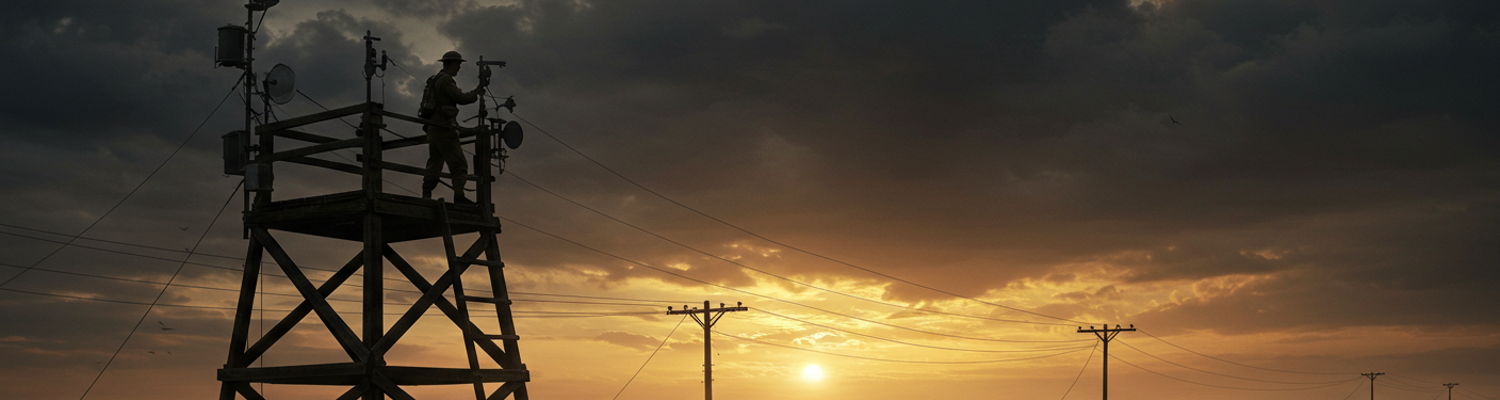

A Joint Resolution of Congress, signed into law by President Ulysses S. Grant on February 9, 1870, tasked the Secretary of War with a novel and expansive mission. The law directed him to organize meteorological observations at military stations across the interior of the continent. It also required him to provide notice of approaching storms to the Great Lakes and the nation's sea coasts. This was not a simple request. It was a strategic directive born from national growing pains and economic necessity. The responsibility fell squarely upon the U.S. Army Signal Corps, a small, specialized unit forged in the Civil War for battlefield communication. Its new assignment was to map and predict the weather for the entire nation, a domain of chaos it was now ordered to chart.
The decision to use the Army was deliberate. Previous attempts at a national weather network, like the volunteer system coordinated by the Smithsonian Institution under Joseph Henry, had proven valuable but lacked the speed and discipline required for true forecasting. Commerce and westward expansion moved too fast for data sent by mail. The nation needed a network that operated with military precision. Congressman Halbert E. Paine, a former Union general who had witnessed the power of the telegraph, championed the legislation. He understood that only the Army possessed the command structure, the disciplined personnel, and the control over telegraph lines to make such a system function on a continental scale.
A New National Domain
Brigadier General Albert J. Myer, the Army’s Chief Signal Officer and a physician by training, seized command of this new enterprise. He possessed the vision to see beyond a simple military support function. Myer established the “Division of Telegrams and Reports for the Benefit of Commerce,” a name that explicitly broadcasted its dual purpose. The network would certainly serve the Army’s operational needs on the expanding frontier, providing vital data for troop movements and logistics in harsh, unpredictable environments where a sudden blizzard could be as deadly as an ambush. At the same time, it would offer an immense benefit to the civilian world. Destructive gales on the Great Lakes had recently wrecked hundreds of vessels, and agriculturalists pushing into the plains faced blizzards, droughts, and floods with no warning. Myer envisioned a system that protected both soldier and citizen, recognizing that a nation’s strength depended on its economic vitality as much as its military might.
The first official, synchronized observations from twenty-four stations commenced on November 1, 1870. The system proved its worth almost immediately. Just one week later, Dr. Increase A. Lapham, a scientific collaborator of Myer's based in Chicago, used telegraphed data to issue the first storm warning for the Great Lakes. The warning was accurate, vindicating the entire concept. Expansion followed at a relentless pace. From the initial twenty-four stations, the network grew to sixty-six by 1872. By the end of the decade, over one hundred stations dotted the map, from the arid Southwest to the frigid northern plains. The Signal Corps began publishing daily weather maps and bulletins, creating a flow of information that was entirely new to the public. These “Weather Probabilities” were posted in post offices, printed in newspapers, and displayed at ports, becoming a part of daily American life. This was an act of national consolidation, using military infrastructure to bind the country together. It represented a powerful lesson in military-civilian synergy. The Army, by building an institution for the common good, was projecting national power and stability inward, securing the economic frontiers of the Gilded Age just as it secured the physical ones.
Nerve System of Wire and Will
The technological heart of the Army's weather service was the electromagnetic telegraph. Without the ability to transmit observations with near-instant speed, a synoptic, or simultaneous, view of continental weather would be impossible. The Signal Corps leveraged and massively expanded the nation’s telegraph infrastructure. It strung thousands of miles of its own dedicated wire across desolate territories where no commercial incentive existed. These military lines connected forts, depots, and remote observation posts, creating a robust network resistant to the failures that plagued purely commercial systems. This network became the literal nerve system of American meteorology. It connected isolated outposts in the Arizona and Dakota Territories with the central processing office in Washington, D.C. Data that once took weeks to travel by horse and rail now moved at the speed of electricity.
At the frontier end of these wires were the observer-sergeants, a new type of soldier trained for scientific rigor. These enlisted men received specialized training at Fort Whipple, Virginia, which was later renamed Fort Myer in honor of the Chief Signal Officer. Their toolkit was basic by modern standards yet effective for its time. Each station was equipped with a Green-type mercurial barometer to measure atmospheric pressure, a set of thermometers for air and water temperature, a hygrometer for humidity, a rain gauge, and an anemometer, often of the Robinson cup design, to measure wind speed. The delicate glass tube of the barometer required careful handling and constant correction for temperature and elevation using standardized tables. The anemometer’s spinning cups, while mechanically simple, required constant lubrication and clearing of ice or debris. Maintaining this equipment in the pervasive dust of the plains, the corrosive salt air of the Gulf Coast, or the freezing cold of a mountain station was a constant battle against the elements the men were sent to observe. The post on Pikes Peak, Colorado, established in 1873, was the highest meteorological station in the world, a place of extreme cold and physical hardship for the soldiers stationed there.
The daily routine was one of rigid, unyielding discipline. Three times a day, at 7:35 a.m., 4:35 p.m., and 11:35 p.m. Washington time, every observer-sergeant across the country would read his instruments. This synchronization was paramount. He would record the data, encode it into a complex numerical cipher to ensure brevity and accuracy over the telegraph lines, and transmit it immediately. This cipher condensed a full report of pressure, temperature, wind direction and velocity, cloud cover, and precipitation into just a few words, a critical efficiency for the era’s telegraphy. The observers also recorded local phenomena, from the movement of locust swarms to the state of rivers, adding qualitative depth to the quantitative data. Life at a remote station was one of profound isolation and immense responsibility. A single missed or faulty observation from a key location like Cheyenne or El Paso could compromise the entire national forecast. These soldiers were information-gatherers on the front lines of a scientific and economic war against uncertainty. Their work formed the bedrock data upon which the entire national weather forecasting system was built. The lessons in standardization, disciplined data collection, and remote network management learned by the Signal Corps are still foundational to global military and civilian information-gathering operations today.
Mission Accomplished, A New Bureau Born
The Army’s weather service produced tangible results that resonated far beyond military installations. The storm warnings issued for the Great Lakes and the Atlantic coast saved countless ships and lives, proving the system’s value to maritime commerce. Farmers on the plains, for the first time, received advance notice of “cold waves” and major storms, allowing them to protect vulnerable livestock and crops. River flood warnings, added to the Corps’ duties in 1871 after a direct request from Congress, provided critical information for communities along the Mississippi and its tributaries. The “Division of Telegrams and Reports for the Benefit of Commerce” became a profoundly successful public works project, managed with military efficiency and discipline.
General Myer and his successors, General William Babcock Hazen and General Adolphus Greely, created an organization that was respected internationally for its scientific output. Hazen, in particular, fought to maintain the scientific integrity and funding of the service against political pressures and accusations of forecast inaccuracies. By the late 1880s, however, the weather mission consumed the majority of the Signal Corps’ budget and personnel, often at the expense of its primary military signaling duties. The program had become a victim of its own success. Its function was so deeply embedded in the civilian economy that its placement within the Department of War seemed increasingly illogical. A consensus grew, particularly within the Department of Agriculture, that this national asset, now mature and stable, belonged under civilian authority where its focus on agriculture and commerce could be fully realized without the constraints of military budgets.
This evolution was not a failure for the Army but a strategic success of the highest order. On October 1, 1890, Congress passed an act, at the request of President Benjamin Harrison, to transfer the meteorological responsibilities to a new, civilian U.S. Weather Bureau under the Department of Agriculture. The transition became effective on July 1, 1891. The Signal Corps handed over a functioning, nationwide system of observation stations, a trained cadre of personnel, many of whom transferred to the new Bureau, and two decades of invaluable climatological data. It was a deliberate and planned handover of a capability that had achieved its purpose. The Army had acted as an incubator, using its unique structure and discipline to build a vital national institution that could now stand on its own. This act of institutional creation and successful transition provides a powerful model for future military endeavors in stabilization and infrastructure development. It demonstrates that the ultimate measure of a mission’s success can be the creation of a civilian capacity that renders the military’s role no longer necessary.