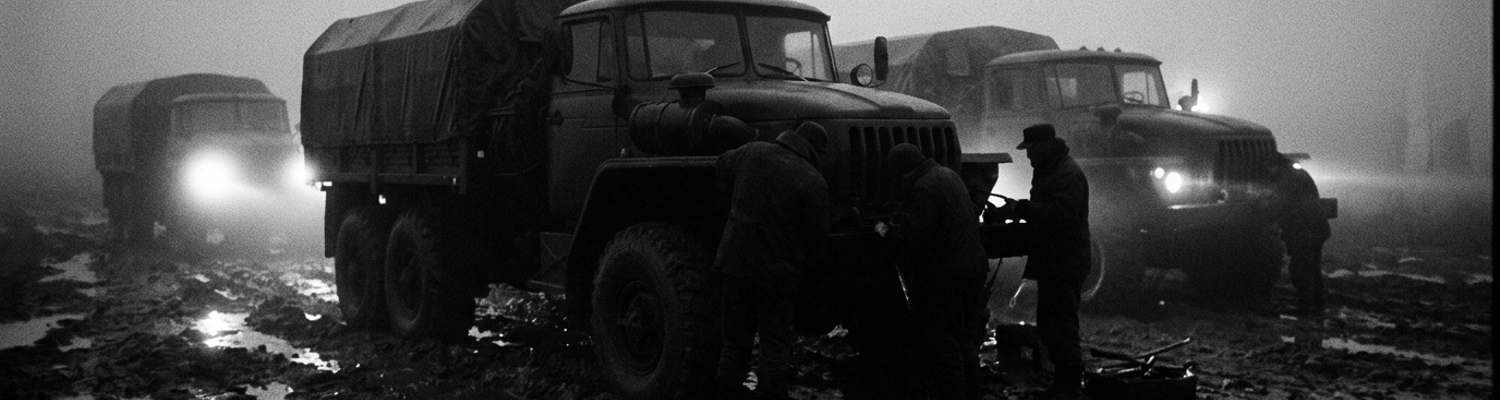

August 1918 Retrograde Across the Vesle River
Inside the differential housing of lead shop truck number seven, the forged manganese bronze bevel gears stripped four consecutive teeth with an audible metallic shriek. Hydraulic pressure dropped to zero within three seconds. The severed high pressure brass line whipped against the chassis rail. It vented forty pounds per square inch of compressed air and atomized motor oil directly into the dirt. When examining the historical record of the 10th Ordnance Mobile Repair Company, this specific drive shaft seizure occurred precisely at 0314 hours along the southern river embankment outside Fismes. The disabled five ton Four Wheel Drive Model B truck sat dead across the wheel rutted approach track. It blocked a three ton lathe trailer and two motorized tool supply vans directly in front of the southern pontoon crossing.
The road was completely impassable.
Archival evidence shows that elements of the 28th and 77th Divisions were executing an uncoordinated retrograde movement southward across the swollen Vesle River. German artillery observers monitored the crossing from the northern ridge of the Chemin des Dames plateau. Imperial German batteries from the Seventh Army poured intermittent salvos of 150 millimeter high explosive rounds and blue cross diphenylchloroarsine gas shells into the valley floor around map coordinate 284.145. Infantrymen from the 112th Infantry Regiment squeezed past stalled transport wagons along the narrow corduroy approaches. They carried shattered litters and bent Springfield rifles. Shrapnel cut through the willows flanking the water.
Company commanders on the ground lacked wireless coordination.
They relied on runners who repeatedly disappeared in the cratered wheatfields north of the railway embankment. Shell bursts repeatedly ruptured the pontoon anchoring cables. This pitched wooden bridge balks into the current. The destruction compressed three entire infantry battalions into a four hundred yard pocket against the riverbank. Evacuation had broken down entirely. A close review of operational logs indicates that the motorized machine shops of the 10th Ordnance Mobile Repair Company received orders to clear the north bank by dawn. This directive aimed to preserve the division's only mobile repair machinery. Six heavy machine shop trucks converged simultaneously on the single remaining canvas pontoon bridge constructed by the 107th Engineers. These platforms carried overhead belt driven lathes, drill presses, and fragile acetylene generator tanks.
Ordnance mechanics worked frantically in knee deep mud beneath blackout tarpaulins.
They utilized hand cranks and pry bars to manhandle the seized truck chassis away from the bridge abutment. Counter battery fire splintered the surrounding trees. Every passing minute under the German bombardment threatened the total destruction of the field maintenance apparatus required to keep the corps artillery functional. Sergeant Arthur Campbell directed three mechanics to cut the truck's locked rear drive chain with cold chisels. Hot splinter fragments struck the steel hull plates around them. Ten minutes remained before daylight. Field records show that between 0317 and 0322 hours, the entire retreat stalled at the southern bridgehead. Shell craters forty feet wide bracketed the western pontoon anchors.
Chlorine vapor settled into the axle hubs of the trailing tool trucks.
Captain Ellis of the 10th Ordnance made an immediate command decision. He attached tow cables from an intact Mack AC Bulldog recovery truck to the dead chassis. He stripped the transmission linkage clear with brute torque rather than waiting for mechanical disengagement. Metal sheared against metal with a sharp snap as the recovery winch engaged at maximum throttle. The winch dragged the broken chassis into the river mud at 0321 hours. This reopened a nine foot lane across the bridge ramps. Over four hundred retreating soldiers and eight motorized repair platforms passed across the pontoons into the relative cover of the southern woods. The next artillery bracket struck the crossing point at 0329 hours.
Dichlorodiethyl Sulfide Exposure on Transport Chassis
Archival evidence shows that German artillery batteries emplaced across the northern heights of Mont Notre Dame and the crest of Hill 164 systematically saturated the unpaved approaches between Fismes and Courlandon. They fired Gelbkreuz shells throughout the preceding forty eight hours. Over two thousand rounds of dichlorodiethyl sulfide rained down on coordinates 283.140 to 286.155. This bombardment soaked the damp alluvial silt of the southern Vesle flood basin with thick dark amber liquid. The ambient valley temperature hovered at sixty four degrees Fahrenheit under heavy overcast with zero wind. This weather pattern prevented the vapor from dispersing. The persistent chemical agent pooled directly inside saturated wagon ruts, crater lips, and muddy bypass channels.
The 10th Ordnance convoy lurched southward along the corduroy logs at five miles per hour.
The churning thirty six inch artillery type solid rubber wheels continuously scooped this oily chemical sludge directly into the undercarriages. Soil chemistry reports compiled by the Chemical Warfare Service confirm that the high moisture content of the river clay decelerated normal environmental hydrolysis. Liquid agent clung tenaciously to organic detritus. This created a continuous chemical mire along the three mile withdrawal corridor that resisted rain runoff. It coated the lower running gear of every machine attempting the passage. The mud itself had become toxic ordnance. A close review of operational logs indicates that the mechanical design of the Four Wheel Drive Model B three ton shop truck made its entire propulsion system uniquely vulnerable to this chemical immersion.
Standard rear wheel drive military transports of 1918 featured enclosed rear axles.
The FWD chassis utilized an intricate four wheel drive layout with exposed front and rear drive shafts. It featured external differential drop cases and open Cardan universal joints packed inside spherical steering knuckle balls. Heavy petroleum based cup grease inside these knuckle housings readily absorbed the lipophilic dichlorodiethyl sulfide on contact. The chemical acted as an aggressive organic solvent. It broke down the heavy grease matrix into a thin caustic slurry. This slurry washed out of the seals entirely. Within forty minutes of sustained churning through contaminated muck, sulfur mustard penetrated the vegetable tanned leather dust boots protecting the front axle steering pivots.
The chemical dissolved the stitching.
This left the precision bronze bushings exposed to river grit. Entrained water from the riverbed then triggered rapid acid hydrolysis within the joint housings. This reaction generated high concentrations of corrosive hydrochloric acid. The acid pitted the hardened nickel steel surfaces of the bevel drive pinions. It etched the roller bearings. It caused severe galling across the sliding spline shafts. Friction welded moving components together under full load. When examining the historical record of the 10th Ordnance maintenance detachment, field mechanics first observed the severe mechanical binding on four consecutive FWD repair trucks at 0334 hours. This occurred exactly five hundred yards south of the pontoon ramps.
Driving torque sheared the kingpin retaining pins.
Sulfur mustard destroyed the mineral lubricants inside the front axle knuckles. Drivers found themselves unable to turn the heavy wooden steering wheels against the seized joints. Captain Ellis directed shop crews to scrape the acidic paste from the front wheel hubs using iron spud bars, discarded bayonets, and bare wire brushes. The black grease clinging to the wheel flanges contained lethal concentrations of vesicant. Ordnance mechanics working without rubber gauntlets wiped stinging sweat from their faces with chemical drenched woolen uniform cuffs. They developed deep tissue burns across their forearms while hammering loose the frozen linkage rods. Corrosive seizing immobilized two lathes and an internal power plant mounted inside shop truck number twelve by 0338 hours. The forward drive chain jammed tight against the etched transfer case sprocket. This halted the column on the south bank.
Failure of Field Decontamination Spray Systems
A close review of operational logs indicates that Captain Ellis ordered the immediate deployment of three field expedient decontamination rigs at 0341 hours near map coordinate 285.142. He positioned the apparatus beneath the tree line three hundred yards south of the river crossing. American forces had no standardized power driven chemical neutralizer dispersal units in France during the summer of 1918. Ordnance mechanics instead relied on improvised wash down kits. They assembled these kits from commercial orchard sprayers, copper lined fire pumps, and belt driven bilge pumps. Mechanics hastily adapted these pumps to the power take off shafts of the Model B trucks. Technicians shoveled dry bleach powder directly into five hundred gallon wooden vat tanks.
This calcium hypochlorite powder contained roughly thirty five percent available chlorine.
They filled the vats with sediment heavy water drawn straight from the Vesle River. This unrefined mixture formed a thick abrasive calcium hydroxide slurry rather than a clean aqueous solution. Undissolved lime grit, river silt, and gravel particulates entered the cast iron pump manifolds. The fluid did not pass through secondary fine mesh strainers. The strainers had clogged within seconds and were pulled out by the crews. Inside the reciprocating twin cylinder sprayers, the heavy alkaline slurry ground down the cast iron piston rings. It gouged the brass sleeve walls. It clogged the spring loaded ball check valves.
Drive belts slipped on the slurry slicked wooden pulleys.
Friction heat scorched the leather belts. This froze the pump crankshafts solid by 0344 hours. The slurry turned into solid plaster inside the intake valves. Archival evidence shows that the failure escalated when the corrosive neutralizer reacted with the contaminated surfaces of the equipment. The maintenance detachment utilized fifty foot sections of standard one inch vulcanized rubber fire hose to convey the caustic liquid under fifty pounds per square inch of head pressure. They also used garden grade delivery tubing scavenged from French agricultural depots. These flexible lines were never engineered to resist concurrent contact with industrial oxidizers and lipophilic chemical warfare agents.
Dichlorodiethyl sulfide residue scraped from the truck differentials saturated the outer exterior plies of the canvas wrapped rubber.
This exposure broke down the polyisoprene elastomer chains. Concurrently, the hot hyper alkaline calcium hypochlorite fluid ate through the interior core. This triggered rapid devulcanization of the sulfur bonds within the cured rubber lining. Swelling occurred along the entire length of the lines within six minutes of continuous exposure. The chemical reaction softened the structural walls into a gummy semi liquid state. Internal delivery pressures ballooned the weakened tubing at the brass coupling shanks. Gaskets cut from sheet vulcanized rubber inside the swivel fittings turned to soft jelly. This eliminated the airtight seal required to maintain fluid velocity.
Braided canvas outer casings ruptured simultaneously across all three operating wash bays.
When examining the historical record, this structural degradation produced a chain reaction across the wash line between 0346 and 0349 hours. Pressurized jets of caustic slurry burst through the delaminated hose walls. The spray blinded Corporal Vance and two assistant repairmen from the 10th Ordnance. They were attempting to scour the contaminated Cardan joints on truck nine. The unit lacked replacement neoprene or chemical resistant fluoroelastomers. Sergeant Campbell attempted to bind the split delivery lines using friction tape, copper safety wire, and tarred hemp twine. The caustic bleach ate through the cotton backing of the adhesive tape in under ninety seconds.
Liquid lime and dissolved mustard oil sprayed backward over the open engine compartments.
The fluid coated hot exhaust manifolds. It vaporized into dense irritating white clouds that enveloped the work crews. Pumping operations collapsed completely at 0349 hours. Five contaminated FWD shop trucks sat parked nose to tail on the south bank. Unneutralized liquid sulfur mustard dripped off their steering knuckles directly into the dry brush.
Five Minutes of Critical Mechanical Paralysis
Total mechanical and tactical paralysis immobilized the south riverbank at precisely 0350 hours. Archival evidence shows that the airborne dispersion of vaporized calcium hypochlorite and atomized mustard agent settled directly over the security detachment from Company C of the 112th Infantry. Within sixty seconds of the wash line blowout, thirty infantrymen securing the southern approach trail discovered their M1903 Springfield service rifles had locked solid. Airborne calcium lime dust bonded instantly with residual whale oil lubricant and damp river sediment inside the receiver mechanisms. This formed a chalky abrasive crust that caked the internal locking recesses. Soldiers attempted to cycle the actions.
Case hardened carbon steel bolt bodies jammed tight against the receiver raceways.
Dual locking lugs bound within their forward recesses. Extraction collars froze against the cartridge heads. Soldiers smashed rifle butts against corduroy logs. They hammered bolt handles with trench boot heels to force the mechanisms open. This action sheared three extractor collars off their sleeves near map coordinate 285.142. Defensive small arms fire across the riverbank ceased entirely. The infantrymen stood disarmed in front of their own transport column. A close review of operational logs indicates that the identical chemical mist destroyed the division's only active wire connection at that exact moment.
Two operators from the 107th Field Signal Battalion occupied an open slit trench forty yards east of the disabled shop trucks.
They attempted to maintain communication with the 28th Division message center at Mont Saint Pere using a Model 1914 Signal Corps Service Buzzer. Acidic fumes from the hydrolyzing mustard wash settled across the instrument board. The vapor reacted immediately with the uninsulated brass binding posts. Rapid galvanic corrosion formed a layer of non conductive copper carbonate across the wiring terminals. This snapped the degraded copper leads clean at the posts. Chemical droplets penetrated the hard rubber housing to coat the platinum contact points of the electromagnetic interrupter. This broke the circuit between the induction coil and the dry cell batteries.
The key clicked without generating current.
No signal could escape the valley floor. When examining the historical record, this compound breakdown enforced an absolute granular five minute operational halt between 0350 and 0355 hours. Private First Class Harold Meade and Sergeant Louis Dubin of AEF Signal Corps Photographic Unit Number Two were positioned twenty yards south of truck nine. They were tasked with documenting the river crossing using a heavy Graflex plate camera. Seventh Army artillery batteries perched along Hill 164 laid intermittent 150 millimeter high explosive shellfire directly across the tree line. The batteries detonated airbursts sixty feet above the mud tracks every forty five seconds.
Meade recorded the paralysis on glass negative emulsions under direct fragmentation showers.
He captured the frozen column in minute by minute sequence. Negative number 18429, exposed at 0352 hours, recorded mechanics pinned motionless beneath the running boards of truck twelve. It showed drivers pressing gas masks against burning faces. Captain Ellis stood beside a dead engine block with a useless wrench. For three hundred seconds, the convoy did not advance an inch. Active artillery fragmentation severed the upper foliage overhead while the convoy sat stationary on the corduroy road.
Emergency Remediation and Bridgehead Extraction
Operational records show that during these three hundred seconds of exposure, Captain Ellis weighed abandoning the division's machine tools against the total annihilation of his personnel. German battery fire walked fifty yards closer at 0353 hours. The shells cratered the riverbank at coordinate 285.140. The explosions threw mud over the photographic plates. The maintenance detachment lacked rifle protection against German patrols crossing the shallows. They possessed no wire communication to summon counter battery fire. The unit faced complete capture or destruction in the valley.
Ellis made a final command decision at 0354 hours.
He declared the motorized spray rigs a total loss. He ordered mechanics to abandon the ruptured chemical pumps where they lay in the brush. The arrival of three runners from the 109th Infantry bearing handwritten withdrawal coordinates to Dravegny brought the five minute freeze to an end at precisely 0355 hours. This prompted crews to manually lash hemp tow cables directly between the surviving trucks. Mechanics bypassed the seized FWD steering knuckles by chaining the front axles rigidly to the rear pintle hooks of the towing vehicles. They sacrificed all steering control for raw forward momentum.
The Mack AC Bulldog recovery truck took the lead position.
Its heavy chain drive transmission engaged low gear. The recovery truck dragged the first disabled FWD shop truck out of the contaminated mud rut. The rigid tow cables snapped taut. The convoy began a slow grinding advance up the southern embankment. The unsprung weight of the chained axles gouged deep trenches into the corduroy logs. Mechanics walked alongside the moving trucks. They used heavy wooden chocks to prevent the vehicles from sliding backward down the incline during gear shifts. The convoy cleared the immediate blast radius of the pontoon crossing at 0402 hours.
German artillery observers adjusted their fire.
A concentrated barrage of high explosive shells obliterated the exact coordinates where the wash line had collapsed just seven minutes prior. The abandoned wooden vat tanks shattered into splinters. The remaining calcium hypochlorite powder dispersed into the air as a dry white cloud. The 10th Ordnance Mobile Repair Company sustained severe chemical burns across forty percent of its forward personnel. They successfully extracted four of the six heavy machine shop trucks from the Vesle River basin. The unit relocated to the secondary defensive line at Dravegny. They arrived with ruined steering linkages, stripped gears, and heavily contaminated chassis frames. The mechanics immediately began manual teardowns of the seized differentials using hand tools.