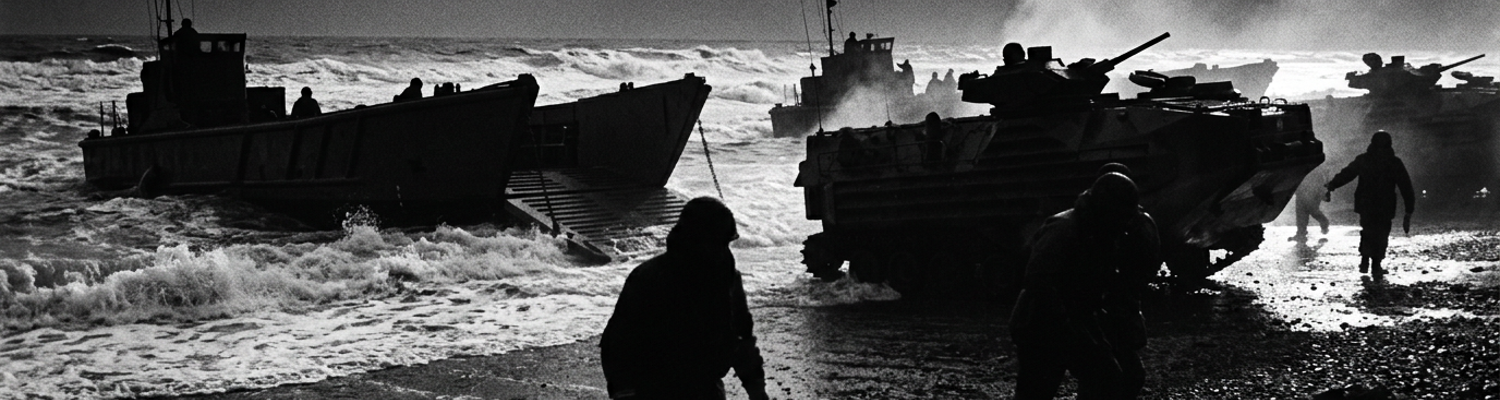

Surf-Zone Hydraulic Casualties along the Pohang Shingle
030642I MAR 1973. Coordinates 35 degrees 59 minutes North, 129 degrees 24 minutes East. Designated Beach Green. This was six kilometers southeast of Pohang, Republic of Korea. Plunging breakers slammed directly onto a steep gravel shoreline. The assault waves of the 33rd Marine Amphibious Unit approached the beachhead. Battalion Landing Team 2/4 initiated its run from amphibious transport docks five miles out. They hit a localized littoral shelf. Ground swell wave energy doubled in velocity against the retreating undertow.
Cold brine stripped the lubricants from exposed exterior fittings in seconds.
Archival evidence shows that the primary mechanical failure cascade originated inside the hydraulic power transfer loops of the newly fielded LVTP-7 tracked landing vehicles. The hulls experienced abrupt thermal shock from the near-freezing sea water. They entered the four-foot plunging surf at sub-zero ambient temperatures of minus eight degrees Celsius. Standard mineral-based MIL-H-5606 hydraulic fluid drastically thickened inside the narrow distribution lines. This created massive hydrostatic pressure spikes against cold-embrittled synthetic nitrile elastomer seals. Water-jet deflector actuators cycled under maximum resistance against turbulent backwash. These hardened seals ruptured across forward bulkheads and lower engine compartments. Pressurized fluid emptied directly into the bilges. Operating pressures dropped below functional thresholds. The hydraulic motors governing the steering vanes failed completely. Multiple thirty-ton vehicles lost heading control sixty yards offshore.
They broached parallel to incoming waves.
A close review of operational logs indicates that the tactical disaster intensified the moment vehicle commanders attempted emergency troop debarkations along the high-water breaker line. Driven by gale-force sea spray, salt water coated the exterior bow ramp assemblies. It froze into solid sheets of ice around the mechanical ramp locking pins and their hull-mounted receiver sockets. Crew chiefs energized the hydraulic solenoids to drop the main forward doors. The locking pins remained frozen in place. Hydraulic cylinders forced heavy pressure against the mechanical blockages. The internal piston packing tore away. Hot fluid vented across the forward crew compartments. The bow ramps dropped only eighteen inches before binding hard against damaged trunnion hinges. They remained frozen open at a rigid twenty-degree angle. This gap was completely impassable for combat infantrymen carrying full cold-weather gear and sixty-pound field packs. It served as an open scoop for breaking waves.
Freezing ocean water filled the troop bays within ninety seconds.
Field reports document how combat elements from the 33rd Marine Amphibious Unit were forced to ditch gear. They scrambled out through top-side cargo hatches directly into crashing overhead surf. Cascading salt water shorted out the twenty-four-volt primary electrical bus bars. This shut down the auxiliary electric bilge pumps. The bilges flooded with a mix of diesel fuel, hydraulic oil, and sea water. Marines dropping from the vehicle roofs into the five-foot surf along the unstable shingle slope were dragged down by backwash. They sustained severe hypothermia, crushed legs against rolling tracks, and blunt-force trauma from rolling cobbles. Beach recovery parties from the Shore Operations Battalion were unable to secure towing cables. The vehicle bow shackles were completely submerged beneath heavy breaker foam. Three immobilized LVTP-7 hulls settled directly onto their belly armor in the wet shingle.
They functioned as accidental groins channeling breaking surf directly across the evacuation hatches.
Emergency Well-Deck Triage aboard USS Anchorage
Archival evidence shows that casualty evacuation runs began failing during the five-mile transit from the shingle back to the amphibious transport line. Open-topped LCM-8 mechanized landing craft and thirty-six-foot LCVP utility boats took continuous green water over their low gunwales within minutes of clearing the breaker line. Sub-zero air temperatures transformed incoming sea spray into rime ice across exposed deck surfaces. The non-skid deck plating was coated in a two-inch sheet of frozen brine. Salt encrustation quickly jammed mechanical throttle linkages. Boat engineers worked fuel-injection racks by hand inside unheated engine compartments. Navy corpsmen from Battalion Landing Team 2/4 attempted to splint compound limb fractures and apply pressure dressings with bare hands. They lost fine motor function within eight minutes as sub-zero spray soaked their gloves. Wet wool liners froze into stiff boards. Deck wind chills dropped below minus twenty-two degrees Celsius. Resuscitation efforts collapsed across the open cargo wells. Silicone valves inside bag-valve resuscitators froze solid. This cut off manual ventilation to unconscious patients.
Three utility boat coxswains lost tactile control of their helm wheels after peripheral nerve freeze deadened their hands.
A close review of operational logs indicates that landing craft recovery inside USS Anchorage deteriorated as soon as the ballast tanks flooded down. Ship engineers filled ballast compartments twenty-six through thirty-two to lower the stern sill ten feet beneath the waterline. This allowed displacement craft to float directly into the internal dock. Incoming swells from the Sea of Japan entered the open stern gate without restriction. Four-foot standing waves surged along the entire 430-foot well deck. Water sloshed violently across the steel deck plates. Loose dunnage, fuel cans, and mooring lines washed against the wing-wall catwalks. Coxswains attempting to enter the flooded cavern fought turbulent undertows. These currents threw steering rudders hard against their mechanical stops. Salt-glazed helm glass obscured their view. Two landing craft struck the interior steel docking buffers at seven knots. Forward mooring lines severed. Injured troops were thrown across the open bilges.
Sea water washing through the well deck registered minus one degree Celsius.
The medical complement aboard USS Anchorage broke down under the simultaneous arrival of extreme cold-exposure cases and severe trauma patients. Stretcher teams in rubber exposure suits waded through waist-deep water to drag casualties out of the surging boats. Marine infantrymen pulled from the surf suffered from compound pelvic fractures, crushed lower limbs from rolling tracks, and severe head lacerations alongside profound systemic hypothermia. Portable suction units failed because cold brine shorted their unsealed battery casings. Navy doctors attempting intravenous access found peripheral veins completely collapsed by vascular constriction. Needles bent against frozen skin tissue. Electric warming blankets short-circuited when salt water soaked their transformer units. Emergency circuit breakers tripped across the forward repair lockers. Core body temperatures among twenty-two Marines dropped below thirty degrees Celsius before medical staff could cut through their ice-sheathed field jackets.
Medical supplies of dry wool blankets and lactated Ringer solution ran out at 0920.
Mechanical Vulnerabilities of the LVTP-7 Amphibious Vehicle
Archival evidence shows that the primary vulnerabilities of the LVTP-7 traced directly to metallurgy choices made during procurement for early production runs by FMC Corporation. The high-pressure fluid lines feeding the dual bow-ramp actuator cylinders were fabricated from cold-drawn thin-wall carbon steel coupled to synthetic fluorocarbon jumper hoses. Ambient temperatures off Pohang plunged to minus eight degrees Celsius with minus twenty-degree wind chills. The thermal contraction rates between the metal tubing and the unjacketed end fittings diverged sharply. Pumping thick, cold MIL-H-5606 fluid through these narrow-gauge conduits forced internal system pressures upward past 2,200 pounds per square inch during initial ramp-cycling attempts. The cold-induced embrittlement caused circumferential micro-fractures along the ninety-degree bend radii behind the forward port bulkheads. Under this sustained load, the pressurized lines burst open along their seam welds. High-velocity mists of hydraulic oil discharged across the troop bay. The forward ramp jacks were instantly deprived of operational pressure.
Brittle steel fractures severed fluid delivery to both bow-ramp actuators simultaneously.
A close review of operational logs indicates that maintenance crews had flagged these specific hydraulic lines during dockside inspections at Camp Schwab, Okinawa, two months prior to the deployment. Regimental logistics officers had requested cold-weather replacement assemblies rated down to minus thirty-five degrees Celsius. Supply depots in Subic Bay had marked the requisition back-ordered until late spring. Training schedules dictated immediate deployment for the amphibious phase of Exercise Golden Dragon-73. Maintenance battalions retained the standard-issue temperate lines. The failure rate was immediate and total across five assault craft in the first assault wave when vehicles entered the sub-zero water off Pohang. Mechanics attempting emergency repairs inside swamped hulls found the retaining flare nuts frozen to their bulkhead couplings. Aluminum mounting threads stripped when wrench torque was applied. Bow ramps jammed rigidly shut or hung half-dropped against their trunnions. Combat personnel were prevented from clearing the swamped compartments.
Frozen line fittings prevented field mechanics from bypassing the ruptured loops.
Sea-surface dynamics compounded these structural weaknesses the moment vehicles reached drifting ice bands two miles off the coast. The LVTP-7 relied on twin hull-recessed Aerojet water-jet propulsion units. Each was driven through power take-off shafts linked to the Detroit Diesel 8V53T turbocharged engine. Protective grates on the bottom hull sponsons were spaced only one and a half inches apart. This spacing was designed to prevent rocks and foreign debris from damaging the high-speed aluminum impellers. Assault elements of Battalion Landing Team 2/4 pushed through drifting sea-ice floes moving south along the East Korean Current. These intake grilles collected floating slush and fragmented pancake ice. Slush packed into solid plugs across the intake faces within three minutes of forward waterborne transit. Starved of incoming sea water, the axial-flow impellers experienced continuous hydrodynamic cavitation. Severe rotational imbalances tore through the rubber carrier bearings of the drive shafts.
Loss of water throughput immediately disabled the auxiliary heat exchangers.
These exchangers relied on open-circuit raw seawater to cool the closed jacket-water loop of the engine. Operating at full throttle to maintain a six-knot waterborne speed against heavy offshore chop, the turbocharged diesel engines began dumping heat directly into dry heat-exchanger shells. Coolant temperatures inside the engine blocks surged from normal operating thresholds of eighty-two degrees Celsius past the safety ceiling of one hundred and ten degrees Celsius in under ninety seconds. Cylinder heads warped along the exhaust valves. Copper head gaskets blew out. Superheated coolant entered directly into combustion chambers. Automatic thermal shutdown cutouts engaged on four separate hulls. The engines of two others suffered cracked cast-iron exhaust manifolds and internal seizure. Deprived of both water-jet thrust and electrical power, the stalled aluminum hulls swung broadside into the four-foot swells.
Engine logs recorded cylinder exhaust temperatures exceeding six hundred and fifty degrees Celsius before ignition ceased entirely.
Small Boat Operations and Exposure Casualties
Archival evidence shows that the embarkation phase alongside the amphibious transport dock USS Dubuque failed completely. Six-foot swell trains rebounded off the vertical hull plates of the ship. Battalion Landing Team 2/4 personnel descended knotted debarkation nets toward open thirty-six-foot LCVP utility craft. These boats were pitching violently across eight-foot vertical arcs. Heavy ground swells rolling out of Yeongil Bay created severe hydrodynamic pressure waves along the port side of the ship. Coxswains were prevented from stabilizing their displacement hulls. Synthetic five-inch nylon breast lines snapped under peak shock loads. They whipped across open cockpits and left the boats entirely at the mercy of the surging sea. Craft drifted uncontrollably under the staging nets. Their armored steel gunwales slammed into the exterior hull frames of the transport dock with every wave cycle. Marines clinging to the lower rungs of cargo nets were caught directly in the pinch point between the rising utility craft and the armor belt of the ship. Transfer teams documented multiple compound pelvic fractures, crushed extremities, and shattered femurs before deck officers could halt troop descent down the scramble nets.
Braided nylon mooring hawsers sheared across the forward embarkation stations within forty seconds of line tensioning.
A close review of operational logs indicates that transport dock command personnel delayed aborting the transfer. Landing schedules dictated landing wave synchronization with South Korean marine units ashore. Craft coxswains operating mechanical single-screw throttles could not counter the combined force of backwash and five-knot tidal currents running through the roadstead. Wave crests surged upward. Twenty-ton steel landing craft were thrown laterally against the staging ladders of the ship. Bronze mounting brackets sheared off. Fully combat-equipped riflemen were dumped into the water gap. Three infantrymen fell between an unguided utility boat and the sea chest of the ship. Hull compression caused severe crush injuries, ruptured internal organs, and fatal traumatic asphyxiation. Deck crews dropped wooden fenders down the sheer hull plating. The timber assemblies splintered instantly under the dynamic impact of eighty-ton displacement loads. Emergency retrieval lines tangled in rotating propulsion screws. Power was cut to two craft. They were left rolling dead in the water against the steel hull.
Steel gunwales crushed lower limbs against the transport dock plating with eight tons of kinetic force.
Small boat operations faced an immediate medical crisis once utility craft cleared the lee of the ship and entered open coastal breakers. Freezing Korean surf broke cleanly over low utility craft gunwales. Unheated troop compartments filled with sixteen inches of near-freezing sea water within three minutes of departure. Ambient air temperatures sat at minus eight degrees Celsius. Sea-surface readings offshore from Pohang registered zero degrees Celsius. Personnel from Battalion Landing Team 2/4 were packed into open-deck wells without thermal shelter. They suffered acute hypothermic shock within minutes of total brine immersion. Water entering unsealed combat boots and cotton-blend cold-weather trousers accelerated metabolic heat loss twenty-five times faster than dry air. Involuntary cold-shock gasping caused multiple riflemen to aspirate salt spray. This triggered severe laryngeal spasms and acute respiratory distress.
Peripheral vasoconstriction incapacitated the motor functions of seventy-four infantrymen before their craft cleared the outer sandbars.
Medical logs maintained by craft corpsmen document how profound shivering gave way to muscle rigidity and altered mental status within six minutes of wave impact. Wet utility jackets froze into rigid carapaces. Men were prevented from discarding sixty-pound combat rucksacks or holding steadying lines along the gunwales. Core body temperatures among wet-well occupants plunged below thirty-two degrees Celsius. This induced cardiac arrhythmias, bradycardia, and sudden loss of consciousness. Navy corpsmen aboard the swamped boats were unable to initiate warming measures. Auxiliary heating stoves had failed from salt encrustation. Dry blanket reserves were soaked by incoming green water. Beachmaster teams receiving the utility craft along Beach Green found dozens of Marines collapsed across wet bilges. Their hands were frozen into claw-like positions around rifle slings. Medical officers triaged forty-two severe hypothermia cases directly on the wet shingle. They used cut field jackets to check carotid pulses on comatose personnel.
Field dressing stations recorded rectal core temperatures of twenty-nine degrees Celsius among seven unconscious Marines pulled from the craft bilges.
Combat Engineer Operations under Arctic Conditions
Archival evidence shows that engineering operations on Beach Green disintegrated forty minutes after the initial landing. The planned mechanized heavy plant failed to reach the waterline. Heavy surf and broached assault craft blocked the landing lanes for mechanized landing craft carrying two Caterpillar D7G crawler tractors and a rubber-tired rough-terrain crane. Both tractor operators dropped their ramp doors into six feet of rolling foam. Diesel air intakes flooded. The thirty-ton machines were drowned inside their craft. Forty-eight personnel from the Combat Engineer Platoon of Battalion Landing Team 2/4 stood alone against the incoming tide without earthmoving machinery. Breakers running five feet high tore through the unstable shingle. They carved deep scours beneath temporary aggregate barriers designed to shield vehicle staging pads. Combat engineers entered the minus-one-degree wash with entrenching tools and aluminum shovels. They hauled five-foot hemlock timbers and four-by-four dimensional lumber directly into the backwash. Teams attempted to drive vertical bracing posts into loose beach gravel to pin sandbag revetments while working chest-deep in freezing brine without dry suits. Rushing water liquefied the gravel fill beneath their boots. Loose bags were pulled out to sea as fast as three-man crews could stack them. Sea spray had iced over tool handles by 0745. Grip traction was stripped. Sixteen hand-crush injuries resulted from errant sledgehammer strikes.
Salt spray froze across entrenching tool handles within ninety seconds of surf contact.
A close review of operational logs indicates that the physical composition of the upper shingle terrace halted lane construction across the entire engineer sector. Sea-drenched gravel and rounded granite cobbles had fused into an eighteen-inch crust of frozen aggregate under the sub-zero night air behind the high-water line at coordinates 35 degrees 59 minutes North, 129 degrees 24 minutes East. Standard issue equipment consisted of five-foot steel pickets, Class 1 duckbill earth anchors, and standard T-post stakes designed to secure airfield surfacing and expeditionary trackway mats. Sledgehammer blows rebounded off the frozen cobbles without driving the picket tips deeper than three inches. Driving attempts split the hardened steel shafts. Mechanical impact heads mushroomed into flattened burrs that shredded heavy work gloves. Engineers had no method to breach the frost line to plant subterranean deadman logs. They lacked pneumatic rock drills or shaped explosive cratering charges. Guy-lines securing the lateral edges of heavy-duty M8A1 steel landing mat sections went unanchored. Three hundred feet of assembled metal trackway was left floating loosely over the unyielding shingle.
Sixteen-pound sledgehammers bounced off the frozen crust without indenting the cobble matrix.
The anchor failure caused the immediate destruction of the primary vehicle staging lane. Heavy wheeled traffic departing the water edge hit the unpinned M8A1 steel mats at speeds of four to six miles per hour. Driven by twenty-ton displacement loads, the steel track sections slid laterally across the frozen round stones. Five-ton tactical trucks attempted to ascend the eight-percent beach gradient. Their locked tire lugs caught the unsecured matting. The perforated steel sheets rolled upward into sharp, folded obstructions three feet high. Vehicles following behind tore their brake lines and steering linkages against the jagged metal edges while pinned against the rising tide. Six M151 utility trucks and an ambulance Jeep were stranded directly in the primary surf-exit channel. Beach egress narrowed from sixty yards to nine yards in under twenty minutes. Engineers attempting to burn away the bunched steel with oxyacetylene cutting torches found their regulator valves frozen shut by sub-zero wind chills of minus twenty-four degrees Celsius.
Thermal torch regulators ceased gas flow when frost clogged the internal brass diaphragms at 0815.
Operational Planning under Combined Task Force 193
Archival evidence shows that the root planning breakdown took place in early January inside the Combined Task Force 193 staff headquarters at Yokosuka. Planners drafting the amphibious operation annexes for Exercise Golden Dragon-73 prioritized high-tempo ship-to-shore movement schedules over regional environmental intelligence. Staff officers issued Control Order 1-73 on January 18. This directed amphibious maneuvers across the outer reaches of Yeongil Bay without accounting for late-winter East Sea pack ice hazards. Meteorological briefs delivered to the task force commander relied on temperate sea-surface models from the southern Korea Strait. They completely discounted littoral shelf conditions along the eastern Korean peninsula. Satellite reconnaissance had already documented southward-drifting sheet ice driven by the North Korea Cold Current. CTF 193 intelligence officers categorized these satellite contacts as temporary floating brash. Control Order 1-73 ordered amphibious transport groups to stage assault waves five nautical miles out. This required displacement landing craft and tracked vehicles to churn directly through coastal zones where sub-zero Siberian winds froze surface spray into expansive fields of pancake ice.
Control Order 1-73 contained zero contingency routing for littoral sea-ice obstructions.
A close review of operational logs indicates that the operational schedule for Exercise Golden Dragon-73 established rigid landing timelines between the 33rd Marine Amphibious Unit and the 1st Republic of Korea Marine Division. Naval planners calculated embarkation-to-beachhead transit times using baseline warm-weather formulas developed in Subic Bay. They allocated four hours of open-water staging without provisions for thermal protection. Calculations across the operational schedule failed to incorporate realistic thermal exposure limits for combined US-ROK Marine forces. They assumed standard field jackets and wet-weather gear would prevent combat degradation in sub-zero surf. Environmental directives neglected wet-bulb globe temperatures. They ignored how wind-chill factors of minus twenty-four degrees Celsius coupled with continuous brine immersion reduced physical endurance by eighty percent in under fifteen minutes. CTF 193 scheduled three successive waves of open-topped landing craft to circle in assembly areas for forty-five minutes before receiving clearance to advance toward Beach Green. Combat troops were left exposed to wind and frozen wash.
Task force planners scheduled infantry debarkations as if seawater could not freeze human flesh.
Senior medical officers from the Pacific Fleet had submitted formal warnings regarding cold-weather tissue injury thresholds three weeks prior to ship deployment. These medical memorandums outlined how combined US-ROK Marine forces faced lethal systemic hypothermia if landing waves remained inside flooded well decks and unheated utility craft exceeding thirty minutes. Joint planning officers under CTF 193 suppressed the warnings. They refused to alter the synchronized beach-assault schedule out of concern that introducing warming cycles would disrupt artillery preparation timetables and naval gunfire coordination drills. ROK Marine units boarding transport hulls at Jinhae were issued light cotton utility uniforms alongside standard field gear. American units lacked insulated wet-suits or waterproof over-boots. By synchronizing amphibious movements to an inflexible minute-by-minute countdown, the operational schedule forced over twelve hundred combat troops into a freezing maritime bottleneck. Exposure began debilitating personnel hours before the first vehicle touched the shore. Field commands received no authorization to rotate wet personnel into dry ship compartments once the launch cycle commenced.
Fleet weather advisories received at 0400 on the morning of the assault were filed without distribution to boat group commanders.
Doctrinal Revisions in Cold-Weather Amphibious Warfare
Archival evidence shows that post-exercise evaluations conducted jointly by the Marine Corps Development and Education Command at Quantico and Naval Sea Systems Command focused directly on the catastrophic material failures of Battalion Landing Team 2/4. Detailed metallurgical inspections revealed that sub-zero surf had converted standard nitrile synthetic elastomer O-rings into rigid, brittle collars incapable of retaining high-pressure MIL-H-5606 fluid. Engineering investigation teams determined that twenty-two separate vehicle breakdowns were caused entirely by fluid leakage past hardened cylinder glands and actuator packings. Headquarters issued mandatory engineering change directives requiring low-temperature cold-weather seal kits across all deployed Marine Corps LVTP-7 variants. Manufacturer FMC Corporation formulated new internal packings using fluorosilicone elastomers and low-temperature Buna-N compounds rated to maintain pliability down to minus forty-five degrees Celsius. Depot technicians at Marine Corps Logistics Base Albany and Marine Corps Logistics Base Barstow began stripping forward-deployed amtracks to replace standard bow-ramp jack packings, water-jet deflector valve seals, and steering vane actuator rings. Marine amphibious units received orders forbidding deployment into northern Pacific or North Atlantic waters without verified installation of these cold-weather seal packages.
Supply depots condemned over forty thousand standard temperate-zone hydraulic seals during the subsequent six-month purge of Pacific Fleet inventories.
A close review of operational logs indicates that casualty reporting from Amphibious Squadron 5 generated immediate, binding revisions to surface landing craft doctrine. Commander Amphibious Squadron 5 submitted formal reports documenting seventy-four hypothermia casualties, three crush fatalities alongside hull plates, and total motor failure across five landing craft crews. Pacific Fleet surface commanders acted on this data by establishing strict environmental operational ceilings for open utility craft operating in littoral ice environments. Naval directives barred thirty-six-foot LCVP and open LCM-8 craft from participating in ship-to-shore transits whenever sea-surface temperatures registered at or below one degree Celsius in the presence of grease ice or floating brash. Wind chill limits were fixed at minus twelve degrees Celsius for all personnel occupying exposed boat wells without continuous dry-deck shelter. The revised tactical manuals mandated that when plunging breakers on shingle beaches exceeded three feet during freezing conditions, utility boat transfers were terminated automatically by the primary control officer without requiring task force commander concurrence.
Hypothermia logs from the sick bay of USS Anchorage established the thirty-minute exposure limit that permanently grounded open-boat assault doctrine in arctic waters.
Combined Task Force 193 doctrine was restructured to prevent the scheduling rigidities that had crippled the Pohang landing. Operational instructions for future iterations of Operation Team Spirit stripped open displacement craft of their primary assault role in freezing weather. All initial beach assault waves were reallocated exclusively to sealed amphibious tractors outfitted with internal crew compartment heaters. Joint safety directives required local commanders to record wet-bulb globe temperatures every twenty minutes from the well-deck sills of amphibious transport docks. ROK Marine Corps units were integrated into standardized thermal protection protocols. This required insulated exposure suits and water-resistant over-boots for all personnel staged within five miles of sea-ice fields. Amphibious control officers received standing authority to hold assault waves inside dry shipboard assembly areas whenever drifting pack ice moved within three thousand yards of designated beach egress lanes. Beachmaster units received vehicle-mounted hot-air blowers and portable de-icing spray rigs. This ensured steel ramp latches and tow shackles were cleared of spray-freeze before vehicles descended down shipboard stern gates.
The revised operational annex for Exercise Golden Dragon-74 mandated a permanent halt to all open-water staging operations in sub-zero conditions.