
Soviet Bastion Defense and Regional Intelligence Assessments
At 0412 Zulu, encrypted high-frequency telemetry between the radar installation on Shemya Island and Naval Station Adak went dead. This severed the forward operating garrison completely from Pacific Command. An external ceramic insulator on the primary feed line of the AN/FPS-108 Cobra Dane phased-array radar snapped under arctic winds and ice accumulation. Both voice circuits and real-time electronic data cables collapsed. Fifty-two technical and military personnel found themselves completely isolated in freezing darkness on a windswept strip of volcanic rock located twelve hundred miles west of Anchorage. The massive radar antenna face continued scanning the Kamchatka Peninsula. The tactical information flow stopped transmitting southward.
Emergency backup diesel generators (model 3412 Caterpillar units) sputtered under sudden load fluctuations. The communications shelter dropped into deafening electrical alarm.
Isolation was instantaneous.
Archival evidence shows that this sudden equipment failure occurred amidst heightened strategic suspicion across the northern theater. National Intelligence Estimate 11-14/40-81 documented expanding Soviet nuclear stockpiles and force posture in the Far East. Central Intelligence Agency analysts (working under Directorate of Intelligence mandate 81-A) tracked a systemic restructuring of the Soviet Far East High Command headquartered at Ulan-Ude. The declassified estimate verified that Moscow had accelerated the forward deployment of mobile SS-20 Saber intermediate-range ballistic missile regiments into eastern Siberia. These units were positioned specifically to target air installations in Alaska and maritime facilities in northern Japan. Hardened nuclear warhead storage depots multiplied across Primorsky Krai and the Amur basin. Regional theater warhead reserves elevated well past four thousand active casings.
Soviet Naval Aviation stationed two full regiments of Tu-22M Backfire strike bombers at Alekseyevka and Belaya air bases. Each platform carried Kh-22 long-range anti-ship missiles fitted with 350-kiloton warheads. These weapon stockpiles formed an offensive infrastructure built to eliminate American radar outposts throughout the Aleutian chain within twelve minutes of an alert.
Command centers in Washington operated on zero margin for error.
A close review of operational logs indicates that this buildup directly sustained a regional denial doctrine. Soviet sea denial exercises reinforced strategic ballistic missile bastion defense throughout the Sea of Okhotsk. This cordoned off 614,000 square miles of water behind the geographic shield of the Kuril Islands. Project 667BDR Kalmar nuclear ballistic missile submarines operated continuously out of the Rybachiy Nuclear Submarine Base on Avacha Bay. Soviet war plans linked the survivability of their nuclear deterrent directly to these hidden underwater assets. To ensure Western hunter-killer submarines could never breach this perimeter, the Soviet Pacific Fleet staged continuous sea denial maneuvers. They sealed deep maritime entry corridors including the Bussol Strait and the Vries Strait.
Surface strike groups led by Kresta II cruisers and Udaloy-class guided missile destroyers executed combined active sonar sweeps alongside regiments of Tu-142 Bear-F anti-submarine aircraft. Soviet minelayers dropped shelf-anchored acoustic torpedo mines across the undersea ridges. Any unconfirmed acoustic profile inside the sanctuary would encounter immediate depth-bomb saturation.
Inside the National Military Command Center at the Pentagon, the silence from Shemya arrived precisely as Soviet Pacific Fleet exercises closed the straits off Paramushir Island. Joint Chiefs watch officers ordered alert interceptor squadrons at Galena and King Salmon to immediate cockpit readiness. Naval intelligence analysts reviewing the sudden blackout flagged the incident as an electronic sabotage effort aimed at blinding American early-warning radar arrays before an impending ballistic test.
Diplomatic backchannels in Moscow received inquiries within sixty minutes.
The Unexploded Naval Ordnance at Shemya Island
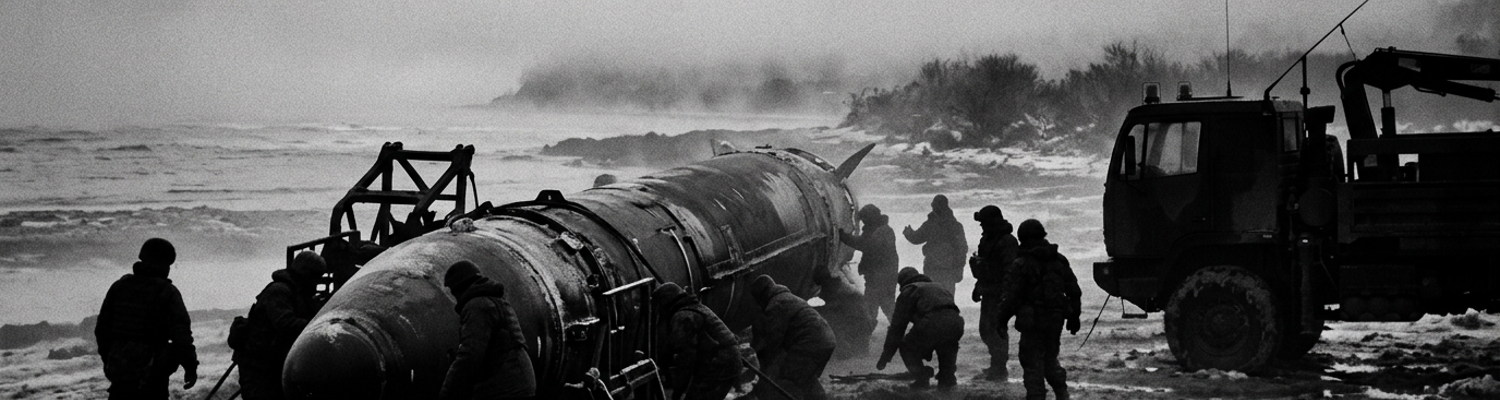
Archival evidence shows that during a routine perimeter sweep at 0730 local time on October 14, 1985, a security patrol from the 5073rd Air Base Group spotted an unrecorded cylindrical object resting along the northern coastline of Shemya Island. Satellite positioning placed the casing at coordinates 52 degrees 43 minutes North, 174 degrees 06 minutes East. It was wedged between jagged basalt outcroppings inside the intertidal zone. High winds had driven the forty-foot projectile past the offshore reef during maximum high tide. The intact airframe rested in saturated muskeg and freezing silt.
Operational logs (File Designation 44-B) indicate that the weapon originated as an anti-ship cruise missile test vehicle. The Soviet Pacific Fleet launched it during a live-fire exercise along the Kamchatka shelf, roughly four hundred miles west. A mechanical failure in the secondary control surface actuators caused the vehicle to veer off its pre-programmed tracking corridor. It flew eastward until its solid-propellant booster spent itself and the sustained kerosene fuel flow starved the turbojet. Impact occurred at a shallow angle across the intertidal mudflats. This spared the weapon from structural disintegration.
The casing matched the dimensions of a P-500 Bazalt or a derivative test platform.
The titanium alloy skin showed severe thermal scoring from the booster phase. Freezing ocean water filled the lower avionics bay twice every twenty-four hours. Initial field assessments by ground teams confirmed that the weapon presented an immediate explosive hazard. Over nine hundred pounds of high-explosive compound sat packed inside the warhead compartment. Dual-channel inertial fuzing systems had armed upon launch.
Decaying peat moss and thick muskeg surrounded the main fuselage. This acted as a soft cushion that had prevented structural breakup while simultaneously grounding the casing against the permafrost shelf. Liquid hypergolic fuel components inside the auxiliary pressure systems hissed beneath the salt crust. Toxic vapors leaked across the flats. Officers at the 5073rd Air Base Group cordoned off a two-mile perimeter. They halted all non-essential diesel vehicle movement along the perimeter patrol road to prevent ground vibrations from disturbing the sensitive electromechanical fuzes.
Nobody stepped within fifty yards without grounding rods strapped to their boots.
When examining the historical record, technical inspections carried out by forward-deployed Navy Explosive Ordnance Disposal personnel revealed an unprecedented intelligence prize. Technicians from EOD Mobile Unit One chipped away frozen sediment to inspect the nose cone and instrumentation sections. Initial reconnaissance confirmed the munition retained intact, classified guidance electronics and telemetry packages. The radome had survived the ditching without structural fractures. This preserved an active radar homing seeker, internal pulse-doppler receiver assemblies, and solid-state silicon circuits that Western intelligence agencies had never captured intact.
Internal wire bundles connected directly to telemetry transmitters behind the warhead compartment. These housed undamaged magnetic recording reels that held the complete digital flight-profile logs and diagnostic sensor data broadcast before descent.
The Soviet Navy had no idea their weapon sat unbroken on American soil.
Operational cables routed through the Defense Intelligence Agency confirmed the strategic value of the telemetry payload within three hours of visual inspection. Dedicated multichannel transmitters inside the avionics bay operated on proprietary pulse-code modulation bands. This offered the United States Air Force Foreign Technology Division at Wright-Patterson Air Force Base direct access to Soviet naval datalink architecture. Cryptographic microchips inside the guidance interface stayed sealed against the corrosive salt air.
Hostile maritime patrol flights tracked along the Kamchatka corridor. Soviet Pacific Fleet units possessed the capability to execute an offshore strike to destroy the classified hardware if the loss became known. Standard disposal protocols called for immediate in-place detonation. Commanders ordered Navy EOD teams to bypass explosive demolition and extract the weapon intact.
Tactical Deployment of Navy EOD Mobile Unit 1
A close review of operational logs indicates that Commander, Third Fleet bypassed standard response chains at 0945 to activate an expeditionary disposal detachment. Specialists from US Navy Explosive Ordnance Disposal Mobile Unit 1 deployed directly to the isolated Aleutian outpost from Naval Air Station Adak aboard an Air Force HC-130 Hercules transport aircraft. Pilots fought fifty-knot crosswinds to set the heavy transport down on Shemya fog-covered 10,000-foot asphalt runway. Five Navy technicians disembarked with field-diagnostic equipment.
Detachment personnel hauled heavy Pelican cases loaded with non-sparking beryllium-copper wrenches, MK-23 remote pull rigs, and portable pulsed X-ray generators down the western perimeter access track. Pacific Fleet task orders mandated recovery rather than tactical destruction. Direct telephone links between the Commander-in-Chief of the Pacific Fleet and the White House Situation Room placed the tactical unit under immediate national oversight.
Flight crews refueled the aircraft on the ramp. Turbine engines idled in the event of an emergency evacuation order.
Ground zero was an exposed gravel ledge submerged in surf.
Archival evidence shows that early recovery attempts required establishing a secure forward staging area directly above the high-water line. Chief Petty Officer lead technicians selected a basalt shelf sixty yards south of the missile casing to assemble diagnostic monitors and pneumatic lift equipment. Standard operating procedure required running two-hundred-foot remote firing leads back to a sandbagged revetment. The perimeter bluffs offered zero natural protection against fragment dispersion. Air Force support personnel from the 5073rd Air Base Group assisted the Navy team by laying electrical grounding wire across the muskeg. This neutralized stray voltage from the AN/FPS-108 radar transmitters pulsing nearby.
Every technician wore antistatic neoprene outer layers over heavy wool undergarments. They moved across the basalt shelf on foot to prevent engine exhaust from igniting aerosolized fuel.
Saltwater froze against steel the instant each wave receded.
When examining the historical record, technicians operated under sub-freezing temperatures and severe tidal shifts that risked washing the weapon out to sea. Bering Sea wind chill drove ambient conditions down to minus twenty-five degrees Fahrenheit. Sea spray solidified into thick rime ice across the missile alloy skin. Hydraulic valve ports on the airframe froze shut within minutes of exposure. Divers could not secure mechanical bypass valves on the liquid propellant conduits. Working hands lost fine motor dexterity after eight minutes of contact with the chilled titanium hull. Technicians rotated inside a heated military van stationed three hundred yards up the cliff road.
Ice wedged between the access panel fasteners resisted pneumatic impact tools. The EOD detachment applied controlled chemical de-icing alcohol by hand to access the internal safing pins without striking the explosive warhead.
Oceanic data recorded at the Shemya harbor station logged twelve-foot tidal variations crashing against the northern coastline twice every twenty-four hours. Incoming swells pushed walling water across the intertidal mudflat. This generated buoyant lift beneath the empty fuel tanks of the Soviet projectile. Each surge threatened to dislodge the four-ton weapon from the mudbank and sweep it into a four-hundred-fathom deep-water trench just eighty yards offshore.
Working in chest-deep surf, detachment divers hammered four steel earth anchors into the frozen permafrost shelf behind the missile. Riggers looped high-tensile braided steel winch cables through the missile dorsal transport lugs. They connected the lines to the front winch drum of an M923 five-ton tactical truck (serial number 44-12998) parked along the perimeter road. The truck idled in neutral. Its transmission engaged the front winch drum. Tension gauges on the mechanical winches spiked past eight thousand pounds as the team locked the casing against the bedrock.
National Security Council Directives and Command Oversight
Archival evidence shows that standard naval protocol dictated immediate explosive countercharging for any armed, chemically unstable ordnance resting within base boundaries. Explosive Ordnance Disposal Mobile Unit 1 had already staged forty-pound crates of M112 composition C-4 demolition blocks on the Shemya beachhead. They calculated the necessary blast radius to vaporize the nine-hundred-pound high-explosive warhead.
Washington terminated those preparations before a single blasting cap left its case.
Flash-priority teletype orders dispatched through the National Military Command Center forced an immediate cease to all standard blow-in-place procedures. Inside the White House Situation Room, Deputy National Security Advisor John Poindexter and specialized foreign-materiel staff recognized a specific opportunity. Destroying the cruise missile would erase an intelligence windfall. Smashing the projectile with demolition charges meant incinerating the intact active radar seeker, the pulse-code modulation telemetry reels, and the guidance sub-assemblies. Operational directives signed at the executive level instructed the field team to disarm the live weapon manually.
Detonation was forbidden.
When examining the historical record, this political restriction forced technicians to operate in direct opposition to standard safety handbooks. Navy EOD doctrine under NAVSEA OP-3565 (Revision 4) classified any dented, unexploded cruise missile containing pressurized liquid propellants and armed dual-channel inertial fuzes as an emergency blast hazard. Field teams had orders to neutralize ordnance by remote detonation whenever the risk of uncommanded fuze closure exceeded acceptable thresholds.
National Security Council officials transferred all mechanical risk directly to the five technicians wading through the intertidal mudflats. Removing the secondary nose fuzing required technicians to manually cut through frozen fairings with hand-cranked bronze-alloy saws. They operated within inches of nine hundred pounds of cracked explosive matrix. A single errant slip or unexpected electrical arc would level the western shoreline.
Every tactical movement on the beach required clearance from Washington.
A close review of operational logs indicates that advisers maintained real-time tactical command through a dedicated AN/PSC-3 ultra-high-frequency satellite terminal perched on a basalt ridge behind the surf. Communications specialists ran heavy-duty shielded coaxial cabling from the mudflat to an encrypted satellite transceiver aimed at a Defense Satellite Communications System transponder positioned in geosynchronous orbit over the mid-Pacific. Tactical advisers inside the National Security Council and naval intelligence liaisons listened to the breath of the team leader through narrow-band voice circuits.
Every mechanical step required verbal authorization from staff officers eight time zones away. This included extracting the nose-mounted safing pin and disconnecting the internal wiring harnesses of the hypergolic fuel pressurization lines. Disconnecting the seeker assembly involved reading telemetry serial numbers over the encrypted satellite link to civilian analysts at Wright-Patterson Air Force Base. These analysts checked blueprinted Soviet schematics before granting permission to loosen the next chassis bolt.
Radio silence across all standard military frequencies held absolute.
Archival evidence shows that this strict reliance on point-to-point satellite communications fulfilled an explicit strategic function. It evaded detection by Soviet electronic intelligence stations ringing the Kamchatka shelf. Soviet radar installations at Cape Lopatka and long-range listening posts on the Commander Islands kept continuous electronic watch over Shemya frequency bands. Two hundred miles offshore, a Soviet Primorye-class intelligence collection ship monitored electromagnetic radiation across the Bering Sea.
Broadcasting standard high-frequency tactical radio traffic from the beach would have instantly signaled an emergency operation to Soviet cryptanalysts. It would reveal that their lost weapon had survived its crash. Pacific Command enforced strict emission control protocol EMCON Alpha. They deactivated non-essential base transmitters and forbade local radio contact between the EOD detachment and the 5073rd Air Base Group. Pointed directly skyward, the narrow UHF satellite beam bled zero side-lobe energy horizontally toward Soviet signal interceptors. This allowed advisers to direct the recovery without registering a single decibel on Kamchatka radar arrays.
Technical Intelligence Recovery and Geopolitical Ramifications
A close review of operational logs indicates that at 1415 local time, Navy EOD Mobile Unit 1 specialists severed the secondary electrical firing conduits running between the forward impact fuze and the high-explosive matrix. Technicians deployed non-magnetic bronze chill bars across the wiring harness to bleed off residual capacitance before unthreading the mechanical base fuze assembly from the nine-hundred-pound warhead.
Freezing seawater continued to breach the lower access port. This required continuous hand-pumping of warm isopropyl alcohol to prevent ice from jamming the internal safing collars. Once technicians isolated the booster igniters, the team separated the radome and avionics section from the main fuselage using hand-cranked shear cutters. Ground crews hoisted the four-hundred-pound seeker bay into a foam-lined shipping crate. They secured the complete Soviet active radar homing seeker and pulse-code modulation datalink hardware for immediate transfer to an awaiting C-141 Starlifter.
The warhead did not detonate.
Archival evidence shows that this successful extraction delivered the hardware directly to engineers at the Air Force Foreign Technology Division at Wright-Patterson Air Force Base. Diagnostic teams worked alongside cryptanalysts from the Naval Technical Intelligence Center. They disassembled the Soviet guidance system down to its individual gallium-arsenide circuit boards and planar array antennas. By analyzing the physical wiring of the monopulse radar seeker, technical specialists identified the exact frequency-hopping intervals (spanning the X-band and Ku-band spectrums) and counter-countermeasure logic gates. The Soviet Pacific Fleet utilized these specific electronic pathways to evade Western shipboard electronic jamming.
Laboratory personnel in Ohio copied the magnetic core memory containing hardcoded flight algorithms. This exposed pre-programmed terminal sea-skimming trajectories and terminal evasive weave profiles. These discoveries allowed naval engineers to redesign signal processing algorithms for the AN/SLQ-32 electronic warfare suite deployed across American aircraft carrier battle groups. They neutralized a primary Soviet naval strike threat without firing a shot.
No diplomatic protests crossed the wire from Moscow.
When examining the historical record, this bloodless tactical recovery prevented a direct confrontation along the disputed international boundary line running through the Bering Sea. Soviet naval reconnaissance flights out of Petropavlovsk-Kamchatsky tracked the missile ballistic path to the edge of American airspace. They lacked confirmation that the airframe survived water entry intact. Had the EOD detachment executed an in-place explosive demolition, the low-frequency acoustic signature would have alerted Soviet hydrophone networks and signals intelligence trawlers stationed along the Aleutian shelf. This would have forced the Soviet foreign ministry to demand return of state property or initiate aggressive naval salvage patrols inside American territorial waters.
Absolute radio silence and surgical recovery kept the incident completely off diplomatic dockets.
The quiet success directly validated the forward-leaning concepts championed in the Reagan administration 1986 Maritime Strategy. This doctrine emphasized offensive power projection into northern Pacific waters and the contested peripheries of Soviet submarine bastions. Navy Secretary John Lehman used the intelligence yield to demonstrate that forward-deployed forces in the Aleutians could absorb Soviet tactical oversights and exploit them directly beneath the sensor umbrella of the Soviet Far East High Command.
The tactical risk taken by five technicians in the freezing mud of Shemya Island shifted the electronic balance of power in the Pacific theater. The Soviet Pacific Fleet continued to operate under the assumption that their guidance systems remained secure. Pacific Command distributed the updated electronic threat libraries to Seventh Fleet surface combatants on November 12, 1985.