
The Forward Edge of Care
The Pacific War's immense distances and brutal island campaigns demanded a radical overhaul of American battlefield medicine. The strategy of island-hopping, from the malarial jungles of the Solomons to the volcanic shores of Japan itself, presented logistical and medical challenges on a scale never before confronted. Central to this necessary evolution was the U.S. Navy's Hospital Corps. While the interwar years saw the steady formalization of training for Pharmacist's Mates at schools in San Diego and Great Lakes, the outbreak of war forced a massive, accelerated expansion. These corpsmen, often young men with minimal prior medical experience, were rushed through intensive training programs covering anatomy, sterile technique, field sanitation, and the administration of new life-saving technologies like blood plasma and sulfa drugs before their assignment to ships, naval hospitals, or, most critically, the U.S. Marine Corps.
This direct integration of Navy medical personnel with Marine ground units became a defining feature of the Pacific conflict. Starting in World War II, corpsmen assigned to the Fleet Marine Force (FMF) first endured Marine Corps boot camp, embedding them within the very fabric of the rifle companies they would support. They learned to fight, to protect themselves, and to protect their patients, a grim necessity in a theater where the enemy often disregarded the Red Cross emblem. This shared crucible of training forged a unique and powerful bond. The corpsman was no longer an outsider but a brother in arms, a 'Doc' who shared the same C-rations, foxholes, and mortal risks. On the black sands of Iwo Jima and in the muddy, corpse-strewn ravines of Okinawa, these Navy corpsmen advanced with the first assault waves. They carried not just rifles but medical kits packed with morphine syrettes, battle dressings, and tourniquets, their primary mission being immediate, forward-line care. They worked to disinfect wounds, stabilize fractures, and administer plasma, often under direct fire, to prepare a casualty for the long, perilous journey rearward.
Sanctuaries of Steel and White Paint
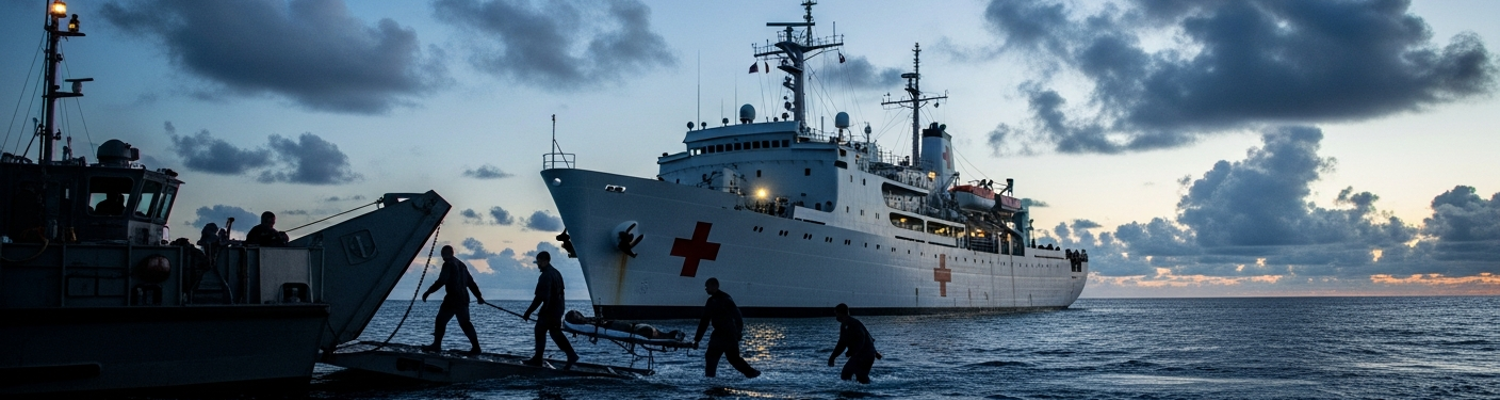
If the corpsman was the first link in the lifeline, the hospital ship was its heart. These vessels were not mere transports but fully equipped, floating surgical facilities. The practice of converting civilian liners into hospital ships, refined during the interwar period, accelerated dramatically after 1941. The SS Iroquois, a Clyde Mallory Steamship Line passenger liner, became the USS Solace (AH-5). Commissioned just months before the attack on Pearl Harbor, she was anchored off Ford Island on December 7, 1941. Her crew witnessed the catastrophic explosion of the USS Arizona, and her motor launches were among the first to pull wounded and burned sailors from the oily, burning water. The Solace's baptism by fire marked the first time a U.S. Navy hospital ship operated in the midst of a combat zone, treating 141 casualties that day under the most dire emergency conditions.
The USS Solace, with a capacity for over 400 patients and a complement of nearly 466 personnel, followed the fleet across the Pacific. She evacuated casualties from Tarawa, Saipan, Guam, Peleliu, Iwo Jima, and Okinawa, sometimes anchoring within 2,000 yards of the beach as fighting raged. Later in the war, purpose-built vessels like the Haven-class ships entered service. These were not conversions but were designed from the keel up as hospitals, boasting air conditioning in operating rooms and wards, a significant advancement. A ship like the USS Haven (AH-12) featured three surgical operating rooms, a fracture operating room, X-ray facilities, a laboratory, a pharmacy, and dental offices. It could hold nearly 800 patients and was staffed by a combined Navy and Army medical team. These ships operated under the Hague and Geneva Conventions, painted stark white with massive red crosses, a status that offered protection but not guaranteed immunity. The USS Comfort (AH-6), another key vessel, learned this lesson tragically. While evacuating wounded from Okinawa on April 28, 1945, a Japanese kamikaze aircraft smashed through three decks, exploding in a surgical suite. The attack killed 28 people, including six Army nurses and seven patients, and wounded 48 more. It was a brutal demonstration of the risks these floating hospitals faced.
Forging the Chain of Survival
The journey of a wounded Marine or soldier from the battlefield to recovery was a meticulously planned, if brutally tested, logistical chain. It began with the corpsman's initial treatment in the chaos of combat. From there, casualties were moved, often by stretcher bearers crawling under fire, to a battalion aid station established just behind the front lines. These were rudimentary affairs, focused on triage, stemming blood loss, and preparing the wounded for the next step. The system was severely tested during the Battle of Okinawa. The 82-day campaign produced immense casualties, overwhelming medical facilities at every level. From the beachhead aid stations, the wounded were funneled to larger casualty clearing stations and then to field hospitals established as the invasion force clawed its way inland. Evacuation off the island itself was a joint Army-Navy effort, coordinated but enormously complex. When torrential rains turned roads into impassable rivers of mud, a critical innovation took over: the Landing Ship, Tank (Hospital), or LST(H). These amphibious craft were modified with extra ventilation and 60 bunks, and augmented with surgical teams from the fleet to provide care before a patient even reached a dedicated hospital ship. They ferried thousands of wounded from the shore to the white ships waiting offshore. From vessels like the Solace and Comfort, patients were then transported to large rear-area naval hospitals on islands like Guam or sent on the long voyage back to the United States. During the Okinawa campaign, this chain, combining sea and air assets from the Naval Air Transport Service, evacuated over 33,000 American casualties.
A Necessary, Strained Alliance
The medical lifeline in the Pacific was a product of inter-service cooperation born of absolute necessity, but it was not without significant friction. The very structure of the system, with Navy medical assets supporting Army and Marine Corps ground forces, created inherent command and control challenges. The USS Comfort and her sister ships, for instance, were crewed by the Navy but medically staffed by the Army, a hybrid arrangement that reflected the joint nature of the operations but could lead to conflicts in procedure and authority. On Okinawa, the Tenth Army, composed of both Army and Marine corps, had to integrate its disparate medical planning. The final plan saw Navy hospitals assigned to support the Marine III Amphibious Corps and Army hospitals supporting the Army’s XXIV Corps, a division of labor that required constant coordination.
Competition for resources was a constant reality. Planners for the Okinawa invasion estimated a need for 8,000 hospital beds but had only 4,500 available when the operation began. This scarcity placed immense pressure on the entire evacuation chain, forcing difficult triage decisions and prioritizing the rapid rearward movement of casualties over extended local treatment. Despite these strains, the system functioned. Medical supplies were often interchanged among the Army, Navy, and Marines on the ground. The shared, urgent goal of saving lives overrode many of the bureaucratic and command rivalries. The success of this forced cooperation provided a blueprint for future joint medical operations. The hard-won lessons in battlefield triage, multi-modal evacuation, and inter-service logistical support from the bloody campaigns of the Pacific would fundamentally shape American military medical doctrine for decades to come.