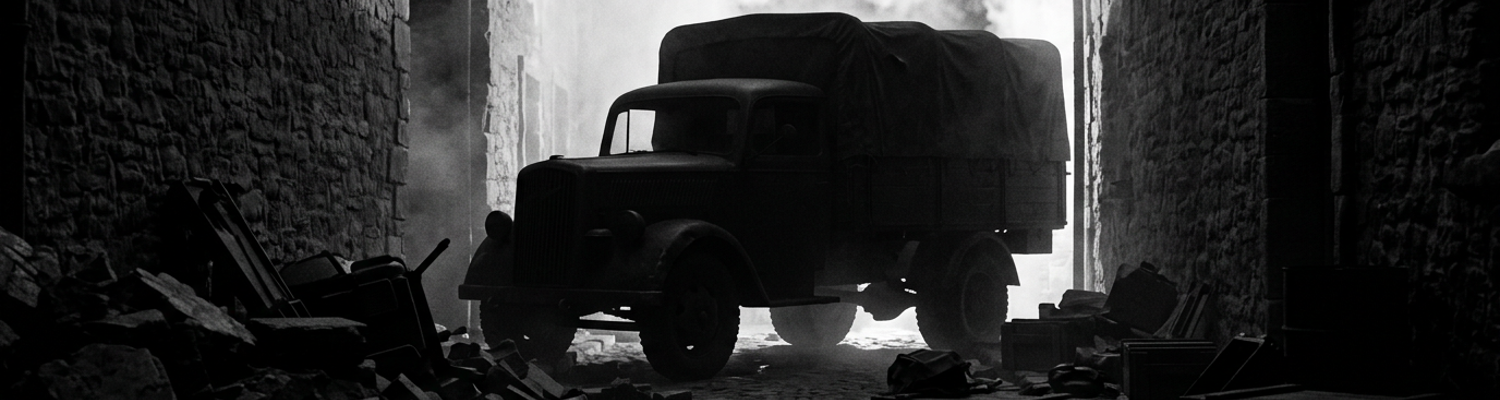

Allied Advance and Arno River Demolitions
Infantrymen of the British Eighth Army dragged their weapons through forty-mile forced marches under blinding ninety-degree heat. They fired zero shots at the river line. Dust from the Tuscan switchbacks caked the lips and nostrils of the 6th South African Armoured Division. Water rations shrank to less than a pint per man per day. Rations spoiled in the metal lockers of Bedford transport lorries. Entire platoons subsisted on hard biscuits and rancid corned beef. Hundreds of frontline soldiers fell out of column from severe dysentery. They collapsed onto scorched vineyard shoulders while their boots split along worn seams. Forty-eight continuous hours without sleep left rifle companies reeling along Route 2. They hallucinated as they dragged heavy three-inch mortars through dry ravines. Men walked unconscious for seconds at a time. Canvas webbing rubbed their shoulders raw down to muscle tissue.
The forward riflemen hit the southern bank of the Arno running on empty bellies and dry canteens.
Archival evidence shows that Eighth Army commanders sat in a deep communications void twenty miles south at Greve in Chianti. They studied outdated topographical sheets while the riverfront systematically exploded. Between late evening on August 3 and dawn on August 4, 1944, German demolition squads of the 4th Parachute Division detonated electrical blasting circuits across five historical bridges over the Arno. This stopped Allied progress cold. Pioneer Battalion 4 packed tens of thousands of pounds of heavy industrial explosives, aircraft bombs, and naval depth charges into the pier chambers of the Ponte Santa Trinita, the Ponte alla Carraia, the Ponte San Niccolo, and the Ponte alle Grazie. Reinforced arch spans dating back to the sixteenth century shattered instantly. Centuries of masonry dropped into the dried summer riverbed. Field Marshal Albert Kesselring issued explicit orders forbidding the demolition of the Ponte Vecchio. His operational assessment determined its narrow medieval footprint could be converted into a lethal kill zone. Radio detachments at Allied headquarters did not log the collapse of the river crossings until nine hours after the detonations occurred. They issued useless operational orders for motorized sweeps across structures that lay in fragments beneath black smoke.
Radio silence enveloped the north bank. Signal wire lay shredded beneath hundreds of tons of stone.
A close review of operational logs indicates that German combat engineers compensated for leaving the Ponte Vecchio intact by executing controlled building demolitions. These completely sealed off access corridors into northern Florence. Sapper units packed explosive charges into the basements of fourteenth-century stone palazzi, medieval towers, and tenement blocks fronting Via Guicciardini and Borgo San Jacopo on the southern bank. They rigged Via Por Santa Maria on the northern exit. Detonations dropped thousands of tons of stone masonry outward into the narrow alleys. Rubble fields rose four stories tall across every approach street. The resulting debris mounds blocked tracked vehicles entirely. M4 Sherman tanks stranded themselves. Their planetary steering differentials burned out under the strain of climbing jagged masonry inclines. Tracks slipped and snapped on fragmented flagstones. Recovery vehicles could not deploy winches through the narrow defiles. Pioneer bulldozers broke hydraulic seals trying to scrape through fifteen-foot berms of compacted ash, mortar, and timber. German machine-gun teams inside upper-floor masonry pockets held unbroken fields of fire across the tangled stone piles. Allied sappers failed to lay cleared footpaths into the northern sector.
OSS Mediterranean Section Exploitation Mandate
Archival evidence shows that Allied Force Headquarters operated out of the royal palace at Caserta. They sat over two hundred miles south of the fighting. They were completely cut off from the physical chaos along the Arno riverfront. Staff officers plotted forward movements on clean acetate map overlays. They treated the northern half of Florence as an open administrative sector ready for immediate technical seizure. Intelligence directors assumed German rear-guard forces would abandon municipal infrastructure intact during their retreat toward the Gothic Line. Orders went out directly to the Office of Strategic Services Mediterranean Section. They mandated an immediate technical dash into the city core before local records could be destroyed.
The staff planners mapped routes across bridges that had already ceased to exist.
When examining the historical record of the deployment, the OSS Mediterranean Section assembled a specialized motorized column at an advanced staging depot outside Siena on August 4, 1944. Mechanics prepared six Dodge three-quarter-ton WC-51 weapons carriers and two GMC two-and-a-half-ton trucks. These carried experimental technical equipment developed by the OSS Research and Development branch. Specialists bolted commercial Recordak thirty-five-millimeter microfilming cameras to reinforced shock-cradles in the truck beds. They loaded portable chemical emulsion tanks, darkroom developing trays, and gasoline-driven Onan two-kilowatt electrical generators. Riding in the open transports were Research and Analysis economists, metallurgical engineers, and German-language document analysts. Their assignment required them to locate and translate technical files directly at the point of capture. Ground-level mechanics struggled instantly with the physical hardware. Volcanic dust along the unpaved approach roads penetrated unsealed air filters. This choked carburetor jets. Drivers had to strip fuel pumps on roadside shoulders under ninety-five-degree heat. Uneven mechanical vibration sheared the mounting brackets on the experimental microfilm cameras. Fluctuating generator voltages repeatedly blew internal vacuum tubes inside portable fluoroscope testing units.
Every breakdown cost fuel, daylight, and unrecoverable hours.
A close review of operational logs indicates that the mission operated under an inflexible forty-eight-hour execution window handed down by theater command (Directive 44-A9). Field analysts faced strict instructions to secure target facilities within two days of forward Allied elements reaching the city perimeter. Headquarters targeted the Officine Galileo production facilities on the northern outskirts for their optical tooling machinery and precision fire-control drawings. They also targeted the Magneti Marelli electrical plant and the technical archives of the Campo di Marte rail maintenance center. Intelligence officers feared that delay would allow German military engineers to apply thermite incendiary charges to corporate balance sheets, secret tooling patents, and production ledgers documenting industrial supply chains. Advancing Allied infantry represented an equal threat to paper records. Riflemen routinely ransacked corporate filing cabinets to light heating fires in ruined basements. They tossed technical blueprints into wet gutters. The forty-eight-hour deadline permitted zero operational margin for river obstacles or sapper delays. Caserta calculated vehicle transit purely on peacetime highway distances. They ignored blown bridges and zeroed-in sniper lanes.
Field dispatch logs show the technical convoy ground to a complete halt five miles south of the river before a single camera could be unloaded.
Allied Force Headquarters Command from Caserta
Archival evidence shows that Allied Force Headquarters directed Mediterranean theater logistics from the Reggia di Caserta. This eighteenth-century Bourbon palace sat two hundred and sixty miles south of the active Florence frontline. General Sir Henry Maitland Wilson and his joint British-American staff occupied portions of a complex spanning two million square feet and containing twelve hundred rooms. High-ranking planners mapped theater fuel distributions, rail reconstruction schedules, and heavy artillery allocations inside marble chambers designed for Neapolitan royalty. They were insulated from the summer dust and muzzle blasts of the Tuscan riverfront. Signals personnel ran thousands of yards of field telephone wire across ornate frescoed ceilings. This connected the headquarters to the deep-water port operations at Naples and rear supply depots in Salerno. Theater logistics officers processed supply manifests for two entire field armies from desks positioned near ornamental gardens and stone fountains. Supply priority lists favored Operation Dragoon. The pending amphibious invasion of southern France stripped combat divisions in Italy of their frontline trucks, bridging trains, and replacement radios. Ground commanders along the Arno competed for standard supply requisitions against staff departments managing the entire Mediterranean basin.
Teleprinters clattered against vaulted limestone walls while forward infantry units dug into rubble with bare hands.
A close review of operational logs indicates that staff officers in Caserta made daily tactical decisions through fragmented, unreliable communications links. Radio detachments relied on high-frequency signals transmitted through SCR-299 mobile transmitter trucks and fixed base stations. The jagged ridgelines of the Apennine Mountains repeatedly deflected radio waves. This produced severe atmospheric signal fading. Landline telegraph cables running up Route 6 and Route 7 suffered routine physical disruptions. Italian partisan activity, vehicular traffic accidents, and German delayed-action demolition charges left inside subterranean culverts severed the lines. Messages passing between Caserta and forward tactical headquarters at Greve in Chianti or Siena required manual relay through overburdened signal switchboards in Rome. Encrypted signals routinely sat queued in Caserta communications centers for twelve to fourteen hours. They awaited decryption by Typex and SIGABA cipher machine operators. Forward units had already executed tactical withdrawals or suffered heavy casualties by the time written acknowledgments or supply allocations returned down the wire.
Theater command functioned on a twenty-four-hour operational delay.
When examining the historical record of staff planning during early August 1944, AFHQ operations officers retained an incomplete understanding of tactical street conditions inside Florence. Planners treated the Tuscan capital on administrative situation maps as an evacuated transit corridor. They drafted routing instructions for supply convoys and technical field units based on pre-war Italian road atlases. Caserta staff officers did not recognize that the German 4th Parachute Division had transformed the street network into interlocking fields of fire. High-explosive charges had dropped five-story palazzi directly into Via Guicciardini and Borgo San Jacopo. This created forty-foot debris berms that completely prevented vehicle movement. Machine-gun teams from Pioneer Battalion 4 held zeroed-in firing lanes over every open intersection south of the river. 20mm anti-aircraft autocannons fired flat-trajectory shells down open avenues. Operational directives drafted inside the royal palace ordered technical collection vehicles and fuel trucks to move through intersections already pinned down by snipers inside the Torre dei Ramaglianti. Staff officers assumed bridgeheads were open based on erroneous morning intelligence summaries. They directed heavy transport columns into dead-end alleys blocked by jagged masonry.
Headquarters dispatchers closed their daily delivery registers at Caserta having routed ten-ton truck sections toward municipal river quays that were covered by German mortar batteries.
Bureaucratic Friction and Property Tracking Mandates
Archival evidence shows that supply administrators at Caserta prioritized strict cargo manifests and signed property accountability receipts over incoming tactical emergency signals from the Arno front. Bureaucrats inside the Mediterranean theater procurement office enforced War Department Standard Form 1058 and Form 44 property accounting procedures with administrative rigidity. They refused to release spare mechanical components without signed receipts returned in quadruplicate. The OSS Mediterranean Section advanced motorized team reached the southern staging hamlet of Galluzzo along Route 2. The column commander requested immediate priority delivery of replacement leaf springs, heavy-duty inner tubes, and water pump gaskets. Base section logistics clerks in Caserta halted the processing of the convoy work orders. Supply officers demanded that field personnel first log, balance, and serialize every individual piece of equipment onboard the vehicles. This included specialized Recordak thirty-five-millimeter camera bodies and five-gallon Jerry cans. Field inventory officers logged forty-two distinct line items for each Dodge WC-51 weapons carrier. They documented chassis numbers, generator spark coils, and portable chemical development kits before fuel requisition chits could be rubber-stamped. Theater signals channels designated cargo manifest confirmations as mandatory administrative traffic. They assigned these transmission bundles equal priority handling to urgent forward intelligence alerts.
Paperwork superseded survival.
A close review of operational logs indicates that bureaucratic administrative transmissions jammed low-bandwidth tactical radio networks precisely as forward field teams ran into crippling mobility failures. The OSS technical section operated low-power SCR-284 and SCR-694 field transmitter sets. These relied on continuous-wave telegraphy across crowded frequency bands between 3.8 and 6.5 megacycles. Radio operators faced transmission limits of roughly twenty words per minute under daytime atmospheric static caused by the Apennine ridgelines. Caserta base stations choked these narrow signal channels for hours with encrypted administrative manifests. They demanded serial number verifications for replacement half-shafts, carbon paper reams, and Onan generator spare armatures. Forward operators attempting to transmit flash-priority reports regarding German 88mm anti-tank guns dug into the Boboli Gardens found the airwaves completely clogged. Dodge trucks belonging to the technical detachment sat immobilised in the mud off Via Senese. Their rear axle half-shafts snapped by weight overloads from six-hundred-pound Recordak film cabinets and lead battery boxes. Drivers could not call forward pioneer recovery tractors. Rear-echelon quartermasters were transmitting three-page inventory reconciliations concerning missing toolkits.
Wrecked axles cooled in Tuscan ditch water while cipher operators encoded supply ledger corrections.
When examining the historical record of the 2677th Regiment OSS communications log from August 5, 1944, field technicians outside the Porta Romana gate were actively taking sporadic mortar fire while wrestling with property regulations. Two three-quarter-ton trucks suffered shattered radiator cores when mortar fragments sprayed the gravel roadway near the Certosa di Firenze monastery. Drivers prepared to strip salvageable components from one machine to repair the other. This emergency maintenance measure was known as field cannibalization. Theater administrative directives strictly prohibited the unauthorized stripping of vehicle assemblies without prior inspection by an Ordnance Department mobile survey board. Officers who abandoned government equipment without a signed Report of Survey faced personal financial liability and administrative demotion. The convoy leader spent five hours drafting handwritten justification statements on field desks instead of supervising the towing of deadlined trucks under darkness. Signal units attached to the British Eighth Army attempted to coordinate sapper clearance for a secondary trail west of the blown river crossings. Their radio frequencies overlapped with the AFHQ supply network. Caserta dispatchers continued to broadcast encoded property updates across those very channels. They insisted on written confirmation of sixteen cases of darkroom fixing salt shipped three weeks earlier to a depot in Salerno.
The convoy stayed pinned to the roadside while property clerks closed their morning files in the palace.
Urban Congestion and Civilian Crisis in the Oltrarno
Archival evidence shows that when the OSS detachment crossed the threshold of the Porta Romana on the morning of August 5, 1944, their planned route collapsed under tons of fractured stone. Sapper units of the German 4th Parachute Division had detonated demolition charges at the bases of fourteenth-century masonry towers and fortified residences flanking the northern stretch of Via Romana. Heavy limestone blocks, shattered roof tiles, and charred chestnut support beams spilled into the street. This created impassable debris cones twelve feet high near the church of San Felice. The lead GMC two-and-a-half-ton transport truck could not climb over the jagged masonry without ripping its oil pan open on exposed iron rebar. Field commanders ordered the eight-vehicle column off the paved arterial and into the parallel maze of secondary residential alleys. They attempted to bypass the blockage via Via de Serragli and Via delle Caldaie. These medieval corridors narrowed to widths of barely eight and a half feet between projecting stone balconies. They were designed for handcarts and pack mules.
Hubcaps scraped centuries-old stucco off building facades with every clutch release.
A close review of operational logs indicates that the mechanical limitations of Allied wheeled transport triggered immediate breakdowns within the narrow alleys. Long-wheelbase GMC trucks lacked the turning radius to navigate the sharp ninety-degree corners connecting Via delle Caldaie to Via del Campuccio. Drivers attempting three-point turns repeatedly slammed their rear pintle hooks into ancient stone doorframes. This bent transfer cases and cracked cast-iron differential housings against stone curbs. Two Dodge WC-51 weapons carriers sheared their steering knuckle pins when their front wheels dropped into open drainage channels hidden beneath dust heaps. Radiator cores on both Dodge trucks boiled within twenty minutes of low-gear crawling. They vented glycol steam into vehicle cabs in the afternoon heat. Convoy mechanics had to abandon broken mechanical jacks on the street cobbles because the truck chassis sat pinned against adjacent palazzo walls. Recovery crews were unable to access the flat tire wells.
Every engine shutoff turned the suffocating stone corridors dead quiet.
When examining the historical record of the 2677th Regiment operations, the convoy ground to a complete halt among 400,000 starving and displaced Florentine civilians trapped in the Oltrarno district. German engineers had severed the municipal aqueduct conduits feeding the southern bank. The city flour mills in the Campo di Marte remained isolated across the mined riverbed. Civilians forced out of northern districts by German evacuation edicts had packed into the cellars of the Palazzo Pitti and surrounding tenements without food, medicine, or sanitation. As the American column stalled along Via de Serragli, thousands of skeletal residents surged around the cargo beds. People climbed directly onto the running boards with metal saucepans and glass bottles. They begged for water and scavenged for C-ration crates. Desperate civilians unscrewed the radiator drain petcocks on idling trucks to catch contaminated water. They scorched their hands on scalding engine fluid. Drivers could not shift forward into the dense human crush without crushing refugees pressed flat against vehicle hoods. This brought all tactical momentum to a dead stop four hundred yards south of the Arno.
The convoy sat paralyzed in the heat.
Allied Military Government civil affairs officers had not yet established ration points or emergency water distribution centers along the Boboli Gardens perimeter. OSS personnel were under explicit orders to preserve their thirty-five-millimeter Recordak film supplies and chemical developer stocks. Starving mothers offered family heirlooms for single cans of lard. Column officers radioed Eighth Army forward headquarters requesting an armored recovery vehicle and an armed military police escort to clear a path through the human blockage. They received no reply over static-choked tactical frequencies. Frontline field logs record that the convoy advanced less than seventy yards in seven hours. They remained trapped at the intersection of Via Maggio and Borgo San Jacopo under continuous observation from German mortar observers stationed atop the Bellosguardo ridge.
Sniper Ambush along the Via de Guicciardini Corridor
Archival evidence shows that at 1245 hours on August 5, 1944, the lead elements of the OSS 2677th Regiment column crawled north past the Piazza de Pitti. They moved directly into the three-hundred-yard stone defile of Via de Guicciardini. Heavy dust from the morning demolitions had settled under the midday sun. This created an eerie quiet along the deserted corridor where every shutter hung closed. Entrenched Italian fascist franchi tiratori belonging to the Republican Fascist Party and remnants of the Black Brigades had fortified the terracotta rooflines, chimney copings, and attic dormers of the four-story palazzi flanking the street. They were armed with 6.5mm Carcano Modello 91/38 rifles and Breda 30 light machine guns. These snipers held pre-sighted fields of fire over the narrow cobblestone roadway leading toward the blown approaches of the Ponte Vecchio. The lead Dodge WC-51 weapons carrier cleared the intersection near the church of Santa Felicita. Rooftop riflemen opened fire simultaneously from three masonry towers. They targeted drivers through open windshield frames.
Muzzle flashes cut through the dust.
A close review of operational logs indicates that the sudden volley pinned the open-topped vehicles inside a street measuring less than twenty-five feet across. Ground-level commanders could not identify the firing positions. High masonry parapets deflected the sound of rifle cracks down into the pavement. This made the shots echo from every angle at once. Lieutenant James Morrison of the field exploitation unit ordered his drivers to reverse. The column stood bumper-to-bumper with zero lateral clearance between overhanging stone lintels. Eighth Army tactical headquarters twenty miles south at Greve in Chianti had marked Via de Guicciardini as cleared by friendly partisan scouts ninety minutes prior. This left the convoy without armored car protection or dedicated infantry sweepers. Drivers scrambled over tailgates to seek cover behind stone stoops. Italian marksmen systematically put armor-piercing bullets through vehicle engine hoods. They severed copper ignition cables and cracked cast-iron cylinder heads.
Nobody answered on the tactical frequency.
When examining the historical record of the 2677th Regiment, sniper rounds punctured four auxiliary steel Jerry cans mounted to the passenger running boards of the second Dodge weapons carrier. This sparked catastrophic vehicle fires along the constrained corridor. Volatile 80-octane motor gasoline sprayed across the red-hot exhaust headers and electrical junction boxes. It ignited into an expanding fuel fire that trapped the third vehicle directly behind it. Flames engulfed the rear wooden cargo beds packed with specialized Research and Development assets. These included forty cases of thirty-five-millimeter cellulose nitrate microfilm, darkroom ethanol solutions, and dry chemical developing powders. Burning fuel ran down the street gutters. It ignited the vulcanized rubber tires of both transport trucks and detonated twelve boxes of .45 ACP ammunition stored inside the side lockers. Thick, toxic petroleum smoke filled the corridor from pavement to roof level. It choked the technicians attempting to pull portable Onan electrical generators and steel film-storage cases out of the burning truck beds.
Tires burst under the heat.
Archival evidence shows that the third truck in column attempted an emergency reverse extraction back toward Piazza San Felice. This was a GMC two-and-a-half-ton cargo hauler carrying heavy Recordak microfilming cameras and lead-acid battery banks. Driver Corporal Thomas Vane slammed the transfer case into low reverse. The rear differential housing bottomed out on a pile of fallen limestone masonry. This sheared the universal joint clean off the driveshaft. The disabled truck wedged sideways across the street. It locked the remaining vehicles inside the kill zone while sniper fire continued to chip limestone flakes into the vehicle beds from the roof of the Palazzo Guicciardini. Radio operators crouched beneath the smoking tailgate sent three emergency priority dispatches to Caserta requesting sapper extraction and smoke rounds. Rear-echelon signal logs show the transmissions sat unrouted in the switchboard queue at Rome. Staff clerks were busy verifying the serial numbers of the abandoned cargo.
Psychological Collapse and Tactical Extraction Failures
Civilian scholars trained for archival research suddenly faced point-blank automatic fire in an echoing stone alleyway.
When examining the historical record of the Office of Strategic Services Research and Analysis detachment, these analysts were civilian economists, Balkan linguists, and Mediterranean geographers. They were commissioned directly out of university lecture halls at Columbia and Harvard. Few had fired a service weapon outside basic orientation courses at Area B in Maryland. These men crouched behind the running boards of burning Dodge WC-51 trucks along Via de Guicciardini. They encountered concussive rifle fire rebounding between vertical stone palazzi at three-second intervals. High-velocity 6.5mm rounds pulverized limestone cornices overhead. This showered the open vehicle cabs with blinding pulverized mortar and stone splinters. Operational logs record that two industrial economists collapsed into catatonic stupors beneath the bench seats. They curled into fetal positions while pressing their hands over their ears to shut out the concussive cracks. Several analysts vomited uncontrollably onto the floorboards. They were incapacitated by acute sensory overload and hyperventilation as smoke from burning 80-octane gasoline filled the corridor. Field officers thrust standard-issue M1 carbines into their hands. Several academics proved physically incapable of releasing the trigger safety catches due to violent muscle spasms in their hands. They could not orient themselves on their acetate street maps. They read compass bearings backward as sniper fire stripped away their spatial awareness.
Panic tore through the column before any officer could establish a defensive perimeter.
A close review of operational logs indicates that the breakdown of communication gear destroyed any hope of an organized tactical withdrawal. Sniper fire had shattered the ceramic whip-antenna insulators on the primary SCR-284 radio set (Signal Corps stock number 2A284). Battery acid from a cracked lead-acid storage cell ruined the internal coils of the backup SCR-694 receiver. The detachment commander operated without radio links to Eighth Army artillery batteries or forward recovery squads. He faced complete tactical isolation inside the kill zone. Operatives received contradictory verbal orders shouted over the engine roar and ricocheting bullets. This triggered a disjointed scramble south toward the Piazza San Felice. Personnel abandoned specialized research hardware developed over eighteen months by the OSS Research and Development branch. Three heavy Recordak thirty-five-millimeter microfilming units sat bolted inside the bed of the disabled GMC truck. Each weighed over two hundred pounds. Field analysts left behind portable chemical emulsion tanks, darkroom processing trays, precision fluoroscopes, and hundreds of blank film rolls to burn on the cobblestones. Drivers tossed their vehicle toolkits into open street drains to lighten their run. Classified target dossiers detailing the internal layouts of the Officine Galileo plants lay scattered across the bloodied floorboards of the lead weapons carrier.
The retreat devolved into an unguided footrace through fire-swept alleys.
Archival evidence shows that surviving personnel fled along the western stone walls of the Boboli Gardens in small, disoriented groups of two and three. Men threw down their canvas field packs, steel helmets, and web belts to scramble over an eight-foot brick retaining wall near the Porta Romana. Snipers positioned on the upper parapets of the Torre dei Ramaglianti continued to track the fleeing operatives through crosshairs. They wounded three analysts in the shoulders and legs as they crossed exposed street openings. By 1530 hours on August 5, the scattered remnants of the technical convoy straggled into an advanced medical clearing station operated by the 6th South African Armoured Division at Galluzzo. Out of eight original vehicles, the technical unit had abandoned six trucks, forty cases of microfilming supplies, two Onan generators, and eighteen sensitive target maps along three hundred yards of ruined street.