
Quartermaster Corps training manuals promised an orderly retrograde of materiel. Field commanders were told to expect a methodical consolidation of assets, a careful inventory, and a disciplined shipment of equipment to rear-area depots or the mainland United States. The reality in the Pacific after August 15, 1945, was an avalanche of contradictory directives colliding with the largest logistical surplus in military history. On islands like Manus and Guam, transformed into colossal supply and repair bases, the declaration of peace created immediate paralysis. A depot on Okinawa holding thousands of aircraft engines might receive a directive from Pearl Harbor to prepare all stock for shipment to the Philippines. This would be superseded 24 hours later by an order from MacArthur’s headquarters in Tokyo to crate the same engines for long-term storage. The scale was incomprehensible. Seeadler Harbor at Manus held hundreds of warships and support vessels, thousands of vehicles, and mountains of supplies intended for an invasion of Japan that would never happen. The abrupt end of the war rendered this vast accumulation of military power instantly obsolete. It was a multi-billion dollar problem scattered across a thousand islands with no clear plan for its removal.
The orders were unworkable because the hands trained to execute them were being shipped home.
The rapid demobilization of experienced personnel gutted the very units tasked with managing this crisis. The US Army’s Adjusted Service Rating Score, the points system, was designed for equity. It awarded points for months in service, time overseas, combat decorations, and dependents. While a morale booster for combat troops, it was a logistical disaster. A master sergeant who had spent four years running a depot, or a chief petty officer who knew the intricacies of a floating drydock’s machinery, was often among the first to reach the 85 points required for repatriation. The system prioritized individual service records over unit-critical skills. Veteran divisions were hollowed out, losing their most experienced NCOs and specialist officers in weeks. This created a vacuum of knowledge. A nineteen-year-old corporal with six months of service was left in charge of vast vehicle pools he did not know how to maintain. Green lieutenants were tasked with inventorying warehouses full of complex electronics and engine components they could not identify. The institutional memory of the entire Pacific theater logistical chain was effectively erased as an average of 435,000 personnel were sent home every month under Operation Magic Carpet.
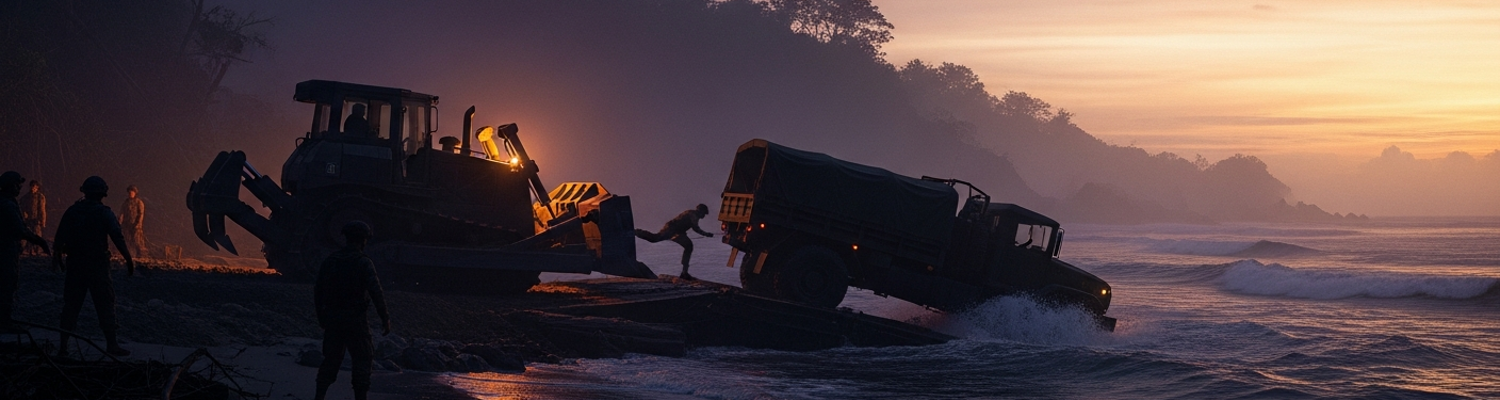
This breakdown fed directly into a crisis of communication that saw millions of dollars of usable equipment intentionally destroyed. Across the Pacific, radio was a fragile link. With experienced operators gone, garbled teletype messages and faint voice transmissions were left to the interpretation of novices. The core of the problem became semantic. A single, poorly received word could mean the difference between conservation and destruction. Headquarters might issue an order to salvage excess vehicles, meaning to recover and preserve them. After passing through multiple relay stations and being transcribed by an inexperienced clerk, that order could arrive at a remote motor pool on Espiritu Santo as an instruction to scrap the vehicles. This ambiguity was rampant. At naval bases like Manus, officers gave orders for the disposal of equipment. This was interpreted by some as a directive for destruction to prevent it from falling into other hands or to avoid the cost of shipping it home. This resulted in scenes of profound waste. Landing craft were scuttled in harbors. Tons of serviceable equipment, from typewriters to entire aircraft engines, were pushed by bulldozers off barges into the deep ocean. This culminated in infamous events like the creation of Million Dollar Point, where the military dumped a fortune in jeeps, cranes, and other machinery into the sea off Espiritu Santo, a direct result of failed policy and broken communication chains.
Operational logs from late 1945 reveal a blizzard of conflicting directives that paralyzed on-the-ground commanders. At the Naval Supply Depot on Guam, a single shipment of 5,000 Pratt & Whitney R-2800 engines, essential for the F4U Corsair and F6F Hellcat, became the subject of a bureaucratic war. A directive from the Bureau of Aeronautics in Washington D.C., dated September 5th, ordered all such engines to be coated in Cosmoline, hermetically sealed in specialized containers, and shipped to naval air depots in California. Less than a week later, a teletype from Headquarters, U.S. Army Air Forces, Pacific Ocean Areas, demanded the same engines be prepared for immediate transfer to air depots in the Philippines. The depot commander, a Navy captain, possessed neither the specific containers required for the first order nor the authority to transfer Navy property to the Army under the second. The experienced logistics officers and senior NCOs who could have navigated this inter-service quagmire were already on ships headed home, their high point scores having guaranteed them early departure. The remaining junior officers were left to interpret the irreconcilable orders, filing requests for clarification that went unanswered for weeks. Millions of dollars of high-performance aircraft engines sat on the tarmac under tarpaulins.
The pressure from Washington was absolute.
This command paralysis was compounded by inflexible timelines driven by domestic political concerns. The Bring the Boys Home movement exerted enormous pressure on the Truman administration, which translated into non-negotiable demobilization quotas for the theater commands. A general at Pearl Harbor was not asked to manage an orderly drawdown; he was told to ship a set number of men home by a set date. This top-down pressure cascaded through the chain of command, resulting in impossible deadlines. On Tinian, the commander of the 13th Ordnance Battalion was given sixty days to render all remaining B-29 munitions inert and prepare them for deep-ocean dumping. During that same sixty-day window, the points system stripped his unit of every single officer and NCO with formal Explosive Ordnance Disposal training. The timeline was never adjusted. Green second lieutenants and teenage draftees were left in charge of handling thousands of tons of sensitive high explosives and complex fuzing mechanisms, working from technical manuals they barely understood against a clock that showed no mercy.
Archival evidence shows that commanders in the rear lived in a world of pure abstraction. Inside the air-conditioned headquarters of the Pacific command, officers analyzed readiness charts and logistics tables that presented a neat, orderly view of the theater. A pin on a map represented a full-strength engineering battalion. A number on a spreadsheet showed a motor pool with 90 percent of its vehicles ready for service. What the charts did not show was that the readiness figure was a work of fiction. It was a number passed up the chain by a desperate junior officer on some remote island who knew that reporting the actual state of his unit, that 70 percent of his trucks were deadlined for lack of parts and 95 percent of his trained mechanics were gone, would invite an investigation he could not survive. Based on this phantom data, headquarters would issue a complex operational order: move three infantry regiments from one side of Luzon to the other. The order would arrive at a forward depot where the commander could barely assemble a convoy of ten working vehicles, forcing him to report back fictitious delays while his men frantically cannibalized wrecks for parts. The headquarters bubble, floated on a sea of falsified reports, remained serenely intact.
The war in the Pacific was an Engineer’s War, a conflict won by transforming jungle and coral into the crucial infrastructure of advance. In the immediate aftermath of victory, this same designation became a curse for the Army Combat Engineer and Naval Construction Battalions (Seabees) left behind. The points system systematically gutted these essential units of their most experienced personnel. On islands like Guam and Okinawa, engineer battalions found their ranks of veteran heavy equipment operators, master mechanics, and demolition specialists decimated almost overnight. Operational logs from late 1945 show units like the Army’s 1897th Engineer Aviation Battalion on Leyte, once capable of laying entire airfields of steel matting in weeks, reduced to skeletal crews. These undermanned outfits were now tasked not with building for invasion, but with the colossal and ill-defined mission of decommissioning an entire theater of war. They were responsible for maintaining hundreds of miles of roads that dissolved in tropical downpours and keeping ports and airfields from falling into disrepair.
This was an impossible mandate.
The most immediate and dangerous task was the clearance of unexploded ordnance. Across the Pacific, from the Solomon Islands to Palau, battlefields were littered with hundreds of thousands of tons of munitions. This included everything from Japanese Type 91 grenades and American mortar rounds to massive 2,000-pound aircraft bombs that had failed to detonate. On islands that had served as major supply depots, the problem was compounded by stockpiles of abandoned ordnance, with ammunition dumps containing shells and cartridges slowly corroding in the tropical humidity. The specialist Explosive Ordnance Disposal teams trained to handle these items were among the first to be sent home. This left green lieutenants and hastily trained draftees to identify and disarm complex and unstable chemical fuzes. Vast vehicle graveyards stretched for acres, filled with rusting trucks, tanks, and construction equipment that had to be cataloged, salvaged for parts, or disposed of.
The tools needed for this monumental cleanup were themselves casualties of the demobilization. The few remaining engineer units suffered from a critical lack of functioning heavy lift equipment. The same points system that removed the operators also removed the senior mechanics who knew how to maintain the complex machinery in the punishing tropical environment. Archival records detail a recurring cycle of failure. A P&H crane essential for rebuilding a shattered pier in Manila Harbor would be deadlined for want of a specific hydraulic part. A LeTourneau bulldozer needed to clear a landslide from a vital road on Luzon would throw a track, and the remaining mechanics, lacking experience, could not perform the repair. Naval Construction Battalions on Guam, who had started from scratch to build the massive naval base at Apra Harbor, now faced the challenge of maintaining it with failing equipment. The pre-invasion bombardment had destroyed most original facilities, and the expedient sheet piling used for wharf construction required constant upkeep, a task made nearly impossible without functioning cranes and pile drivers. This mechanical breakdown created a paralyzing bottleneck. Without heavy lift gear, engineers could not clear the acres of derelict vehicles or the mountains of rubble from bombed-out infrastructure. Without the ability to clear ports and repair wharves, the very equipment needed for the cleanup could not be shipped out.
The economic logic of demobilization dictated the destruction of billions of dollars in military assets. Washington’s primary objective was the swift repatriation of over eight million personnel under Operation Magic Carpet, a logistical undertaking that consumed nearly all available shipping. An internal calculus determined that the cost to crate, load, transport, unload, store, and process a single Willys MB jeep from a remote island often exceeded its original manufacturing price. This created an official policy of liquidation. The operation, known as Roll-Up, was designed to clear the Pacific islands of nine million tons of surplus material. On Manus in the Admiralty Islands, a sprawling naval base that once serviced the entire Seventh Fleet, entire fleets of landing craft were scuttled in the harbor. At depots on Guam and Tinian, acres of pristine aircraft components, from Pratt & Whitney R-2800 engines to entire wing assemblies, were bulldozed into pits and buried.
This was not an isolated incident.
The policy was most visibly executed on the island of Espiritu Santo in the New Hebrides. American forces had established a massive supply and staging base there, accumulating a vast inventory of vehicles, heavy equipment, and general supplies. At the war’s end, this equipment was offered to the presiding Anglo-French colonial government at a significant discount, reportedly as low as six cents on the dollar. Assuming the Americans would be forced to abandon the equipment for free, the offer was refused. The American command, unwilling to set a precedent, gave the order to dispose of the assets. Engineers constructed a long ramp extending into the deep water off the coast. For days, Seabees and Army personnel drove brand-new jeeps, six-by-six trucks, ambulances, bulldozers, and cranes directly off the ramp and into the sea. Crates of tools, clothing, and even Coca-Cola bottles followed, pushed into the ocean by the last bulldozers, which were then also driven over the edge. The site became known as Million Dollar Point, an underwater monument to the blunt priorities of post-war economics.
Supply corps and quartermaster unit logs from the period reveal a deep and pervasive sense of frustration among the personnel ordered to carry out this destruction. These were men who had spent years on tropical islands managing a complex supply chain where the loss of a single crate of parts could deadline an entire company of tanks. They were trained to account for every item, to conserve, repair, and reuse. The abrupt command to facilitate mass waste was a profound psychological shock. On Guadalcanal, medical supply officers who had meticulously managed dwindling stocks of quinine, sulfa drugs, and sterile bandages to combat rampant malaria and battlefield wounds were now ordered to dump thousands of units of life-saving supplies. Accounts from ordnance personnel describe the methodical process of rendering thousands of tons of serviceable ammunition inert before dumping it at sea, a task made all the more bitter by the memory of shortages during active campaigns. This sense of futility was sharpened by the points system, which saw the most experienced senior NCOs, the very men who embodied the ethos of conservation, be the first to depart for home. This left demoralized junior soldiers to oversee the dismantling of the arsenal they had so carefully maintained.
Morale plummeted. Soldiers who had survived years of combat now found themselves stranded on isolated islands, performing pointless guard duty over mountains of rotting supplies or carrying out destructive orders that offended their training. The material cost was a direct consequence of this human breakdown. Without skilled mechanics, vast vehicle pools were deadlined by minor mechanical failures. Without experienced ordnance technicians, huge ammunition dumps became dangerously unstable. The official policy became one of liquidation. It was a cold calculation: the cost to ship a single jeep from a remote island back to the United States often exceeded its manufacturing cost. The environmental impact was severe, with thousands of tons of steel, oil, and other hazardous materials dumped directly into fragile marine ecosystems, creating toxic time capsules that continue to leak pollutants decades later. The economic loss represented billions of dollars in taxpayer-funded equipment, obliterated by a policy that prioritized short-term expediency over any form of long-term value recovery. The effort to reclaim some of this material for the Korean War years later, also dubbed Operation Roll-Up, underscored the shortsightedness of the initial destruction, as the Army scrambled to refurbish the very types of equipment it had so recently and systematically destroyed.