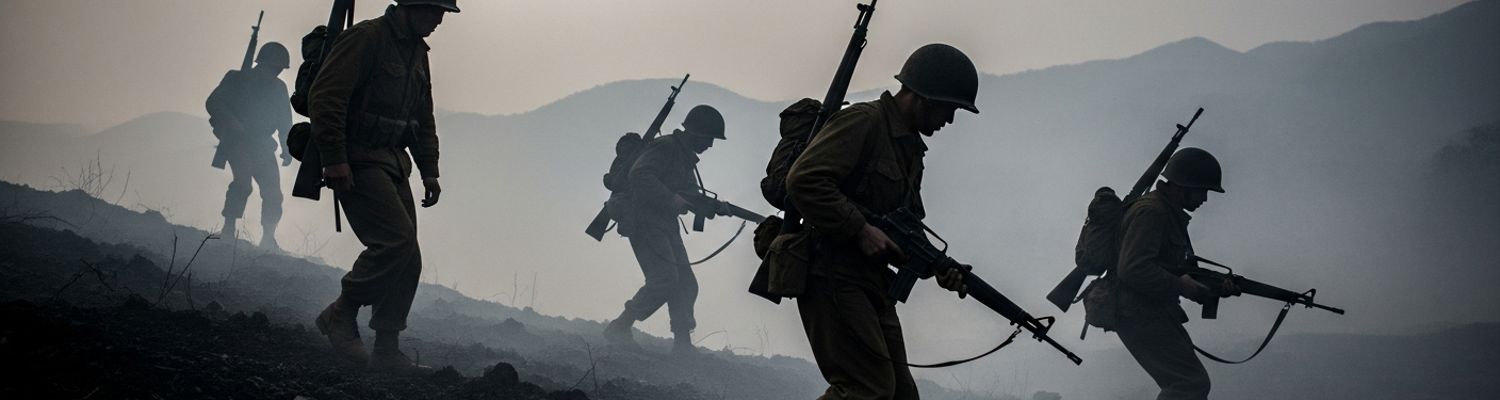

Victory in 1945 presented the United States with a strategic contradiction. The nation stood as a global colossus, its industrial might and military power seemingly absolute after years of total war. Yet, beneath the surface of this triumph, a different reality was taking shape, driven by a powerful domestic impulse. The American public, exhausted by conflict, demanded one thing with overwhelming force, the return of its soldiers. This societal demand, codified in policy and amplified by political pressure, triggered a military contraction so swift and deep it would leave the U.S. Army a hollowed-out force. Five years later, on the rainy hillsides of the Korean peninsula, the dire geopolitical consequences of this rapid dismantlement would become painfully clear.
Post-War Manpower Collapse
At its zenith in May 1945, the United States Army, including its Army Air Forces component, numbered over 8.2 million personnel. This force had crushed Nazi Germany and was instrumental in defeating Imperial Japan. It was, by any measure, the most powerful ground and air force on the planet. Its existence, however, was fleeting. The public and political cry to 'bring the boys home' was not just a popular sentiment, it was a political imperative that Congress could not ignore. Wives and mothers sent letters, baby shoes, and telegrams to their representatives, while organized campaigns like the 'No Boats, No Votes' movement saw soldiers themselves protesting the pace of their return. The pressure was relentless. The War Department implemented the Adjusted Service Rating Score, a points system that prioritized discharge based on months of service, overseas duty, combat decorations, and number of dependents. This system, designed for fairness, systematically targeted the Army's most seasoned combat veterans and experienced leaders for the quickest exit. Operation Magic Carpet, a massive sealift and airlift effort, began returning millions of servicemen from theaters across the globe. The drawdown was a torrent. By the end of 1945, over 1.5 million soldiers were being discharged per month. By June 1947, the total strength of all U.S. military branches had plummeted from a wartime high of 12 million to just 1.5 million. The Army bore the brunt of this reduction. From its peak of over 8 million, its strength was slashed to 684,000 by July 1947. It shrank further to a skeletal 591,000 by the eve of the Korean War in June 1950. In less than five years, the Army had shed more than 90 percent of its wartime strength, leaving it with just ten active divisions, a shadow of the 89 it fielded in 1945. Many of these divisions existed only on paper, severely undermanned and poorly equipped. Military planners, including Army Chief of Staff Dwight D. Eisenhower, watched this rapid drawdown with alarm. They argued that the force was becoming too small to fulfill its occupation duties in Germany, Austria, and Japan, let alone respond to new threats posed by an expansionist Soviet Union. The political reality, however, was unstoppable. The nation had won the war and was determined to cash its peace dividend, regardless of the strategic risks simmering in a newly divided world.
The GI Bill's Unforeseen Drain
The Servicemen's Readjustment Act of 1944, universally known as the GI Bill, stands as a landmark piece of American social legislation. Its architects designed it to successfully reintegrate millions of returning veterans into civilian life, fearing a post-war wave of unemployment. It offered a suite of benefits, including low-cost mortgages and business loans. Its most transformative provision, however, was educational funding. The act provided tuition, books, and a living stipend for veterans to attend college or vocational school. It was a spectacular success in its intended purpose. By 1947, veterans accounted for almost half of all college admissions in the United States, creating a more educated workforce that fueled decades of economic prosperity. This success, however, had a direct and debilitating impact on the active-duty Army.
The GI Bill presented the most experienced, battle-hardened non-commissioned officers (NCOs) and junior officers with an irresistible off-ramp from military life. These were the platoon sergeants, company commanders, and staff officers who had formed the leadership backbone of the victorious WWII force. Consider a 25-year-old master sergeant, a veteran of the Battle of the Bulge who knew how to lead a rifle platoon under fire and maintain morale in frozen foxholes. The peacetime Army offered him low pay, poor housing for his family, and the monotony of garrison duty. The GI Bill offered him a free engineering degree from a state university and a path to a professional middle-class life. The choice was simple. This created a massive exodus of talent, stripping the Army of its institutional knowledge and combat leadership. The NCO corps, the repository of practical warfighting skill, was gutted. The force that remained was increasingly composed of inexperienced recruits, many of whom enlisted to escape trouble at home, and junior officers who lacked the hard-won expertise of their predecessors. This brain drain left a hollow core where a wealth of combat experience once resided. The Army lost not just riflemen, but its expert mechanics, its seasoned artillery gunners, and its logistical wizards who knew how to get ammunition to the front. It was a force that looked like an army but lacked the sinew and bone of real combat power.
Task Force Smith's Ordeal
On June 25, 1950, the bill for America's post-war military gambles came due. The North Korean People's Army (NKPA), equipped with Soviet tanks and artillery, stormed across the 38th Parallel, shattering the unprepared Republic of Korea Army. The United States, forced to intervene under a United Nations mandate, turned to the only ground troops available, the under-strength divisions performing occupation duty in Japan. These soldiers were 'occupation fat,' accustomed to garrison life and ill-prepared for combat. The first unit dispatched to the front was a hastily assembled, battalion-sized element from the 24th Infantry Division, named Task Force Smith. Commanded by Lieutenant Colonel Charles B. Smith, the 540-man task force was flown from Japan to Pusan and then moved north. Its mission was not to defeat the NKPA but to conduct a delaying action, a desperate attempt to buy time for more U.S. troops to arrive.
On the rainy morning of July 5, 1950, they dug into positions on a ridge north of Osan. Most of the soldiers were young, some just teenagers, with little training beyond basic marksmanship. Their equipment was a catalog of inadequacy. Their primary anti-tank weapons were 2.36-inch M9A1 bazookas, a WWII weapon whose rockets were known to be unreliable and ineffective against the frontal armor of the Soviet-made T-34-85 tanks they were about to face. Much of the ammunition was old stock, its chemical propellant degraded from years of storage. The task force's single artillery battery had six 105mm howitzers but only six high-explosive anti-tank (HEAT) shells among them, the only artillery ammunition capable of damaging the enemy armor.
At approximately 0730 hours, the lead elements of the NKPA 107th Tank Regiment appeared, a column of 33 T-34-85s. The American 105mm howitzers opened fire. The standard high-explosive shells bounced harmlessly off the tanks' sloped armor. The few precious HEAT rounds, fired at close range, managed to disable two of the lead tanks. Then, as the tanks closed in, infantrymen saw their 2.36-inch bazooka rockets fail to penetrate the T-34s, even at point-blank range. One sergeant later reported firing 22 rockets with no effect. The tank column rolled through the American position with contemptuous ease, cutting communication lines and continuing south. Hours later, a six-mile-long column of NKPA trucks carrying some 5,000 infantrymen appeared. Task Force Smith engaged them with machine guns and mortars but was soon outflanked and overwhelmed by superior numbers. With his position untenable and communications severed, Smith ordered a retreat. The withdrawal quickly devolved into a chaotic rout, with men abandoning heavy equipment, crew-served weapons, and the wounded who could not walk.
The ordeal was over in hours. Task Force Smith had delayed the enemy for about seven hours at the cost of being shattered as a fighting force. It suffered roughly 180 casualties, killed, wounded, or captured. The Battle of Osan was a brutal lesson in readiness. It was the direct, bloody result of a five-year period of demobilization, budget cuts, and the draining of expertise that left the U.S. Army unready for war. The soldiers of Task Force Smith were not sent into a fair fight. They were sent to pay the price for a national policy that had prioritized a swift return to peacetime life over maintaining a credible conventional deterrent. Their sacrifice was the first down payment on rebuilding a force that had been too quickly cast aside, a wake-up call that echoed from the Korean hills all the way back to a shocked Pentagon.