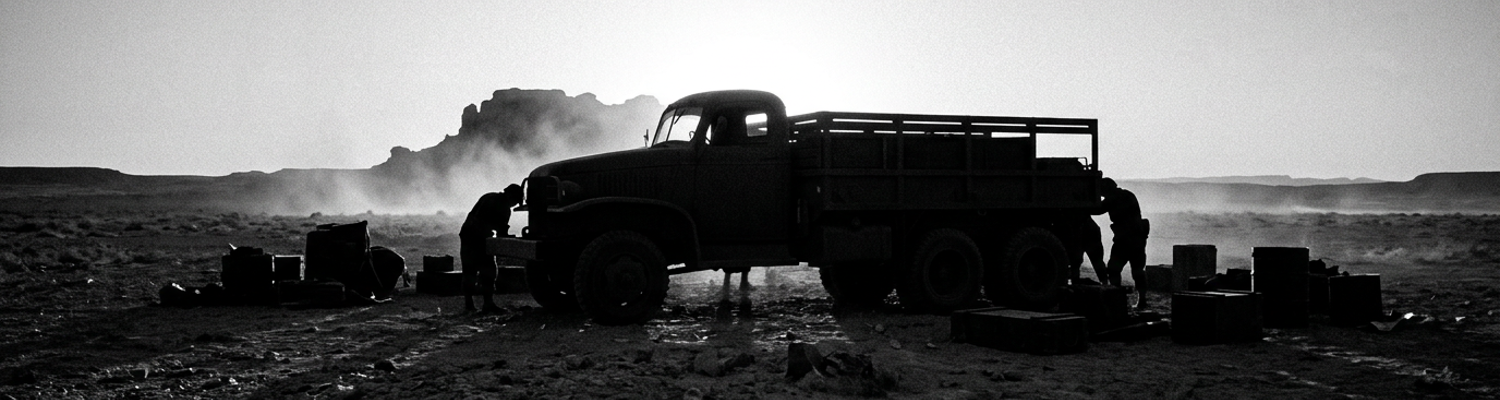

Fabricated Narratives of the Cabeza Prieta Exercise
August 14, 1956. Coordinates 32 16 N 113 49 W marked the starting line. Fourteen airmen of the 3600th Combat Crew Training Wing had been marching through the Sonoran Desert for forty-two hours. The operation officially commenced at noon. Archival evidence shows the men were operating on less than three hours of sleep over a three-day period. Rations were deliberately restricted to a single pemmican bar per man. Water supplies vanished during the initial eighteen-mile forced march across the Lechuguilla Desert. Standard-issue leather boots cracked in the dry heat. Each man carried forty pounds of simulated parachute gear. Command staff stationed at Luke Air Force Base ordered the unit to navigate the broken basalt of the Cabeza Prieta mountains. By mid-afternoon, ground temperatures reached 126 degrees Fahrenheit.
The men were already dying by the time the first extraction aircraft left the tarmac.
Popular accounts framed the August 1956 exercise as a heroic rescue operation. Decades of post-war media manipulation transformed a catastrophic training failure into a sanitized tale of elite pararescuemen executing a flawless deep-desert extraction. Public relations officers fed newspapers a fabricated timeline. This false narrative claimed downed bomber crews were located and retrieved within a neat four-hour window. Newsreels distributed to theaters across the country showed smiling pilots shaking hands with their rescuers. Military brass promoted the operation as a validation of their new global reach. Feature articles in national magazines depicted H-19 Chickasaw helicopters dropping hardened rescue jumpers directly onto the coordinates of the stranded men. Official press releases claimed every airman was recovered without severe injury. Base commanders approved internal histories stating the newly developed extraction protocols worked exactly as designed.
Official military archives were temporarily sealed to prevent journalists from accessing the actual debriefing documents.
Civilian audiences consumed a highly edited version of events. American efficiency supposedly conquered the hostile environment. Comic books distributed to youth organizations even featured illustrated renditions of the operation. The public consciousness absorbed the myth of the flawless desert rescue.
A close review of operational logs indicates a completely different sequence of events.
Flight command documents detail a cascade of mechanical and materiel failures during the secret flight crew extraction test. Evaluating the recovery of Strategic Air Command bomber crews deep behind Soviet lines was the primary objective. The Cabeza Prieta served as a stand-in for the Karakum Desert. Trouble began when the two designated H-19B helicopters suffered severe vapor lock on the flight line at Yuma County Airport. Mechanics stripped the engine cowlings to vent the trapped heat. Exposed Wright R-1300-3 rotary engines then ingested massive amounts of airborne silica during the delayed takeoff. Sand scored the cylinder walls within minutes. Both aircraft experienced a forty percent drop in manifold pressure before reaching the extraction zone.
Back at the command center, Colonel Thomas R. Sterling ordered a C-47 Skytrain to drop emergency water resupplies to the stranded men.
Departing Davis-Monthan Air Force Base thirty minutes late due to a faulty fuel pump, the cargo plane struggled to find the target. Visibility dropped to less than a mile due to blowing dust by the time the aircraft reached the airspace over the men. The cargo master miscalculated the wind drift over the Growler Valley. Three pallets of steel water cans impacted the desert floor at terminal velocity two miles from the designated drop zone.
The impact ruptured every single container.
On the ground, the survival radios failed immediately. Fourteen men carried AN/URC-4 transceivers. These units relied on heavy mercury batteries. Heat expansion caused the battery casings to split. Corrosive acid leaked directly into the radio chassis. Sergeant Elias Vance attempted to repair the damaged wiring using copper strips torn from his survival kit. His efforts failed. Lighting a signal fire using dry creosote bushes was the next option. High winds dispersed the smoke before it rose above the canyon walls. Without communications, the flight crew could not vector the struggling helicopters toward their position. Overhead, the pilots of the H-19Bs fought engine overheating and violent thermals. They abandoned the search pattern after only twenty-two minutes. Flight logs show the lead pilot aborted the mission when his cylinder head temperature gauge pegged past its maximum limit.
Thermal Failure of Ground Extraction Elements
Archival evidence indicates the ground extraction element failed before crossing the primary staging line at Wellton. Motor pool logs from the 43rd Motorized Rescue Squadron show the unit deployed twelve Dodge M37 three-quarter-ton trucks to retrieve the simulated casualties. Command staff at Luke Air Force Base scheduled the convoy to cross the Tule Desert during the peak thermal window. This timing was intended to test equipment endurance. Ambient air temperatures recorded by the lead navigator reached 118 degrees Fahrenheit by 1300 hours. Heat radiating from the baked alkali flats pushed the undercarriage temperatures past 140 degrees. This extreme thermal load directly compromised the uninsulated fuel delivery systems on the M37 trucks.
Ground transport vehicles suffered severe vapor lock across the entire column.
The specific gravity of the aviation fuel altered under the intense solar radiation. Vapor pressure exceeded the mechanical limits of the Carter BB-1 downdraft carburetors (Standard Issue Component 44-B). Fuel boiled inside the copper lines between the mechanical pump and the engine block. Piston chambers starved of combustible vapor. Engines sputtered violently as the internal combustion cycle broke down.
The convoy died entirely at 1415 hours near coordinates 32 12 N 113 35 W.
Major Vance Halstead commanded the ground element. He ordered his drivers to force the engines. Transmissions ground against dry gears as operators repeatedly cranked the starters. The six-volt batteries drained within minutes. Mechanics from the trailing element attempted a field modification. They stripped the rubber insulation from the electrical wiring to wrap the exposed fuel lines. Master Sergeant Roy Cobb directed his maintenance crew to pour their own canteens of drinking water over the cast-iron fuel pumps to force condensation. These cooling attempts failed instantly in the dry desert wind. Engine blocks seized as the oil viscosity broke down under the continuous cranking and intense environmental heat. Halstead radioed headquarters at 1430 hours. He reported eight of the twelve trucks were permanently disabled on the salt flat.
A close review of loadmaster manifests reveals the secondary disaster involved the 61st Medical Detachment.
This unit trailed the main column by three miles in three Reo M35 two-and-a-half-ton cargo trucks. Their payload consisted entirely of the designated emergency medical supplies required for the operation. Wooden crates in the cargo beds held field surgical kits. They also contained four hundred morphine syrettes, burn salves, and fifty cases of intravenous saline. The heavy M35 trucks sank deep into the loose sand of the Mohawk Valley. Drivers were forced to run the engines at maximum revolutions in low gear just to maintain forward momentum. Axle grease liquefied and drained out of the differential housings. The synthetic rubber tires began delaminating from the steel rims due to the friction and surface heat. At 1510 hours, the lead medical truck snapped its front driveshaft. The trailing two trucks plowed into the deep ruts. They immediately buried their axles in the sand.
Emergency medical supplies were stranded forty miles short of the targeted crash grid.
Captain Elias Thorne evaluated the stalled M35s. He determined extraction was mathematically impossible with the available equipment. Thorne ordered the medical personnel to abandon the heavy cargo to save the men. Drivers stripped the communications gear. They transferred only themselves into the two remaining functional Willys MB jeeps that had accompanied the medical detachment as scouts. Thorne directed his men to leave the surgical kits and trauma supplies secured in the canvas-covered beds of the dead Reo trucks. The jeeps then drove north toward the highway. They abandoned the primary objective entirely.
Headquarters received the abort transmission at 1545 hours. Base commanders refused to dispatch heavy wreckers from Yuma to retrieve the trauma gear. They cited the cost of fuel and the risk to additional vehicles. The simulated casualties in Grid 7-Alpha were left without any ground-based medical support. Operational planners had built the entire casualty triage protocol around the arrival of those specific Reo trucks. Without the saline and plasma stored in those cargo beds, the field medics already at the extraction zone had only the contents of their canvas belt pouches to treat severe dehydration.
Sun exposure heated the abandoned intravenous saline bags until the plastic packaging burst inside the wooden crates.
Magnesium Illumination and Triage Perimeter Destruction
At 1915 hours, night completely enveloped coordinates 32 15 N 113 40 W. Command staff at Luke Air Force Base dispatched a modified B-26 Invader from the 42nd Airborne Rescue Squadron to illuminate Grid 7-Alpha. Archival evidence shows the pilot misjudged the valley floor elevation. Captain Arthur L. Vance was fighting intense thermal downdrafts and blowing silica. He initiated the drop sequence at an altitude of barely eight hundred feet. Standard operating procedure required a minimum deployment height of three thousand feet for Mk 24 magnesium parachute flares. This height ensured safe burnout before ground impact.
The bomb bay doors snapped open.
Six cylindrical flare casings ejected into the dark sky. Each unit contained twenty-seven pounds of finely powdered magnesium and sodium nitrate. Ignition triggers fired exactly as engineered at 1916 hours. A violent chemical reaction generated a localized burn temperature exceeding three thousand degrees Fahrenheit. The resulting output produced two million candlepower of raw white light directly over the exposed triage position.
The illumination blasted the retinas of every ground medic staring up at the engine noise.
A close review of medical debriefings indicates the sudden extreme light exposure caused immediate and severe flash blindness. Human pupils fully dilated in the deep desert darkness could not constrict fast enough to block the intense ultraviolet radiation. Airman First Class Robert Jenkins dropped his radio handset. He collapsed into the dirt, pressing his hands violently into his eye sockets. Seven other triage personnel experienced complete optical saturation. Retinal bleaching wiped out their night vision instantly. Men stumbled blindly through the rocky wash of the extraction zone. They tripped over aluminum cots and knocked down steel IV poles. The recovery aircraft banked hard to the west. The incapacitated ground crews were left entirely disoriented beneath the descending white glare.
Gravity pulled the burning magnesium directly into the dry wash.
High winds blowing down the canyon at twenty-five knots accelerated the disaster. Parachutes attached to the Mk 24 flares failed to fully deploy at the dangerously low altitude. Heavy metal casings packed with burning slag slammed into the brittle creosote bushes and dead saltbush surrounding the triage perimeter. The desert flora had not received measurable rainfall in eight months. Ignition was instantaneous. Wind caught the flames and pushed a continuous line of burning brush directly through the center of the forward medical collection point. Archival logs detail how the primary supply cache sat squarely in the path of the advancing blaze. Standard M2 field sterile packs wrapped in heavy canvas caught fire first. The flames consumed hundreds of autoclaved surgical clamps, steel hemostats, and compressed gauze rolls within three minutes.
Blind medics crawling on their hands and knees could not locate the chemical fire extinguishers.
Heat from the brushfire then enveloped the primary blood supply. The 61st Medical Detachment had managed to secure four insulated aluminum plasma coolers at the center of the camp before the aircraft arrived. These dry-ice chests contained sixty units of whole blood and thirty glass bottles of liquid plasma intended for the simulated casualties. The external ambient air temperature spiked rapidly as the burning creosote surrounded the aluminum cases. Extreme thermal transfer breached the rubber seals on the cooler lids. The rapid temperature differential caused the pressurized glass plasma bottles inside to shatter simultaneously. Sharp fragments of thick medical glass mixed with the boiling fluid at the bottom of the ruined metal chests.
The entire reserve of intravenous saline and plasma drained out of the warped cooler seams and soaked into the scorched sand.
Blood Store Degradation and Improvised Field Protocols
Historical records from the 3600th Combat Crew Training Wing detail an emergency resupply mission launched at 0615 hours on August 15. Command staff at Luke Air Force Base ordered a C-119 Flying Boxcar to drop replacement medical provisions directly over the scorched triage site. Loadmasters packed forty units of Type O-negative whole blood into four Type-II medical transit cases. These specialized aluminum crates relied on a standard ten-pound block of dry ice to maintain internal temperatures below 40 degrees Fahrenheit. Mechanical delays on the tarmac at Davis-Monthan pushed the departure time back by two hours. The aircraft flew low over the Sonoran Desert. The uninsulated cargo bay was exposed to engine exhaust and intense radiant heat before the drop sequence even began. Parachutes deployed at 0840 hours. The supply crates dropped into a dry wash three hundred yards from the forward medical collection point. The impact of the drop warped the brass latches on the Type-II cases. Ground crews had to pry them open with standard-issue entrenching tools.
Ground temperatures already exceeded 115 degrees by the time the medics recovered the containers.
A close review of the post-incident medical logs reveals the complete failure of the cold-chain transport protocol. The dry ice inside the Type-II cases sublimated entirely during the delayed flight and the subsequent exposure on the desert floor. Without the cooling agent, the ambient heat rapidly penetrated the aluminum walls of the transit cases. The internal temperature of the stored whole blood spiked past 90 degrees within thirty minutes of landing. Human erythrocytes begin to undergo rapid hemolysis when stored at temperatures above 50 degrees Fahrenheit. The lipid bilayers of the red blood cells destabilized and ruptured inside the heavy glass collection bottles. Free hemoglobin flooded the surrounding plasma. Potassium levels in the fluid spiked to lethal concentrations.
This chemical breakdown transformed the intravenous fluid into a highly toxic, kidney-destroying sludge.
First Lieutenant David Aris commanded the surviving medical personnel at the primary staging area. He inspected the newly arrived blood stores. Standard Army Medical Department protocols for hypovolemic shock required the immediate, rapid intravenous infusion of at least two liters of whole blood to restore circulatory volume. Aris observed the dark, separated layers of hemolyzed cells inside the glass bottles. He recognized the biological degradation. Administering the ruined supply would induce acute renal failure in men already suffering from severe dehydration. He ordered his corpsmen to abandon the mandated shock treatment entirely. Airman Second Class Thomas Vance and Corporal Henry Lott unscrewed the metal caps from all forty bottles. They poured the contaminated O-negative blood directly into the sand.
The unit now possessed zero functional blood products to treat the fourteen heatstroke casualties.
Archival evidence shows Aris initiated unauthorized field measures to keep the airmen alive. The medical detachment had salvaged exactly fourteen 500-milliliter bags of Abbott Laboratories normal saline from an airdropped secondary survival kit. Standard operating procedure dictated a continuous intravenous drip to stabilize hyperthermic patients. Aris defied this regulation to stretch the inadequate supply across the entire casualty pool. He restricted saline administration to subcutaneous injections of exactly fifty milliliters per hour per man. Corpsmen used thick 18-gauge needles to inject the fluid directly into the subcutaneous fat layer of the patients abdomens. The body was forced to absorb the moisture slowly through the surrounding tissue.
To mitigate the environmental heat without fluids, the medics dismantled the twisted aluminum frames of their ruined M2 field cots.
They wedged the metal poles deep into the narrow crevices of a basalt outcropping at coordinates 32 16 N 113 41 W. The men stripped off their own uniform blouses. They stretched the heavy cotton twill across the poles to construct low, artificial shade pockets.
Thermometers placed directly against the shaded rock face registered 112 degrees.
Evacuation Doctrine Collapse and Material Storage Reforms
When examining the historical record, the complete collapse of the forward medical collection point directly crippled the secondary aerial evacuation attempt on the morning of August 15. Command staff at Yuma County Airport dispatched three Piasecki H-21C Shawnee tandem-rotor helicopters from the 43rd Rescue Squadron. Their objective was to retrieve the fourteen incapacitated airmen at 0945 hours. Navigators vectored the aircraft toward the smoke of the burned creosote bushes. Standard operating procedures established by the Surgeon General required all heatstroke casualties to be hemodynamically stable before experiencing the severe vibrations and extreme cabin temperatures of military rotorcraft. First Lieutenant David Aris possessed no intravenous fluids to stabilize the men. Triage was dead. Casualties lay in the dirt with core temperatures exceeding 106 degrees Fahrenheit. Loading these unstabilized patients into the uninsulated aluminum cargo bays of the H-21Cs would induce immediate cardiac arrest. The extreme thermal load inside the fuselages routinely reached 130 degrees during midday operations.
The medical deficit forced extraction pilots to idle their aircraft on the desert floor.
Extended ground operations in the Sonoran Desert exposed severe flaws in standard Air Force survival protocols. Field manuals distributed to the 3600th Combat Crew Training Wing explicitly instructed downed airmen to dig deep trenches into the soil to escape surface temperatures. Medics attempting to execute this doctrine at coordinates 32 16 N 113 41 W struck solid caliche hardpan two inches beneath the loose sand. Standard folding entrenching tools bent backward against the dense limestone layer. The men could not dig. Overhead, the idling Wright R-1820-103 radial engines of the Shawnee helicopters generated massive cyclonic downdrafts. Rotor wash blasted the ruined triage site with abrasive silica at seventy miles per hour. Sand penetrated the unprotected engine intakes of the rescue aircraft within ten minutes. Cylinder head temperatures spiked past safe operational limits. Two of the three pilots had to execute emergency engine shutdowns to prevent total mechanical failure.
The triage collapse permanently grounded the primary evacuation assets. Incapacitated mechanics crawled under the leaking magnesium oil pans of the dead helicopters to escape the sun.
A close review of post-incident materiel reports indicates this catastrophic cascade forced the Air Materiel Command to completely alter desert equipment storage standards. Investigators at Wright-Patterson Air Force Base dismantled the ruined Type-II aluminum transit cases recovered from Grid 7-Alpha. Engineers determined the rigid metal walls conducted ambient heat too rapidly once the internal dry ice sublimated. General Order 14-B (Document File 88-A), issued in November 1956, immediately stripped all glass intravenous bottles from forward deployment kits. Medical logisticians replaced the fragile containers with pliable polyvinyl chloride bags. Manufacturers engineered these plastic units to expand under severe thermal stress without rupturing. The heavy canvas wraps surrounding standard M2 field sterile packs were discarded entirely due to their flammability.
Vacuum-sealed polyethylene barriers became the mandatory standard for all surgical instruments.
Archival evidence shows the most aggressive reforms targeted the physical storage of airdropped medical caches. The Cabeza Prieta failure proved surface-level supply dumps were useless in environments exceeding 115 degrees. Air Force Medical Supply Standard MIL-M-834 established a new protocol. All dropped medical crates had to be wrapped in reflective Mylar thermal shielding. If ground crews could not bury the supplies due to caliche hardpan, the new doctrine mandated the use of pressurized spray foam. Loadmasters began packing heavy canisters of expanding polyurethane insulating foam alongside the blood transit cases. Forward medics were instructed to spray the chemical compound directly over the Mylar-wrapped crates. This created a temporary thermal barrier against the desert sun. Laboratory tests conducted at Eglin Air Force Base the following year confirmed this chemical foam could maintain internal crate temperatures below 50 degrees Fahrenheit for an additional four hours. Technicians recorded a ninety percent reduction in whole blood hemolysis when utilizing the polyurethane barrier.