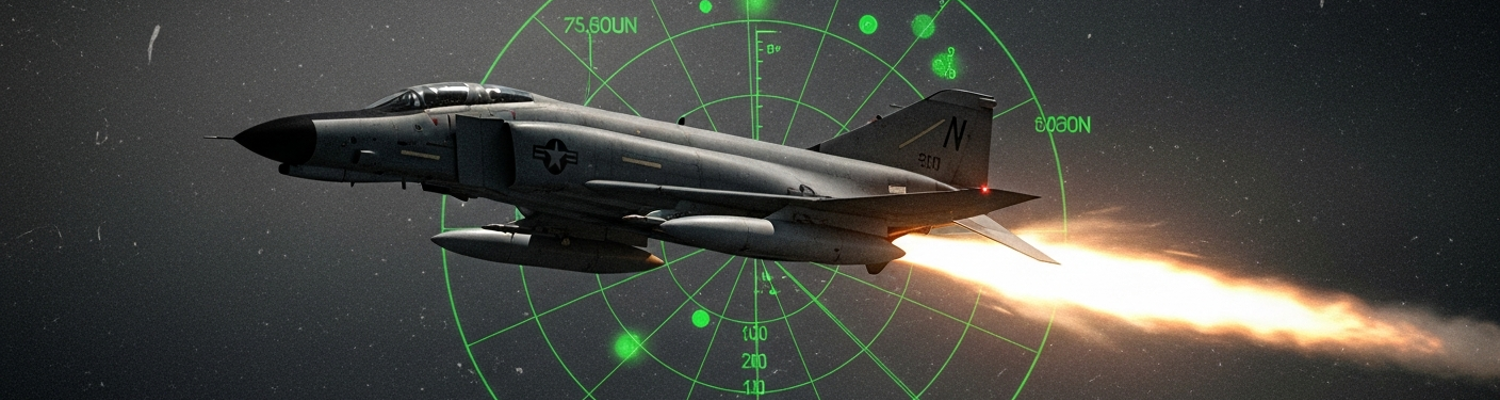

The post-war surge in turbojet technology created an unforgiving new reality in aerial combat. As fighters tore past the sound barrier, the fleeting window for a successful gun attack shrank to a near-impossibility. For United States Naval Aviation, operating from the pitching, confined decks of aircraft carriers, this high-speed problem was particularly acute. The answer appeared to be the guided air-to-air missile, a weapon that promised to restore lethality to the fleet's defenders. The mid-1950s saw the operational integration of two landmark systems, the AIM-9 Sidewinder and the AIM-7 Sparrow. This shift was not a simple ordnance swap. It forced a fundamental, painful, and bloody re-evaluation of doctrine, training, and the very identity of the naval aviator.
Integrating New Weapons on Carrier Decks
The Navy's entry into the missile age began in earnest in 1956 with the fleet introduction of the AIM-9 Sidewinder. A product of the Naval Ordnance Test Station at China Lake, the Sidewinder was an exercise in elegant simplicity, developed by a team under physicist William B. McLean. His design philosophy prioritized reliability and ease of use. The initial AIM-9B variant was a short-range, infrared-guided missile that homed on the heat signature of an enemy aircraft's engine. Its uncooled lead-sulfide seeker possessed a narrow four-degree field of view and a slow tracking rate. These technical facts restricted engagements to the rear-aspect of a non-maneuvering target. The seeker was notoriously susceptible to being decoyed by the sun or even bright reflections from clouds and water. Armed with a small blast-fragmentation warhead, it was first deployed on the Grumman F9F-8 Cougar and later the Vought F-8 Crusader, bringing a new, though highly conditional, capability to the fleet's day fighters.
Developed in parallel was the far more ambitious AIM-7 Sparrow. Born from a 1946 Navy requirement, the Sparrow was envisioned as the primary all-weather, beyond-visual-range weapon for fleet air defense. The first operational version, the Sparrow I, used a crude beam-riding guidance system. The launch aircraft, like the Douglas F3H-2M Demon, had to illuminate the target with its AN/APG-51 radar. The missile would then attempt to fly down the center of this radar beam. This tactic was fundamentally dangerous. It required the pilot to maintain a steady, predictable flight path to keep the beam on target, making them a perfect target for other enemy fighters. The missile's accuracy also degraded significantly with range as the radar beam naturally widened. The Navy quickly pursued the semi-active radar homing Sparrow III, or AIM-7C, which armed the new McDonnell F-4 Phantom II. With this system, the missile had its own receiver and homed on radar energy reflected from a target illuminated by the launching aircraft's powerful AN/APQ-72 radar. This was an improvement, but it still required the F-4 to maintain a continuous radar lock until missile impact, a period of intense vulnerability in a hostile sky.
From Gunfighter to Systems Operator
The transition from guns to missiles created a deep cultural schism in naval aviation. Pilots who had mastered the art of high-G maneuvering and deflection shooting were now told to place their trust in temperamental electronic boxes. The very language of air combat changed. Instead of visually judging range and lead, pilots had to listen for the distinctive audio growl of the Sidewinder's seeker locking onto a heat source, a sound that indicated the missile was ready for launch. For the Sparrow, the two-man crew of the F-4 Phantom had to develop a new synergy. The pilot flew the aircraft while the Radar Intercept Officer, or RIO, in the back seat managed the complex radar system, acquiring the target, achieving a lock, and monitoring the missile's flight. This new human-machine interface was fraught with potential for error under the extreme stress of combat.
This new methodology was counter-intuitive for aviators schooled in the axiom that speed and maneuverability were life itself. The idea of holding a steady course to guide a Sparrow felt like a direct invitation to be shot down. Early training syllabi were dangerously simplistic. They often consisted of classroom lectures on the missile's theoretical firing envelope, a chart of range, altitude, and aspect parameters known as the 'Pk envelope', followed by a few live-fire exercises against non-maneuvering target drones. This sterile environment did little to prepare aircrews for the high-G, three-dimensional chaos of a dogfight against a thinking, maneuvering opponent like the agile MiG-17 or MiG-21. The limitations were stark. Early missiles could not be fired under high G-loads, and their seekers could be easily 'broken' by a sharp turn. A deep-seated skepticism took hold in many squadrons. Pilots often joked that the missile's effective range was zero, as it was most likely to score a hit if it detonated on the launch rail. This sentiment was reflected in the design of the F-8 Crusader, which entered service in 1957. Armed with both Sidewinders and four powerful 20mm cannons, it earned the nickname 'The Last of the Gunfighters', a title that celebrated a pilot's retained agency in a close-in fight.
Trial by Fire Over Asia
The first major combat test for air-to-air missiles occurred during the Second Taiwan Strait Crisis in 1958. In a clandestine U.S. initiative known as Operation Black Magic, Republic of China Air Force F-86 Sabres were secretly equipped with the AIM-9B Sidewinder. On September 24, 1958, these missiles were used for the first time in combat against People's Liberation Army Air Force MiG-17s. The results were immediate. ROCAF pilots achieved multiple kills, demonstrating the missile's lethal potential. The engagement was a watershed moment. It also provided an intelligence windfall for the opposition. One Sidewinder lodged in a MiG's fuselage without exploding. The missile was recovered, handed over to Soviet engineers, and reverse-engineered into their own K-13 missile, codenamed 'Atoll' by NATO, which would plague American pilots for years.
Naval aviation's own brutal reckoning came in the skies over North Vietnam during Operation Rolling Thunder, beginning in 1965. Navy F-4 Phantom IIs from carriers like USS Ranger and USS Constellation, designed from the ground up as missile-armed interceptors without an internal gun, were the primary platform. The performance of the expensive, complex missiles was catastrophic. From 1965 to 1968, the Navy's probability of kill, or Pk, for the AIM-7 Sparrow hovered around a mere nine percent. The supposedly simpler AIM-9 Sidewinder's Pk was only slightly better at about eighteen percent. Overall U.S. kill ratios against the North Vietnamese air force plummeted to a dismal 2:1, a shocking decline from the 10:1 ratios common in the Korean War.
Pilots discovered the vast gap between training theory and combat reality. Strict Rules of Engagement often required visual identification of targets, completely negating the Sparrow's beyond-visual-range design and forcing F-4 crews into close-range turning fights with more nimble MiGs. The Sparrow's large minimum range made it useless in these knife fights. Its semi-active radar homing was frequently broken by hard enemy maneuvering, interference from ground clutter, or the F-4 crew having to break their own lock to evade an attack. The early AIM-9B Sidewinder's seeker was easily fooled by the sun and could only be employed from a narrow 30-degree cone behind the enemy MiG. The missiles themselves were unreliable. Maintenance crews on hot, humid carrier decks struggled to keep the complex electronics functioning. Pilots reported missiles that failed to launch, failed to guide, or simply flew harmlessly into the sky.
The abysmal results forced a deep institutional introspection. In 1968, the Chief of Naval Operations, Admiral Thomas Moorer, directed Captain Frank Ault to conduct a comprehensive review of the Navy's air-to-air missile performance. The resulting 'Air-to-Air Missile System Capability Review', known universally as the 'Ault Report', was a blunt and unflinching indictment of the Navy's entire approach. It concluded that the problem was not just the hardware but a systemic failure in training and doctrine. The report found that pilots were consistently firing outside of the missiles' effective launch envelopes because they lacked the training to recognize the proper parameters in a dynamic dogfight. There was no effective feedback loop to incorporate combat lessons into the training syllabus. The Ault Report's primary recommendation was the immediate creation of an advanced fighter weapons school. This school would teach air combat maneuvering and revive the lost art of dogfighting, but within the specific context of maximizing missile employment. This recommendation led directly to the establishment of the U.S. Navy Fighter Weapons School, famously known as TOPGUN, at NAS Miramar in March 1969. This new institution would train a new generation of instructors, turning the hard, bloody lessons of Vietnam into a new, more lethal naval aviation doctrine.