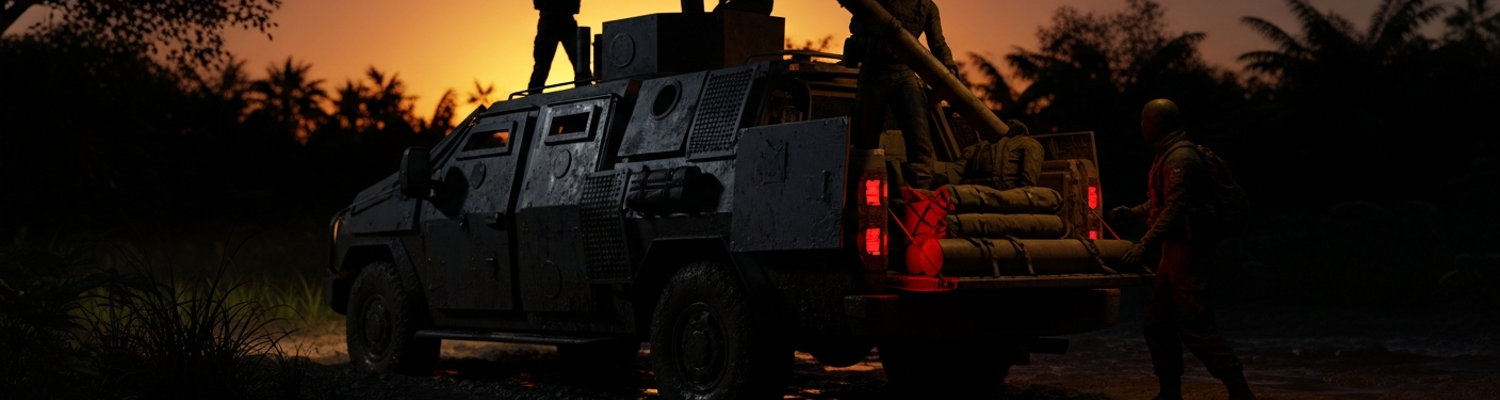

US Army Civil Affairs Deployment 1983
By the time the first US Army Civil Affairs and medical teams arrived in El Salvador in 1983, the national campaign plan was already in motion. There was no gradual introduction. The objective was to secure the central departments of San Vicente and Usulután, re-establishing government authority in regions contested by the Farabundo Martí National Liberation Front (FMLN). This plan inserted the American teams, many sourced from the 7th Special Forces Group, directly into a focused counterinsurgency effort where the operational tempo was already at maximum.
An examination of declassified operational logs (NARA Record Group 472) confirms the deployment to the Usulután Department was a direct insertion. Usulután, a region of coastal plains and agricultural lowlands, served as a primary logistics corridor for the FMLN. The FMLN was not a conventional army but a deeply embedded insurgency, a coalition of five leftist groups unified in 1980 with backing from Cuba. US personnel, operating under a politically mandated 55-man cap for the entire country, were not building rear-area bases. They were augmenting Salvadoran Army brigades already in contact with FMLN units. The mission was centered on Medical Civic Action Programs (MEDCAPs) and other civic improvement projects, a clinical term for providing basic services to a population caught between government forces and guerrilla fighters.
Every trip to a remote village was a calculated risk.
The operational focus on winning civilian support existed in a state of permanent tension with the tactical requirements for survival. By the early 1980s, FMLN forces numbered around 10,000 fighters and were increasingly well-armed, fielding M60 machine guns, RPG-7s, and M79 grenade launchers, many of which were of Western origin and acquired through a covert supply chain. For a Civil Affairs team, a mission to vaccinate children could be interrupted by a coordinated ambush. The FMLN had established firm control over large parts of the Morazán and Chalatenango departments, and while Usulután was a target for government pacification, it was simultaneously a battlefield. The Salvadoran military itself was implicated in a high percentage of civilian atrocities, creating a deep well of mistrust that the US teams had to attempt to overcome, one village at a time.
This dual mission was reflected in the standard payload. The M16A1 rifle was the fundamental tool for personal defense. The M79 grenade launcher provided a crucial force multiplier for a small team needing to break contact, its 40mm high-explosive rounds suppressing enemy positions to create space for withdrawal. The inclusion of C4 demolition charges was equally pragmatic. Ostensibly for civic action tasks like clearing rockslides, C4 was also a vital counter-insurgency tool. It could be used to destroy captured FMLN weapon caches, create defensive obstacles, or neutralize the enemy-laid booby traps and improvised explosive devices that were a common feature of the conflict. This loadout was the specific, curated arsenal of a small, mobile unit designed to build and persuade, but fully expected to fight for its own life.
Cold War Conflict Environment
The operational environment in El Salvador was a direct manifestation of late Cold War proxy conflict. American teams deployed into a layered, ideologically charged civil war fueled by external powers. The FMLN's doctrine was classic insurgency: avoid direct, set-piece battles with the superior firepower of the Salvadoran military and instead wage a war of attrition. Archival evidence shows their tactics centered on economic sabotage, ambushes of government patrols, and establishing control over rural departments. For the incoming American Civil Affairs and Special Forces advisors, this meant there was no secure rear area. The front line was everywhere.
This dynamic was amplified by the deeply politicized and fractured state of local support. Winning civilian trust was profoundly complicated by the Salvadoran government's own actions. The Salvadoran Armed Forces (ESAF) and associated paramilitary groups were responsible for the vast majority of human rights violations during the conflict, creating a chasm of fear between the state and the rural populace. The United Nations would later attribute 85 percent of atrocities to government forces. This history of violence meant many villagers viewed any government uniform with suspicion or terror. The FMLN capitalized on this, enforcing its own control through a mixture of ideological education and targeted intimidation. Civilians were caught in an impossible bind. Accepting medical aid from a US team could mark them for assassination by the FMLN, while refusing could place them on a list of suspected subversives held by the local ESAF garrison commander.
The core of the Civil Affairs task was not combat, but the technical work of improvised engineering and basic service provision in a high-threat zone. The enemy was not only an armed insurgent but also metal fatigue, logistical scarcity, and a collapsed infrastructure. A mission to repair a village water pump, a task critical for demonstrating government legitimacy, was a case study in operational friction. The required parts were unavailable through any formal supply chain, forcing US Army engineers to cannibalize equipment or fabricate solutions with hand tools. The route to the village was a constant threat, with roads frequently mined or subject to FMLN ambush. These small teams had to provide their own security, traveling with a minimalist arsenal intended to break contact from an ambush, not win a sustained firefight. The success of the national campaign hinged less on major military victories and more on this quiet troubleshooting: the thankless, dangerous work of keeping a generator running or a road passable under lethal pressure.
Medical Evacuation Doctrine Breakdown
A review of operational logs from the period reveals a near-total collapse of standard U.S. Army medical evacuation doctrine. The established procedure for evacuating a battlefield casualty was predicated on the use of dedicated, unarmed medical evacuation (MEDEVAC) helicopters, typically the Bell UH-1H Huey, marked with the Red Cross emblem. This doctrine was built around the concept of the Golden Hour, the 60-minute window from injury to surgical facility. In El Salvador, this system was unworkable. The FMLN did not adhere to the Geneva Conventions and viewed any helicopter as a military target. A slow-moving, conspicuously marked Huey on a predictable flight path would have been an easy kill. FMLN fighters were proficient in the use of small arms fire against low-flying aircraft. This forced a grim calculation. Using a proper MEDEVAC helicopter was to invite an attack. As a result, the use of marked MEDEVAC assets was abandoned. All evacuations became Casualty Evacuations (CASEVAC), executed by whatever armed, unmarked Huey was available. This shift fundamentally altered the risk profile, turning a medical necessity into a running gunfight.
This doctrinal failure was compounded by the absence of usable local infrastructure. Standard U.S. military medical protocol envisioned a chain of evacuation: from point of injury to a battalion aid station, then to a Combat Support Hospital (CSH). In regions like Usulután, this chain had no links. Roads were often dirt tracks, frequently mined or subject to ambush, making ground transport of a critical patient impossible. Local Salvadoran hospitals were not viable options. They were underfunded, lacked sterile surgical environments, had unreliable power, and were overwhelmed. These facilities were also not secure. The only realistic destination for a seriously wounded U.S. advisor was Gorgas Army Hospital in Panama. There was no middle ground. The entire medical system between a firefight in a Salvadoran village and a first-world operating room in another country was nonexistent.
Material decay was a constant. The tropical environment of El Salvador was a relentless enemy of specialized medical equipment. The high heat and oppressive humidity of coastal departments like Usulután caused immediate and catastrophic failures. Delicate electronics in the few advanced portable devices available would short-circuit. Adhesive seals on sterile packaging for items like surgical dressings or intravenous catheters would fail, rendering the contents non-sterile. Rubber and plastic components on suction units became brittle and cracked. Temperature-sensitive drugs, from vaccines for MEDCAP missions to anesthetics for field trauma, would spoil. Even a medic’s field radio, essential for coordinating an evacuation, could be rendered useless by corrosion on its battery terminals. This constant material breakdown meant that medics and Special Forces engineers spent an inordinate amount of time on quiet troubleshooting, the work of trying to repair, waterproof, and fabricate solutions for equipment not designed for the realities of a jungle war.
Improvised Armored Ambulance Vehicles
The collapse of helicopter-based medical evacuation forced a reversion to ground transport. With FMLN units systematically destroying bridges and mining roads, standard military ambulances were both too vulnerable and incapable of traversing the terrain. The response from US Army Special Forces and Civil Affairs teams, working with the Salvadoran military’s workshop units (Maestranza), was one of forced innovation: the creation of improvised armored ambulances from whatever vehicle chassis could be acquired. The platform of choice was often the common civilian pickup truck. Records indicate the use of Ford F-250s and Dodge M37s. The conversion process was a grim exercise in field engineering. Half-inch steel plates, often of unknown ballistic resistance and cut from salvaged industrial boilers, were welded onto the vehicle’s frame, creating a crude armored box in the truck bed to protect casualties and medics.
The addition of thousands of pounds of steel armor to a civilian-grade suspension and powertrain had immediate consequences. Leaf springs flattened and snapped. Engines, already stressed by the tropical heat, frequently overheated. Brake systems, designed for a much lighter vehicle, were prone to catastrophic failure on Usulután’s hilly backroads. These vehicles, nicknamed Astroboy by Salvadoran troops, became a maintenance nightmare, requiring constant work by US Army engineers and their Salvadoran counterparts just to remain operational. The armor provided marginal protection against small arms fire and offered almost no defense against the RPG-7s and command-detonated mines favored by FMLN units.
Inside these makeshift ambulances, the improvisation was even more stark. There were no sterile, well-lit medical compartments. Medics and Special Forces engineers jury-rigged essential life-support equipment into the bouncing, cramped confines of the truck bed. Ad-hoc installation of intravenous (IV) stands, often simple metal hooks welded to the interior of the armored shell, held bags of saline solution. Securing oxygen tanks, a massive liability in a firefight, presented another challenge. These heavy steel cylinders were typically fastened to the floor or interior walls with scavenged cargo straps or custom-fabricated metal clamps, anything to prevent them from becoming a lethal projectile during a sudden stop or ambush. Every element was a field-expedient solution, turning the truck bed into a precarious, mobile trauma bay.
When even the jury-rigged Astroboys were unavailable, units had to depend on a loose collection of civilian assets. This meant commandeering local buses, flagging down commercial delivery trucks, or paying civilian drivers to transport the wounded. This practice was fraught with danger. FMLN doctrine explicitly targeted the country’s infrastructure, which included blockading public transportation and attacking any vehicle suspected of collaborating with the government. A civilian driver caught transporting a wounded Salvadoran soldier could be marked for death. Communication was non-existent. After-action reports from the era highlight the sheer gamble of this system.
Engineer Designed Triage Solutions
Operational logs from the Usulután and San Vicente campaigns expose a critical vulnerability: the inability of CASEVAC helicopters to locate landing zones at night or in marginal weather. The dense jungle canopy, mountainous terrain, and frequent low-lying cloud cover rendered visual acquisition from the air almost impossible without ground-based guidance. Standard-issue military lighting systems were either too heavy, required dedicated generators unavailable to small teams, or failed quickly in the humidity. This deficiency created a lethal paradox. A patrol could successfully fight off an FMLN ambush, only to have their wounded die because the inbound Huey could not find a safe place to land.
Survival depended on a light in the dark.
The solution came from the workshops of Special Forces engineers. These were men of the 18C MOS (Special Forces Engineer Sergeant), specialists in expedient construction, who fabricated their own landing zone markers. They created man-portable lighting kits built from scavenged materials. The core components were often sealed-beam automotive headlights, stripped from wrecked civilian vehicles. These were wired in simple parallel circuits and mounted inside durable, waterproof containers, frequently .50 caliber ammunition cans. An engineer could pack four to five of these light boxes, along with wiring, into a standard ALICE pack, creating a self-contained, portable LZ marking system.
Powering these improvised landing lights presented its own set of problems. The standard BA-5590 military batteries were heavy and a finite resource. Engineers turned to the local economy. Field records show the widespread adoption of common 12-volt motorcycle batteries. These were relatively lightweight, commercially available, and easily recharged. Special Forces teams fabricated charging harnesses that could be connected to the electrical systems of their unarmored pickup trucks, allowing them to keep a rotation of batteries charged while on the move. Engineers had to waterproof the battery terminals, often using thick grease or rudimentary plastic covers, to prevent corrosion and short-circuits. This entire system was a fragile, ad-hoc invention.
This improvised electrical grid was the critical link between frontline triage and survival. When a patrol took casualties and requested a night evacuation, the mission hinged on these engineer-designed kits. As medics worked to stabilize the wounded, the team’s engineers would scout a viable landing zone. They would then deploy the ammo-can lights in an inverted “Y” pattern to mark the touchdown point and orientation for the inbound pilot. The successful activation of these lights transformed a dark, indistinguishable patch of jungle into a viable target for a helicopter pilot navigating by night vision goggles. This system, born from necessity and built from scraps, directly enabled the evacuation of critically wounded soldiers and civilians.
Technical Troubleshooting Under Fire
An examination of operational records from Civil Affairs and Special Forces teams in El Salvador reveals a war fought on a second front: a battle against equipment failure. The tropical environment was a corrosive agent. The mechanical backbone of any field team, the AN/PRC-77 man-portable radio, was a frequent casualty. This twenty-pound transceiver, the primary link for coordinating patrols or requesting medical evacuation, was notoriously susceptible to moisture. Field reports repeatedly document instances where humidity penetrated the radio’s housing, causing corrosion on battery contacts and short-circuits on internal components. A team engaged in a firefight could lose communications not to enemy action, but to a failure caused by the air itself. Engineers and radio operators spent an inordinate amount of time on preventative maintenance, fabricating makeshift gaskets from rubber inner tubes and packing battery compartments with water-resistant grease. When these measures failed, they had to perform delicate repairs in the field, scraping corrosion off contacts with a knife blade just to get a signal out.
This material decay extended to every piece of equipment. Power generation was a significant point of failure. The portable generators needed to run command posts or power refrigerators for vaccines were not designed for a jungle war. Spark plugs would foul, fuel lines would clog with sediment from local fuel sources, and engine blocks would overheat. Special Forces engineers, MOS 18C, became expert small-engine mechanics out of necessity. They learned to strip down and rebuild carburetors in near-total darkness, using parts cannibalized from civilian motorcycles. A common field modification involved jury-rigging larger fuel filters from pickup trucks onto a generator’s fuel line to prevent clogging. The success of a multi-day MEDCAP in a remote village often depended not on the skill of the medics, but on the engineer’s ability to keep a single, temperamental generator running.
The systemic destruction of El Salvador’s infrastructure by the FMLN compounded these technical challenges. By the mid-1980s, FMLN sabotage had destroyed or damaged the vast majority of the country’s major bridges and constantly targeted the electrical grid, isolating entire regions. This forced a near-total reliance on vehicles that were mechanically unfit for the mission. The non-armored pickup trucks used for daily transport suffered constant breakdowns. Maintenance logs show a litany of failures: suspension leaf springs snapping under the combined weight of soldiers and supplies; tires shredded by poor quality roads; and brake lines rupturing on steep, muddy tracks. US engineers and their Salvadoran Army counterparts in the Maestranza units became masters of improvisation. They learned to weld cracked frames with power from multiple truck batteries wired in series. Broken fan belts were replaced with nylon rope, a temporary fix that might last just long enough to get back to a secure area.
The Legacy of Expedient Operations
After-action reports from El Salvador demonstrate that the survival of U.S. advisory teams was directly dependent on their capacity for material invention. The formal systems of supply and support had failed. The impact of expedient solutions like the Astroboy armored ambulances and the ammo-can landing zone lights was absolute. They were the difference between evacuation and death. An analysis of mission logs shows these inventions were not isolated novelties but became the functional, if unwritten, doctrine for casualty evacuation. A patrol hit by an FMLN ambush would have its wounded stabilized by a medic while the team engineer prepared the improvised LZ lights. If the evacuation had to move to a different pickup zone, the wounded were transported in a jury-rigged pickup truck. Without the engineer’s ability to create a visible landing zone at night from car headlights and motorcycle batteries, night CASEVACs would have been impossible. Without the crude armored truck to shuttle casualties across mined roads, many wounded would never have reached the helicopter.
These were not enhancements to the mission. They were the mission.
The operational record in El Salvador codified a harsh lesson in adaptability. The conflict demonstrated that in an austere, low-intensity war, the most effective soldier was not necessarily the one best trained on standard-issue equipment, but the one who could make something work with nothing. The reliance on local economies for essential parts, from 12-volt batteries out of motorcycles in San Salvador to sealed-beam headlights from wrecked civilian cars, represented a complete departure from centralized logistics. An 18C Special Forces Engineer’s most valuable skill was no longer just the proper application of C4 or the construction of a wire obstacle according to a field manual. His value was in his ability to diagnose a failing generator and fabricate a new part from a discarded food can, or to keep a vehicle running by replacing a snapped fan belt with nylon rope. Resourcefulness was the primary combat attribute.
The strategic objective in places like Usulután was to build legitimacy for the Salvadoran government by providing services the FMLN could not. This was a war of perception fought with tangible results. When a village’s only water pump, disabled for months, was repaired by a U.S. Army engineer using scavenged parts, it was a more powerful message than any propaganda leaflet. When a generator was brought back online to power a medical clinic, it demonstrated a competence that directly countered the FMLN’s narrative of government collapse. A review of Civil Affairs project logs (File Ref: CA-USL-84-07B) shows that success was measured in repaired infrastructure and functioning services. These successes were almost entirely dependent on the technical creativity of engineers working far outside any established supply system. Their ability to troubleshoot and repair with limited tools under constant threat was the mechanism that allowed the campaign to function on its most basic level. The engineer fixing a machine was the policy in action.