
European Reliance and Domestic Imperative
The United States Army emerged from its revolutionary crucible possessing a new flag but facing an old, material weakness. Its capacity to defend the nation’s sovereignty depended almost entirely upon the arsenals of Europe. The war for independence had been won with French loans, French fleets, and, critically, French cannon. This dependency was most acute in the realm of heavy ordnance. The Continental Army’s artillery train, a cobbled-together assortment of French guns and battlefield captures, underscored a fundamental flaw in America’s nascent industrial base. Following the Treaty of Paris, the imperative to fortify a vast and vulnerable coastline against the world's great naval powers forced an immediate and deeply uncomfortable reckoning. The nation possessed a sprawling shoreline with commercially vital ports, but it lacked the industrial might to shield them from attack. The only viable short-term solution was to continue acquiring heavy siege and coastal defense artillery from abroad, primarily from France. The French Gribeauval system, with its standardized calibers and interchangeable components for guns like the 24-pounder long gun and 12-inch mortar, represented a level of manufacturing sophistication that American industry could only envy. American engineers, many trained by French officers like Louis Lebègue Duportail, designed fortifications based on European principles that demanded heavy ordnance the nation simply could not produce.
This reliance was not a matter of preference but of stark necessity. Secretary of War Henry Knox, a former chief of artillery, understood the danger intimately. His early reports to Congress detailed the alarming deficit of heavy cannon needed to secure American harbors. The First System of seacoast fortifications, authorized by Congress in 1794 amid the widening conflicts of the French Revolution, was a direct expression of this anxiety. The armament for these initial forts, including early works at Fort Mifflin in Pennsylvania and the defenses of Charleston, consisted largely of leftover Revolutionary War pieces. This was a motley collection of American, French, and British guns of varying calibers and states of disrepair. When new ordnance was required, particularly heavy 24- and 32-pounder cannons, the young republic had to dispatch agents to European foundries. This created a perilous strategic vulnerability. The flow of arms was subject to the whims of international politics, a fact made painfully clear during the Quasi-War with France from 1798 to 1800. The nation’s primary supplier of advanced weaponry became its chief antagonist, threatening to sever the supply line at its source. The supply chain was fragile, threatened by naval blockades and the simple dangers of transatlantic shipping. An army whose defensive power is contingent upon a foreign supply chain operates with its hands tied, a grim reality that planners in the early War Department understood all too well.
The Crucible of Early American Foundries
The strategic imperative to develop a domestic ordnance capability was clear, but the path to achieving it was littered with technical failure and explosive danger. The few American foundries that attempted to cast large-caliber cannon faced a steep and often disastrous learning curve. Facilities like the Principio Furnace and the Cecil Furnace in Maryland became the crucibles for this national project, and their results were frequently discouraging. Casting a multi-ton iron tube capable of withstanding the immense pressures of a gunpowder explosion was a complex metallurgical art. The process was plagued with inconsistencies. The quality of local iron ore varied wildly, with high levels of phosphorus and sulfur creating brittle, or 'cold-short', iron that was prone to fracture. The charcoal used for fuel was likewise inconsistent, leading to unpredictable furnace temperatures. The primary challenge lay in managing the cooling process of such a massive casting. Uneven cooling could introduce invisible stresses and impurities into the iron, creating weak points that would prove catastrophic under pressure. The common American practice was to cast cannons hollow, around a loam and horsehair core. This method was faster but often resulted in an imperfect bore and a weaker overall structure. The superior European method, perfected by men like Jean Maritz and Jan Verbruggen, involved casting the cannon as a solid block of iron and then precisely boring out the barrel. This was a more technologically demanding process requiring specialized machinery, but it ensured a stronger, more uniform weapon.
The result of these American shortcomings, time and again, was a burst barrel. For an artillery crew, a cannon failure was a death sentence, turning their primary weapon into a shrapnel bomb that cared little for allegiance. The proving process, a critical step in quality control, was a moment of high drama. A cannon would be secured and fired with a proof charge, often double its normal service load of powder. A War Department inspector’s report from the period might read plainly,
'Cannon number five, from the casting of June 1799 at Cecil Furnace, burst upon the first proof firing. The breech separated from the tube, shattering the proof-house wall and killing one assistant.'Each failure represented a loss of time, scarce material, and life. It also eroded confidence in all domestic arms. This uncertainty directly impacted combat effectiveness, forcing gun crews to use reduced powder charges, which in turn limited the range and striking power of their weapons and further cemented a defensive mindset. The establishment of the Army Ordnance Department in 1812 under Colonel Decius Wadsworth was a desperate attempt to impose order on this chaos, but it would take decades to overcome these foundational industrial deficiencies.
Logistical Chokepoints and Strategic Consequence
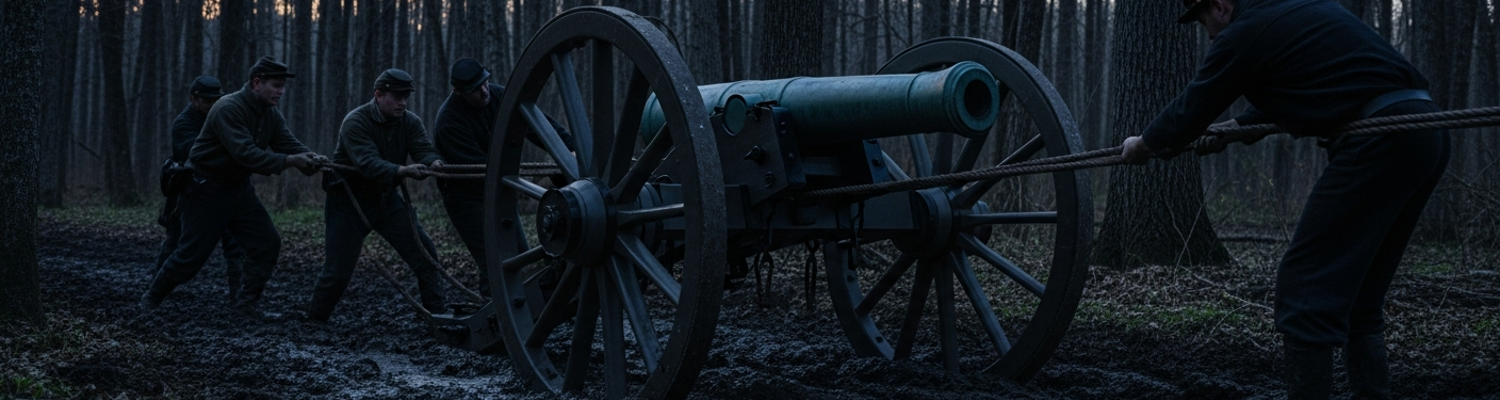
Even when a foundry succeeded in producing a sound heavy cannon, the army faced the monumental task of moving it. The logistical burden of transporting these iron behemoths over the primitive infrastructure of the early United States was immense. This reality placed severe constraints on strategic planning. A 24-pounder iron cannon barrel alone weighed over 5,000 pounds. Its wooden garrison carriage and mounting hardware added another ton. The nation’s road network was a collection of dirt tracks, muddy ruts, and undeveloped wilderness paths, often impassable for the teams of twenty or more oxen required to haul such an extreme weight. A journey from the Schuylkill Arsenal near Philadelphia to a new fortification on the Great Lakes frontier was a months-long ordeal. The cannon would travel by barge where possible, but long overland portages were unavoidable. Axles on the specialized wagons would snap. Draft animals would perish from exhaustion. Progress was measured in a few grueling miles per day. This 'tyranny of distance' was a logistical chokepoint that defined American military potential.
The primary arteries for transport were the waterways. Rivers and coastal routes were essential for moving heavy ordnance from foundries in Maryland and Pennsylvania to the coastal batteries and frontier forts where they were desperately needed. This reliance on water transport dictated the strategic geography of national defense. Forts were positioned to command harbors and rivers not just to repel invaders, but because these were the only reliable routes to supply and arm them. This logistical reality severely limited the offensive utility of heavy artillery. The concept of a mobile siege train, a hallmark of Napoleonic warfare in Europe, was largely unworkable in the American interior. The effort required to move even a single 24-pounder inland for an offensive operation against a fortified frontier position was often prohibitive. This rendered such weapons useless for projecting power, especially during the War of 1812. American failures to capture British-held positions like Fort Malden were not just tactical defeats. They were logistical failures rooted in the inability to bring sufficient heavy firepower to bear in a timely manner.
A Strategy Born of Constraint
This immobility consequently dictated a predominantly defensive posture for the early U.S. Army. Heavy ordnance became a static asset, locked into fixed fortifications. Military strategy revolved around defending key points rather than projecting power across the continent. The First System and the later, more robust Second System of fortifications were explicit acknowledgments of this limitation. They created a chain of forts to protect major cities and harbors, a strategy of coastal denial. The successful defense of Baltimore in 1814, anchored by the guns of Fort McHenry, was a validation of this strategy. It demonstrated that well-placed and adequately armed fortifications could repel a powerful naval force. It was, however, a success born of constraint. The inability to easily move heavy guns meant the army could only fight where it had spent years preparing to fight. The ease with which British forces captured and burned Washington D.C. that same year revealed the strategy’s great failure. With no mobile heavy forces to counter the enemy landing at Benedict, Maryland, the capital was left defenseless. The American militia at Bladensburg, lacking any meaningful artillery support, was quickly routed. This defensive crouch, forced upon the army by its industrial and logistical weaknesses, defined American military thinking for decades. It was a strategic reality forged in the fires of faulty castings and the mud of impassable roads, a harsh lesson in the absolute necessity of a self-reliant industrial base for national defense.