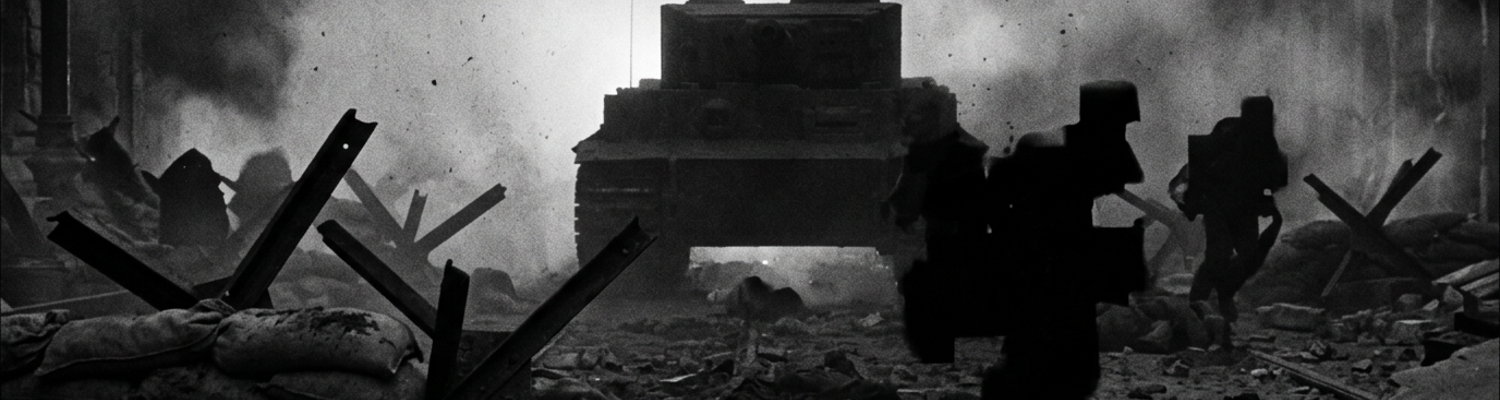

North Korean Urban Fortifications Across Central Seoul
Archival evidence shows that by September 24, 1950, more than twenty thousand fortified North Korean soldiers occupied the inner core of Seoul. They heavily outnumbered the fragmented forward platoons crossing the Han River. Soldiers of the 25th Infantry Brigade and the 78th Independent Infantry Regiment held interior lines across every ridge and stone intersection. Advancing company commanders faced high casualty projections. For every American rifle company pushing east along Mapo Boulevard, defensive battalions manned fortified concrete positions three lines deep across the paved avenues. Reconnaissance patrols moving off the riverbanks reported enemy personnel massing along the rail lines in densities that choked typical maneuver doctrine.
Every open avenue was an engineered trap.
In late September 1950, North Korean forces erected barricades across Seoul boulevards using soil-packed rice bags and embedded streetcar rails. Construction teams conscripted local civilian laborers under armed guard to tear up the double-track municipal tramways along Sejongno and Taepyeongno. Workers pried heavy steel rails loose from their ties with crowbars. They sank them vertically three to four feet into holes blasted through the asphalt roadbed. Burlap and woven straw rice sacks were filled with dense river clay, wet soil, and masonry rubble. These sacks were stacked between the vertical rails to construct breastworks measuring five to eight feet high and ten feet thick. Spaced at intervals of two hundred to three hundred yards, these obstacles blocked the major east-west arteries leading toward the Capitol building. Company logs from the 1st Marine Regiment note that standard tank dozer blades could not shear through the rail-reinforced centers without bending their hydraulic rams or breaking track shoes on the granite curbing.
Forward momentum halted against raw dirt and forged steel.
Eighth Army assault echelons encountered interlocking machine-gun positions and anti-tank guns sited behind major street barricades. North Korean gun crews placed 45mm M1937 anti-tank guns and heavier 57mm anti-tank pieces directly behind the earthen ramparts. They dug shallow revetments that left only the muzzle brakes visible through narrow embrasures cut into the rice bags. Wheeled 7.62mm Maxim 1910 and Degtyaryov heavy machine guns were positioned in adjacent ground-floor masonry structures. These weapons laid grazing crossfires across the pavement twenty yards in front of the wall. Any rifle squad attempting an exposed frontal charge across the asphalt was cut apart before reaching the base of the berm. Lead M26 Pershing tanks attempting to breach the obstruction took high-velocity solid shot rounds into their lower hull plates and final drive assemblies. The disabled tanks blocked the street for following recovery vehicles.
A close review of operational logs indicates that artillery forward observers could not bring high-explosive shells down on these street-level barricades without flattening adjacent structures. This action filled the avenue with additional tons of brick and severed overhead tram wiring. Direct fire from 90mm tank guns routinely failed to displace the packed clay sacks. The dirt absorbed solid shot without collapsing the embedded structural rails. North Korean defenders used these moments of mechanical paralysis to crawl through sewer mains beneath the streetcars. They planted TM-46 wooden and metal mines along the tank bypass lanes.
Tactical Isolation and Signal Severance Among Masonry Ruins
Signal logs from the 1st Marine Division and attached engineer detachments demonstrate that tactical high-frequency and very-high-frequency radio transmissions failed completely once assault elements entered the narrow urban corridors flanking Namdaemun Gate. Reinforced concrete structures, heavy granite facade government offices, and the multi-story Bank of Korea complex absorbed and deflected the line-of-sight frequency-modulated waves. Portable SCR-300 back-pack radios and vehicular SCR-508 transceivers broadcast these waves. Operating on bandwidths between 20 and 27.9 megacycles, these sets relied on unobstructed ground waves. The Japanese-built imperial stone buildings created immediate signal dead zones across Sejongno. Radio operators found their headsets filled with dead carrier hiss or erratic multipath reflections bouncing off collapsed masonry walls. This interference cut off forward obstacle reconnaissance parties from their supporting mortar batteries barely four hundred yards to the rear. Transmitters operating at maximum rated wattage could not push signals through three-foot-thick load-bearing granite walls laced with dense iron rebar.
Solid stone blocked high-frequency emissions entirely.
Communications personnel resorted to crude technical adaptations on the pavement to bypass this atmospheric and structural dampening. Combat engineers from Company A of the 73rd Heavy Tank Battalion and Marine communications teams stripped rubber-jacketed coaxial leads from wrecked vehicles. They spliced them into long-wire dipole antennas. Soldiers hoisted these arrays up shattered elevator shafts and exterior drainpipes using salvaged telephone poles. Signalmen scaled exposed multi-story rooftops under constant sniper fire from North Korean 7.62mm Mosin-Nagant rifles. They positioned directional wire arrays pointed directly toward command relay points along the Han River bluffs. If a shell splinter sheared an improvised antenna mast, operators immediately descended into street basements. They tried low-frequency ground-conduction rigs. Men connected bare copper wire directly to municipal cast-iron water conduits in an unproven effort to transmit through subterranean piping networks.
Standard communication protocol ceased to function.
Field telephone lines suffered an equally rapid mechanical destruction along every primary advance route. Twin-conductor WD-1/TT field wire and heavier rubber-sheathed W-110-B lines laid by RL-39 reel dispensers along the gutters were instantly ground into fragments. The steel cleats of M26 Pershing and M46 tanks belonging to the 73rd Heavy Tank Battalion crushed the cables. Weighing over forty-four tons, these armored vehicles routinely pivoted in place to avoid incoming 57mm anti-tank rounds. The tracks crushed telephone wire against stone curbstones and stripped the copper-clad steel strands down to raw metal. North Korean 76mm divisional guns and 120mm mortar barrages detonating against the asphalt severed whatever lines survived the armor traffic. Engineer clearance squads were left out of contact with regimental command posts for hours at a time.
Armor tracks crushed essential copper wiring.
Wire teams responded by abandoning doctrine. They ran telephone lines through destroyed shop interiors, second-story residential windows, and the municipal storm sewer network beneath Taepyeongno. Troubleshooters crawled forward without weapons. They carried only friction tape, wire cutters, and TL-13 pliers to trace breaks by running their bare fingers along punctured insulation in the mud. Repair teams spliced shattered ends using bare-wire Western Union twists wrapped in electrical tape. They dipped the splices in motor oil to repel water pooled in the gutters. In areas where crossfire prevented linemen from crossing wide intersections, engineers tied field wire to spent 3.5-inch rocket casings. They fired them across the open pavement using hand-wound launching wires to drape the line across overhead telephone poles out of reach of turning tank treads. This improvised rigging kept field lines operational until the next artillery barrage collapsed the remaining wooden utility poles at dusk on September 25.
Field Maintenance on Damaged Hydraulic and Pneumatic Systems
By midday on September 26, 1950, Company A of the 1st Marine Engineer Battalion had four Caterpillar D7 armored bulldozers immobilized along the rubble-choked approach to the Government General Building. High-velocity 7.62mm rounds fired by North Korean snipers hidden in the upper floors of the Ministry of Communications repeatedly targeted the exposed high-pressure rubber-jacketed lines feeding the hydraulic lift cylinders. Fluid pressurized at 1,200 pounds per square inch erupted from jagged bullet punctures. The multi-ton dozer blades dropped dead against the pavement. The immobilized earthmovers completely blocked the narrow clearing lanes required for advancing M26 Pershing tanks. Tractor drivers could neither elevate the heavy steel moldboards nor pivot their tracks without burning out their hydraulic pumps.
Pressurized oil sprayed across hot manifold covers.
Engineer mechanics crawled directly into the fatal exposure zone beneath the front idler wheels to execute field splices. Rifle fire chipped the granite curbstones inches overhead. Supply convoys were unable to bring replacement hydraulic hoses through the contested intersections. Repair crews used hacksaws to cut away shredded sections of wire-braided hose down to undamaged steel fittings. Soldiers then took salvaged copper fuel tubing stripped from burned-out civilian trucks. They forced it into the severed hydraulic hose ends as an internal sleeve. The men locked the joint tight using pairs of doubled screw clamps salvaged from generator engines. Commercial hose clamps snapped under the system operating pressure. Engineers wrapped the rubber joints in friction tape and bound them with high-tensile tripwire twisted down with fencing pliers. Crews bled air from the lift rams by manually cycling the control levers while kneeling in puddles of hot hydraulic fluid mixed with engine grease. This action restored sufficient line pressure to raise the blades four feet off the deck.
Three mechanics took direct bullet hits while tightening clamp screws beneath the tractor hulls.
Clearance squads operating along the central axis simultaneously experienced severe pressure drops in their pneumatic demolition gear. Maintenance reports from the 185th Engineer Combat Battalion reveal that truck-mounted Le Roi 105-cubic-foot-per-minute air compressors rapidly fouled in the thick clouds of masonry dust churned up by artillery barrages. Dust and brick grit bypassed damaged intake air filters. The particulate matter settled directly onto the compressor cylinder heads and jammed the delicate spring-loaded reed and discharge valves. Without continuous ninety-pound-per-square-inch air pressure, pneumatic paving breakers and rock drills could not drive steel bits into the granite-aggregate bases of North Korean tram-rail breastworks. Forward squads preparing demolition boreholes found their pneumatic tools stalling against the concrete. Men were forced to strike hand-held star drills with eight-pound sledges under point-blank small-arms fire.
Stalled air lines silenced every mechanical drill along the roadbed.
Repair personnel dismantled the hot compressor cylinder heads on the open street without shelter. They pulled distorted valve plates while North Korean 82mm mortar fragments struck the chassis rails. Mechanics found valve seats deeply scored by powdered masonry. This scoring prevented the spring flaps from sealing during compression strokes. Lacking replacement valves from division depots, soldiers created abrasive lapping paste by mixing motor oil with fine concrete dust scraped from the pavement. Technicians spent hours rubbing the steel reed valves against flat armor plate to grind away burrs and re-establish a flush seal against the valve blocks. Damaged copper gaskets failed to hold air during test cycles. Engineers cut replacement sealing rings from heavy fiberboard ration boxes and sealed them with shellac compound scavenged from a nearby maintenance shop. This field expedient maintained line pressure at eighty-five pounds per square inch. Pneumatic drills could once again drill three-inch boreholes deep into the breastworks for M3 shaped charges.
Improvised Pole Charges and Chongno Avenue Blast Engineering
Standard breaching doctrine collapsed against the forged tram tracks of downtown Seoul.
By September 26, combat engineers from Company C, 1st Engineer Combat Battalion, were forced to improvise heavy demolition weapons on the pavement to breach barricades along the central avenues. North Korean defenders had anchored heavy seventy-five-pound municipal streetcar rails vertically into three-foot-deep holes cut into the roadbed. They boxed them inside gravel-filled timber frames that deflected standard bazooka rockets and 75mm recoilless rifle rounds. Lacking specialized line-clearing explosives, sappers salvaged six-foot wooden two-by-fours from collapsed storefronts. They spliced them to telephone crossarm timbers with heavy electrical wire. Along the distal ends of these wooden poles, technicians stacked five to eight 2.5-pound blocks of Composition C-2 and Composition C-3 plastic explosive. They molded the putty-like RDX compound directly against split-bamboo splints to concentrate the blast vector inward. Men primed each assembly with military detonating cord threaded through dual non-electric blasting caps. By fixing friction-igniter pull fuses with fifteen-second delay cords to the base of the shafts, demolition men built crude stand-off weapon assemblies. These devices transferred extreme concussive energy directly into the steel flanges of the embedded rails.
Two sappers fell to sniper fire while taping the final cap to an eight-foot pole.
Clearance teams pushed these charges forward through drainage gutters beneath continuous 7.62mm fire. Demolition men crawled prone across the granite pavers. They shoved the weighted poles ahead of their bodies until the explosive head rested dead against the narrow web of the vertical tram tracks. Detonations ripped through the intersections with a velocity of 26,000 feet per second. The blast shattered the brittle forged steel rather than bending it. High detonation pressure fractured the manganese-alloy rail metal into jagged three-inch shards. The explosion blew out the earth-filled rice sacks anchored between the structural uprights. Shockwaves sheared the lower anchor pins beneath the asphalt line. This cleared sixty-inch gaps wide enough for recovery tanks to hook tow cables onto the remaining debris.
Every street-level advance invited crossfire from reinforced brick storefronts.
After-action reports from the 5th Marine Regiment confirm that forward movement along Chongno Avenue stalled completely when North Korean troops converted multi-story commercial buildings into interlocking machine-gun strongpoints. Heavy 7.62mm Maxim 1910 water-cooled guns and Degtyaryov DT weapons were locked into ground-floor corners. They fired through low apertures chipped into the masonry just four inches above the curb. Advancing down the open boulevard meant running directly into intersecting grazing fire that eliminated entire fireteams in seconds. Marine demolition squads abandoned exterior street movements entirely. They initiated aggressive room-to-room blast entries directly through the load-bearing masonry walls. Engineers packed ten-pound satchels with blocks of Composition C-3. They pressed the malleable explosive flat against the interior brick partitions separating adjacent shops. To prevent backblast from collapsing ceilings onto the assault squads, troops braced sandbags and heavy timber dressers directly against the explosive charges. This focused ninety percent of the shockwave through the brick course.
Explosive pressure blew three-foot access voids straight through the double-brick barriers.
Assault teams followed immediately behind the detonations. They stepped through smoking breaches before the masonry dust cleared. Concussive overpressure inside the enclosed rooms routinely stunned enemy gunners. The blasts ruptured eardrums and blew heavy Maxim mounts off their traverse pins before the North Korean crews could swing their barrels toward the interior partitions. Riflemen armed with Browning Automatic Rifles and M1 carbines suppressed surviving defenders in the corners. Engineers prepared secondary five-pound kicker charges to blow through second-story floor joists. At the intersection of Chongno and Supyo-ro, clearance squads neutralized four distinct machine-gun nests across a single two-hundred-yard city block using eleven consecutive wall breaches. They expended over two hundred and forty pounds of Composition C without once stepping foot onto the exposed roadway.
Close Armor Coordination with the 73rd Tank Battalion
External vehicular communications on the M26 Pershing tanks of Company C, 73rd Tank Battalion had failed completely along the South Gate approach by September 26, 1950. Mounted on the right rear fender of each Pershing, the standard EE-8 infantry field telephone and BC-1362 interphone boxes were repeatedly sheared away by North Korean 14.5mm PTRD anti-tank rifle fire and 82mm mortar fragmentation. Inside the sealed turrets, Ford GAF V8 engines roaring at 2,600 revolutions per minute combined with continuous coaxial .30-caliber firing to render the crew entirely deaf to exterior shouting. Engineers from the 73rd and attached Marine demolition teams could not speak to tank commanders buttoned up beneath two-inch forged steel hatches. Direct coordination required physical contact. Combat engineers designated individual runners who crawled across the exposed pavement directly through lanes of grazing 7.62mm Maxim fire. They closed the distance to the idling armor. Runners hammered their entrenching tool blades and M1 carbine receivers against the lower hull sponsons to alert the drivers. They then scaled the rear engine deck to stand exposed before the commander vision cupola. Runners used exaggerated hand signals to guide the gunner traverse. A flat hand chopping downward toward a specific cellar window indicated a target. A closed fist pumped horizontally toward an embedded tram rail ordered a halt. Gun crews rotated the heavy 90mm M3 main gun to point-blank azimuths. They laid high-explosive and armor-piercing rounds directly into enemy embrasures barely thirty yards away.
Four runners were cut down while banging carbine butts against the steel idler housings.
Buttoned-up tank commanders frequently lost all forward situational awareness when North Korean snipers deliberately shattered their M9 and M10 periscope glass. Tank commanders cracked open their heavy split hatches just two inches. They risked immediate head wounds to read the visual direction vectors given by prone engineers lying in the street gutters. Dismounted soldiers used crossed arm patterns to indicate buried metallic mines. They used rapid horizontal slashing motions across the throat to order an immediate emergency halt before the tracks crossed hidden anti-tank trenches. Pershing drivers slipped their mechanical clutches into neutral. This allowed the ninety-pounder to fire directly over the heads of crouching sappers without crushing the men beneath the steel track pads.
Armor plate was the only cover left on the street.
After-action reports from the 73rd Tank Battalion detail how infantry-engineer teams turned these forty-four-ton Pershings into mobile armor shields. North Korean gunners on Taepyeongno maintained relentless interlocking fire from water-cooled machine guns mounted four inches off the asphalt. This made unassisted dismounted approaches lethal within seconds. Assault squads adapted by packing four-man demolition parties tight against the rear engine decks and idler wheels of lead M26s advancing in low gear at two miles per hour. Engineers moved in unison with the slow rotation of the twenty-four-inch steel tracks. They stayed within the narrow ballistic shadow of the tank. They were protected from small-arms fire and mortar shrapnel spraying against the cast front glacis plate. Soldiers carried forty-pound M3 shaped demolition charges and prefabricated satchels of Composition C-3 directly behind the exhaust deflector louvers of the vehicle. Once the tank pushed its steel nose to within five feet of an earth-and-rail barricade, the driver braked hard. He revved the engine to drown out the sound of approaching footfalls and let the engineers work.
Sappers broke from behind the final drive housings. They dropped flat onto the torn asphalt beneath the overhang of the 90mm gun barrel. The men shoved the cone-shaped metal bodies of the M3 shaped charges directly against the lower anchor points where structural tram rails entered blasted foundation pockets. North Korean riflemen leaned over the crest of the barricade to drop hand grenades. Pershing bow gunners tracked upward and fired blind .30-caliber bursts into the earthen breastwork to suppress the defense while engineers seated the charges. Mechanics jammed wooden shims beneath the charge standoff legs to lock the concave cavity perpendicular to the structural rail flanges. Demolition specialists worked with numb fingers. They yanked M1A1 friction igniters attached to sixty-second safety fuses. They rolled backward into the protective space between the rubber-bushed track blocks of the Pershing before the driver threw the transmission into reverse.
Concussive jet explosions sliced the embedded steel uprights flush with the sub-pavement granite.
Technical Adaptation in Cold War Urban Combat Doctrine
Doctrine written on open European plains dissolved inside the rubble of Seoul.
By early October 1950, operational reports forced General Headquarters to confront systemic command failures in combined-arms coordination. The fighting in Seoul compelled the Eighth Army to integrate dedicated combat engineer squads directly into leading tank platoons. Previously, Field Manual 5-5 had relegated combat engineers to general support roles behind primary infantry axes. This kept specialized sappers under centralized battalion control until obstacle reconnaissance requested their dispatch. That spatial separation proved disastrous along Sejongno and Mapo Boulevard. Tank crews faced street-wide barriers without the technical means to demolish embedded rails. Forward engineers lacked direct ballistic protection from North Korean heavy machine guns. Eighth Army field orders reorganized forward assault teams into permanent mechanized demolition elements. They attached an eight-man squad from the 73rd Engineer Combat Battalion or 65th Engineer Combat Battalion directly to each five-tank platoon of M26 Pershings. Demolition specialists rode inside the secondary compartments or followed in M39 armored utility vehicles assigned specifically to the tank section. Sappers carried pre-rigged twenty-pound satchel charges, pneumatic demolition hoses, and M1A1 Bangalore torpedoes calibrated for rapid deployment under the physical cover of thirty-foot tank hulls. Tank commanders and engineer squad leaders held joint pre-assault technical briefings. They synchronized turret traverse angles to cover specific curb-level danger spaces before clearing runs began.
Armored hulls shielded flesh. They severed voice communication.
Inter-arm coordination collapsed mechanically as soon as vehicles entered dense debris fields. Post-action assessments highlighted the need for armored wire conduits and ruggedized short-range transceivers in urban warfare. External telephone wires linking the rear hull interphone boxes to internal vehicle intercom amplifiers were mounted inside thin sheet-metal gutters along the right fender of the Pershing. Masonry blocks tumbling from upper-story apartment facades and fragments from North Korean 82mm mortar shells consistently crushed these sheet-steel tracks. The impacts sliced the insulated dual-conductor lines against the hull armor. Tank crews inside buttoned turrets remained oblivious to sappers pounding on their exhaust louvers. Technical reports submitted to the Army Field Forces Board at Smith Hall recommended encasing all hull wiring in heavy one-inch seamless steel pipe welded flush to the armor plate. Engineers designed spring-buffered terminal junction boxes recessed into the rear sponson armor. This isolated electrical connections from the concussive shock of direct high-explosive hits.
Radio waves died against masonry before clearing a single city block.
Signal deficiencies proved equally fatal to dismounted demolition teams operating without wire links. Standard portable radios like the SCR-536 hand-held transceiver and SCR-300 back-pack set operated at frequency modulations that could not penetrate granite facades or multi-layer brick commercial districts. Wet masonry and metal tram lines absorbed low-wattage transmissions. This caused immediate radio silence between sappers clearing street basements and armor platoons waiting on the road surface. Demolition squads attempted to coordinate satchel-charge detonations using runner personnel. They suffered severe casualties while crossing open avenues. Communications development boards responding to Eighth Army debriefs demanded compact, shock-resistant transceivers featuring reinforced aluminum-diecast housings and rubberized moisture gaskets. They requested short flexible whip antennas capable of surviving five-foot drops onto jagged concrete. Technicians specified frequency bands capable of utilizing building apertures for wave propagation. They demanded dual-channel crystal controls that eliminated manual tuning drift during intense mechanical vibration. Ordnance shops began testing prototype radio enclosures wrapped in vulcanized rubber sleeves. The goal was to withstand the high-amplitude concussions produced by point-blank 90mm cannon blasts.