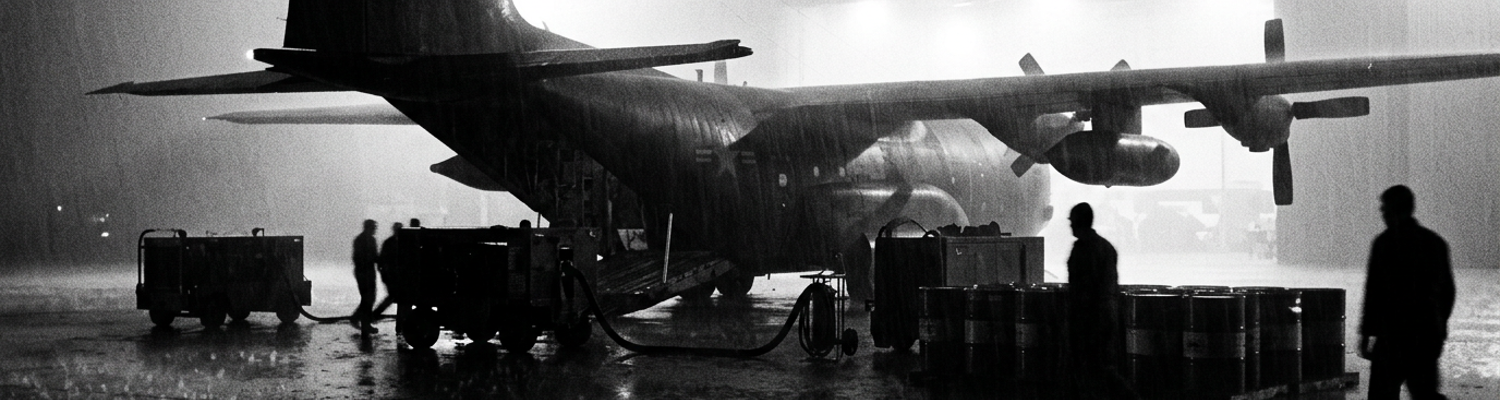

The November 1 Mortar Attack Devastation
At precisely 0026 hours on November 1, 1964.
A direct mortar blast severed the physical landline trunk lines running along Route 1. This abruptly cut Bien Hoa Air Base off from Military Assistance Command headquarters in Saigon. The frontline garrison was isolated in the opening seconds of the attack.
Archival evidence shows that the switchboard inside the 33rd Tactical Group operations center went dead before operators could transmit an emergency distress code. Base communication specialists raced to switch to secondary ultra-high-frequency radio arrays. Incoming fragmentation had already severed the feeder coaxial cables connected to the perimeter antenna masts. Flight controllers in the air base tower watched their radio consoles spark into silence. Outside the control facilities. Isolated security personnel crouched behind perimeter bunkers. They had no contact with secondary response forces at Tan Son Nhut airfield twenty-five kilometers away. Local wire teams attempted manual circuit rerouting. Falling shrapnel destroyed the junction boxes mounted on the northern revetment boundaries.
Every direct line to regional headquarters dissolved.
A close review of operational logs indicates that Viet Cong mortar crews assigned to the 83rd Artillery Battalion had infiltrated scrub terrain four hundred meters north of runway 09L/27R. They set up six 81-millimeter launch tubes without being detected. The gunners hammered baseplates into wet ground. They sighted their weapon mounts using pre-surveyed stakes aligned with the airfield apron lights. A rapid twenty-eight-minute bombardment commenced.
Eighty-three high-explosive rounds dropped into the barrels. They arced high into the night sky before slamming across the open parking ramps.
Aircraft were parked wingtip to wingtip in tight rows. They lacked protective dirt revetments to stop blast effects. Shrapnel ignited fifty-five-gallon drums of JP-4 aviation fuel. Fires swept through parked transport trucks and unarmored maintenance buildings. Four American military personnel and two Vietnamese soldiers died from fragmentation strikes. Another seventy-two men sustained serious shrapnel wounds inside temporary billeting quarters. Defending South Vietnamese ground units failed to return counter-battery fire from their perimeter positions.
The mortar crews disassembled their weapons. They loaded their equipment onto pack frames and escaped into surrounding rubber plantations.
Archival evidence shows that the bombardment wrecked five Martin B-57B Canberra light bombers. It inflicted severe fragment damage on thirteen other Canberras belonging to the 8th and 13th Bombardment Squadrons. Three South Vietnamese Air Force A-1H Skyraiders and one USAF HH-43 Huskie rescue helicopter lay ruined beside them. Two damaged Douglas C-47 transports sat nearby. Shrapnel ripped through the sensitive maintenance area of Operating Location Twenty. This secretive detachment of the 4080th Strategic Reconnaissance Wing ran Operation Lucky Dragon.
Fragments pierced the thin aluminum skin of deployed Lockheed U-2 reconnaissance aircraft parked in temporary facilities.
Blast concussion shattered delicate B-camera lenses. It distorted precision optical alignment frames. It ruptured high-pressure hydraulic lines necessary for high-altitude sensor operation. Second Air Division commanders in Saigon reacted by ordering a suspension of all operational reconnaissance flights. Every scheduled strategic sortie across the Laotian border and the southern regions of North Vietnam was scrubbed. Air Force technicians inspecting the site found the ground facilities incapable of supporting flight operations. Field teams dragged surviving aircraft away from burning wreckage using tow tractors. Mortar fragments had ruined mobile test benches and oxygen servicing carts. Specialized electrical ground power generators were destroyed.
Replacement components for high-altitude reconnaissance cameras did not exist in local theater stocks.
Emergency air shipments from depots in the continental United States were required. General William Westmoreland ordered undamaged aircraft evacuated southward to Tan Son Nhut and east to Clark Air Base in the Philippines. Reconnaissance aircrews stayed grounded at Bien Hoa for weeks. Civil engineers poured concrete revetments around remaining hardstands. Intelligence officers had to rely on low-altitude tactical aircraft. These planes lacked high-altitude cameras.
The photographic collection program over the Ho Chi Minh Trail lost all high-altitude coverage through late November.
Vulnerability of Unrevetted Support Infrastructure
Archival evidence shows that senior planners in the 2nd Air Division chose not to build soil-filled steel revetments along the flight line prior to the assault. Bureaucratic resistance to permanent infrastructure spending in South Vietnam left the airfield arranged like a peacetime training base. Host-nation political sensitivity regarding visible defensive fortifications played a major role.
Flight ramp engineering diagrams (NARA Record Group 342) dated August 1964 show a completely open layout. Tactical bombers and transport planes shared contiguous asphalt hardstands with reconnaissance detachments. No blast barriers or splinter deflectors separated the aircraft stalls.
Aircraft sat clustered less than thirty feet apart.
Military engineers had submitted construction requests for corrugated metal bin revetments as early as June. Procurement officers stalled the delivery schedules in Hawaii and Saigon depots. The first 81-millimeter high-explosive rounds struck the edge of the apron. The open flat surface offered zero structural resistance to direct blast overpressure. Steel shell casings ruptured into thousands of high-velocity jagged fragments. These traveled across hundreds of meters of unobstructed concrete. They were unimpeded by sandbags or earthworks.
No defensive walls broke the horizontal flight paths of the incoming shrapnel.
A close review of operational logs indicates that this total absence of revetments left high-value reconnaissance assets completely exposed. Operating Location 20 maintained fragile Lockheed U-2 airframes. These were designed with thin 2024-T3 aluminum skins and extended lightweight wings. They were engineered for laminar flow at 70,000 feet. They were not built for explosive combat environments. Mortar fragments moving at over 2,500 feet per second tore directly through the fuselage panels. They punctured unarmored internal fuel cells. They severed three-thousand-pound-per-square-inch hydraulic control lines.
Blast waves rattled precision sensor compartments.
Fragile B-camera optical assemblies were knocked out of micron-level alignment. Focal plane glass cracked. Secondary fragmentation shredded the skin of adjoining B-57B Canberra light bombers. This produced secondary clouds of flying aluminum shards. Dislodged control surfaces and fractured drop tanks sprayed adjacent aircraft. There were no physical dividers to isolate individual parking spaces. Every single detonation transmitted blast shockwaves down the line. Parked aircraft turned into lethal sources of secondary projectiles. This compromised every sensitive collection platform within reach.
When examining the historical record of base logistics. The primary driver of the cascading destruction was the tactical bulk fuel farm.
Air Force quartermasters had positioned twelve unarmored ten-thousand-gallon collapsible rubberized fabric fuel bladders. These sat less than one hundred and fifty yards south of the primary parking ramp. These neoprene-coated nylon containers held high-volatility JP-4 aviation kerosene. They were completely unshielded by earthen containment dikes or protective concrete baffles. Direct mortar strikes and supersonic casing fragments sliced through the three-sixteenths-inch rubberized walls during the second minute of the bombardment. Escaping jet fuel caught fire from hot metal shrapnel and open electrical arcs. Hundreds of thousands of gallons of pressurized liquid transformed into rolling waves of fire.
The burning hydrocarbon flood followed the drainage slope of the parking ramp.
It rushed directly toward the maintenance hardstands. Auxiliary electrical generators and towing vehicles were engulfed. Pungent black smoke smothered firefighting crews from the base civil engineering squadron. Boiling fuel surrounded unignited airframes. High-pressure tire assemblies ruptured across the apron.
Damage assessment teams found fifty-two aircraft tires and fourteen mobile ground-power trailers melted into the concrete surface by dawn.
Post-Tonkin Deployment Mandates and Rapid Staging
Archival evidence shows that inside the underground command post at Offutt Air Force Base in Nebraska. Strategic Air Command controllers received an emergency Joint Chiefs of Staff deployment directive at 1830 hours on August 4, 1964. Naval clashes in the Gulf of Tonkin had triggered a theater-wide alert across Pacific Command.
Under operational mandate Lucky Dragon. The 4080th Strategic Reconnaissance Wing was ordered to deploy high-altitude reconnaissance detachments from Davis-Monthan Air Force Base to Bien Hoa Air Base. They operated under a mandatory seventy-two-hour readiness deadline. Planners slated four modified Lockheed U-2A airframes for immediate repositioning. Forty-eight flight line mechanics and specialized photo interpreters were assigned to the first air echelon. Strategic Air Command headquarters required wheels down and operational reconnaissance sorties ready to launch from South Vietnam before the seventy-two-hour clock expired.
Nine Lockheed C-130E Hercules transports and three Douglas C-124 cargo planes were loaded.
They carried liquid oxygen generation trailers and pre-packaged spare Pratt and Whitney J57-P-37A turbojet engines. Specialized JP-TS fuel test kits were strapped into the cargo bays. Flight routes stretched across twelve thousand miles of Pacific airspace. Crews routed through Hickam Air Force Base and Clark Air Base under priority military air routing codes. Commercial flights were pushed into holding patterns.
Headquarters demanded combat photographic sorties over North Vietnam seventy-two hours after the first transport touched down.
When examining the historical record. Flight logs demonstrate that maintenance detachments met the timeline only by discarding standardized basing protocols. Two Lockheed U-2 reconnaissance aircraft touched down on the runway at Bien Hoa on August 9. They carried sensitive Type B high-resolution panoramic cameras inside their payload bays. Ground crews assigned to Operating Location 20 unloaded thirty-eight tons of maintenance equipment into unconditioned storage sheds. The humid eighty-eight-degree weather slowed operations.
Mechanics worked thirty-six consecutive hours without sleep.
They assembled ground electrical rigs and aligned delicate focal-plane optical prisms. They tested nitrogen purging systems inside the fuselage compartments. Each airframe required extended ground handling gear. This included pogo outrigger wheels fitted beneath the wings. These required completely flat surfaces during ground towing operations. Base personnel rushed pre-flight functional checks. They did not perform the standard depot-level vibration testing normally required after long transoceanic ferry flights. Operational readiness was declared on schedule. The Pentagon timeline was met while entirely bypassing defensive installation requirements.
Speed took absolute precedence over base security.
A close review of operational logs indicates that the compressed staging timeline forced aircraft directly onto degraded concrete parking hardstands. These were laid during the French colonial era. Civil engineering teams from the 2nd Air Division found no available revetted bays tall or wide enough to house the eighty-foot wingspan of the high-altitude gliders. Standard steel bin revetments assembled across tactical fighter bases possessed interior widths of only forty-eight feet. This rendered them incapable of shielding long-span reconnaissance wings.
Pouring custom reinforced concrete revetments with five-inch blast-deflection walls required a forty-five-day construction schedule.
Field commanders refused to authorize this delay. Airfield operations officers instead directed the fragile U-2s onto an open auxiliary taxiway apron. It was surfaced with six-inch concrete slabs that had cracked and spalled under monsoon water saturation. No blast deflectors or sandbag barriers separated these high-value reconnaissance assets from adjacent parking ramps. Ground personnel parked the unarmored airframes fifty feet away from fully fueled Martin B-57B jet bombers. The delicate reconnaissance cameras and thin aluminum wings were left completely exposed to horizontal fragmentation across the open tarmac.
The reconnaissance aircraft sat on bare concrete just four hundred meters from unmonitored scrub jungle.
Chemical Erosion from Specialized JP-TS Fuel Spills
Archival evidence shows that ground handlers servicing Operating Location 20 at Bien Hoa encountered an unforeseen chemical hazard. This occurred immediately after fuel transfer lines touched down in mid-August 1964.
The Lockheed U-2 required MIL-F-25524 operational fluid. This was designated JP-TS. Thermally Stable Jet Propellant. It was specially formulated with a narrow boiling range and high thermal oxidation stability. This kerosene-type mixture survived extreme friction heating at 70,000 feet without vaporizing or forming internal coking deposits. These specific aliphatic and aromatic hydrocarbons exerted a severe solvent effect on organic materials.
Bien Hoa secondary parking apron was built during the 1950s under French colonial administration.
It consisted of basic petroleum-based asphalt binder poured over an untreated base of laterite gravel. Each pre-flight servicing cycle for a high-altitude sortie required over 1,300 gallons of JP-TS. It was pumped through pressurized hose couplings that frequently dripped under tropical humidity. Uncontained fuel spills quickly penetrated the porous pavement surface. Within forty-eight hours of constant exposure. The corrosive kerosene dissolved the petroleum binder holding the aggregate matrix together. It stripped away the bitumen and left behind a mushy tar-black sludge.
Liquid fuel ate the tarmac down to bare gravel.
When examining the historical record of base maintenance. Standard operating procedures at Davis-Monthan Air Force Base had never accounted for the combination of tropical heat and substandard bituminous pavement. The 4080th Strategic Reconnaissance Wing relied on mobile R-5 servicing trailers with pressurized dry-break disconnect fittings. The neoprene gaskets deteriorated rapidly in the thirty-three-degree Celsius heat of Bien Hoa. Technicians disconnecting the servicing nozzles over the left and right wing sumps watched pressurized streams of raw JP-TS spill directly onto the open apron.
The dissolved asphalt gave off dense petroleum fumes.
Ground crews working beneath the wings without respirators grew sick. Ground maintenance logs from the 33rd Tactical Group document that heavy landing gear wheel assemblies sank four inches into the liquefied surface. Tow crews backed the airframes into their parking stalls. Tow bar shear pins repeatedly snapped as wheels bogged down in the softened pavement. Mechanics placed steel boiler plates beneath the dual main gear tires and the fragile wing-tip pogo outrigger wheels. This stopped the thirty-thousand-pound airframes from sinking into the eroding subgrade.
Bitumen failure exposed thousands of loose laterite stones directly in front of the aircraft.
A close review of operational logs indicates that this chemical degradation generated loose aggregate debris. This posed foreign object damage risks to sensitive intake ducts. The Pratt and Whitney J57-P-37A turbojet engine powering the U-2 was engineered without intake guide vane screens. This maximized high-altitude airflow efficiency. Its twin lateral air scoops sat less than thirty-four inches above the pavement surface. During ground runs and low-speed taxiing. The high static suction created by the nine-stage low-pressure compressor generated a powerful ground vortex. This lifted loose gravel and fractured binder chips directly off the eroded ramp.
Archival inspection records from September 1964 reveal that even a pebble measuring three millimeters across could chip the thin leading edges of the titanium first-stage compressor blades.
This caused microscopic micro-cracks that risked catastrophic blade failure under the sustained thermal stresses of high-altitude climb. The risk of ingestion forced technicians onto their knees. Flight line supervisors instituted emergency foreign object damage walks across the entire parking area three times each day. Maintenance personnel crawled shoulder to shoulder with wire brushes and handheld putty knives across two thousand square yards of degraded tarmac. They manually picked up dislodged aggregate before every scheduled engine start.
Mechanical street sweepers requested by 2nd Air Division quartermasters were unavailable in the Saigon logistics pipeline.
Airmen were forced to sweep the crumbling apron with handheld corn brooms. Operating Location 20 commanders established an operational rule. Ground crews were prohibited from advancing throttle settings past sixty-five percent low-pressure rotor speed until the aircraft rolled completely clear of the dissolved asphalt zone. On September 18, 1964. Mechanics performing a post-flight bore-scope examination on airframe 56-6680 discovered pitting across five second-stage compressor blades.
Ground personnel had to pull the entire J57 engine for a complete depot tear-down.
Monsoon Inundation and Airfield Subbase Failure
Archival evidence shows that between late August and October 1964. The southwest monsoon dumped up to ten inches of rain across the Dong Nai River basin in single twenty-four-hour cycles.
Bien Hoa primary runway 09L/27R depended on an antiquated network of unlined earthen drainage ditches dug during the French colonial era. Civil engineers from the 33rd Tactical Group discovered that these unreinforced swales lacked concrete retaining walls. They measured six feet across and barely four feet deep. They had no stone riprap or sufficient hydraulic gradient to channel rapid runoff. Torrents of silt-laden water stripped topsoil from the shoulders. Tons of laterite mud washed into the ditch beds within minutes of each cloudburst.
Clogged by dense tropical brush and collapsed earthen banks. The ditches backed up completely.
Standing water quickly sheeted across the unpaved runway margins. It spilled twelve feet onto the active asphalt surface and submerged the airfield edge lighting fixtures. Base operations logs record that on September 22. Maintenance detachments attempted to clear the main northern collector trench with an unarmored Caterpillar D7 bulldozer. The machine threw a track in four feet of liquefied mud.
The ditch networks ceased functioning as drains and became holding basins.
When examining the historical record of base civil engineering. Unchecked surface ponding quickly initiated deep subsurface saturation. Rainwater penetrated down through open expansion joints and horizontal fissures in the French-era concrete slabs. It soaked the untreated clay-laterite subgrade underneath. This regional soil possessed high concentrations of aluminum and iron oxides. It remained structurally stable only while dry.
Saturated with millions of gallons of trapped water. The subgrade lost its internal shear strength and transformed into a fluid zero-bearing-capacity slurry.
Base survey records from late September indicate that soil moisture content beneath the midsection of runway 09L/27R reached thirty-two percent. This far exceeded the plastic limit of the subbase material. Hydrostatic pressure built under the pavement. There were no subsurface perforated drainage pipes to relieve the trapped fluid. Water began bubbling upward through slab seams during torrential downpours. It carried liquefied silt out from beneath the load-bearing foundation.
Unseen voids were expanding beneath the active landing strip.
A close review of operational logs indicates that rolling wheel loads from incoming aircraft triggered severe structural settlement across the weakened foundation. Heavily laden Martin B-57B bombers carrying five-thousand-pound internal bomb loads exerted ground pressures exceeding one hundred pounds per square inch on the pavement. Fully fueled Lockheed C-130 transports did the same. When forty-ton transport planes rolled across the saturated sections. The hydraulic pumping effect forced liquefied subsoil up through pavement cracks. Plumes of brown mud blew eight inches into the air.
With the supporting soil washed out beneath them. Concrete slabs cracked into irregular geometric fragments under the sheer tonnage.
Differential settlement dropped some slab corners three inches below the surrounding grade. This created sharp subterranean steps along the primary touchdown zone. This uneven surface posed catastrophic risks to the Lockheed U-2. Its fragile landing gear configuration concentrated its entire thirty-thousand-pound gross weight onto two inline high-pressure main wheels without multi-wheel dispersal trucks. On October 4. A landing U-2 struck a depressed slab joint at ninety knots. Both main gear tires blew and the oleo strut mounting brackets bent.
Civil engineers could only fill the resulting three-inch pavement steps with cold-mix asphalt patches. These washed out during the next morning downpour.
Strategic Reconnaissance Standdown and Remedial Fortification
Strategic Air Command terminated high-altitude collection flights out of Bien Hoa before sunrise on November 1.
Archival evidence shows that Operating Location 20 commanders sent an emergency flash cable to Offutt Air Force Base. It detailed total infrastructure paralysis across their flight line sector. Blast fragmentation and kerosene fires had wrecked the detachment specialized ground-support inventory. Three A/M32A-60 gas-turbine generator carts were incinerated. The vacuum-insulated liquid nitrogen servicing trailers required to purge Type B camera bays were perforated. Without stable 400-hertz electrical ground carts. Technicians could not spin up the U-2 gyroscopic navigation platforms or run diagnostic sweeps on damaged focal-plane shutters.
Blast grit had coated the optical collimators.
The delicate quartz alignment mirrors were scratched beyond field repair. Second Air Division leaders recognized that Bien Hoa could no longer provide the dust-free temperature-controlled maintenance spaces required to service high-altitude panoramic sensors. Under orders from General Curtis LeMay. Strategic Air Command ordered an indefinite operational standdown of the Lucky Dragon detachment. Surviving airframes were pulled out of South Vietnam entirely. Ferry crews flew the remaining operational Lockheed U-2 aircraft eastward to Clark Air Base in the Philippines. Crated camera assemblies and injured avionics mechanics boarded Douglas C-124 transports bound for the Sacramento Air Materiel Area at McClellan Air Force Base.
High-altitude photographic reconnaissance over southern North Vietnam and the Laotian mountain passes ceased for thirty-eight consecutive days.
Field commanders suddenly found themselves flying completely blind along the Ho Chi Minh Trail. A close review of operational logs indicates that the complete destruction of unprotected aircraft forced Pacific Air Forces to scrap its peacetime construction restrictions. Physical blast barriers were mandated across every primary airbase in South Vietnam. Headquarters Pacific Air Forces issued urgent procurement orders for thousands of prefabricated ARMCO steel bin revetment panels. These moved through naval logistics channels in Subic Bay.
Combat engineers from the United States Army 87th Engineer Battalion and civilian crews under the RMK-BRJ construction consortium began assembling corrugated steel bin revetment cells.
These measured twelve feet in height and twelve feet in thickness. They stretched fifty-two feet in length along the Bien Hoa aprons. Bulldozers excavated thousands of tons of local red laterite soil to pack inside the double-walled steel bins. This created fragment-proof blast pens capable of absorbing direct hits from eighty-two-millimeter mortar shells. Construction teams cast six-inch reinforced concrete caps over the packed soil. This prevented monsoon rains from turning the laterite fill into mud. Within six months. Military engineers erected more than four hundred steel-and-earth revetment bays at Bien Hoa. Da Nang and Tan Son Nhut received similar upgrades.
Individual tactical aircraft were physically isolated so that an exploding bomb could not send shrapnel slicing into adjoining airframes.
Open-apron parking ceased permanently across the theater. When examining the historical record of airfield engineering. Base civil engineers directed their secondary focus toward hardening fuel systems that had burned uncontrollably during the attack. Quartermaster records confirm that the military command outlawed the use of unarmored open-air rubber fuel bladders within blast distance of active runways. Engineers dug deep perimeter containment ditches around fuel storage parks. The punctured ten-thousand-gallon neoprene fuel cells were replaced with bolted steel storage tanks encircled by twelve-foot earthen berms.
Civil engineering units installed concrete blast baffles and rapid-action pneumatic shutoff valves.
Heavy-gauge steel piping was buried three feet beneath compacted subgrade to protect JP-4 and specialized JP-TS supply lines against surface mortar detonations. Contractors from RMK-BRJ poured thick reinforced concrete retaining basins. These were designed to hold one hundred and ten percent of total tank storage volumes in the event of catastrophic shell penetration.
The defensive upgrades consumed 140,000 barrels of bulk cement across the central air facilities by the summer of 1965.