
Forged for Speed and Fire
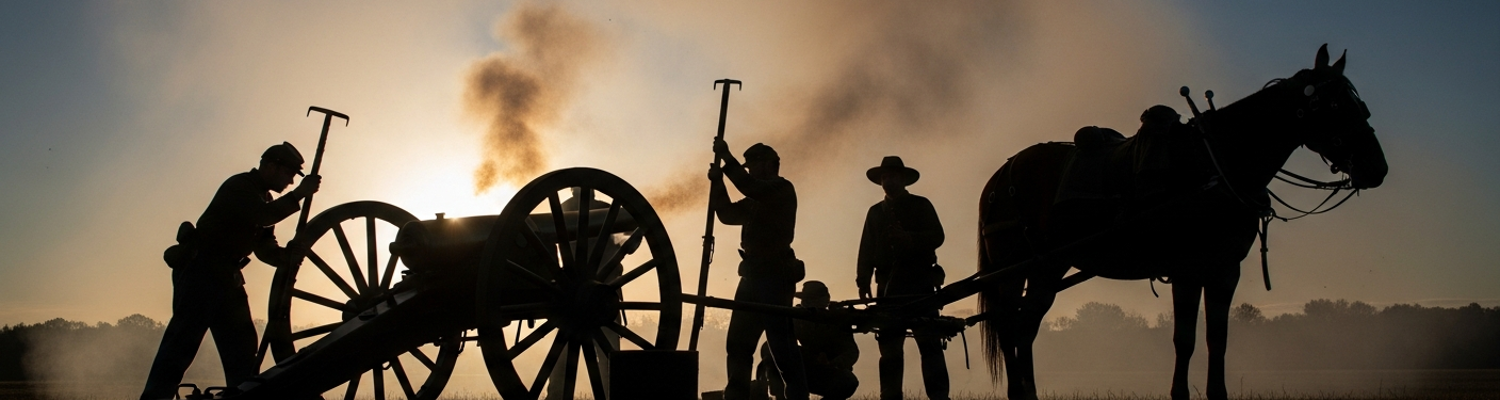
The Union Army’s Horse Artillery Brigades entered the Gettysburg Campaign as a specialized force, a fusion of cavalry speed and artillery firepower. Their doctrine demanded a punishing operational tempo: keep pace with fast-moving cavalry, deliver rapid fire support, and redeploy across the battlefield at a full gallop. Unlike conventional field artillery where cannoneers walked or rode on limber chests, every member of a horse artillery battery, from the gunner to the lowest-ranking driver, had his own mount. This complete motorization transformed the unit into a weapon system defined by its velocity. Such capability came at a steep logistical price. A single six-gun battery required over 114 horses to pull the guns, caissons, and supply wagons, and to mount the 155 officers and men. The constant need for forage and fresh mounts made these brigades a significant administrative burden, but one the Union high command deemed necessary.
At Gettysburg, the Army of the Potomac’s cavalry corps was supported by two such brigades. The First Brigade, under the command of Captain James M. Robertson, and the Second Brigade, led by Captain John C. Tidball, were composed of seasoned regulars. Both Robertson and Tidball were career artillerists, holding the modest rank of captain while commanding formations with the tactical weight of an infantry brigade. Their batteries were equipped with the premier mobile cannon of the war: the 3-inch Ordnance Rifle. This 820-pound tube of hammer-welded wrought iron was prized for its extraordinary accuracy, long range, and safety. It could fire a 9.5-pound shell with precision to over 1,800 yards, making it a superior weapon for engaging enemy artillery and breaking up infantry formations before they could close. Its lightweight construction, relative to the bronze 12-pounder Napoleon smoothbore, made it the ideal armament for horse artillery. A standard battery comprised six guns, each drawn by a six-horse team and served by a nine-man crew trained for rapid unlimbering and firing. Ammunition chests carried a lethal mix of percussion shells for hard targets, timed-fuse shrapnel for airbursts over infantry, and case shot, a lighter version of canister. For close-in defense, they carried canister rounds, turning the rifle into a massive shotgun. This combination of advanced ordnance and a doctrine of extreme mobility would be put to its ultimate test in the fields of Pennsylvania.
A Gallop to the Collapsing Flank
The second day of battle at Gettysburg demonstrated the immense value of this mobile firepower. As the afternoon of July 2nd wore on, Major General Daniel Sickles advanced his III Corps into a vulnerable salient, creating a battlefield crisis that rippled across the Union left. When Confederate assaults shattered Sickles's line at the Peach Orchard and Wheatfield, the Union command desperately needed to plug the gaps. While foot artillery fought and died in place, horse artillery batteries were used as a high-speed reaction force, dispatched at a gallop to stabilize crumbling sectors. The First Horse Artillery Brigade under Robertson was positioned near the center of the army, a ready reserve. As the situation deteriorated, its batteries were sent careening toward the sound of the guns.
Lieutenant John H. Calef's Battery A, 2nd U.S. Artillery, part of Tidball’s brigade, was ordered from its reserve position to support the III Corps. Arriving near the Trostle Farm, Calef found a chaotic scene of retreating Union infantry and advancing Confederates. He immediately brought his six 3-inch rifles into action, dueling with Confederate batteries and pouring fire into the infantry of Kershaw's South Carolina brigade. Under immense pressure, Calef’s battery was forced to conduct a difficult fighting withdrawal, leapfrogging sections of two guns at a time, each providing covering fire for the other as they pulled back. This maneuver, executed under heavy fire, was a textbook example of horse artillery tactics. It delayed the Confederate advance and prevented a complete breakthrough, buying precious time for General Gouverneur K. Warren to organize the defense of Little Round Top and for General Henry Hunt, the army's artillery chief, to build a new gun line on Cemetery Ridge.
Simultaneously, other batteries were thrown into the fray. The desperate stand of Captain John Bigelow’s 9th Massachusetts Battery, a foot artillery unit operating with the same mobile urgency, became legendary. Ordered to hold the Trostle Farm lane at all costs, Bigelow’s six 12-pounder Napoleons fired until they were nearly overrun, losing 80 of their 88 horses. Their sacrifice was critical, but it was the professional, orderly withdrawals of horse batteries like Calef's that showcased the doctrine's intent: to delay and disrupt, not to fight to annihilation. Robertson’s batteries, including Lieutenant Alexander C. M. Pennington’s Battery M, 2nd U.S. Artillery, were also engaged, moving rapidly to threatened points and adding their long-range fire to the defensive effort. This fluid deployment stood in stark contrast to the static, attritional fighting that characterized much of the battle. The horse artillery acted as a fire brigade, racing from one emergency to the next.
The Destructive Power of Canister and Case Shot
The ability of Union artillery to deliver overwhelming firepower at critical moments was a decisive factor at Gettysburg. At close quarters, this power was embodied by canister. A single round packed dozens of iron balls into a tin can that disintegrated upon firing, spraying a wide cone of metal that could obliterate the front ranks of an infantry regiment. Experienced gunners knew how to skip the shot off the ground, maximizing its deadly spread. A six-gun battery firing double canister, with two rounds loaded into each gun, could unleash a storm of metal that no infantry formation could withstand.
On July 3rd, while the main Confederate assault was being prepared, a separate and vital action took place in the fields east of Gettysburg. Confederate Major General J.E.B. Stuart’s cavalry division attempted to swing around the Union right flank and strike the army's rear. They were met by Union cavalry under Brigadier Generals David Gregg and George Custer. The ensuing fight, known as the Battle of East Cavalry Field, was decided by Union horse artillery. Pennington’s Battery M, 2nd U.S. Artillery, supported by sections from other batteries, deployed its six 3-inch Ordnance Rifles in a commanding position. Their superior range and accuracy systematically silenced the Confederate horse artillery under Major Robert Beckham. When the Confederate cavalry brigades formed up to charge, Pennington’s gunners tore into their dense formations with precisely aimed shell and case shot. The Confederate lines faltered and broke apart under the relentless fire before they could fully engage Custer’s troopers. Stuart’s threat to the Union rear was neutralized, a strategic victory made possible by mobile, accurate artillery.
During Pickett’s Charge, the climactic Confederate assault on Cemetery Ridge, the Union artillery response was a masterpiece of controlled violence orchestrated by General Hunt. While the bulk of the guns that met the charge were from corps and reserve field artillery, the principles of massed, mobile fire were paramount. Hunt ordered his gunners to hold their fire during the massive Confederate preliminary bombardment, conserving ammunition and deceiving the attackers into believing the Union guns had been destroyed. As the 12,000 Confederate infantrymen advanced, they were met by a converging hell of shell and shrapnel from dozens of cannons. As the attackers crossed the Emmitsburg Road, the order was given to switch to canister. The effect was catastrophic. Entire companies vanished in clouds of smoke and dust. While the horse artillery brigades were not positioned in the center of this maelstrom, their presence on the flanks was essential. They guarded the Taneytown Road and other approaches, ensuring that no Confederate support units or cavalry could exploit the flanks of the main Union line during its moment of greatest peril. They secured the arena in which the main event took place.
A New Doctrine Proven in Battle
The performance of the Union Horse Artillery at Gettysburg was a powerful validation of an evolving military doctrine. Historically, artillery was a ponderous weapon, dragged into a strong position to remain for the duration of a battle. The concept of horse artillery, purpose-built for high-speed maneuver and intimate cooperation with cavalry, represented a paradigm shift toward mobile warfare. The battle confirmed the wisdom of organizational reforms championed by officers like Henry Hunt. He had fought to create a centralized Artillery Reserve at the army level, wresting control of batteries from infantry division commanders. This gave the army commander the flexibility to deploy massed artillery as a strategic asset to the most critical point on the battlefield.
This system proved its worth unequivocally on July 2nd. As Sickles’s corps collapsed, it was the rapid deployment of batteries from the Artillery Reserve, combined with the inherent mobility of the horse artillery brigades, that enabled Hunt to stitch together the crumbling Union line. The ability to move a six-gun battery at a gallop from a reserve position to a threatened flank in minutes was a revolutionary capability. The actions of Calef's battery, and the readiness of Robertson's and Tidball's brigades, demonstrated the immense tactical value of mobile firepower as a crisis-response tool. This flexibility stood in sharp contrast to the Confederate system, where artillery was more rigidly attached to infantry divisions, limiting its ability to be massed or shifted to exploit opportunities or counter threats.
The battle also cemented the synergy between mobile tactics and advanced ordnance. The 3-inch Ordnance Rifle was the perfect instrument for this new form of warfare. Its light weight did not compromise its range or accuracy, allowing horse batteries to keep pace with cavalry, unlimber, fire effectively from a distance, and then limber up and move again before the enemy could effectively counter them. This was seen with devastating effect at East Cavalry Field, where Pennington’s battery dominated its Confederate counterparts and broke up cavalry charges from afar. The strategic successes were undeniable. Union horse artillery delayed the enemy on the battle's first day, stabilized a collapsing flank on the second, and protected the army’s rear on the third. Its limitations were logistical, centered on the immense organization of horses, men, and ammunition required for its operation. Gettysburg proved that artillery was no longer just a defensive sledgehammer. It was a mobile, rapier-like weapon that could react, adapt, and deliver decisive firepower at the fulcrum of battle.