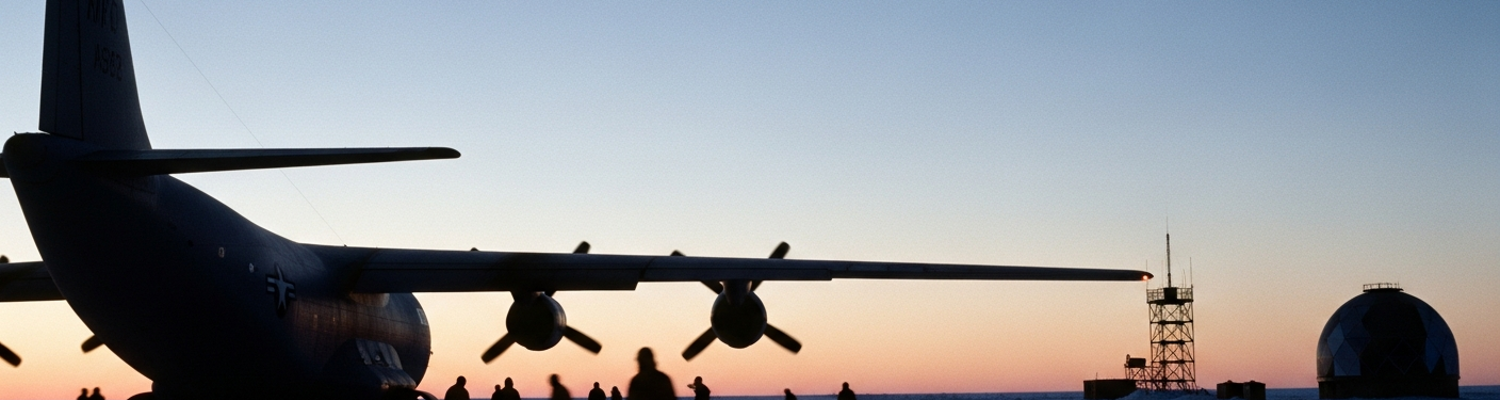

In 1952, a study group at the Massachusetts Institute of Technology confirmed a stark vulnerability in North American defense. A massive gap existed in radar coverage, leaving the continent blind to a Soviet bomber attack flying the short route over the North Pole. The strategic imperative became absolute, to plug the gap. The answer, authorized in 1954, was the Distant Early Warning Line, a 3,000-mile fence of radar stations across the 69th parallel. Constructing it between 1955 and 1957 was a war waged against the Arctic itself, a conflict defined by logistics, engineering, and the sheer hostility of the environment. The project, codenamed Project 572, forced a radical rewriting of doctrine for Arctic operations and became a defining logistical feat of the Cold War.
The Arctic Logistical Gauntlet
Project 572 demanded the movement of 460,000 tons of cargo into one of the planet’s most inaccessible regions. This material included everything from structural steel, fuel drums, and heavy machinery to prefabricated building panels and sensitive radar components. The United States Air Force, working with its partners, developed a multi-modal supply chain on a scale never before attempted in the polar regions. The plan was a three-pronged assault by sea, air, and land.
The annual sealift formed the backbone of the entire operation. During the brief and unpredictable Arctic summer shipping season, massive convoys organized by the U.S. Navy's Military Sea Transportation Service (MSTS) pushed north. These fleets, including cargo vessels, tankers, and Landing Ship, Tanks (LSTs), were often escorted by U.S. and Canadian icebreakers like the USS Glacier. Over three summers, these convoys delivered 281,600 tons of material. More than 3,000 U.S. Army Transportation Corps soldiers, specially trained for Arctic amphibious landings, managed the chaotic unloading process onto unimproved beaches. They raced against time and the encroaching sea ice, wrestling equipment ashore at sites that were little more than barren stretches of gravel and rock.
Where the sea routes ended or were impassable, air power took over. The DEW Line airlift was the largest commercial air operation of its era. A vast fleet of aircraft, spearheaded by the USAF’s Douglas C-124 Globemaster II, flew alongside planes from 50 Canadian and 31 U.S. commercial airlines. In total, these aircraft executed 45,000 flights over 32 months, delivering over 140,000 tons of cargo and personnel. The C-124s were the workhorses, their clamshell nose doors opening to disgorge bulldozers and generators directly onto hastily prepared gravel or ice runways. For eight inland sites completely inaccessible by sea, the airlift was the only lifeline. Pilots contended with extreme weather, whiteout conditions, and limited navigational aids, landing on airstrips up to 5,000 feet long that were themselves major construction projects carved from the frozen landscape.
The final link in the supply chain was the 'Cat Train'. These overland convoys of heavy-duty Caterpillar D8 tractors pulling long trains of sleds were essential for moving supplies from coastal depots to inland construction sites. These trains hauled 17,600 tons of material, clawing their way over sea ice and frozen tundra. Operators lived for weeks in 'wanigans', small living quarters built on sleds, enduring temperatures that could snap steel and the constant danger of tractors breaking through the ice. The treks were slow and perilous, but they were the only method to connect the main logistical arteries to the final, remote destinations.
Engineering on Frozen Ground
Building permanent structures in the Arctic presented a unique engineering problem, permafrost. The ground, frozen solid for centuries, would turn into an unstable slurry if the heat from the buildings caused it to thaw. This reality demanded a radical departure from conventional construction. Instead of fighting the cold, engineers had to incorporate it into their designs, developing techniques to keep the permafrost frozen.
The primary solution was to elevate buildings or place them on thick, insulating pads. The most common method involved drilling or steaming holes into the permafrost to set wooden or steel pilings. These pilings anchored the buildings several feet above the ground, allowing frigid air to circulate underneath and prevent any heat transfer to the ground. For heavier structures or where pilings were not feasible, engineers constructed massive gravel pads, some four to six feet thick. These pads acted as a thermal barrier, insulating the permafrost from the building’s heat and distributing the structure's weight to prevent catastrophic subsidence. The project required quarrying, crushing, and moving over 9.6 million cubic yards of gravel, a monumental task in an environment with little loose aggregate.
The buildings themselves were marvels of modular design. To accelerate construction and minimize exposure to the elements, prefabricated panels were used extensively. These panels, typically made of plywood and aluminum bonded to an insulating core, could be assembled quickly. The main buildings at most sites consisted of long 'module trains', interconnected structures that formed a self-contained habitat against the brutal Arctic winter. This standardized design allowed for rapid erection of the main, auxiliary, and intermediate stations across the entire 3,000-mile line.
The iconic white radomes, which protected the sensitive AN/FPS-19 search radars and AN/FPS-23 Doppler gap-filler radars from wind and ice, were also engineering feats. Assembling the fiberglass triangles of these 55-foot diameter spheres in gale-force winds and sub-zero temperatures required specialized crews and meticulous procedures. The entire construction process was a constant battle against an environment that actively worked to reclaim any ground gained by human effort.
A Coalition Against the Cold
The construction of the DEW Line was far too vast for any single organization. It demanded a complex partnership between military commands, government agencies, and private industry. While the U.S. Air Force Air Defense Command provided military oversight, the on-the-ground execution was a civilian-led enterprise. The Department of Defense selected the Bell System, with its subsidiary Western Electric as the prime contractor, to manage the entire project. This brought a corporate project management structure to a military-strategic problem. Bell Telephone Laboratories designed the sophisticated communications systems, while subcontractors like Puget Sound and Drake handled the physical construction.
The project was a joint U.S. and Canadian venture from its inception. The Canadian government, balancing concerns for national sovereignty with the reality of a shared threat, was a vital partner. Canada provided the land, facilitated surveys through its Department of Northern Affairs and National Resources, and ensured Canadian labor was utilized. The Royal Canadian Air Force worked alongside the USAF in planning and later operating the line. This deep cooperation laid the groundwork for the creation of the North American Air Defense Command (NORAD) in 1958, which institutionalized the joint defense of the continent.
The workforce was a diverse coalition of over 25,000 people. It included thousands of American and Canadian civilian contractors, from engineers and heavy equipment operators to cooks and clerks, who signed on for high pay and extreme hardship. An essential part of this workforce was the local indigenous population. Inuit workers were employed as guides, laborers, and equipment operators. Their innate knowledge of the local environment proved invaluable, and they were recognized as reliable and quick-learning members of the construction teams. The Canadian government created Northern Service Officer positions to manage the interactions between the massive influx of workers and the local Inuit communities, attempting to mitigate the social disruption to their traditional way of life.
Forging New Military Doctrine
The DEW Line project fundamentally altered U.S. military doctrine. It represented a major shift in air defense strategy, moving away from a point defense of key cities to a forward-interception model. The line's entire purpose was to provide four to six hours of warning time, enough to get Strategic Air Command’s nuclear-armed bombers off the ground and to scramble interceptor squadrons. This doctrine, known as 'defending the deterrent', prioritized the survival of America’s retaliatory capability. The DEW Line was the tripwire, the electronic frontier designed to ensure that a surprise first strike was impossible.
Logistically, the DEW Line was a brutal but effective teacher. It forced the Air Force and the Department of Defense to master the art of sustained, large-scale operations in the Arctic. The lessons learned in multi-modal transport, cold-weather engineering, and inter-agency project management became the foundation for all subsequent military activity in the polar regions. It proved that a massive technological and human presence could be established and sustained north of the Arctic Circle. The success of Project 572 broke the psychological barrier of the Arctic, demonstrating it was no longer an impassable frontier but an operational theater. The DEW Line’s frozen supply lines, forged in the urgency of the Cold War, did more than support the construction of radar domes; they built a new understanding of strategic reach and the enduring power of logistics.