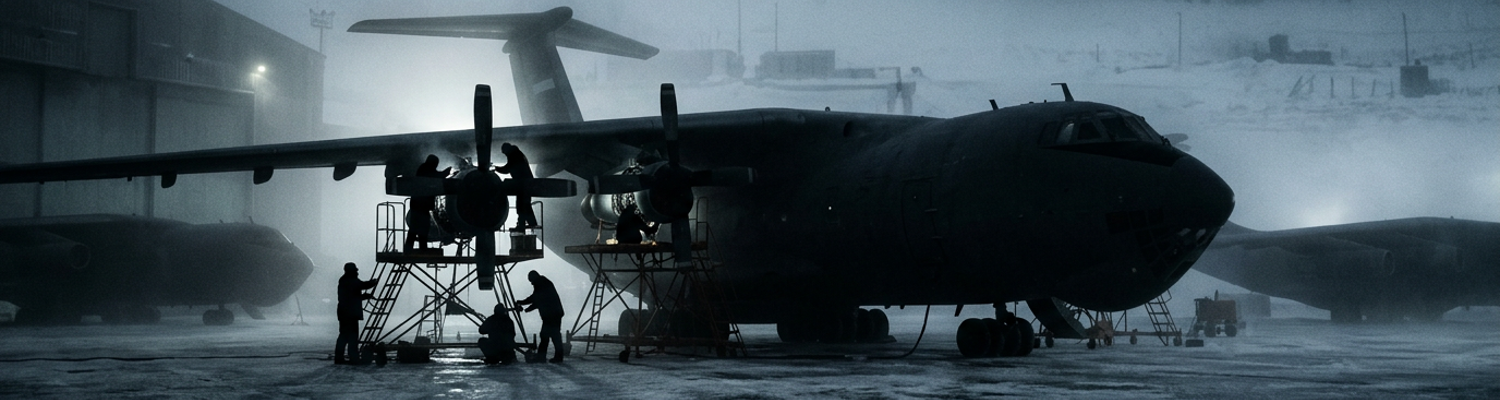

Tactical Airlift Fleet Grounding and Overhaul
By February 13, 1964, United States Strike Command officially grounded the remaining tactical airlift fleet at Elmendorf Air Force Base. The order mandated a complete overhaul of winterization protocols across all aviation units. The deployment exposed a severe inability to project power in sub-zero environments. Exercise Polar Strike was conducted across interior Alaska to test arctic operational readiness against simulated Soviet incursions. Air Force planners assigned multiple troop carrier wings to sustain the daily supply requirements of ground elements. Every phase of this timeline disintegrated within the first seventy-two hours.
A compounding sequence of atmospheric and mechanical failures led to a complete tactical airlift breakdown. The United States Air Force relied heavily on the C-124 Globemaster II and the newer C-130 Hercules to ferry supplies onto the ice-covered runways at Eielson Air Force Base. High-pressure systems trapped sub-zero moisture near the ground. Dense layers of ice fog formed immediately. Runway visibility dropped to less than fifty feet. Incoming flights halted. Aircraft that managed to land before the fog settled suffered severe mechanical degradation. Ground crews discovered that standard military specification hydraulic fluid thickened into a sludge. Landing gear refused to retract. Cargo ramps became completely immovable. Rubber O-rings inside the propeller pitch control assemblies shattered upon engine startup.
The massive Pratt and Whitney R-4360 radial engines on the C-124s refused to turn over.
Lubricating oil froze solid within the crankcases.
Personnel attempting to service these grounded transports became the next point of failure. Maintenance technicians working on the tarmac without adequate windbreaks sustained second-degree frostbite on their hands. This occurred within three minutes of removing their specialized arctic mittens to manipulate fine tools. Herman Nelson portable heaters deployed to thaw frozen engine nacelles frequently malfunctioned. They pumped high concentrations of carbon monoxide directly into the enclosed cargo bays. Loadmasters were attempting to secure loose pallets inside these bays during the heating process. Medical detachments recorded over two hundred cases of severe cold-weather injuries and fume inhalation among the flightline personnel during a four-day window. Field hospitals quickly ran out of heated shelter space. Mechanics were incapacitated. Replacement parts froze in transit. The backlog of unserviceable aircraft consumed all available parking aprons. Air traffic controllers diverted inbound supply flights to civilian airfields hundreds of miles away from the maneuver zone.
Medical Crises and Tanana River Field Amputations
A close review of operational logs indicates the airborne insertion phase triggered a mass casualty event before a single simulated shot was fired. At 0730 hours on February 11, C-130 Hercules transports carrying elements of the 82nd Airborne Division approached the Donnelly Drop Zone. They flew at an altitude of twelve hundred feet. The geographic coordinates of the drop zone (63 degrees 46 minutes North, 145 degrees 44 minutes West) placed the incoming aircraft directly into the center of a high-pressure arctic front. Ambient air temperatures sat at negative sixty-eight degrees Fahrenheit. The moment the jumpmasters opened the troop doors, the slipstream from the four Allison T56 turboprop engines accelerated the windchill. The temperature dropped to an estimated negative one hundred and ten degrees. Standard-issue M-1951 field jackets provided zero thermal retention against this extreme atmospheric anomaly. Experimental rubberized cold-weather boots failed completely. Paratroopers experienced immediate tissue freezing on any exposed skin as they stood in the paratroop doors waiting for the green light.
The parachute descent to the frozen tundra took exactly ninety-five seconds.
Upon impacting the ground, the crisis compounded rapidly across the drop zone. High surface winds dragged the paratroopers across jagged ice ridges before they could actuate their canopy release assemblies. The thick arctic mittens they wore to prevent frostbite made it physically impossible to manipulate the Capewell release mechanisms on their harnesses. Archival evidence shows that soldiers were forced to remove their hand protection to free themselves from their inflating parachutes. Exposure of bare skin to the windchill caused severe frostbite within forty-five seconds. Ice crystals formed in the intracellular fluid of their fingers. This destroyed vascular tissues and turned the skin a pale waxy white. Company commanders from the 504th Parachute Infantry Regiment reported that over four hundred men suffered second and third-degree frostbite before the first defensive perimeter was established.
Medical evacuation requests flooded the battalion radio nets by 0900 hours.
Tactical flight surgeons attached to the 5th Infantry Division attempted to establish forward casualty collection points. Planners had designated a stretch of the frozen Tanana River near Big Delta as a tactical landing zone for medical evacuation flights. Four C-130 transports parked directly on the river ice to serve as temporary triage centers. The auxiliary power units on these aircraft failed to generate enough continuous electrical output to run the internal cargo bay heating systems. Ambient temperatures inside the aluminum fuselages dropped to negative forty degrees within twenty minutes of engine shutdown. Blood plasma supplies shattered inside their glass vials. Syringes clogged as morphine syrettes froze solid in the hands of the medics. Flight surgeons found themselves entirely overwhelmed by the heavy volume of severe cold-weather injuries pouring in from the surrounding drop zones.
Triage protocols collapsed completely within the first hour of the operation.
With no heated shelter available and tissue necrosis spreading rapidly among the airborne troops, medical officers authorized emergency field amputations to prevent systemic gangrene. Surgeons operated by the dim glow of battery-powered flashlights in the completely unheated cargo holds of the grounded aircraft. Post-exercise medical reports detail the primitive conditions of these procedures. Stainless steel surgical scalpels froze instantly to the exposed flesh of the patients upon contact. Medical personnel resorted to using standard-issue combat knives and heavy wire cutters from aircraft maintenance kits to sever gangrenous digits. The lack of liquid anesthetics forced medics to physically restrain patients against the aluminum deck tie-downs. Flight surgeons worked down rows of incapacitated soldiers. They removed blackened fingers and toes without sterile fields or proper surgical instruments.
Medical logs from the 326th Medical Battalion list sixty-four separate procedures involving the removal of necrotic tissue with non-surgical aviation shears.
Temperature Inversions and Trailing Wire Antenna Snaps
Operational flight logs from February 12 reveal a severe atmospheric anomaly suspended directly over the Yukon-Tanana terrain. High-pressure ridges trapped dense, supercooled air in the valleys near 64 degrees 44 minutes North, 147 degrees 12 minutes West. This pushed ground temperatures down to negative sixty-two degrees Fahrenheit. Above this freezing surface layer, a severe arctic temperature inversion dominated the airspace. Warm air masses moving from the Gulf of Alaska slid directly over the trapped cold air. Flight crews from the 317th Troop Carrier Wing climbing out of Eielson Air Force Base hit this boundary layer at exactly three thousand feet above sea level. The outside air temperature gauge on a climbing C-130B transport would read negative sixty degrees at two thousand feet. It would then spike violently to positive twenty-five degrees within sixty seconds of vertical ascent. Pilots experienced rapid thermal shifts that stressed the physical integrity of every flying aircraft in the theater.
The aluminum skin of the transports expanded and contracted at rates exceeding factory design limits.
Maintenance reports detail the immediate damage inflicted by these violent temperature fluctuations. Moisture accumulated rapidly inside the unpressurized aft fuselage sections as the aircraft transitioned from sub-zero air into the warmer inversion layer. This condensation pooled along the lower aluminum longerons and unsealed avionics bays. When the aircraft descended back through the inversion boundary to execute simulated tactical airdrops at one thousand feet, the pooled water froze solid in under two minutes. Ice expanded inside the flight control cable pulleys. This jammed the elevator trim tabs in fixed positions. Navigators documented their radar scopes shorting out as frost melted and dripped directly into the high-voltage power supplies during the ascent. The cooling fans froze solid during the descent. The physical strain of moving between extreme temperature zones caused the rubber pressure seals around the main cargo doors to crack and blow out entirely. This instantly depressurized the flight deck.
Communication networks failed entirely across the maneuver area.
Commanders at United States Strike Command relied on High Frequency radio networks to coordinate the complex airborne insertions across the vast Alaskan interior. C-130B transports utilized specialized trailing-wire HF antennas to transmit these long-range signals over the curvature of the earth and bypass the mountainous terrain. Loadmasters spooled out over two hundred feet of copper-clad steel wire from a mechanized winch located in the tail section of the aircraft. Standard operating procedures required this wire to trail behind the aircraft in the slipstream to establish a resonant radio frequency with ground stations in Fairbanks. The extreme cold at the surface layer caused the insulating neoprene sheath and the internal copper core to undergo a rapid ductile-to-brittle transition. At negative sixty degrees, the metal lost all elasticity.
Aerodynamic flutter in the wake of the four turboprop engines violently battered the embrittled lines.
Archival evidence shows a near-total loss of long-range radio contact between the inbound troop carriers and the forward command posts by mid-morning. As the C-130B transports descended through the inversion layer, the sudden drop in temperature flash-froze the trailing wires while they were fully extended. The mechanical shock of penetrating the turbulent boundary layer caused the frozen copper-clad steel to snap off just inches from the tail cone fairings. Flight crews sitting in the cargo bays reported hearing loud metallic cracks as the heavy wires broke away and fell into the frozen wilderness below. Without functional HF antennas, the aircraft lost all ability to receive updated weather reports or abort codes from the 21st Air Division headquarters. Pilots operating under strict radio silence protocols found themselves flying completely blind into the dense ice fog covering the Donnelly Drop Zone. Formation leaders fired physical red distress flares from their cockpit windows to signal an immediate abort of the drop sequence. Individual aircraft banked sharply away from the formation to avoid mid-air collisions. Navigators directed the planes by dead reckoning back toward civilian airfields near Anchorage with their cargo holds still packed with freezing infantrymen.
Auroral Storms and Defense Intelligence Agency Blackouts
Across the Bering Strait, the Soviet Far East Military District maintained twenty-five motorized rifle divisions and three thousand armored vehicles on high alert. Red Army aviation regiments operated hundreds of Tupolev Tu-16 bombers out of forward bases in Anadyr and Provideniya. These airfields sat less than five hundred miles from the Alaskan coastline. United States Alaskan Command possessed exactly two understrength infantry brigades to defend six hundred thousand square miles of territory. War games consistently projected that a conventional Soviet armored thrust across the frozen Bering Sea would overrun early warning radar sites at Cape Lisburne within twelve hours. Facing an adversary outnumbering them ten to one in conventional ground forces, United States Strike Command depended entirely on the rapid deployment of the 82nd Airborne Division from bases in North Carolina to reinforce the defensive line.
This defensive strategy required uninterrupted long-range radio coordination between airborne troop carriers and ground command posts.
A close review of operational logs indicates that an intense period of solar activity intersected directly with the airborne insertion phase on February 13. High-energy charged particles ejected from a solar flare struck the magnetosphere of the Earth. This triggered massive auroral ionospheric storms directly over the Alaskan theater. These geomagnetic disturbances violently altered the electron density of the ionosphere above 64 degrees North latitude. Standard military communications relied on High Frequency radio waves transmitting between two and thirty megahertz to bounce off the ionospheric F-layer and reach receivers beyond the line of sight. The auroral storm supercharged the lower D-layer of the atmosphere. This caused the layer to absorb these radio waves entirely rather than reflecting them. Radio operators at the 21st Air Division headquarters at Elmendorf Air Force Base attempted to broadcast updated drop zone coordinates to inbound C-130 Hercules transports using Collins KWT-6 transmitters. One-kilowatt signals dissipated into the heavily ionized atmosphere before traveling fifty miles. Airborne navigators twisting the frequency selector dials on their AN/ARC-58 radio sets heard only heavy static and solar hiss. The blackout severed all contact between the airborne armada and the ground controllers at Fort Greely.
Entire squadrons flew blindly toward drop zones shrouded in dense ice fog.
Defense Intelligence Agency technical observers embedded at the Big Delta forward operating base documented the complete breakdown of these long-range command communications. Analysts operating out of unheated canvas tents near coordinates 64 degrees 09 minutes North, 145 degrees 50 minutes West monitored the spectrum analyzers connected to the tactical radio nets. Their field reports detail a chronological collapse of the command structure between 0800 and 1130 hours. When the primary HF voice channels failed, command staff ordered radio operators to switch to encrypted KW-26 Romulus teletype machines (Block IV variants). Auroral interference scrambled the cryptographic synchronization pulses. This resulted in pages of garbled text printing out on the teletype receivers. DIA technicians recorded the failure of sixty-two consecutive transmission attempts from the Joint Task Force commander trying to issue a theater-wide abort order. With HF networks dead, officers attempted to relay messages using Very High Frequency line-of-sight radios. The granite peaks of the Alaska Range completely blocked the VHF signals. Observers noted that commanders possessed no secondary means to contact the troop carrier wings.
The exercise degenerated into hundreds of isolated tactical elements operating without central direction.
Post-exercise autopsies reveal the specific mechanical adjustments ground crews attempted in order to pierce the blackout. Signal Corps technicians at the Donnelly Drop Zone extended standard dipole antennas by splicing an additional one hundred feet of copper wire to the terminal ends. They hoped to catch lower frequency bands. They strung these makeshift arrays between the frozen trunks of black spruce trees using nylon parachute cord. Modified antennas failed to achieve resonance. Ambient temperatures of negative sixty degrees Fahrenheit caused the copper wire to shrink. This increased electrical resistance and burned out the final amplifier tubes in the PRC-47 manpack radios (National Stock Number 5820-00-892-3514) upon keying the handset. Logs filed by the DIA list the exact serial numbers of fourteen different radio sets destroyed by these impedance mismatches within a three-hour window.
Freeze Thaw Mechanics and Tactical Avionics Failures
The physical environment inside the tactical airlift fleet destroyed its own electronic infrastructure. Military planners assigned the 62nd Troop Carrier Wing to sustain continuous supply drops out of Eielson Air Force Base. This facility was located at coordinates 64 degrees 39 minutes North, 147 degrees 06 minutes West. Flight crews operating C-130B Hercules and C-124 Globemaster II transports utilized high-output Janitrol gas combustion heaters to maintain survivable temperatures within the unpressurized cargo bays during flight. One hundred fully equipped infantrymen exhaling constantly into the enclosed space generated high volumes of water vapor. This airborne moisture migrated toward the coldest surfaces of the aircraft interior. Condensation formed thick layers of frost directly onto the uninsulated aluminum bulkheads. It also coated the metal equipment racks housing the primary avionics packages.
The transition from heated flight operations to sub-zero parking aprons triggered a rapid physical state change.
Ground crews at the Fort Greely forward operating base near 63 degrees 58 minutes North, 145 degrees 44 minutes West opened the massive aft cargo ramps to offload the 5th Infantry Division. Ambient air at negative sixty-five degrees Fahrenheit flooded the compartments. The accumulated condensation flash-froze instantly. Ice coated the exposed wiring harnesses and internal relay boxes of the AN/ARC-27 Ultra High Frequency transceivers. Archival evidence shows that maintenance personnel applied external 28-volt DC power carts to restart the aircraft hours later. The internal combustion heaters melted this frost directly into the unsealed avionics bays. Water pooled across the high-voltage terminal boards. Circuit breakers tripped violently. Copper wiring shorted out under the heavy electrical load. This produced thick electrical smoke that filled the flight decks and forced crews to execute emergency shutdown procedures on the tarmac.
Technicians recorded a ninety-two percent failure rate for all primary communications hardware within a thirty-six-hour window.
Navigational electronics suffered identical degradation sequences that permanently stranded the airlift units in interior Alaska. Pilots relied heavily on the AN/ARN-21 Tactical Air Navigation system to locate auxiliary landing strips hidden under dense ice fog. Moisture intrusion inside these receiver-transmitter units caused the mechanical tuning gears to rust and seize solid after a single freeze-thaw cycle. Flight instruments dependent on gyroscopic stability failed entirely across the theater. The J-8 artificial horizon indicators utilized delicate internal bearings lubricated with specialized synthetic oils designed for standard operating climates. Extreme cold exposure during prolonged ground delays caused this liquid lubricant to solidify into a rigid paste. Vacuum lines driving the directional gyros became completely blocked by expanding ice crystals. Pilots initiating their pre-flight checks discovered their attitude indicators spinning erratically. Many were locked permanently in a pitched-down position despite the aircraft sitting level on the frozen concrete.
Aircrews possessed no reliable data to verify their heading or altitude.
Commanders from the 21st Air Division faced an unrecoverable operational deficit. Flying heavy transport aircraft through the granite peaks of the Alaska Range required fully functional instrument flight rules capability. Grounding orders were issued at 1400 hours on February 14 for all units operating north of the 60th parallel. Over forty C-130 and C-124 transports sat immobilized on the parking aprons at Ladd Field and Eielson Air Force Base. Mechanics lacked the heated hangar space required to pull the avionics chassis out of the airframes and bake the moisture out of the circuitry. Replacement gyroscopes shipped from logistics depots in California arrived via unheated railcar completely frozen and mechanically unusable. Squadron logs from the 317th Troop Carrier Wing list sixty-two separate aircraft designated as non-mission capable due to shattered altimeter glass and flooded radio compasses.