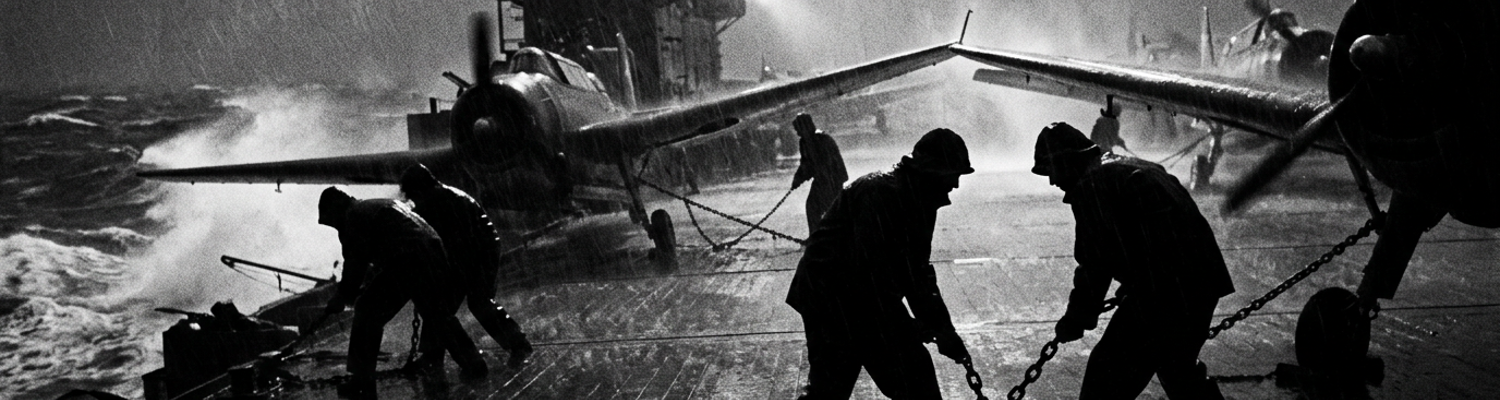

Third Fleet Strategic Objectives Off the Philippines
17 December 1944. Coordinates 14 degrees 50 minutes North, 129 degrees 57 minutes East.
Archival evidence shows Admiral William Halsey commanded the United States Third Fleet from the enclosed flag bridge of the battleship USS New Jersey. His staff directed a large-scale series of air strikes supporting operations in the Philippines throughout December 1944. The strategic directive involved neutralizing Japanese aviation units to protect General Douglas MacArthur and his amphibious landings on the island of Mindoro. Halsey and his senior planners operated within a sealed command center filled with steel bulkheads and cipher machines. They formulated blind strategic decisions miles away from the vanguard combat units. Information reached the flag plot exclusively through delayed radio teleprinter messages.
Junior officers updated large plotting tables using contact reports that were often four to six hours out of date.
The high command required the fleet to stay positioned roughly three hundred miles east of Luzon. This maintained a constant combat air patrol over the invasion beaches. This geographical restriction forced the ships to maneuver within a narrow patch of the Philippine Sea. Top-ranking officers evaluated the campaign entirely through paper overlays and decrypted intercepts rather than direct observation of the physical environment.
Radio silence protocols masked the deteriorating sea conditions outside the flag plot.
A close review of operational logs indicates Task Force 38 maintained continuous offensive carrier operations against Japanese land installations. Vice Admiral John S. McCain commanded this specific task force. Between December 14 and December 16, air groups from fleet carriers including USS Lexington, USS Hancock, and USS Ticonderoga launched thousands of sorties. Their primary targets consisted of Clark Field and other major airbases dotting the Luzon terrain. Fighter squadrons deployed 500-pound general-purpose bombs to crater concrete runways. They fired standard .50-caliber machine guns into parked Mitsubishi A6M Zero interceptors. Generating these continuous flight schedules demanded rapid and repeated course changes.
Carriers had to turn directly into the prevailing winds at speeds exceeding twenty-five knots to launch and recover aircraft safely.
Running at high velocity for three consecutive days rapidly depleted the unrefined fuel oil reserves of the escort screen. Destroyers burned fuel in massive quantities to keep pace with the fast carriers. McCain and his staff prioritized sortie generation over immediate replenishment during the strikes. The continuous high-speed maneuvering caused ships of the Farragut and Fletcher classes to drain their bunkers to critically low levels.
Destroyers like USS Spence reported fuel states dropping below fifteen percent capacity.
These lightweight vessels lost their deep drafts. Riding dangerously high in the water severely compromised their hydrostatic stability. Staff accountants inside the flag bridge of the USS New Jersey reviewed the daily fuel consumption spreadsheets. They scheduled a mandatory at-sea replenishment rendezvous. Task Force 38 received orders to disengage from the Luzon coastal waters and proceed eastward to meet the fleet oilers of Captain Jasper Acuff and his Task Group 30.8.
Communications delays prevented the immediate transmission of localized barometric pressure readings from the outer picket ships.
Staff officers plotted the refueling coordinates based entirely on scheduled timetables rather than real-time environmental data. Halsey directed the fleet to specific grid squares assuming standard winter trade winds. The physical isolation of the headquarters meant senior admirals could not feel the changing ocean swells. They could not see the rapidly dropping cloud ceilings. Course headings went out to the entire armada based on aerological forecasts drafted over twenty-four hours earlier by weather stations in Hawaii and the Marianas. Captains of the escort destroyers received encrypted orders to prepare their deck crews for complex underway replenishment procedures involving heavy rubber hoses and steel tension cables.
Emergence of Typhoon Cobra in the Philippine Sea
Archival evidence shows aerological officers aboard the light cruiser USS Miami logged a sharp decline in barometric pressure on the morning of December 17. The standard atmospheric pressure of 1013 millibars plummeted past 990 millibars within a four-hour window. This steep gradient directly indicated a rapidly organizing tropical cyclone forming east of the Philippine Sea. Weather stations in Saipan and Pearl Harbor lacked the proximity to detect this localized cyclogenesis.
The physical instruments aboard the outer picket destroyers recorded the atmospheric collapse in real time.
Aneroid barometers mounted on the bulkheads of the USS Dewey and USS Aylwin showed the pressure dropping below 980 millibars. Junior quartermasters tapped the glass dials. They watched the needle sink lower with each passing hour. Chief petty officers noted the physical air felt heavy and damp within the unventilated below-deck compartments. The barometric pressure drops indicated an approaching storm system east of the Philippine Sea with absolute mathematical certainty. This raw data never penetrated the command bubble.
The headquarters staff aboard the USS New Jersey remained isolated from these localized anomalies.
Radio operators on the destroyers attempted to transmit the alarming barometric readings back to the flag plot. Atmospheric static generated by the tightening isobars degraded the high-frequency radio bands. The transmissions turned into unintelligible noise. Halsey and his aerological officers continued plotting standard winter weather patterns on their charts. They failed to recognize the localized pressure drop as the leading edge of a severe tropical cyclone.
The barograph needles aboard the fleet oilers traced a nearly vertical downward line across their paper drums.
Task Force 38 sailed directly into the tightening pressure gradient of the unmapped storm system. When examining the historical record, ship logs detail a rapid escalation of atmospheric turbulence shortly after the aborted refueling attempts. Wind velocities escalated from standard twenty-knot trade winds to sustained gales. Anemometers mounted on the mastheads of the fleet carriers registered wind speeds exceeding 70 knots by the morning of December 18.
Task Force 38 entered severe atmospheric turbulence.
The physical force of this air mass stripped the heavy canvas covers off the 5-inch gun mounts. Heavy cruisers and battleships pitched violently against the changing sea state. Top-heavy destroyers suffered the worst of the aerodynamic assault. The 70-knot winds caught the exposed superstructures of the Farragut-class destroyers. This acted against the steel plating to push the ships into severe rolls. Standard steering commands became useless. The wind sheer drove solid sheets of seawater horizontally across the flight decks of the USS Monterey and USS Cowpens.
The physical pressure of the 70-knot gusts overwhelmed the steel tie-down cables securing the parked F6F Hellcat fighters.
Aircraft weighing over twelve thousand pounds broke loose from their chocks. They slid across the wooden flight decks. The wind drove these aircraft into one another. The impacts sheared off wings and ruptured aviation fuel tanks. Deck crews attempting to secure the loose airframes were blown entirely off their feet.
A close review of operational logs indicates the severe atmospheric turbulence dismantled the sensory equipment of the fleet.
The 70-knot winds bent the SC-2 radar antennas. They snapped the YE homing beacons mounted on the highest points of the carrier masts. Commanders inside the flag bridge lost their electronic capability to track the formation of their own ships. The low barometric pressure center generated towering cross-seas that collided with the wind-driven swells. Ships fell into deep troughs between sixty-foot waves. The anemometer cups spun violently until the internal bearings seized or the assemblies tore away from the masts entirely.
Intense barometric pressure drops combined with the 70-knot winds created a vacuum effect within the ship ventilation systems.
This sucked seawater down into the engine rooms. Captains navigated blindly through the zero-visibility turbulence using only magnetic compasses and manual helm control. The fleet oilers struggled to maintain headway against the sheer force of the sustained gusts. These ships carried thousands of tons of bunker fuel. Destroyers riding high in the water due to their depleted fuel bunkers caught the full broadside impact of the wind.
The USS Hull rolled past seventy degrees.
Third Fleet Headquarters and Delayed Communications
When examining the historical record, the flow of aerological data from Pacific Fleet headquarters to the combat units suffered from severe systemic delays. Meteorologists stationed at Fleet Weather Central in Hawaii generated daily synoptic charts. They used reports gathered from distant land stations and high-altitude patrol aircraft. These officers drafted regional forecasts for the Philippine Sea and transmitted them across the Pacific via low-frequency radio broadcasts.
The encryption process required clerks to manually convert the weather data into cipher blocks using ECM Mark II machines.
This standard procedure added hours to the transmission timeline. The low-frequency radio signals eventually reached the steel antennas of the USS New Jersey. Operators recorded the encrypted intercepts on perforated paper tape. Decoding teams working in the cramped cipher rooms of the flagship then reversed the process to produce plaintext documents. Commander George Kosco served as the Third Fleet aerological officer. By the time he reviewed the typed sheets, the barometric readings and wind vectors were already twelve to twenty-four hours out of date.
The vast geographic distances between the Hawaiian weather center and the Philippine Sea meant the data reflected atmospheric conditions that no longer existed.
Kosco updated the headquarters plotting board based entirely on this stale intelligence. The fleet headquarters operated entirely blind to the localized atmospheric collapse happening directly outside their bulkheads. Archival evidence shows this delayed communication chain completely isolated the tactical carrier commanders operating within Task Force 38. Vice Admiral John S. McCain and his subordinate task group commanders relied exclusively on the official Pacific Fleet weather bulletins to make navigational decisions.
Officers aboard the flag bridges received direct orders to disregard their own local barometric drops.
Staff commands instructed them to wait for the official headquarters updates before altering course. Local aneroid barometers on the outer picket ships showed pressure dropping at alarming rates. Standard operating procedures prevented individual captains from breaking radio silence to report these localized pressure drops. The carrier commanders sat in their armored flag plots. They remained separated from the physical environment by layers of steel and rigid chain-of-command protocols.
These admirals stared at paper maps showing clear weather.
Sixty-foot swells began slamming into the flight deck supports of their own vessels. Every tactical decision depended on radioed forecasts that no longer matched the physical ocean. A close review of operational logs indicates rigid operational directives forced the entire armada to maintain a precise geometric formation despite the rapidly deteriorating sea states. Third Fleet orders required Task Force 38 to hold a tight circular screen. This protected the high-value Essex-class fleet carriers from potential Japanese submarine attacks.
Regulations dictated that screening destroyers of the Fletcher and Farragut classes maintain exact distances of two thousand yards from the heavy ships.
Captains navigated their vessels using specialized plotting boards to keep their exact station bearing and range. The wind speeds escalated past fifty knots. The ocean surface fractured into deep troughs. These formation orders became highly dangerous. Ship commanders lost the ability to independently maneuver their vessels to ride out the heavy swells. They could not turn their bows directly into the oncoming waves to minimize rolling.
The heavy carriers dictated the movement of the entire formation.
Maintaining this strict formation forced the lightweight destroyers to execute dangerous helm commands. Officers on the USS Monterey and the USS Cowpens ordered their helmsmen to apply full rudder inputs simply to keep pace with the fleet carriers ahead of them. Heavy seas caught the flat sides of the light carriers and destroyers as they attempted to hold the mandated heading. Seawater flooded the ventilation intakes and poured over the main decks. Headquarters dictated a specific rendezvous point with the refueling oilers of Task Group 30.8. Halsey and his staff refused to authorize any deviation from the designated compass heading.
The fleet maintained a speed of fifteen knots on a southern track.
This drove the ships broadside to the massive wave fronts rather than slicing through them. Destroyers rolled past forty degrees as they fought to stay within their assigned two-thousand-yard grid boxes. Water rushed down the exhaust stacks of the smaller vessels. This threatened to extinguish the boiler fires. Strict adherence to the navigation plan stripped the individual captains of their ship-handling autonomy. Bridge crews watched the inclinometers tilt toward the capsizing point while strictly following the fleet speed requirements printed on their daily operational orders.
Flight Deck Vulnerabilities and Structural Fatigue
Archival evidence shows deck handling crews aboard the light carriers USS Monterey and USS San Jacinto received no orders to strike their aircraft below to the hangar decks on the morning of December 18. Fleet doctrine required rapid sortie generation. This dictated that Grumman TBF and General Motors TBM Avenger torpedo bombers remain spotted on the open flight decks. These single-engine aircraft weighed roughly ten thousand five hundred pounds empty. They occupied significant square footage with their fifty-four-foot wingspans folded back against their fuselages.
Aviation boatswain mates parked the bombers in tight geometric grids along the aft sections of the wooden flight decks to maximize available launch space.
Task Force 38 commanders kept the fleet on a strict heading that positioned the narrow-hulled light carriers broadside to the escalating wave fronts. This strict navigational directive forced the ships into severe roll angles exceeding thirty-five degrees. The extreme list shifted the center of gravity for every parked Avenger far outside its engineered tolerances. High-octane aviation gas sloshed violently inside the internal wing tanks of the aircraft. This created unpredictable dynamic loads that pulled against the securing hardware.
The heavy engines mounted in the noses of the aircraft dragged the airframes downward toward the port side deck edges as the carrier leaned into the troughs.
The severe incline transformed the wet wooden flight decks into steep drop-offs. When examining the historical record, the mechanical limitations of standard naval aviation tie-downs become immediately apparent during these extreme weather events. Deck crews secured the Avengers using heavy wooden wheel chocks and standard half-inch steel wire ropes attached directly to the recessed carrier deck pad-eyes. Violent pitching motions from the sixty-foot swells forced the ship bows to rise and fall by dozens of feet within seconds.
This rapid vertical acceleration drove the massive torpedo bombers down into the deck plates with multiplied gravitational force.
The aircraft oleo struts compressed completely under the weight. This bottomed out the hydraulic shock absorbers. Rebound kinetics then threw the airframes upward against the restraining cables. The continuous up-and-down movement inflicted severe structural fatigue directly onto the aluminum airframes. Landing gear assemblies absorbed lateral and vertical kinetic shocks they were never designed to withstand. Steel attachment points on the aircraft bellies began to stretch and deform under the cyclical stress.
Aluminum bulkheads inside the wheel wells buckled.
This compromised the structural integrity of the wing roots. Solid sheets of green water crashed over the carrier bows and slammed directly into the parked squadrons. A close review of operational logs indicates the combination of severe roll angles and violent pitching eventually exceeded the tensile strength of the securing equipment. Snap-lines on the secured naval aircraft parted with explosive force as the steel wire ropes snapped under the kinetic strain.
Sections of frayed cable whipped across the flight decks.
This posed a lethal hazard to any damage control parties attempting to reinforce the lines. Without their primary restraints, the heavy TBF Avengers jumped their wooden chocks. The torpedo bombers slid sideways down the sharply angled decks of the Independence-class carriers. Heavy aluminum landing gear struts snapped off completely upon lateral impact. This dropped the aircraft fuselages directly onto the wet wood.
The loose Avengers crashed directly through the adjacent rows of parked F6F Hellcat fighters.
Propeller hubs smashed through engine cowlings while sheared metal sliced through aluminum wing panels. The collisions ruptured internal fuel bladders. This spilled hundreds of gallons of 100-octane aviation gas across the deck plates of the USS Monterey. Electrical sparks generated by the grinding metal ignited the pooling fuel. This initiated localized fires directly above the ship magazines. The structural failure of a single aircraft tie-down triggered a cascading physical collapse of the entire spotted deck arrangement.
Strike Readiness Directives Amid Extreme Weather
A close review of operational logs indicates Vice Admiral John S. McCain issued direct teleprinter instructions requiring Task Force 38 to maintain immediate combat flight status throughout the morning of December 18. Officers aboard the fleet carrier USS Lexington transmitted orders to their air groups to keep Grumman F6F Hellcats and TBM Avengers fully armed and spotted for emergency launch. The tactical directive demanded a continuous combat air patrol to protect the fleet from land-based Japanese bombers staging out of Luzon airfields.
Aviation machinists operated on the exposed wooden flight decks to keep the eighteen-cylinder Pratt and Whitney R-2800 radial engines warm.
These crews ran the aircraft engines at low RPM intervals every thirty minutes. This prevented the heavy lubricating oil from congealing in the dropping temperatures. Sustained gale-force winds exceeding forty-five knots drove horizontal sheets of rain into the engine cowlings. This flooded carburetor air scoops and shorted out exposed ignition harnesses. Mechanics strapped themselves to the heavy landing gear struts using standard hemp ropes just to avoid being blown overboard.
Archival evidence shows the rigid adherence to these strike readiness directives forced deck crews into highly dangerous ordnance handling procedures.
Armorers aboard the light carrier USS San Jacinto received orders to keep 2,000-pound Mark 13 aerial torpedoes mounted inside the bomb bays of the spotted Avengers. Loading these heavy steel cylinders required teams of ten men using manual hydraulic lift trucks. The ship rolled violently through twenty-five-degree arcs while the crews attempted to align the torpedo suspension lugs with the aircraft bomb racks. Steel wheels on the lift trucks lost traction on the wet deck plates.
This caused the specialized loading equipment to slide laterally into the aircraft fuselages.
Aviation ordnancemen physically wedged their bodies against the heavy metal casings to prevent the torpedoes from rolling off the dollies. Commanders inside the flag bridge refused to authorize the squadron commanders to strike the armed aircraft below to the enclosed hangar decks. The headquarters staff prioritized the theoretical capability to launch an immediate counter-strike over the physical safety of the deck handling crews. The heavy torpedoes hung suspended by single steel bands directly over the wooden flight decks.
When examining the historical record, the intersection of this mandated strike readiness and the deteriorating sea state generated severe fuel management problems across the task force.
Screening destroyers like the USS Hickox and USS Maddox burned fuel oil at high rates to maintain their designated screening stations while the carriers attempted to find stable headings for flight operations. Standard naval aviation protocols required the fleet carriers to turn directly into the wind and accelerate to twenty-five knots. This generated sufficient airflow over the flight decks for catapult launches. The massive sixty-foot swells generated by the approaching typhoon made this standard maneuver mathematically impossible.
Turning the eight-hundred-foot hulls of the Essex-class carriers into the oncoming wave fronts caused the ships to pitch vertically by more than forty feet.
The bows of the carriers buried themselves deep into the troughs. This scooped hundreds of tons of seawater over the forward flight decks and directly into the catapult tracks. Water flooded the steam catapult cylinders. This instantly neutralized the primary launch mechanisms. Flight operations ceased entirely as the pitching decks prevented both the launching and recovery of aircraft. Carriers could no longer deploy their combat air patrols.
The fleet stayed locked in its high-speed maneuvering patterns attempting to find stable water.
This continuous evasion rapidly drained the available bunker oil in the escorting destroyers. Engineering officers aboard the USS Spence reported their fuel tanks had dropped below ten percent capacity. The lack of liquid ballast in the lower hull sections caused the destroyer to ride abnormally high on the ocean surface. This drastically raised its center of gravity. Ship commanders requested permission to flood their empty fuel bunkers with heavy seawater to restore hydrostatic stability.
Task Force 38 regulations strictly prohibited this practice.
Salt water contaminated the fuel lines and required extensive shipyard maintenance to flush out the boiler manifolds. Destroyer captains steered their top-heavy vessels through fifty-knot crosswinds with empty lower hulls.
Torpedo Squadron 11 Tactical Doctrine Overrides
A close review of operational logs indicates flight deck officers aboard the fleet carrier USS Hornet faced a severe structural crisis on the morning of December 18. Senior staff aboard the USS New Jersey issued teleprinter directives demanding all squadrons maintain standard spotted deck arrangements for immediate strike readiness. The flag plot commanders evaluated the fleet status entirely through paper reports. They remained blind to the physical conditions of the hurricane-force winds tearing across the carrier decks.
Heavy seas generated by the unmapped cyclone pitched the steel carrier deck vertically by over forty feet within a matter of seconds.
Standard Bureau of Aeronautics tie-down procedures required deck crews to secure Grumman TBM-3 Avengers using four half-inch steel wire cables attached to the factory-installed fuselage hold-down fittings. The extreme gravitational loads caused the ten-thousand-pound aircraft to compress their hydraulic landing gear struts entirely upon hitting the troughs. Bouncing airframes snapped the regulation steel cables. Aviators of Torpedo Squadron 11 discarded standard navy lashing manuals to secure Avengers.
Squadron pilots and aviation machinist mates bypassed the isolated central command structure entirely to implement an unauthorized restraint system.
They sourced heavy-duty steel mooring chains normally reserved for securing ship anchors. They wrapped them directly around the main landing gear axles. This raw mechanical adjustment bypassed the shock-absorbing oleo struts completely. Anchoring the wheels directly to the recessed steel deck pad-eyes eliminated the vertical rebound effect. Deck handling crews reinforced these unauthorized chains with four-inch manila mooring ropes tied directly around the heavy steel propeller hubs.
The thick ropes anchored the nose of each bomber directly to the wet wooden flight deck.
Archival evidence shows the chaotic sea state prevented the fleet carriers from turning into the wind to recover their airborne aircraft. Torpedo Squadron 11 had launched a morning patrol of Avengers hours before the localized barometric pressure bottomed out. These heavy bombers entered a holding pattern three thousand feet above the task force as the wind velocities escalated past sixty knots. Fuel consumption rates spiked rapidly.
Pilots fought the intense atmospheric downdrafts by pushing their throttles forward to maximum engine manifold pressure.
The standard TBM Avenger fuel system utilized an engine-driven mechanical pump to pull 100-octane aviation gas from the internal wing tanks. Extreme atmospheric turbulence tossed the aircraft through uncontrolled ninety-degree banks. Liquid fuel sloshed violently away from the intake valves inside the unbaffled wing tanks. The engine pumps sucked empty air. This caused the fourteen-cylinder Wright R-2600 Twin Cyclone radial engines to sputter and stall in mid-air.
Standard flight manuals directed pilots to wait for tank levels to drop below fifty percent before switching the cockpit selector valves.
Following the printed instructions in these conditions guaranteed a fatal stall. Aircrews devised emergency fuel transfer protocols to prevent engine starved crashes. Radiomen crawling through the dark rear fuselage compartments of the airborne Avengers abandoned their radar scopes to focus entirely on the manual wobble pumps. These hand-operated brass levers sat mounted on the starboard aluminum bulkheads. Pilots shouted commands over the static-filled internal intercom systems.
They directed the enlisted crewmen to manually pump fuel from the auxiliary bomb bay tanks directly into the main fuselage tank.
This continuous manual pressurization overrode the cavitating mechanical pumps. It forced a steady stream of pressurized fuel into the carburetors regardless of the extreme flight angles. Enlisted radiomen pumped the heavy metal handles for up to four hours straight. Deep blisters formed on their hands as they fought to maintain a constant head pressure in the fuel lines. Headquarters staff aboard the USS New Jersey operated completely unaware of these localized mechanical failures.
The physical isolation of the Third Fleet command center meant the highest-ranking officers never registered the near-fatal fuel starvation events occurring directly above their own ships.
Senior admirals sitting in the sealed flag plot assumed the airborne squadrons were executing standard holding patterns according to the prescribed fleet directives. They issued no new orders to the struggling aircrews. The physical survival of the aircraft depended entirely on the raw muscular endurance of the enlisted men operating the hand pumps.
Material Losses and Fleet Damage Assessment
Archival evidence shows the physical destruction of Task Force 38 began within the escort screen on the morning of December 18. Vice Admiral John S. McCain and his staff aboard the flagship USS New Jersey transmitted rigid course headings to the fleet via delayed radio relays. Officers locked inside the sealed command center ordered the ships to hold a tight defensive formation against hypothetical Japanese submarine threats. This navigational directive forced lightweight destroyers of the Farragut class to drive broadside into seventy-foot swells.
The USS Hull, USS Spence, and USS Monaghan entered the tightening pressure gradient with their lower fuel bunkers nearly empty.
The lack of liquid ballast caused these vessels to ride dangerously high in the water. Their centers of gravity shifted upward into the steel superstructures. Ship commanders requested permission to alter course and point their bows directly into the oncoming waves. The isolated high command denied these requests based on outdated weather charts that showed clear conditions. Hundred-knot wind gusts slammed into the exposed port sides of the destroyers.
The aerodynamic force pushed the ships into severe rolls exceeding seventy degrees.
Seawater flooded through the topside ventilation ducts and poured down into the engine compartments. Saltwater shorted the electrical switchboards and instantly extinguished the boiler fires. A close review of operational logs indicates the loss of engine power stripped the destroyers of their forward momentum and steering control. The vessels drifted helplessly in the troughs between massive wave fronts. Successive sixty-foot swells crashed over the main decks.
Typhoon Cobra capsized three destroyers and damaged multiple aircraft carriers in Task Force 38.
The USS Hull, USS Spence, and USS Monaghan inverted completely and sank into the Philippine Sea. Staff officers operated entirely blind to the sinkings due to the strict radio silence protocols they had enforced from the flag bridge. The severe weather system also inflicted heavy structural damage across the larger vessels. The light carriers USS Monterey, USS Cowpens, and USS Cabot suffered severe buckling along their flight deck supports.
Heavy seas smashed into the forward hull sections, tearing away the steel plating around the hangar deck bulkheads.
Water poured into the interior spaces. This knocked out radar transmitters and internal communication lines. Commanders in the flag plot evaluated the fleet damage through delayed teleprinter reports while the ships physically degraded under the sustained barometric pressure drop. When examining the historical record, the rigid strike readiness directives issued by the Third Fleet headquarters directly caused massive aviation equipment losses. Admirals evaluating the campaign through paper overlays demanded that air groups stay spotted on the open flight decks.
They anticipated launching an immediate counter-strike against land-based targets on Luzon.
This order prevented deck crews from striking the vulnerable aircraft below to the enclosed hangar decks. Over 140 aircraft were swept overboard or wrecked beyond repair on flight decks across the task force. The sustained ninety-knot crosswinds caught the folded wings of parked Grumman TBM Avengers and F6F Hellcats. The aerodynamic lift generated by the gale-force winds pulled the ten-thousand-pound airframes upward against their steel tie-down cables. Deck pitching exceeded thirty degrees.
The combination of vertical acceleration and lateral wind pressure snapped the heavy wire ropes securing the landing gear struts.
Loose fighter planes accelerated down the wet wooden flight decks and smashed directly into the aft gun galleries. Aviation boatswain mates attempted to secure the sliding aircraft using heavy manila lines. The wind velocities knocked the enlisted men off their feet and drove the loose airframes into tightly packed squadron formations. Propeller blades sliced through aluminum fuel tanks. High-octane aviation gas spilled across the deck plates of the USS Monterey and ignited.
The resulting fires threatened the main ordnance magazines located directly below the flight deck.
Damage control parties abandoned the standard fire suppression protocols. Captains ordered their crews to manually push the burning aircraft over the side of the ship to prevent catastrophic secondary explosions. Groups of mechanics physically shoved dozens of fully armed F6F Hellcats through the safety netting and into the ocean. The headquarters staff miles away logged the aircraft as operational assets for several hours after they had sank to the bottom of the Philippine Sea.
The fleet lost more than 140 combat aircraft to the severe weather before the admirals rescinded the strike readiness orders.
Destroyed airframes littered the hangar decks of the USS Cowpens where loose bomb carts had crushed the fuselages of parked SB2C Helldivers.
Naval Aviation Lessons and Command Reforms
Archival evidence shows Admiral Chester W. Nimitz convened a formal Court of Inquiry aboard the destroyer tender USS Cascade at Ulithi Atoll on December 26, 1944. Vice Admiral John H. Hoover presided over the tribunal. The court forensically dissected the destruction of Task Force 38. The proceedings focused heavily on the physical and procedural isolation of the Third Fleet command structure. High-ranking officers interrogated Vice Admiral John S. McCain and Commander George Kosco regarding the specific timeline of their navigational decisions.
The court heavily criticized the extreme command isolation aboard the flagship USS New Jersey.
Admirals operated behind heavy steel bulkheads. They were completely separated from the deteriorating ocean conditions. Investigators determined that the headquarters staff relied exclusively on delayed low-frequency radio transmissions from Fleet Weather Central in Pearl Harbor. Clerks utilizing ECM Mark II cipher machines required hours to decrypt these incoming atmospheric reports. This procedural bottleneck meant the flag plot made strategic fleet maneuvers based on synoptic charts that were up to twenty-four hours out of date.
The tribunal identified this weather tracking communication delay as the primary mechanical failure leading the armada directly into the eye of the cyclone.
The flag bridge operated entirely blind to the localized barometric collapse. A close review of operational logs indicates the tribunal formally condemned the rigid adherence to radio silence protocols during extreme environmental anomalies. Picket destroyers like the USS Dewey and USS Aylwin had recorded sharp drops on their bulkhead-mounted aneroid barometers hours before the main fleet encountered gale-force winds. Standard operating procedures explicitly forbade these junior captains from transmitting localized atmospheric data back to the central command structure.
The Court of Inquiry ruled this centralized command model fatally flawed.
Admirals sitting miles away from the vanguard units lacked the real-time sensory data required to alter course. The tribunal officially censured Admiral William Halsey for prioritizing scheduled refueling timetables over the immediate physical safety of the top-heavy destroyers. Headquarters personnel evaluated the storm through outdated paper overlays. Following the Ulithi tribunal, Pacific Fleet doctrine updated typhoon evasion protocols to eliminate the headquarters blind spot.
The Bureau of Navigation issued strict new directives mandating the immediate decentralization of weather reporting authority across all operational task forces.
Escort screen commanders received blanket authorization to break radio silence instantly if their shipboard instruments detected a localized barometric pressure drop exceeding three millibars within a three-hour window. This procedural shift stripped the exclusive forecasting authority from the distant Hawaiian weather stations. Naval command established advanced aerological units at forward bases in Guam and Leyte to provide localized, high-frequency synoptic updates. Picket ships operating on the outer geometric grid of the carrier formations became active meteorological data collection points.
Junior quartermasters transmitted raw anemometer readings directly to the flag plots.
When examining the historical record, the structural destruction of the fleet forced immediate changes to ship handling regulations. New tactical manuals dictated specific helm commands for navigating Northern Hemisphere tropical cyclones. Ship captains received orders to place the wind on the starboard bow and make best possible speed to escape the dangerous right-hand semicircle of any approaching storm system. The high command also overhauled the stringent fuel management policies that had capsized the Farragut-class destroyers.
Previous regulations prohibited flooding empty fuel bunkers with seawater because the salt contaminated the transfer pumps.
The updated Pacific Fleet doctrine overrode these maintenance concerns entirely. Destroyers dropping below fifty percent fuel capacity were ordered to immediately pump heavy seawater into their lower hull tanks to maintain hydrostatic stability. Engineers flushed the contaminated boiler manifolds with fresh water only after the vessels safely returned to port.