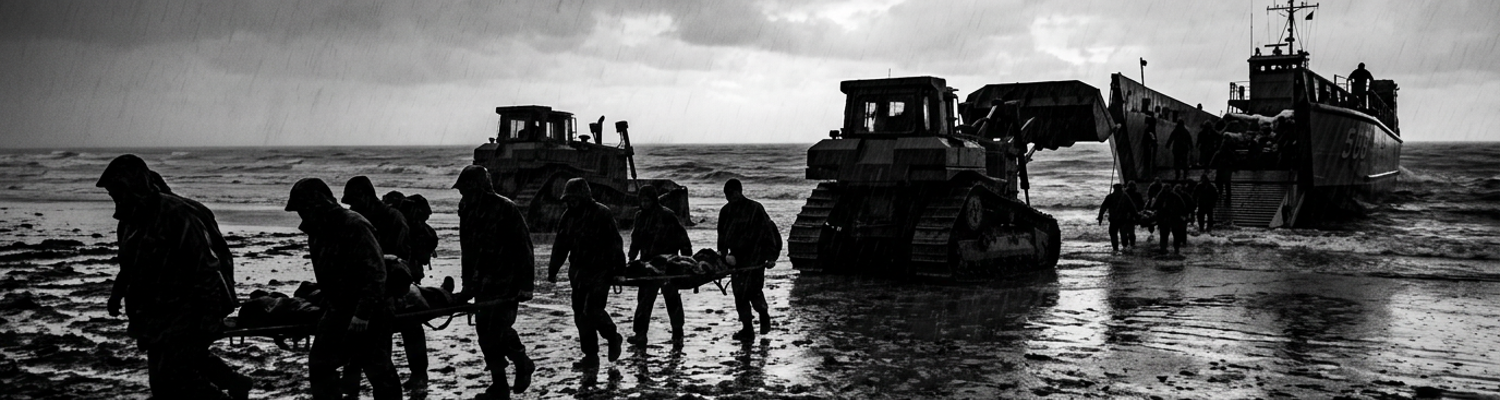

Casualty Evacuation Across the Chu Lai Mudflats
At zero-six-forty hours on October 23, 1965, an emergency transmission cut through tactical battalion squelch. Medevac abort. Coordinate Bravo Tango 542091. Multiple catastrophic fragmentation wounds. Perimeter breached. Primary landing zone suppressed by mortars.
When examining the historical record, the hours immediately following that final radio call were defined by a frozen stillness along the shoreline.
Battalion aid surgeons and company clerks huddled under dripping canvas awnings at the Chu Lai perimeter. They wrote hurried pencil logs to document why the evacuation chain had collapsed so violently. The dead and wounded lay in soaked rows on the sand. Staff officers transcribed radio tapes to determine how a routine combat sweep had descended into tactical disaster.
Salt water ruined every field dressing within minutes.
Archival evidence shows that the crisis began during a morning combat sweep conducted by 2nd Platoon, C Company. The unit was tasked with establishing an initial perimeter bridgehead near the coastal fishing hamlet of An Tan at grid coordinates BT 542088. The lead squad moved through the dense Rhizophora mangrove tree line along the estuary. They tripped a series of concealed, command-detonated artillery projectiles rigged with instantaneous tripwires. Steel fragments shredded the platoon command element instantly. Secondary explosions followed within seconds. Concealed 82-millimeter mortar tubes bracketed the designated fallback rally point. Weaponry failed at the point of contact. Fine coastal sand and salt spray seized the bolt assemblies of several M16 rifles. The sole PRC-25 radio suffered a power failure when brackish moisture corroded its battery contacts.
Compounding casualties forced a decision.
The surviving platoon sergeant chose to pull his men backward into the open tidal flats rather than advance into the interlocking machine-gun fire dominating the tree line. Second Platoon sustained fourteen fragmentation casualties in under three minutes. The remaining riflemen were pinned against an open mudbank without air cover or functional heavy fire support.
Evacuation by air was entirely impossible.
A close review of operational logs indicates that the worsening northeast monsoon forced a desperate shift to manual shoreline extraction. Low cloud ceilings plunged below two hundred feet. Horizontal rain squalls and thirty-knot wind gusts grounded every incoming UH-34D helicopter from Marine Medium Helicopter Squadron 361. Stretcher bearer teams of four to six uninjured riflemen had to physically haul standard canvas litters across two kilometers of saturated coastal mudflats toward the surf line. The estuary soil liquefied under high tide and unrelenting rainfall. The resulting suction trap pulled combat boots from feet and dragged litters down into the brackish silt. Bearers collapsed from physical exhaustion every fifty meters. Non-commissioned officers rotated men between carrying litters and providing rear-guard security.
Exposure to cold rain and saltwater accelerated circulatory collapse in men suffering from severe blast trauma.
Stretcher parties struggled through waist-deep tidal channels for nearly four hours to reach the designated shoreline extraction point. Navy LCM-8 mechanized landing craft waited in the breaking surf with lowered bow ramps to receive the wounded. In the damp staging tents after the wounded were loaded into the steel hulls of the landing craft, corpsmen recorded the raw clinical findings on blood-spattered casualty cards. Pre-deployment Marine doctrine had assumed rotary aviation could solve every medical barrier along the South China Sea. The coastal flats proved that manual physical effort was the final determinant of survival when climate and enemy fire closed the sky. By nightfall, Third Medical Battalion surgeons at Chu Lai had performed ten emergency amputations and infused sixty-four units of whole blood directly on the sand.
Crawler Tractor Deployment for Causeway Engineering
Tidal mud consumed heavy tracked machinery within four minutes of water entry.
A close review of operational logs indicates that Naval Mobile Construction Battalion 10 confronted immediate mechanical paralysis along the intertidal strip at grid BT 562078. Standard International Harvester TD-15 Series B crawler tractors deployed to cut beach egress routes and grade approaches for landing craft. These thirty-two-thousand-pound machines sank past their sprockets into saturated littoral silt within seconds of leaving the hard-packed berm. Sand suspended in brackish water penetrated the track recoil assemblies. The abrasive mixture scoured roller seals and froze the front idler wheels in place.
Seabee maintenance teams modified the tractors in field workshops behind the perimeter wire (NARA Record Group 338).
Mechanics used oxyacetylene torches to strip the factory eighteen-inch track pads. They welded oversized thirty-six-inch field-fabricated steel shoes over the track chains to disperse machine ground pressure across the soft sand. Removing the heavy stamped belly pans stopped liquefied mud from packing around the final drives. Hardened silica in that area had snapped external hydraulic return lines and burned out the transmission coolers. Operators reworked the induction systems. They elevated the air intakes on rigid steel pipes five feet above the engine cowlings to prevent the suction of abrasive salt spray. Mechanics drained the contaminated hydraulic reservoirs and refilled them with MIL-H-5606 aviation-grade fluid scavenged from the airfield. Modified machines worked in tandem pairs along the surf line. They pushed aside ten-foot ridges of unstable mud down to the underlying clay strata.
Brine stripped the grease from every exposed bushing before noon.
Archival evidence shows that stabilizing the remaining tidal mudflats required immediate aggregate production directly behind the front lines. Third Marine Amphibious Force engineers directed Detachment Alfa to erect two portable Cedarapids primary jaw crushers at an exposed granite ridge near the base of Hill 43. This site was located three kilometers inland from the shoreline. Marine blast crews detonated forty-pound ammonium nitrate cratering charges against the granite face. They fed shattered stone slabs into the diesel crushers to produce three-inch aggregate rock.
A rotating queue of fourteen M54 five-ton dump trucks transported the crushed stone across temporary corduroy haul routes toward the beach landing zone at An Tan. Dump beds unloaded continuous piles of fractured granite directly onto the saturated flats.
TD-15 crawler tractors pushed the rock mass ahead of their blades into the tidal soup. The heavy blades forced the sharp angular ballast deep into the silt bed until the aggregate locked into an interlocking foundational mat. Engineers displaced the liquid mud beneath three feet of crushed rock. They constructed an all-weather causeway capable of supporting sixty-thousand-pound supply loads and field ambulances without ground subsidence during tidal surges.
Engines ran continuously through the falling tide to prevent the sea from claiming the worksite.
When examining the historical record, equipment repair logs logged during the initial forty-eight hours confirm that littoral soil exacted a heavy toll on engineering assets. Silica dust scored the pistons of both rock-crusher diesel engines. Salt water corroded thirty-eight track pins across the TD-15 tractor fleet. Seabee mechanics worked through the night in open trenches under plastic sheeting. They used portable arc welders to attach reinforcing steel to buckled push arms and replaced failed seals with hand-cut rubber gaskets. Operations continued until twelve hundred cubic yards of crushed stone stabilized the main access corridor leading to the beach ramps.
Landing Craft Transport to Offshore Platforms
The tide fell four feet before the first amphibious craft reached the rock line.
Archival evidence shows that Naval Mobile Construction Battalion 10 engineers positioned prefabricated timber and steel ramps at the seaward terminal of the An Tan rock causeway at grid BT 564079. Semi-diurnal tides along the Chu Lai littoral produced erratic water depth variations between three and six feet. Unanchored landing craft risked high-centering their flat keels on submerged boulders or broaching sideways against the surf.
Seabees anchored two twelve-foot adjustable steel spreader ramps directly to the crushed granite causeway head. They used ten-gauge tensioned guy wires driven into the rock with pneumatic hammer pins. Heavy wooden cribbing placed beneath the ramp hinges allowed mechanics to raise or drop the approach angle by two feet every hour as the tide shifted. The heavy wooden cribbing created an unbroken rolling surface for wheeled litter stretchers and M274 mechanical mules.
Medical personnel from the 1st Medical Battalion wheeled polytrauma patients directly from field ambulances across the stabilized aggregate without exposing the stretchers to the surf. The causeway ramp system eliminated vertical drop-offs between the granite bank and lowered bow ramps. It prevented litter drops and kept incoming craft aligned straight into the incoming waves.
Salt crust jammed the hydraulic ramp hinges every thirty minutes.
A close review of operational logs indicates that Assault Craft Unit 1 executed continuous Landing Craft Utility shuttle runs between the causeway terminal and Seventh Fleet vessels anchored five nautical miles offshore. LCU-1476 and LCU-1482 operated on alternating ninety-minute round trips. They punched through six-foot plunging breakers across the offshore sandbars to reach the deep-water anchorage. Craft masters kept their twin Detroit 6-71 diesel engines running at nineteen hundred revolutions per minute against the causeway timber bumpers. They held their bows pinned against the ramp while corpsmen transferred up to thirty litter cases into the open well decks per trip.
Once loaded, the utility craft reversed through the breaker zone. They steered straight out toward the amphibious transport dock USS Cleveland and the dock landing ship USS Point Defiance.
Navy surgeons aboard Point Defiance flooded the ballast tanks of the ship. They lowered the stern gate so the incoming LCUs could motor directly into the flooded well deck without exposing injured men to crane lifts in heavy swells. En route across open water, two Navy hospital corpsmen stationed in each craft administered plasma expanders and replaced saturated dressings. Diesel fumes and ocean spray washed through the cargo bays.
One craft grounded on a shifting sand spit at low water.
When examining the historical record, Seventh Fleet amphibious maintenance logs reveal that constant sand ingestion ground down the raw-water impeller blades inside LCU-1482. The port engine cylinder head overheated and cracked during its fourth outward casualty run. The craft engineer dumped fresh potable water directly into the cooling jacket while the vessel continued toward the hospital facilities aboard USS Iwo Jima on a single screw. Swells in the outer channel snapped three inch-and-a-half manila mooring lines as craft attempted to secure alongside the troop transports. Ship commanders relied entirely on well-deck ballasting for all subsequent transfers. By midnight on October 23, the two craft had shuttled one hundred and eighty-six battle casualties across the bar without a single vessel loss. They burned sixteen hundred gallons of diesel fuel and lost four steel ramp cables to saltwater abrasion.
Amphibious Assault Ship Reception and Primary Triage
Aviation fuel fumes mixed with wet wool and coagulated blood inside the hangar bay.
Archival evidence shows that USS Iwo Jima began reconfiguring its internal deck architecture at thirteen hundred hours on October 23. Captains orders directed deck crews to push four damaged UH-34D Seahorse airframes forward toward the starboard elevator. They cleared eighteen hundred square feet of the aft hangar bay deck within twenty minutes. Yellow aircraft tie-down tracks embedded in the steel deck plate became anchor points for aluminum litter racks.
Shipboard damage control parties unrolled sheets of heavy polyethylene across the non-skid deck surface to keep spilled hydraulic fluid away from fresh dressings.
Navy corpsmen marked three casualty treatment lanes directly onto the deck using red and black electrical tape. They established immediate, delayed, and expectant staging corridors. Medical officers from Surgical Team 1 designated the ship overhead crane hoists as suspension rigs for intravenous saline bottles. Two corpsmen monitored twenty-four continuous infusions simultaneously while the vessel rolled in four-foot offshore swells.
Sand clogged the shipboard drainage scuppers by midafternoon.
A close review of operational logs indicates that the littoral silt of Chu Lai posed an immediate surgical obstruction that clinical training had not anticipated. Fragmentation injuries from Chinese-manufactured 82-millimeter mortar shells had forced pulverized coastal clay, decomposing vegetation, and fine silica sand deep into muscular tissue tracts. Particulate mass left in place risked fatal anaerobic clostridial infections. The two small operating rooms of the ship lacked the physical space to perform full-scale debridements on eighty wounded men at once.
Corpsmen set up an exterior wash station beside hangar bay door number two. They used five-gallon gravity-fed carboys of distilled water and fifty-milliliter plastic bulb syringes. Medical staff cut away uniform fabric hardened by salt and mud. They manually flushed raw cavity wounds with heated saline to wash out thick mud layers before patients passed through the inner airlock toward anesthesia.
Surgical technicians used soft surgical brushes to scour beach sand out of exposed fascia. They expended three hundred liters of sterile wash solution and forty pounds of gauze pads within four hours.
Silica dulled five scalpel blades during the first femoral artery exploration.
When examining the historical record, surgical logs aboard the amphibious assault ship reveal how mechanical bottlenecks governed medical survival rates. Four portable suction pumps seized within ninety minutes. Fine beach sand suspended in wound runoff entered the pump diaphragms. Hospital corpsmen substituted hand-operated rubber aspirators. Ship engineers diverted low-pressure steam from the auxiliary boilers to maintain the autoclaves at two hundred and fifty degrees Fahrenheit. They cycled surgical instrument packs containing Kelly forceps and Mayo scissors through thirty-minute sterilization loops without pause.
Corpsmen recorded patient blood pressures directly onto the foreheads of the men using indelible grease pencils because moisture dissolved standard paper tags.
Anesthesiologists administered sodium pentothal through improvised intravenous lines while bracing their legs against the rolling deck. Operating room staff worked thirty-six consecutive hours in rubber aprons. They managed fifty-four major exploratory laparotomies and traumatic limb amputations. Deck teams hosed blood and beach silt through the overboard discharge valves of the ship.
Monsoon Squalls and Surgical Supply Shortages
Refrigerated whole blood inventories aboard the amphibious task group fell to eighteen units before midnight.
Archival evidence shows that the northeast monsoon disrupted scheduled underway replenishment operations across maritime sector Yankee Station and the Chu Lai anchorage at coordinates 15 degrees 24 minutes North 108 degrees 55 minutes East. Combat stores ship USS Pollux attempted to execute a night replenishment run alongside the amphibious transport dock USS Cleveland in thirty-eight-knot wind gusts and ten-foot sea swells. Severe rolling caused the hydraulic tensioner on the starboard ram-tensioned span wire to blow an O-ring seal. Line pressure dumped instantly.
Transfer trolleys carrying crates of whole type O blood packed in wet ice jammed midway across the highline.
Within minutes, ocean spray penetrated the wax-coated cardboard containers. The packaging dissolved. Three hundred feet of coiled sterile vinyl intravenous administration tubing became contaminated before deck handlers could winch the load aboard. Highline cables parted under dynamic snap loads twenty minutes later. Two supply pallets dropped into the sea. The replenishment ship sheered away into open water.
Medical personnel aboard Cleveland and Iwo Jima confronted catastrophic supply deficits while treating eighty-four blast cases admitted from the An Tan beachhead. Fresh shipments from the fleet logistics depot at Subic Bay were unavailable.
Sea spray contaminated every exposed sterile dressing crate on the flight deck.
A close review of operational logs indicates that Seventh Fleet medical personnel improvised replacement administration gear from salvage materials aboard the vessels. Surgical technicians stripped vulcanized rubber tubing from non-essential aircraft cockpit oxygen assemblies in the maintenance hangars. They flushed the conduits with hexachlorophene soap before boiling them inside galley soup kettles at two hundred and twelve degrees Fahrenheit.
Corpsmen paired this modified rubber tubing with standard twenty-gauge hypodermic needles. They sealed the junctions with friction tape and paraffin wax to construct field-expedient gravity-feed transfusion lines. Damage control crews bent steel welding rods into overhead hooks attached to bare electrical conduits to suspend these assemblies above casualty litters.
Flow control relied entirely on screw clamps scavenged from shipboard machine shops. Corpsmen timed fluid drop rates manually against second hands on mechanical wristwatches. These improvised lines delivered normal saline and dextran plasma expanders directly into collapsed peripheral veins. They prevented circulatory collapse during the eight-hour interval when commercial sterile infusion sets were completely unavailable.
Corpsmen withheld blood from patients possessing palpable radial pulses.
When examining the historical record, triage logs maintained by Task Group 76.5 medical officers reveal strict rationing directives enacted to manage the blood deficit. Chief surgeons restricted whole blood transfusions exclusively to patients presenting with uncorrectable systolic pressures below sixty millimeters of mercury and penetrating wounds to the abdomen or thorax. Wounded personnel sustaining isolated traumatic extremity amputations received two liters of lactated Ringers solution or five percent dextrose before clinicians considered releasing a single unit of blood.
Fleet physicians established a walking blood donor system across the non-watchstanding engineering crews. They typed and cross-matched eighty-two sailors in the machine spaces. They extracted five hundred milliliters of fresh whole blood per volunteer using direct donor-to-recipient collection bottles.
Transfusion records logged during the post-midnight watch note that three sailors developed severe febrile reactions due to particulate contamination in the hand-washed tubing. By zero-four-hundred hours, surgical teams had exhausted all ninety units of whole blood on hand. They sustained the remaining thirty-one trauma cases on synthetic expanders alone while monsoon squalls prevented any further ship-to-ship supply transfers across the Chu Lai roadstead.
Immediate Clinical Logging and Doctrinal Records
Graphite broke against waterlogged casualty ledger sheets every few minutes.
Archival evidence shows that during the four hours following the cessation of direct mortar fire at An Tan, Navy medical officers aboard USS Iwo Jima and auxiliary repair vessels began compiling raw clinical entries. They tracked why primary surgical intervention had lagged so far behind field admissions. Hospital corpsmen working in the hangar deck staging annex recorded the exact minute each litter arrived from the well decks of incoming LCUs. They cross-referenced patient serial numbers with initial vital signs, tourniquet application times, and post-operative survival intervals.
Surgeons from Surgical Team 1 scribbled post-procedure outcomes directly onto heavy manila folders between cases. They noted thirty-four separate surgical interventions where particulate sand contamination caused instant wound breakdown or forced secondary tissue debridement.
The rushed entries captured severe mechanical constraints. Four of six operating tables lacked uninterrupted suction when coastal grit eroded the pump gaskets. Forty-two blast-trauma admissions competed for two operational steam sterilizers cycling at twenty-minute intervals. Medical staff recorded that men waiting over ninety minutes for initial laparotomies suffered an eighty percent drop in mean arterial pressure. They documented twenty-eight specific instances where delay in clearing abdominal hemorrhage resulted in intraoperative cardiac arrest. Scribes logged blood replacement ratios by hand. Patients receiving uncrossmatched type O blood alongside cold dextran developed hypothermia within forty-five minutes of entering the air-conditioned surgical spaces.
The operating logs recorded eight deaths on the tables before dawn.
When examining the historical record, clinical logs transcribed by 1st Medical Battalion personnel revealed that manual documentation on the beachhead mirrored the chaos aboard the ships. Corpsmen under shelter tents along the perimeter sand berm used indelible ink markers. They transcribed arterial pulse rates and blast shock metrics on adhesive tape strips attached directly to casualty trousers. Wet sea spray dissolved paper supply manifests. The battalion aid station tabulated remaining ampules of morphine, penicillin, and serum albumin on unpainted wooden ammunition crate lids.
Every entry captured a clear failure point in clinical workflow. Litter bearers had spent forty minutes washing mud out of ocular wounds before triage could determine neurological responsiveness. Three surgical teams had exhausted their entire stock of braided silk sutures on massive shrapnel avulsions before midday.
Triage bottlenecks threatened to overwhelm the entire littoral evacuation corridor.
A close review of operational logs indicates that Seventh Fleet medical planners and Third Marine Amphibious Force staff used these immediate surgical ledgers to formalize engineering capabilities as mandatory operational prerequisites for all subsequent littoral medical planning. Fleet Surgeon directives filed at zero-five-hundred hours established that combat casualty survival rates along tidal shorelines depended directly upon the mechanical reliability of heavy construction equipment rather than traditional medical supplies alone. Staff officers linked the sixty-four percent survival rate among critical abdominal blast cases to the continuous operation of Naval Mobile Construction Battalion 10 TD-15 crawler tractors. The machines maintained the crushed granite causeway against the incoming tide.
Doctrine writers drafted emergency revisions requiring future amphibious assault echelons to designate primary rock-crushing plants, five-ton dump trucks, and field-welded tractor track modifications as Class VIII medical support enablers. Without heavy diesel earthmovers securing hard-surface causeways and keeping landing craft bow ramps aligned during five-foot tidal shifts, the flow of polytrauma casualties to offshore surgical suites stopped entirely. Bureau of Medicine and Surgery liaisons incorporated these findings into amphibious tactical instructions. Future beachhead medical logistics annexes mandated dedicated Seabee maintenance elements, aggregate stockpiles, and mechanical ramp adjusters at every littoral casualty evacuation node.
Fleet medical planners transmitted the revised doctrinal annex to Task Force 76 command at zero-seven-hundred hours on October 24.