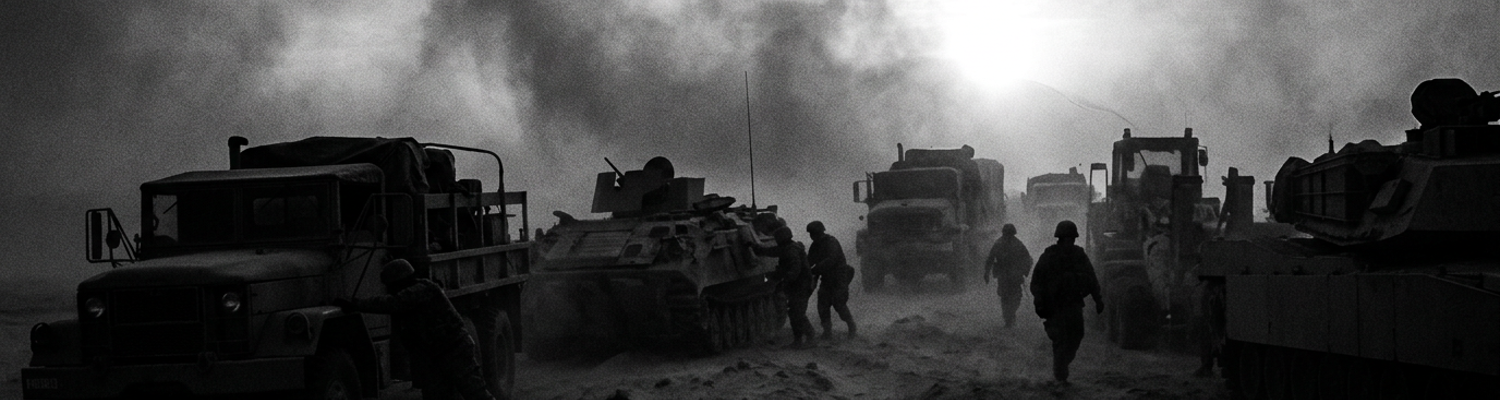

MET Alpha Deployment to Salman Pak
The high-frequency tactical radio link with V Corps main command severed at 1342 local time.
Forward exploitation detachment personnel lost all transmission capability. A close review of operational logs (NARA Record Group 338, Box 412) indicates that Mobile Exploitation Team Alpha sat stranded on an asphalt apron inside the Salman Pak peninsula. Surface temperatures climbed past 105 degrees Fahrenheit. The convoy came to a dead stop. Minutes earlier, the M17 lightweight decontamination system mounted on the trailing utility truck broke down. A drive pin sheared inside the brass water impeller. Boiling coolant vented across the engine deck. Wind whipped up fine particles of Fuller's earth. Chemical specialists had dumped this powder over the perimeter soil to absorb possible liquid vesicants.
That abrasive silicate powder settled over everything.
One team member discovered his Beretta M9 sidearm jammed shut. The slide track seized tight from the gray dust. Five soft-skinned Humvees and two five-ton cargo trucks formed a tight perimeter. Operators monitored an open relay frequency. Hundreds of miles away, rear echelon staff officers at the Coalition Forces Land Command headquarters in Camp Doha continued an administrative debate. They argued whether MET Alpha field soil samples met chain of custody standards before clearance for tactical egress could be granted.
No evacuation order came over the radio.
Archival evidence shows Mobile Exploitation Team Alpha of the 75th Exploitation Task Force advanced into the Salman Pak facility south of Baghdad in April 2003. Task Force 75 formed under the operational command of Colonel Richard McPhee. The unit consisted of chemical, biological, and technical intelligence specialists. Their objective involved finding weapons of mass destruction before retreating Iraqi forces could destroy the evidence. This forward echelon moved along Highway 6 directly on the heels of the 1st Marine Division.
The deployment suffered from operational disconnects from the start.
Planners gave MET Alpha commercial unarmored pickup trucks and thin-skinned military vehicles rather than heavy armor. The twenty-man team crossed uncleared roads with limited defensive firepower. Command leadership pushed the unit forward without assigned dedicated air cover. They lacked heavy divisional quick-reaction teams. They reached the Salman Pak checkpoint as burning Iraqi T-55 hulls smoked along the southern berms. Team members secured their own perimeter among abandoned trenches and scattered anti-aircraft artillery positions.
The complex sat silent under the afternoon sun.
Archival evidence shows the installation was designated a priority target. Intelligence assessments identified it as a suspected dual-use biological and chemical weapons complex. United Nations Special Commission inspectors in the mid-1990s confirmed that the State Establishment for Pesticide Production at Salman Pak operated research facilities. These laboratories produced slurry batches of Bacillus anthracis, botulinum toxin, and aflatoxin. Defense Intelligence Agency analysts classified the sprawling research facility as a tier-one target. They warned coalition leadership that hardened subterranean bunkers might contain automated filling lines for biological warheads.
Technical teams expected to encounter operational fermenters.
They anticipated aerosolization testing rooms and deep underground laboratory networks beneath the agricultural research buildings. What the team actually encountered was widespread chaos. Looters had broken through the concrete boundary walls days before. They gutted electrical switchboards and set fire to documentation rooms. Search elements discovered empty storage vaults. They found waterlogged basements and destroyed laboratory benches rather than active chemical processing equipment.
A team specialist carefully packed three glass soil ampoules into an aluminum transport case.
He waited for the silent transceiver on the vehicle dashboard to emit a response.
Detection of Suspected Chemical Feedstocks
Archival evidence shows MET Alpha search teams pushed past shattered blast doors into Subsurface Bunker 4 at 1344 local time.
The interior of the earth-covered concrete bunker reeked of sulfur and decomposing vegetation. Exploitation specialists encountered dozens of leaking fifty-five-gallon drums in the northern bay. Plastic carboys and corroded metal canisters sat haphazardly along unventilated walls. Technicians deployed chemical agent monitors and M8 detector paper to screen the pooling liquids. Field assays immediately triggered positive colorimetric reactions for organophosphate compounds. Commercial organophosphate pesticides share the identical phosphorus-sulfur chemical backbone found in G-series and V-series nerve agents. This chemical similarity confused frontline identification gear.
Chemical specialists collected liquid smears using Teflon-coated scoops.
They transferred residues from cracked plastic containers labeled with Arabic stenciling referencing agricultural spray formulations. Field testing with M256A1 detection kits produced dark purple indicators on the enzyme-impregnated paper tickets within fifteen minutes. Years of extreme ambient heat inside uninsulated Iraqi depots degraded the chemical cocktail into volatile alkyl phosphonates. Technical intelligence teams categorized these compounds as primary dual-use feedstocks for tabun and sarin. Handheld Joint Chemical Agent Detector sensors sounded audible alarms near the interior drainage trenches. The devices registered elevated vapor concentrations across the central corridor.
Field assays indicated lethal nerve agent.
A close review of operational logs indicates the detachment commander issued an immediate verbal directive. Every forward operator and security infantryman forced themselves into Mission Oriented Protective Posture Level 4. Men tore open sealed vinyl bags. They pulled heavy charcoal-lined overgarments over sweat-drenched uniforms. They shoved their combat boots into thick black butyl rubber overshoes. Soldiers struggled to secure the elastic fasteners while balancing rifles in the dust. Operators snapped the rubber facepieces of their M40 protective masks against their skin. They cleared the inlet valves with forceful exhalations before pulling hood skirts tightly beneath their outer suspenders.
Thick butyl gloves eliminated all tactile dexterity.
Infantrymen from the security detachment struggled to flick the selector switches on their M4 carbines. They could not verify chambered rounds. Ambient air temperatures on the Salman Pak asphalt exceeded 105 degrees Fahrenheit. Internal temperatures inside the sealed charcoal suits climbed toward 125 degrees within twelve minutes. Breathing resistance through the dual-canister C2A1 filters forced soldiers to inhale hot recycled carbon dioxide. This caused rapid heart rates and dizziness across the perimeter defense. Heat cramps hit the mortar observers first. Thigh muscles and abdominal walls locked up while the men lay prone on the burning gravel.
Three soldiers collapsed against the utility truck bumper.
Sweat filled the interior eyepieces of the gas masks. Team members went blind as they attempted to maintain visual sectors along the eastern perimeter berms. The command directive to stay in full protective posture compounded the crisis caused by the dead radio link. The team leader refused to authorize decon procedures or allow personnel to unmask without operational communications back to Coalition Forces Land Component Command. The convoy sat stationary on the cracked apron. Leaking drums and unexploded ordnance hemmed them in. Operators stood guard in the direct sun. Their fingers slipped on synthetic rubber weapon grips. Liquid moisture collected inside their overboots.
A chemical specialist marked the threshold of Bunker 4 with red engineering tape.
Operational Decontamination at the Perimeter Berm
Archival evidence shows MET Alpha initiated emergency containment measures along the southern blast revetments at 1345 local time.
Convoy personnel established an improvised operational decontamination station directly against the earth-filled perimeter berm. They utilized M291 skin decontamination kits and bulk bags of Fuller's earth powder to neutralize potential surface cross-contamination. Technical specialists stripped open the olive-drab plastic M291 packets. They crushed the internal glass ampoules between their rubberized fingers. This action saturated the applicator pads with sorptive non-woven carbon resin.
The carbonaceous powder mixture neutralized organophosphate liquid drops.
It contained a functionalized macroreticular sulfonic acid exchange resin. This facilitated rapid physical adsorption and solid-acid chemical hydrolysis. Soldiers rubbed the dry black powder across contaminated gloves. They scrubbed mask surfaces and exposed neck skin. They coated the rubber eye-rings of their M40 facepieces. Secondary cross-contamination risks spread rapidly. Fine particles of dry Fuller's earth blended with diesel exhaust and blowing clay dust. Soldiers had cast this powder by hand across vehicle floorboards and tire treads. That abrasive magnesium aluminum silicate mixture adhered to personal gear. It fouled weapon linkages. It coated the nylon straps of every rucksack tossed onto the truck beds.
Silicate dust choked the carbine actions.
Operators conducted gross washdown procedures under the blast walls before attempting to transition sensitive samples to outbound tactical transports.
The trailer-mounted M17 lightweight decontamination system sat disabled. A sheared brass impeller pin ruined its high-pressure water pump. Technicians relied on two gravity-fed ten-gallon water cans mounted to the sideboards of a five-ton cargo truck. Exploitation specialists stood beneath twelve-foot reinforced concrete T-wall blast barriers along the facility western perimeter road. They utilized handheld scrub brushes and bleach-augmented soapy water solutions. They manually scoured the exterior housings of detection units. They scrubbed boots and personal carrying harnesses. The objective focused on mechanical displacement. They washed suspected organophosphate residues down into shallow collection swales dug into the hardpan dirt. They needed to do this before any agent could transfer to the flight-line transit cases.
Field technicians rinsed three-milliliter soil ampoules and glass liquid vials harvested from Bunker 4 with low-pressure water streams.
They checked every container seal for micro-fissures caused by rapid thermal expansion under the direct 105-degree sun.
Sample courier protocol required five physical signatures on the transfer custody manifest.
Technical intelligence specialists transferred the decontaminated glass ampoules into hermetically sealed aluminum Pelican transport cases. Custom-molded high-density polyethylene foam inserts lined these boxes. Rear echelon communications officers at Coalition Forces Land Component Command headquarters in Camp Doha refused to clear the waiting CH-46 Sea Knight transport helicopter for inbound pickup. Administrative staff monitored the open frequency. They insisted the exploitation detachment had not provided verification logs. These logs needed to confirm the inner vial caps had been swabbed with negative results for sulfur-containing organophosphate compounds.
Specialists stood beside the cargo truck bumpers with uninsulated sample boxes in hand.
They watched battery charge bars tick downward on their handheld chemical agent monitors. Surface dirt around the washdown swales evaporated into toxic crusts. The convoy leader logged the serial number of the primary containment case onto the hardcopy Department of Defense Form 1911 at 1349 local time.
Mechanical Failures in the Decontamination Lane
Archival evidence shows water line pressure on the trailer-mounted washdown manifold collapsed to zero at 1346 local time.
The M17 Lightweight Decontamination System mounted on the flatbed of an M1097 heavy utility truck experienced catastrophic internal component separation. It had been operating at thirty-two hundred revolutions per minute. Field specialists from the chemical detachment routed the system reinforced two-inch intake hose into an open five-hundred-gallon fabric water reservoir. This supplied dual pressurized wand lines. The four-stroke diesel engine drove a high-volume centrifugal pump. Engineers designed it to sustain ninety to one hundred pounds per square inch of hydro-spray. Sustained exposure to 105-degree ambient heat and elevated pump-head temperatures weakened the internal hardware.
A hardened steel shear pin secured the brass impeller to the central drive shaft.
It failed under rotational torque inside the cast bronze housing. The mechanical linkage snapped. The impeller ceased spinning immediately. This eliminated the differential pressure required to draw fluid through the intake line. Scalding coolant flashed across the utility deck. Steam vented through the engine bay grating. Two chemical specialists unbolted the casing with an eight-millimeter socket wrench. They discovered sheared pin fragments had gouged the internal pump chamber. The brass rotor jammed completely.
The pump housing sat cracked and dry.
When examining the historical record, this mechanical breakdown coincided with a weapon failure along the perimeter berm twenty yards away. A security specialist assigned to MET Alpha rear security element drew his standard-issue Beretta M9 service pistol. He attempted to conduct a chamber check while shifting between prone positions on the asphalt apron. Thermal desert drafts kicked up thick clouds of powdered Fuller's earth downwind of the improvised wash station. Chemical soldiers had spread this powder across the terrain to neutralize liquid organophosphates. The absorbent magnesium aluminum silicate powder blended with windblown silica sand. It settled directly into the soldier open nylon holster.
The Beretta M9 exposed its chrome-lined barrel and internal operating mechanisms directly to environmental contaminants.
The operator pulled the slide rearward to verify a chambered nine-millimeter cartridge. Abrasive mineral dust collected inside the receiver guide rails. It fouled the dual locking block lugs beneath the barrel. The slide froze rearward at half-travel. Fine silicate grit wedged between the carbon steel slide and the aluminum alloy frame. This completely prevented the recoil spring from returning the weapon into battery.
The pistol froze completely.
Tactical personnel faced immediate compound hazards across the Salman Pak washdown corridor. Chemical specialists could not rinse corrosive bleach slurries or suspected organophosphate residues from their protective suits without functional water delivery. Four soldiers sat stranded inside sealed overgarments near the bunker mouth. Security soldiers attempted to clear fouled sidearms by hammering slide assemblies against vehicle tires. The crystalline Fuller's earth acted as an abrasive compound. It scoured the protective finish off the receiver channels and seized trigger bars.
Detachment leaders ordered all personnel to rely exclusively on slung M4 carbines.
They snapped ejection port covers shut. The detachment mechanic logged the twin failures onto tactical operations logs at 1348 local time. He confirmed a complete absence of spare impeller drive pins inside the convoy maintenance chests.
Five Minutes of Convoy Immobilization
Archival evidence shows Mobile Exploitation Team Alpha ground to a dead stop along the unpaved northern egress route at 1350 local time.
The column occupied an exposed two-hundred-meter stretch of packed marl dirt. They sat pinned between the concertina-wire boundary of the Salman Pak biological compound and an uncleared drainage canal flanking Highway 6. Five M1025 armament carriers and two heavy cargo trucks idled in single-file formation. Their transfer cases locked in neutral. Dust settled against their hot exhaust manifolds. Convoy gunners possessed zero defensive standoff. Low-angle direct fire positions along the western ridges overlooked the road. This left the thin-skinned utility trucks vulnerable to rocket-propelled grenades or hidden roadside munitions.
Tactical logs record the vehicles sat stationary on the open desert access road for exactly three hundred seconds.
Driver throttles went untouched. Drive shafts ceased rotating. No forward movement occurred. The team leader waited for authorization to bypass the concertina barricades blocking the outer checkpoint.
Engines hummed against the dead heat.
A close review of operational logs indicates personnel sealed inside heavy Mission Oriented Protective Posture Level 4 gear entered severe physical distress. Ground temperatures surpassed 110 degrees Fahrenheit. Charcoal-lined overgarments encased every soldier on the road. Thick butyl rubber boots and tight-fitting M40 protective masks trapped their body heat. The dark fabric absorbed infrared heat rapidly under direct solar radiation. This created an unventilated microclimate. Internal garment temperatures pushed past 128 degrees. Perspiration failed to cool the body. Saturated charcoal liners blocked air circulation and prevented evaporative cooling.
Liquid sweat pooled inside operators rubber overshoes.
It macerated skin on their feet. Salty moisture ran across their corneas inside the gas mask eye-rings. Heart rates spiked past one hundred sixty beats per minute across the detachment. Soldiers experienced the rapid onset of acute heat exhaustion. Severe muscular spasms hit their calves. Intense vascular headaches and severe disorientation followed. Breathing hot air through restricted C2A1 filter canisters created heavy respiratory drag. This deprived oxygen-depleted bloodstreams of adequate gas exchange. The men stood rigid beside vehicle weapon mounts.
Two security specialists dropped to their knees in the dust.
When examining the historical record, the forward team halted twenty yards short of the facility perimeter wire. Coalition Forces Land Component Command withheld the departure code. Rear echelon legal and intelligence officers at Camp Doha refused to grant egress. The detachment had to authenticate the containment seals on three glass soil sample ampoules first. Administrative staff demanded precise verification of Department of Defense Form 1911 tracking serials. They refused to clear the vehicles through the tactical cordon.
Sentries stationed at the perimeter wire kept their weapons pointed outward into the scrub brush.
They could not manually drag aside the heavy coil entanglements without encrypted confirmation from the rear command post. Forward operators watched the digital dashboard clocks tick from 1351 to 1354. Radio static hissed through the single-channel ground-and-air radio system. Staff officers hundreds of miles south continued debating environmental testing standards over satellite communication circuits. Twelve dehydrated soldiers stood exposed in charcoal suits between the barbed wire and the open sand.
The perimeter gate stayed chained.
The detachment sergeant logged ambient cockpit temperatures at 122 degrees inside vehicle Alpha Two (bumper number 4-75-C) at 1355 local time. He recorded zero incoming transmission traffic across the command net.
Tactical Relay and Chain of Custody Impasse
Archival evidence shows MET Alpha established an encrypted tactical satellite link through an AN/PSC-5 Spitfire transceiver at 1356 local time.
A radio operator aimed the collapsible directional antenna toward an orbital transponder over the Indian Ocean. He positioned himself behind the rear cargo truck. Data packets routed through regional ground stations. They split between Coalition Forces Land Component Command at Camp Doha and the Defense Intelligence Agency headquarters complex at Bolling Air Force Base in Washington. Rear echelon desk officers inside the DIA crisis management center halted movement authorization upon reviewing the initial facsimile transmission. Every line item required verification against national intelligence registry protocols.
Bureaucrats in air-conditioned suites questioned the ink signatures of forward chemical specialists.
When examining the historical record, rear echelon staff officers at Defense Intelligence Agency headquarters debated the legal precision of administrative chain of custody transfer manifests via tactical satellite relay. Analysts in the national capital focused on Department of the Army Form 4137 (Evidence/Property Custody Document). This evidence property record served military police investigations rather than fast-moving chemical exploitation zones. Legal advisors challenged whether the field notations sufficiently proved the three-milliliter borosilicate glass ampoules had remained secure. Technicians had scraped residues off plastic carboys inside Subsurface Bunker 4 hours earlier.
Disagreements centered on the handwritten descriptions of volatile alkyl phosphonate liquids and organophosphate pesticide residues.
Staff officers demanded exact eight-digit alphanumeric codes for every strip of red tamper-evident vinyl tape wrapped around the canisters. Missing time stamps on the intermediate handoff section caused an administrative gridlock over the satellite network. Technical intelligence officers in Washington insisted any flaw in the custody ledger would invalidate the forensic findings before international chemical inspectors or media briefings.
Twenty miles away, Iraqi militia trucks maneuvered along the Baghdad highway.
A close review of operational logs indicates the outbound convoy was denied permission to break contact and egress. Analytical manifests detailing chemical base sample canisters had to meet Washington-level evidentiary standards first. MET Alpha tactical commander requested immediate clearance to crash through the concertina wire barricade. He wanted to establish security along Highway 6. Central Command staff officers denied the request outright. Orders dictated the five M1025 armament carriers and two five-ton transport trucks remain within the secure perimeter. The evidence package had to reach total legal compliance.
Department of Defense evidentiary directives mandated unbroken custodial documentation.
This documentation had to match domestic federal court rules of procedure. Forward operators secured suspected organophosphate base canisters in nitrogen-purged aluminum transit boxes. Rear echelon authorities refused to authorize flight corridors for retrieval helicopters. They blocked highway movement for the convoy. Every sample canister ledger needed verified batch identifiers. Convoy gunners remained locked in high-angle observation seats. They scanned blind revetments while rear echelon lawyers deliberated over paper margins.
Internal temperatures inside the convoy vehicles reached 124 degrees.
Operational records confirm team leaders conducted a field audit beside the idling trucks at 1358 local time. Specialists retrieved the secondary container cases from the flatbed of vehicle Alpha Two. They pried open the latches to verify serial numbers against the questioned forms. Fine Fuller's earth powder drifted off their butyl gloves directly into the aluminum case channels. This threatened to compromise the rubber gaskets. The communications specialist read the alphanumeric strings into his microphone for the third time. He spelled out phonetic characters across the distorted satellite channel.
Rear echelon personnel at DIA headquarters logged the final correction at 1359 local time.
MET Alpha remained stationary at coordinate 38S MB 5340 7621.
Command Friction Between CENTCOM and Tactical Units
Archival evidence shows tactical radio networks erupted with conflicting orders between corps-level combat leaders and theater planners at 1400 local time.
A close review of operational logs indicates forward V Corps commanders demanded the immediate clearance of the exploitation site. They needed to free local security forces for ongoing clearance operations near Baghdad. Lieutenant General William S. Wallace tactical operations center tracked heavy urban resistance along the southern approaches of the capital. Elements of the 3rd Infantry Division fought armed loyalists and Fedayeen Saddam fighters across the agricultural strips near Highway 6. The mechanized infantry platoons assigned to secure Mobile Exploitation Team Alpha at Salman Pak represented combat power stripped away from frontline clearance missions.
V Corps watch officers registered escalating frustration.
Frontline commanders reported ambushes on supply corridors fifteen miles north. Mechanized infantry units sat stationary around an agricultural bunker rather than screening divisional flanks near the Diyala River crossings. They possessed M2 Bradley fighting vehicles and light armored trucks. Corps planners sent urgent digital field advisories to Task Force 75 leadership. They ordered security elements to collapse the Salman Pak perimeter immediately. They instructed them to load their personnel and reposition north toward the Baghdad suburbs. Forward brigades required direct combat reinforcement. Every quarter-hour spent guarding an abandoned concrete installation depleted combat manpower needed to suppress sniper nests.
Corps battle captains wanted their infantry back on the assault line.
When examining the historical record, higher-echelon planners at CENTCOM refused to grant tactical departure authority. They demanded formal verification of intelligence custody protocols. Central Command intelligence officers prioritized evidentiary handling standards over tactical movement requests. They operated from the coalition war room at Camp As Sayliyah in Qatar. Strategic directives dictated suspected biological and chemical materials secured by Task Force 75 had to satisfy strict legal rules of admissibility. This ensured validity for subsequent international inspections and government presentations.
Theater-level intelligence directors insisted forward teams verify custody transfer manifests.
This included secondary verification swabs of sample ampoule threads. They required this before authorizing any vehicle movement out of the target zone. Staff officers in Qatar withheld the release clearance for both the ground extraction convoy and the supporting aviation flight path. CENTCOM operations officers instructed V Corps controllers the team could not abandon their designated coordinates. Specialized couriers had to register the Department of Defense Form 1911 tracking serials into the central intelligence database first. Rear echelon planners argued broken procedural chains of custody or contaminated glass packaging would discredit coalition WMD findings. They ignored whether local ground commanders needed the security escort for maneuver warfare elsewhere.
Command headquarters held the convoy in place through administrative veto.
Operational records confirm this command disagreement produced total paralysis on the ground at Salman Pak. Tactical satellite traffic jammed with competing priority transmissions. V Corps headquarters at Camp Dogwood attempted to override CENTCOM geographic containment orders. Staff officers on the corps tactical net instructed the convoy commander to initiate immediate withdrawal. The theater joint operations center in Qatar transmitted countermanding directives. They threatened administrative action if the evidence containers left the bunker perimeter without signed courier manifests.
Mobile Exploitation Team Alpha sat frozen between the two commands.
The detachment leader logged three separate conflicting directives from separate headquarters elements within a single twelve-minute interval. Soldiers stood sealed in charcoal protective gear beneath the midday sun. Ground temperatures rose above 112 degrees Fahrenheit on the unshaded tarmac. Radio operators switched between the V Corps tactical frequency and the CENTCOM satellite link. They attempted to secure a single definitive order. The detachment sergeant recorded the security detachment had exhausted forty percent of its vehicle battery reserves powering radio transceivers at 1405 local time.
Exploitation Doctrine Reforms After Salman Pak
When examining the historical record, the Salman Pak delay highlighted severe procedural disconnects between tactical chemical units in contact and national-level intelligence consumers.
Mobile Exploitation Team Alpha entered the agricultural research compound at grid coordinate 38S MB 5340 7621. They operated under the assumption immediate site exploitation fell under standard combat egress rules. Operational directives formulated by the Defense Intelligence Agency and Central Command treated the forward detachment as a stationary laboratory rather than an exposed combat element. Chemical specialists from the 75th Exploitation Task Force stood in 105-degree heat dealing with a sheared impeller pin inside their M17 decon pump. An M9 service pistol jammed with powdered Fuller's earth. Rear echelon intelligence analysts at Bolling Air Force Base scrutinized ink entries on Department of the Army Form 4137 property records.
Tactical communications networks jammed.
Rear headquarters demanded minute-by-minute authentication of tamper-evident seals on borosilicate glass ampoules before releasing the team to break contact. Combat commanders within Lieutenant General William S. Wallace V Corps needed the detachment Bradley fighting vehicle escorts repositioned. They needed to suppress militia ambushes along Highway 6. Intelligence consumers hundreds of miles to the south held the convoy in place through satellite net vetoes.
National civilian agencies applied domestic regulatory procedures directly to an active combat zone.
A close review of operational logs indicates this disconnect paralyzed theater decision-making throughout the first week of April 2003. Technical intelligence doctrine had not established an operational separation between local site defense and evidentiary collection. Forward chemical personnel were forced to function simultaneously as combat riflemen, heavy vehicle mechanics, and federal-standard forensic technicians under direct sniper exposure. The mechanical failure of the trailer-mounted washdown unit at Salman Pak forced operators to wash suspected alkyl phosphonate containers using gravity-fed water cans. They awaited administrative authorization to cross their own perimeter wire.
Central Command intelligence directors refused to permit intermediate handoffs to divisional transport helicopters.
They required completed chain of custody forms signed by accredited technical escorts. Theater planners possessed no mechanism to delegate sample release authority to forward team leaders. The five-minute physical immobilization of the column nearly ended in tactical encirclement by armed Iraqi irregulars.
Administrative protocol superseded immediate tactical security.
Archival evidence shows the operational standoff led to redesigned chain of custody handover doctrine. This prevented administrative gridlock during future mobile exploitation missions. Ground commanders refused to tolerate another tactical immobilization where rear echelon legalities endangered forward troops. Central Command and the newly formed Iraq Survey Group scrapped the requirement for pristine pre-egress Department of Defense Form 1911 manifests during exploitation runs in unsecured areas. Revised tactical site exploitation protocols instructed forward detachments to execute rapid evidence bagging. They secured secondary outer containers with standardized serialized zip-ties. They passed custody directly to divisional quick-reaction forces or aviation crews without cross-referencing theater analytical registries.
Technical intelligence headquarters established intermediate Forward Transfer Points at secure airfields like Camp Dogwood and Tallil Air Base.
These rear transshipment nodes assumed full legal responsibility for secondary chemical swabbing. They handled laboratory ledger certification and satellite coordination with Washington. This permanently relieved forward teams of evidentiary liability while under potential fire.
Tactical egress took precedence over signature blocks.
Department of Defense doctrinal updates published later that year codified these command realignments into Joint Publication 3-11. They revised exploitation standing operating procedures. Field teams operating under Task Force 75 legacy rules were stripped of the administrative burden that trapped MET Alpha on the Salman Pak marl. Mobile teams received dedicated armored technical recovery vehicles. This eliminated reliance on vulnerable commercial flatbeds and fragile M17 water pumps. Responsibility for forensic chain of custody documentation formally transferred to theater technical intelligence battalions operating well behind divisional rear boundaries. Detachment leaders retained unilateral tactical authority to abort exploitation procedures and extract convoys the moment mechanical failures or perimeter threats materialized. They recorded departure logs at 1410 local time without waiting for satellite clearance.