
War Department Audits of Italian Military Reforms
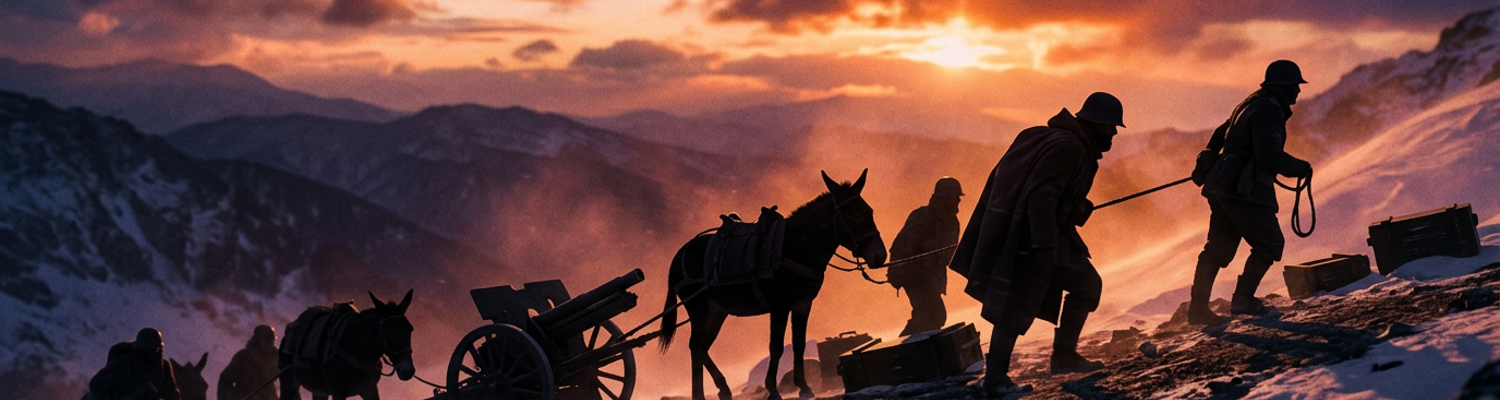
Artillerymen of the Royal Italian Army wrestled three-ton field guns and heavy ammunition caissons across washed-out shale trails above two thousand meters during the opening hours of the 1927 Alpine maneuvers. Crews of eight to twelve soldiers leaned their full weight into damp hemp haulage ropes while iron-shod wheels slid backward into loose rock, forcing battery officers to requisition extra draft animals from neighboring supply echelons. Pack mules collapsed under eighty-pound crate loads on steep switchbacks, scattering rations and small-arms ammunition into ravines as drivers used timber levers to free wedged cart axles. Mountain battalions halted their advance along the ridgeline when forward supply dumps ran out of canned meat, dry fodder, and replacement horse shoes before midday. Commanders attempted to bypass these blocked mule tracks by redirecting transport columns onto narrow dirt roads in the valley floor, but the sudden rerouting snarled dozens of motorized convoys behind stalled command staff cars.
Observers from the United States Military Intelligence Division followed directly behind these immobilized vehicle columns, recording how quickly commercial trucks broke down on steep mountain inclines. Their field dispatches formed the foundation of a sweeping investigation, as Military Intelligence Division file series MID 2022-375 through 2022-427 systematically audited the Royal Italian Army post-1926 organizational framework. Analysts compared the grand military claims published by Rome with the actual machinery, spare parts, and fuel drums delivered to frontline regiments. War Department investigators discovered that the much-publicized modernization programs pushed by the Fascist regime were hollow restructuring measures on paper that masked deep industrial weaknesses. Intelligence reports identified severe systemic shortfalls in Italian strategic fuel reserves, motor vehicles, and heavy artillery ammunition contrary to Fascist claims. Italian staff officers in Rome had reorganized thirty divisions into smaller ternary formations to display greater combat strength in public communiques, but depot warehouses held only enough petrol and diesel to support active field operations for less than three weeks.
Gasoline shortages forced Italian divisional quartermasters to park hundreds of new transport lorries inside regional storage depots instead of assigning them to mountain artillery brigades. Mechanics cannibalized parts from disabled Fiat tractors to keep a handful of staff cars operational, while field gunners remained dependent on fragile wooden carts and underfed pack animals to transport ninety-millimeter shells. Ammunition dumps across northern Italy possessed barely twenty percent of the heavy artillery rounds required by the army operational manuals for sustained defensive operations. Domestic factories lacked the machine tools and imported raw materials needed to produce steel projectile casings at wartime capacity, leaving frontline artillery batteries without the stockpiles necessary to conduct prolonged bombardment. Quartermasters attempted to conceal these deficits during maneuvers by issuing dummy wooden shells to gun crews, but American observers documented that artillerymen had to ration blank training rounds to fewer than five firings per piece each day.
Gunners stood idle beside silent mountain howitzers along the high ridges, unable to simulate fire support missions as attacking infantry scrambled up adjacent peaks. Regimental commanders attempted to mask the absence of live shellfire by sounding bugle calls and waving signal flags from rocky observation posts. War Department intelligence officers mapped these failed engagements across the Alpine sector, cataloging every unsupplied battery, broken-down truck chassis, and stalled assault column. Finalized field assessments disproved the official reports issued by the Italian Ministry of War, establishing that the fascist military apparatus could not conduct sustained high-altitude maneuvers without immediate overseas material supply. Staff officers in Washington used the maneuver data to revise War Department war plans and European mobilization tables, classifying Italy as an industrially dependent combatant incapable of sustaining modern mechanized operations beyond its own borders.
Logistical Starvation in the Piedmont Mountain Passes
Terrain barriers operating in the high passes of Piedmont triggered immediate logistical starvation due to a severe absence of motorized prime movers. Divisional quartermasters could not dispatch convoys of heavy lorries up the narrow mountain corridors because regional motor pools possessed no tracked utility vehicles or high-torque tractors capable of climbing the steep grades. Italian supply officers watched essential food rations, dry animal fodder, and replacement boots pile up at low-altitude railheads while forward rifle companies across the ridges went forty-eight hours without fresh bread or hot rations. Soldiers tightened their web belts and chewed hard crackers scraped from damp canvas bags as mountain temperatures plunged below freezing each afternoon. Regimental commanders sent runners down the rocky trails on foot to demand emergency deliveries from the valley floor before their frontline infantry suffered complete physical collapse.
Artillery batteries and infantry columns relied on animal transport and physical manpower to drag supply caissons and guns up steep shale inclines when the requested trucks never arrived. Gun crews looped thick hemp tow ropes over their shoulders and dug iron-cleated boot soles into crumbly rock ledges, pulling alongside paired mules that repeatedly stumbled and scraped their hocks against sharp boulders. Iron wagon tires broke through the thin crust of packed dirt trails, wedging heavy wooden caisson bodies into deep ditches until eight or ten men could pry the wheel hubs loose with oak levers. Teamsters struck the exhausted draft mules with leather reins and shouted commands into the gusting wind, but dozens of pack animals collapsed onto their bellies and refused to stand under their sixty-kilogram harness frames. Soldiers unhitched the dying animals right on the trail, hoisted wooden crates of seventy-five-millimeter howitzer shells onto their own backs, and continued climbing toward the snowfields on raw, blistered feet.
Ammunition crates arrived at the upper gun emplacements hours behind schedule, forcing battery commanders to cancel their coordinated preparatory fires against mock enemy redoubts. Gun captains ordered their crews to stack the few delivered brass casings inside shallow rock crevices while forward observers waited in vain for signal rockets from valley headquarters. Radios failed to transmit through the granite walls of the passes, leaving tactical officers dependent on field telephone lines that snapped whenever loose scree slid down the canyon walls. Wiremen scrambled across open shale slopes to splice severed copper strands with manual pliers, exposing themselves to freezing sleet that coated the ridges in slick ice. Signal officers abandoned the broken telephone lines and waved colored semaphore flags toward distant peaks, but drifting clouds swallowed the mountain gaps and obscured every optical station before the orders could be acknowledged.
Infantry battalions pushed into the blind valleys without artillery support or fresh supply trains, marching on empty stomachs across fields of wet scree where their operational momentum ground to an absolute halt. Company officers ordered their men to scratch defensive positions into frozen gravel using short entrenching tools, but the steel blades bent against buried granite slabs without penetrating the frost layer. Mountain troops huddled together inside stone sheep pens and under damp shelter halves, sharing handfuls of raw beans while waiting for supply pack trains that had broken down kilometers below them. Corps commanders in Turin received word of the widespread tactical paralysis by nightfall and halted the entire exercise, directing valley depots to send horse wagons and civilian carts into the mountains to evacuate sick soldiers and retrieve abandoned field pieces. Quartermaster officers loaded dozens of frostbitten infantrymen into empty hay wagons while mechanics and teamsters worked through the dark with kerosene lanterns to pry grounded caissons out of the shale banks.
Field Evaluations by Major Robert C. Richardson Jr.
Major Robert C. Richardson Jr. walked beside the recovery teams through the freezing mud, inspecting the jammed wagon wheels and taking pencil notes on the complete breakdown of mountain transport. The American military attaché had accompanied the Italian field formations into the Piedmont ridges to assess their combat capabilities and operational readiness under active maneuver conditions. Italian staff officers had promised foreign observers an impressive display of rapid mechanized movement, but Richardson watched supply columns disintegrate within hours of entering the high passes. He tracked individual rifle companies as they abandoned their designated march routes to search for lost food wagons, discovering that regimental officers lacked the basic supplies needed to sustain their men for even a single night in the field. Richardson recorded every stalled battery, broken wooden axle, and abandoned artillery caisson in his pocket field journal, documenting how rapidly the mountain terrain exposed the structural weaknesses of the Italian military machine.
Pack animals collapsed across the steep trailheads throughout seventy-two continuous hours of operations, creating severe bottlenecks that left thousands of soldiers without food, water, or rifle cartridges. Italian handlers pulled desperately on heavy leather reins, but the exhausted mules lay shivering on wet shale ledges and refused to stand beneath their heavy transport saddles. Richardson followed these rear-guard jams on foot, observing that Italian supply lines had severed completely before forward assault units reached their primary ridge objectives. Frontline mountain battalions ran entirely out of dry rations while their auxiliary baggage wagons remained stranded kilometers behind in deep river gorges. Richardson counted dozens of dead and injured draft animals shoved off cliff edges by desperate soldiers who needed to clear the trail for advancing infantry. Regimental commanders attempted to substitute foot soldiers for the dead pack teams, forcing riflemen to carry fifty-pound wooden ammunition cases up sheer granite switchbacks until entire platoons collapsed onto the rocks from physical exhaustion.
Infantrymen dropped their heavy weapons and fell out of formation along the high ridges, forcing Italian battalion commanders to call unscheduled halts to round up lost stragglers. Richardson observed these scattered units firsthand, noting that field officers had received no hot food or clean drinking water since the opening phase of the exercise. Drivers of the few motorized staff cars assigned to the division abandoned their vehicles after radiators boiled over on steep grades, leaving senior staff officers stranded on dirt roads without reliable communication links to their forward companies. Signal squads tried to relay revised tactical orders using handheld mirrors and smoke flares, but thick Alpine fog rolled through the valleys and blinded every visual relay post. Richardson stood alongside the Italian divisional staff as they realized that whole regiments had lost contact with their command post, unable to confirm whether attacking units had reached their assault lines or remained trapped in the ravines below.
Richardson compiled these tactical failures into classified dispatches for the War Department, detailing the widespread pack-mule exhaustion and collapsing supply lines that crippled the Italian formations over three straight days of mountain maneuvers. Official evaluations explained that Fascist claims of an advanced, fully motorized army were entirely false, as the troops in the field still relied on dying draft animals and broken civilian carts to move vital combat gear. Italian commanders could not provide basic field maintenance, spare parts, or medical evacuation for their forward echelons once supply chains stretched beyond low-altitude rail terminals. Richardson warned American intelligence chiefs in Washington that the Royal Italian Army lacked the industrial foundation and logistical endurance needed for modern warfare. American planners integrated these detailed field assessments directly into War Department war files, revising their strategic estimates to reflect that Italy remained fundamentally unprepared for sustained combat operations against modern industrial armies.
Alpine Weather and Conscript Operational Breakdown
Blizzards confirmed the fatal logistical weaknesses identified in the American field reports, sweeping across the high Piedmont crests with sudden sub-zero gales that caught advancing Italian columns completely unprepared. Heavy snowdrifts quickly buried the exposed mountain trails, snapping the few remaining field telephone wires and severing all tactical communications between forward battalions and their valley headquarters. Signal corporals attempted to light warning fires and aim carbide searchlights across the cloud-filled ravines, but heavy falling snow blocked the light beams before the flashes could reach neighboring observation posts. Regimental commanders lost command coordination across the Alpine passes as whiteout conditions erased visual landmarks and blocked every mountain defile. Staff officers at lower altitudes fired red illumination flares into the storm to signal an emergency withdrawal, yet the thick blizzard clouds muffled the detonations and hid the glowing chemical bursts from the trapped units on the heights.
Conscripts huddled in shallow rock hollows without seeing the recall flares, shivering uncontrollably as sub-zero frost penetrated their thin wool uniforms and unlined capes. Standard field boots made of stiff, low-grade leather froze solid around the men, cracking along the welt seams and letting freezing slush soak directly into their coarse wool socks. Severe frostbite spread rapidly through the conscript infantry columns as the cold intensified, turning toes and heels completely numb before blackening the swollen skin. Battalion medics exhausted their small supplies of grease and cloth dressings, leaving them unable to treat hundreds of conscripts who could no longer walk on their deadened feet. Riflemen dropped their heavy Carcano rifles onto the snowbanks and collapsed into drifts, crying out in pain while squad leaders tried to shake them awake and haul them back into line.
Haversacks carried by the fallen soldiers contained only standard field issue rations of hard wheat crackers and small tins of preserved beef that froze into solid blocks, denying the exhausted riflemen the calories required to resist the bitter chill. Conscripts broke their pocketknife blades trying to pry frozen chunks of salty beef from the tin cans, while others chewed dry biscuits that scraped their parched throats without offering any warmth. Water canteens froze solid against the soldiers, leaving whole platoons to eat dirty snow that rapidly lowered their core body temperatures and induced severe stomach cramps. Starving men suffered rapid physical breakdown across the snowfields, staggering off the ridgelines in a state of delirium or collapsing into snowdrifts where hypothermia set in within minutes. Company cooks at lower elevations could not haul hot soup or boiling coffee up the iced slopes because the supply mules had all died or scattered during the blizzard, leaving the forward rifle columns completely abandoned to their fate.
Medics struggled through deep snowdrifts to reach the abandoned rifle columns, dragging hundreds of disabled conscripts down the icy switchbacks toward valley collection points. Officers sorted the casualties in improvised field hospitals set up inside mountain barns, counting dozens of severe frostbite cases that required immediate foot and toe amputations. Broken tactical units mingled together in total disarray across the staging areas, with company commanders unable to account for entire squads that remained missing in the high passes. Divisional staff officers canceled all scheduled combat maneuvers and diverted every available motor vehicle to transport freezing, broken soldiers to military hospitals in Turin. Mechanics pushed stalled staff cars off the mountain roads to clear lanes for ambulance convoys, while regimental clerks drew up emergency casualty rolls listing hundreds of frostbitten conscripts and missing supply details.
Command Friction and Voluntary Militia Integration
Casualty ledgers drawn up in those valley hospitals recorded not only physical exposure but also severe disputes between regular army officers and political officers over evacuation wagons and medical supplies. Regular battalion commanders discovered that embedded units of the Voluntary Militia for National Security had seized requisitioned motor trucks and heated barns for their own use while regular conscripts froze along open roadsides. Fascist militia officers held separate party commissions and answered directly to their own regional leadership, allowing them to ignore the operational schedules set by regular army corps commanders. Career staff officers openly accused these militia units of hoarding rations, skipping strenuous march assignments, and breaking tactical cohesion during the high-altitude exercises. Regular army corps commanders forwarded written protests directly to the Ministry of War in Rome after militia officers refused to place their rifle battalions under conventional military discipline.
Lieutenant Colonel James L. Collins tracked these bitter internal disputes from the United States Embassy in Rome, collecting field complaints and official records to analyze the divided Italian leadership. The military attaché expanded surveillance files MID 2022-398 to 2022-427 regarding Italian command structures from 1928 onward. Collins identified acute command rivalries and operational friction caused by embedding politically favored Voluntary Militia for National Security battalions into regular army corps. American intelligence monitoring revealed that Benito Mussolini placed these militia units into frontline army divisions to ensure political loyalty, yet the policy created an unworkable dual hierarchy. Regular army generals resented the higher pay, rapid promotions, and special privileges granted to militia officers who lacked formal staff training and modern military education. Collins documented how these promotions bypassed merit and seniority, demoralizing regular army officers who had spent decades mastering Alpine warfare.
Division headquarters across northern Italy struggled with chronic paralysis as two competing officer groups issued conflicting tactical orders to forward combat units. Regular army officers spent valuable operational hours arguing with militia delegates over march tables, artillery support priorities, and the distribution of scarce pack animals. Militia battalions lacked their own field artillery, technical engineers, and telephone squads, which forced regular corps commanders to strip specialist personnel from their own regiments to support the political units. Mountain maneuvers repeatedly collapsed into confusion when militia formations halted their advance without notice or refused to dig entrenchments in rocky soil. Regular army captains withheld spare mule teams and radio sets from adjacent militia companies during these exercises, leaving political units stranded without communication along rocky ridgelines.
Radio breakdowns and tactical squabbles between the regular forces and party battalions gave Collins clear evidence of an army incapable of joint action. The attaché forwarded detailed reports to the War Department in Washington, warning that the inclusion of the militia had degraded the combat value of the Royal Italian Army instead of enhancing it. American military planners incorporated the data from files MID 2022-398 to 2022-427 into their strategic files, noting that political favoritism had destroyed the mutual trust required for combined-arms maneuvers. Intelligence officers concluded that Italian corps tied to this dual command structure could not wage prolonged operations against modern European militaries. War Department staff officers filed these finished reports into the archives and revised operational readiness tables to reflect Italy possessing a fundamentally compromised command apparatus.