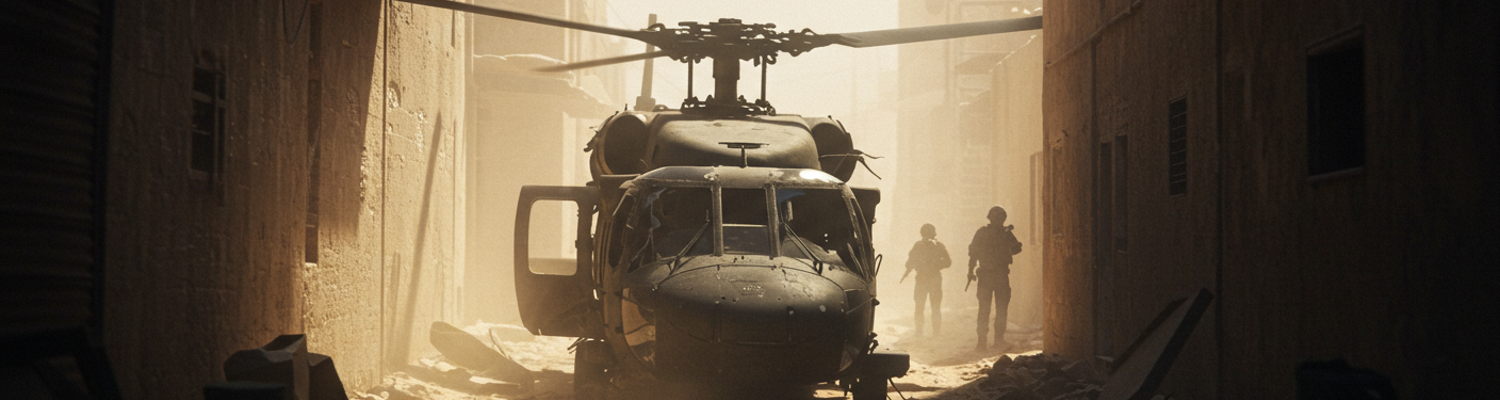

The Operational Tempo Before the Raid
The men were already running on fumes. A review of operational logs from September 1993 shows the soldiers of Task Force Ranger were worn down by the deployment's physical demands. They operated in relentless heat from a fortified airport hangar complex, subsisting on a monotonous diet, under the tension of constant readiness. The 1991 collapse of the Siad Barre regime had thrown Somalia into civil war and famine, prompting the UNOSOM I mission. When that proved insufficient, the U.S. led Operation Restore Hope (UNITAF), landing troops in December 1992. This transitioned to the more aggressive UNOSOM II in March 1993, which had enforcement powers to disarm militias.
This was not a peacekeeping deployment.
In August 1993, after 24 Pakistani peacekeepers were killed, the mission's focus changed. The UN authorized the capture of warlord Mohamed Farrah Aidid. To execute this, the Joint Special Operations Command (JSOC) deployed Task Force Ranger. Under Major General William F. Garrison, the force was a surgical instrument for a manhunt, operating outside the main UN command. It comprised C Squadron, 1st Special Forces Operational Detachment-Delta (Delta Force); B Company, 3rd Battalion, 75th Ranger Regiment; and the 160th Special Operations Aviation Regiment (SOAR), the Night Stalkers. From their Mogadishu Airport base, the 450-man task force was designed to capture Aidid and his lieutenants. A formal request for armored support, including AC-130 gunships and M1 Abrams tanks, was denied by the Pentagon in an effort to maintain a low-profile U.S. presence.
Archival evidence shows the October 3rd mission was the seventh raid of its kind. Throughout September, Task Force Ranger had refined its tactical template: helicopter insertions of Delta operators to assault a target, with Rangers establishing a security perimeter. A ground convoy of Humvees and trucks would then extract the force and any detainees. Raids on the Lig-Ligato house and to capture Aidid’s financier, Osman Atto, had been successful. These repeated actions, however, created a known pattern. Somali militia forces began to anticipate American tactics. They documented the fast-roping, the blocking positions, and the reliance on a ground convoy. They were adapting, learning the procedures of their high-tech opponents, and preparing a counter for the next time helicopters appeared over the city.
The RPG Strike on Super 61
Super 61, an MH-60L Black Hawk from the 160th SOAR, maintained a tight, left-hand orbit over the target building near the Olympic Hotel. Below, the raid’s initial phase was complete. Delta operators were inside, securing their targets. Rangers defended their blocking positions against growing militia resistance. The crew of Super 61, callsign Elvis 61, piloted by Chief Warrant Officer 3 Cliff “Elvis” Wolcott and Chief Warrant Officer 3 Donovan “Bull” Briley, provided overwatch. Their aircraft was an essential aerial command platform.
The attack came from a street-level position. After-action reports confirm the weapon was a Soviet-designed RPG-7, fired by a militiaman who had anticipated the helicopter's predictable holding pattern. The 40mm PG-7V high-explosive anti-tank grenade traveled on a ballistic arc, intersecting with the helicopter’s tail boom. The warhead's detonation was a localized, violent blast. Shrapnel tore through the thin aluminum skin of the tail pylon, severing mechanical and hydraulic components housed within.
The immediate effect was a complete loss of the tail rotor. Examination of the wreckage (NARA Record Group 319) showed the RPG strike severed the tail rotor driveshaft and the associated hydraulic lines. The MH-60L operates with three redundant hydraulic systems; for a failure this total to occur indicates a near-complete structural separation of the tail assembly. Without hydraulic pressure, the tail rotor gearbox became unresponsive. The tail rotor itself, disconnected from its power source, stopped functioning. Instantly, the 11,000-pound aircraft was subject to the rotational force of its main rotor and began a violent, uncommanded yaw to the right. In the cockpit, Wolcott and Briley experienced a sudden, complete loss of directional control. Their training dictated immediate entry into autorotation, but their low altitude of less than 100 feet left them with almost no time or space to execute the emergency procedure.
Uncontrolled Descent and Impact
The aircraft was no longer under aerodynamic control. In the cockpit, Wolcott and Briley fought a non-survivable emergency. The moment of impact was felt as an instantaneous yaw to the right. The only possible response was autorotation, a procedure that involves cutting engine power and using the upward flow of air to keep the main rotor spinning, theoretically allowing a controlled glide. But autorotation requires altitude and time. Super 61 had neither.
Operating below 100 feet, the crew had no margin for error. The violence of the uncontrolled spin, with the fuselage rotating at a dizzying rate, rendered the cyclic and collective controls nearly useless and made establishing a stable glide path impossible. They had seconds, not minutes, to react. The aircraft, now in a rapid and accelerating descent, was falling on a ballistic trajectory dictated by its own momentum and gravity.
At approximately 16:20 local time, Super 61 fell from the sky. Its path took it northeast of the original target building. It crashed deep inside the Bakara Market, a sprawling warren of narrow streets and single-story structures. The specific location, at coordinates 02°03′09.4″N 45°19′34.8″E, was a narrow alley. The aircraft’s forward momentum carried it into the wall of a building, crushing the cockpit and killing both pilots instantly. The tail boom and main fuselage slammed into the alley, kicking up a massive plume of dust and debris visible across the city. This dust cloud became an unambiguous beacon, signaling to both American forces and the swarming Somali militia that the battle had fundamentally changed.
The Sensory Chaos at Crash Site One
The final moments of Super 61’s flight were defined by mechanical violence. The RPG impact was a sharp blast, but the subsequent failure produced the defining sounds of the crash. As the tail rotor assembly was severed, the aircraft's uncommanded spin produced a pulsating growl as the main rotor blades flexed and struck the airframe. The sound was a grinding, percussive cacophony of metal on metal, audible for blocks. Inside the main cabin, the two crew chiefs, Staff Sergeants Ray Dowdy and Charlie Warren, and two Delta snipers, Sergeant Jim Smith and Staff Sergeant Daniel Busch, were subjected to an intense physical assault. Centrifugal force pinned them against the fuselage walls while the airframe groaned and tore apart around them. The twin General Electric T700 turboshaft engines, no longer under pilot control, screamed at maximum revolutions before the impact shattered them.
An abrupt silence followed. The five-ton helicopter, spinning at a high rate of rotation, slammed into the alleyway, dissipating its kinetic energy in a fraction of a second. The composite rotor blades disintegrated. The engines tore from their mounts. The airframe crumpled against a stone building. For a period lasting only a few seconds, the overwhelming noise of the descent vanished, replaced by a vacuum of sound. The only noises were the settling of twisted wreckage, the hiss of leaking hydraulic fluid, and the drip of jet fuel onto hot metal. This sudden quiet was disorienting for the survivors inside the wreck. It was also a tactical signal, confirming the finality of the crash. For the hundreds of Somali militia fighters converging on the area, the end of the helicopter’s screaming descent and the subsequent quiet pinpointed the precise location of their target.
That quiet was broken by a storm of fire. The first rounds were likely probing shots from an AK-47. The metallic plink of 7.62mm rounds striking the Black Hawk’s skin was the start. Within seconds, as militia fighters realized the wreckage was static, this tentative fire grew into a rapid crescendo. From dozens of unseen positions in the surrounding buildings and alleyways, a sustained barrage of small arms fire erupted. The soundscape transformed from silence into a dense wall of noise. For the survivors inside, the sharp cracks of supersonic rounds passing through the cabin mixed with the dull thuds of bullets impacting the fuselage, which offered their only cover. They were pinned, unable to exit the wreckage into the kill zone that had materialized around them. The volume of fire from a 360-degree threat axis effectively sealed the crash site.
The Doctrinal Failure of the Urban Swamp
The Bakara Market district was not a city in the Western sense. It was a sprawling, organic maze of single and two-story mud-brick and corrugated-tin structures. A review of terrain analysis shows a warren of narrow, trash-strewn alleys and unmapped dirt roads. This created what operators called an “urban swamp.” The term was a technical description of a tactical problem. The narrow confines channeled all movement into predictable kill zones, perfectly suited for militia ambushes. The dense construction and high ambient heat rendered many American technological advantages ineffective. Thermal imagers were defeated by the retained heat of sun-baked walls, and early GPS systems were unreliable in the urban canyons.
This environment represented a complete doctrinal failure for the U.S. Army of 1993. Task Force Ranger’s ground component, a convoy of unarmored M998 Humvees and larger M939 5-ton trucks, was designed for rapid movement over open terrain, a concept drawn from decades of planning for conflict in Europe. In the tight confines of Mogadishu, the convoy was slow, loud, and vulnerable. Records of radio traffic show the ground convoy, commanded by Lieutenant Colonel Danny McKnight, almost immediately became disoriented. Lacking accurate maps and reliable real-time intelligence on the rapidly forming barricades of burning tires and rocks, the column repeatedly missed turns or was forced into dead ends. A P-3 Orion spy plane attempted to provide directions, but the information was relayed through a chain of observers, causing delays that often meant a turn was passed before the instruction was received. Each wrong turn forced the convoy to backtrack through ambushes it had just passed, subjecting the vehicles to renewed fire.
Initial attempts to rescue the crew of Super 61 were immediately overwhelmed. The mission’s pre-planned Combat Search and Rescue (CSAR) element was aboard an MH-60, callsign Super 68, piloted by Chief Warrant Officer 3 Dan Jollota. After-action reports detail how Super 68 moved to the crash site and attempted to insert its 15-man rescue team by fast-rope. The volume of ground fire directed at the hovering helicopter was so intense that the insertion was impossible. As the team prepared to deploy, an RPG slammed into Super 68, crippling the aircraft. Though Jollota skillfully managed to fly the damaged helicopter back to the airport, the official CSAR effort was defeated before a single rescuer touched the ground. This failure demonstrated that standard rescue protocols were unworkable. In a separate, daring effort, an MH-6 Little Bird, Star 41, landed near the crash site, evacuating two wounded soldiers before being forced to lift off. The effort was heroic but improvised and unsustainable. The situation had already devolved beyond established contingency plans.
The Five-Minute Command Collapse
A detailed review of the operational timeline shows the mission’s integrity dissolved in the five minutes following Super 61’s crash. At 16:20 local time, the call “Super 61 is down” sliced across multiple radio nets, but it did not create a unified response. It created fractures.
Task Force Ranger’s command and control (C2) architecture was a layered system with separate radio frequencies for the ground convoy, the air component, Delta Force operators, and overall command. This structure, designed for a controlled raid, became a liability. In the air, pilots saw the spin and the impact plume, providing an immediate understanding of the crash’s location. On the ground, however, both the Ranger security elements and Lieutenant Colonel McKnight’s vehicle convoy were engaged in their own firefights, their situational awareness limited to the surrounding buildings. Their radios told them a helicopter was down, but they could not see it. This disconnect between air and ground perspectives was the first failure.
In those first five minutes, a flurry of independent, uncoordinated actions began. The designated CSAR helicopter, Super 68, moved toward the crash site as dictated by doctrine. Some Ranger and Delta elements on the ground began moving on foot toward the smoke plume, an instinctual reaction. The ground convoy, however, was mired in its own fight and awaiting clear instructions on how to proceed to a location it couldn’t pinpoint. After-action reports indicate that for twenty minutes after the crash, both the assault team on the ground and the vehicle convoy were under the mistaken impression that the other would make first contact to coordinate movement. This hesitation allowed Somali militia forces to begin converging and erecting barricades, sealing the area.
Radio Failure and Tactical Devolution
The technical backbone of the command system, the radio network, collapsed under the strain. The primary ground radio, the SINCGARS (Single Channel Ground and Airborne Radio System), is a frequency-hopping system designed for security but is reliant on line-of-sight, a significant flaw in the dense urban canyons of Mogadishu. The signals were absorbed and scattered by the concrete and mud-brick buildings. This physical degradation was amplified by human factors. As the crisis escalated, multiple leaders tried to transmit information simultaneously on the same frequencies. These “stepped-on” transmissions canceled each other out, resulting in unintelligible shrieks of static precisely when clarity was needed. The command-and-control helicopter and the P-3 Orion were meant to act as information hubs, but they became bottlenecks. Information from the spy plane had to be relayed to forward observers, who then passed it to vehicle commanders, a delay that made the intelligence obsolete by the time it was received by drivers navigating a hostile maze.
No coherent operational picture was available. No reliable instructions came from a centralized command. Small unit leaders and individual soldiers were forced to make isolated, ad-hoc tactical decisions based on fragmented information. This was not a coordinated response; it was a series of desperate, independent actions. The pre-planned CSAR element aboard Super 68 proceeded toward the crash site, only to be crippled by ground fire, aborting their mission before a single rescuer made it to the ground. Seeing this, some Ranger and Delta operators near the original target building began moving on foot toward the smoke plume without direct orders. The crew of the MH-6 Little Bird, Star 41, landed unsupported near the wreckage to evacuate two wounded soldiers before being driven off by gunfire. These were heroic efforts, but they were disjointed. While these elements pushed toward the crash, the main ground convoy remained stalled, its commander unable to get a clear vector to the site through the garbled radio traffic. This paralysis allowed Somali forces to consolidate their grip on the area around the downed helicopter.
The Irrevocable Shift
The operational plan for October 3rd was predicated entirely on a successful extraction, designed to last no more than an hour. At 16:20 local time, that entire construct was invalidated by a single RPG-7 projectile. The event transformed a raid into a rescue. Before that moment, the operation was a success; Aidid’s lieutenants were captured. After that moment, the objective became the survival of American soldiers. The plume of smoke from Super 61’s wreckage was a city-wide summons. Having learned from Task Force Ranger’s six previous raids, hundreds of militia fighters now knew exactly where to converge. A sophisticated military operation was upended by one man with a simple, inexpensive anti-tank weapon.
The command-and-control system did not degrade; it shattered. The fatal disconnect between what aerial assets could see and what ground forces knew defined the first five minutes. The pilots had a clear visual on the crash site. The ground convoy was blind. Radio nets became saturated with overlapping, frantic calls. This hesitation afforded the Somali militia the time needed to begin erecting barricades of rocks and burning tires, systematically sealing off the narrow streets leading to the crash site. The doctrinal response, the insertion of the designated CSAR team from Super 68, was attempted and immediately defeated. This failure, occurring within minutes of the first crash, was a definitive sign that the situation had already spiraled beyond any contingency plan. A single wrong turn by the disoriented ground convoy, struggling with inaccurate maps and delayed instructions, would force the unarmored Humvees back through ambushes they had just survived, compounding casualties with each pass. The battle's outcome was not decided at a strategic level; it disintegrated at the tactical edge, where individual radio failures and a driver’s missed turn overwhelmed a technologically superior but doctrinally unprepared force.