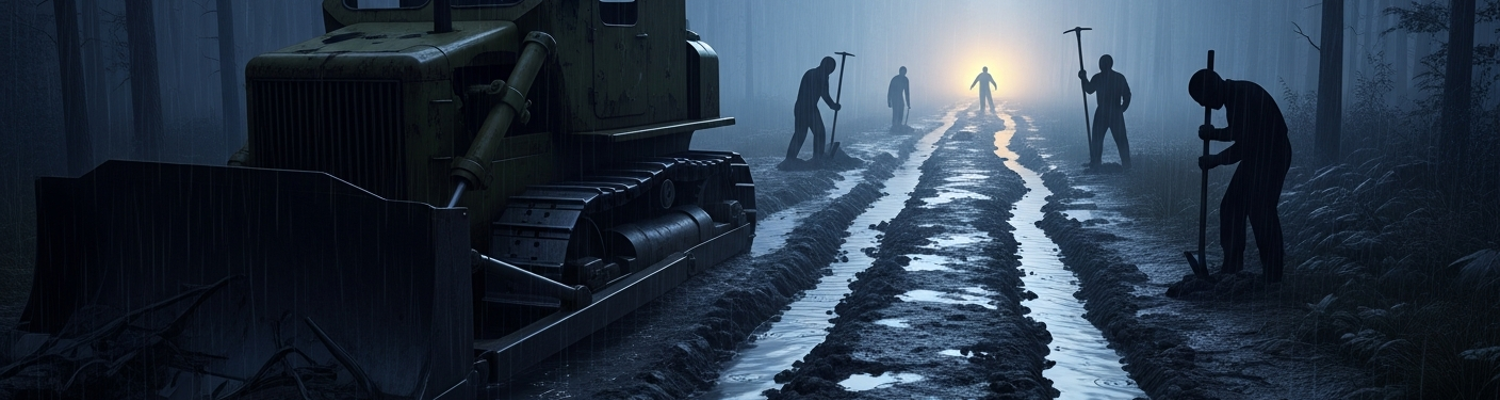

The operational logs of the 299th Engineer Combat Battalion from March 1945 read like a manual on attrition. This unit, already hardened by fighting from Omaha Beach through the Bulge, found itself attached to the U.S. First Army's III Corps, tasked with a singular, desperate mission. The unexpected seizure of the Ludendorff Bridge at Remagen had created a logistical vortex, and the 299th was thrown directly into it. Their job was to force open a supply route through a landscape methodically engineered for destruction by retreating German forces. Using their organic heavy equipment, primarily Caterpillar D-7 bulldozers and truck-mounted air compressors, the engineers began a systematic assault on the terrain itself. Mine-clearing teams, armed with SCR-625 detectors, moved just ahead of the earth-moving machinery, sweeping for Teller mines and other anti-tank devices planted in the road's soft shoulders and packed into the lips of craters. The battalion worked in shifts, around the clock, under the constant threat of pre-registered artillery fire and sporadic Luftwaffe sorties. Their labor was the foundation for the First Army's ability to exploit the Rhine crossing.
The designated Main Supply Route (MSR) was a twelve-kilometer stretch of road coded Route L-13. It was a narrow, winding path through the dense Eifel forest, a region of steep gorges, poor drainage, and a thick canopy that kept the ground in a state of perpetual mud. German pioneers had leveraged this terrain with expertise. Every culvert along the route was blown, creating dozens of unfordable gaps in the roadbed. They felled massive trees, their trunks interwoven and booby-trapped with pull-fuzes to form extensive abatis. At choke points, demolition teams detonated enormous charges, creating craters that consumed the entire road, some measuring over thirty feet wide and ten feet deep. These obstacles were not designed for simple delay. They were engineered to halt an armored advance by forcing combat engineers into time-consuming, physically draining labor under fire.
This short stretch of woodland path became a more formidable barrier than many fortified towns.
The strategic necessity of clearing Route L-13 was absolute. It was the artery required to sustain and expand the bridgehead established by elements of VIII Corps. The capture of the Ludendorff Bridge on March 7, 1945, by Combat Command B of the 9th Armored Division was a tactical coup, but it initiated an immediate supply crisis. Thousands of troops from infantry divisions like the 87th were crossing the Rhine with only the ammunition and rations they could carry. This expanding force on the east bank was a powerful salient that could quickly become an encircled pocket without a high-volume supply line. Route L-13 was that line. Every gallon of gasoline for the Sherman tanks of the 4th Armored Division, every crate of K-rations, every box of .30-caliber ammunition, and every life-saving plasma bottle had to traverse this path. The non-stop effort of the 299th Engineers was a direct race against a forming German counterattack. A supplied bridgehead could break out into Germany's industrial heartland. An isolated one would be annihilated. When the Ludendorff Bridge finally collapsed from sustained damage on March 17, the pontoon bridges built by engineers and the now-cleared Route L-13 were carrying the full logistical weight of the American advance.
German defensive doctrine for the Eifel forest was not merely to delay, but to inflict maximum casualties on the engineers sent to clear the way. The road was saturated with a complex mixture of anti-tank and anti-personnel mines intended to defeat every known method of detection and removal. The primary anti-tank threat was the Teller mine series, specifically the T.Mi. 42 and T.Mi. 43 models. Each contained over eleven pounds of TNT, enough to sever the track of a Sherman tank or a D-7 bulldozer. They were not laid in predictable patterns. German engineers buried them in soft shoulders, hid them at the bottom of craters, and packed them into the tangled abatis. To defeat the standard-issue SCR-625 electronic mine detectors, these were interspersed with devices like the Schu-mine 42, an anti-personnel mine encased in a simple wooden box that rendered it nearly invisible to detection equipment of the era. The most insidious threat, however, was the German use of secondary anti-handling devices. Most Teller mines were manufactured with additional fuse wells on their sides and bottoms. Into these, engineers would screw Z.Z.42 pull-fuzes connected to tripwires or, more dangerously, pressure-release fuzes. The act of lifting a located mine could trigger its own detonation.
This turned every discovery into a lethal puzzle.
The systematic seeding of mixed and booby-trapped mines paralyzed clearance operations. Standard procedure for the men of the 299th was a slow, methodical process. An engineer would sweep his detector, listen for the tell-tale audio signal, and then get on his hands and knees to probe the mud with his bayonet. In the freezing rain of the Eifel, this was agonizing work. The widespread use of wooden Schu-mines made detectors unreliable, forcing engineers to rely almost entirely on probing by hand every few inches. The discovery of a Teller mine was not the end of the threat. The T.Mi.Z.43 fuze, for example, was designed to arm an internal anti-handling device when it was screwed in, meaning any attempt to unscrew it would trigger detonation. Engineers had no way of knowing which fuze was installed. They were often forced to destroy mines in place with small explosive charges, a time-consuming method that further damaged the ruined roadbed. Under constant threat from German artillery, which had pre-sighted the very choke points they were trying to clear, every foot of progress on Route L-13 was purchased with nerve-shredding tension.
This stop-start advance was governed by another factor. Archival data on WWII heavy equipment reveals a critical vulnerability for the armored bulldozers of the 299th. A Caterpillar D-7, operating under the severe load of clearing massive craters and thick mud, could burn through seven gallons of diesel fuel per hour. Operational reports from the Remagen front indicate that forward engineer units were functioning on a logistical shoestring. The rapid advance to the Rhine had stretched supply lines to their breaking point. For the bulldozer teams on Route L-13, this translated to a crippling shortage of diesel fuel. Records show they were operating with reserves that allowed for as little as four hours of continuous work. This single constraint dictated the entire rhythm of the operation. A platoon leader had to choose between running his machines at full power to clear one major crater, knowing they would then sit idle for hours, or operating them intermittently to conserve fuel, prolonging the timeline for opening the road. Every hour the bulldozers sat silent was another hour the bridgehead remained undersupplied.
An examination of III Corps’ G-4 logistical records from mid-March 1945 reveals a severe deficit across multiple classes of supply. For the combat engineers of the 299th, the most acute problem was the availability of demolitions. By March 10th, the battalion’s on-hand quantity of Class V munitions, specifically explosives, had fallen to just 15% of its authorized allowance. This was a tactical disaster. The German strategy of cratering roads relied on forcing American engineers to expend huge quantities of explosives for rapid clearing. A standard thirty-foot road crater required hundreds of pounds of TNT to blast the sides and create a manageable ramp for bulldozers. With their magazines nearly empty, the engineers lacked the means to execute textbook solutions. They were short of M1 TNT blocks, Composition C-2 plastic explosive, and M7 non-electric blasting caps.
These shortages created a uniquely hazardous working environment. An engineer from the 299th attempting to clear a German obstacle was stripped of his two most important tools: his own explosives and the protective fire of his infantry support. Instead of quickly placing and detonating charges to destroy a mine or blow apart a log abatis, he was forced to adopt slower, more dangerous methods. Without adequate C-2 to sever booby-trapped logs, teams resorted to using two-man crosscut saws and axes, manually disassembling obstacles while completely exposed. The infantrymen who were supposed to be overwatching them could offer little more than a token defense. This forced engineer squad leaders to alter their entire approach. Speed was sacrificed for stealth, as drawing the attention of any nearby German units could lead to a situation that the under-supplied riflemen could not handle. The time required to clear a single major obstacle ballooned from minutes into hours.
Transcribed post-action debriefings from the 299th Engineer Combat Battalion reveal a command climate defined by exhaustion. These immediate reviews, documented by Captain Elias Vance, were not formal inquiries but raw, frantic efforts to capture fleeting lessons from the chaos of Route L-13. The notes depict platoon leaders, some no older than twenty-two, hollowed out by a complete lack of sleep and the continuous pressure of the mission. The battalion had been in near-constant action, and the cumulative effects of combat fatigue were profound. Vance’s records (NARA Record Group 407) describe men whose hands shook uncontrollably, not from fear, but from sheer physical and nervous system exhaustion. This was a direct result of operating for days under artillery fire while performing mentally taxing, delicate work. The fatigue manifested in dulled reflexes and slowed decision-making. A lieutenant leading a mine-clearing team had to function on multiple levels simultaneously: calculating explosive charges, monitoring his men, listening for incoming shells, and processing intelligence, all while his body was shutting down.
This state of profound fatigue formed the backdrop for a recurring, agonizing decision. Platoon leaders were constantly forced to weigh the lives of their engineers against the urgent operational timetable. The central dilemma was whether to send men forward to probe un-swept sections of Route L-13 by hand or to wait for armored bulldozers and detection equipment that might be days away. Waiting meant conserving lives but also condemning the undersupplied divisions on the east bank of the Rhine to a potentially disastrous logistical shortfall. Pushing forward meant accepting near-certain casualties. German doctrine favored mining the soft shoulders of roads and the earth at the bottom of craters, precisely where engineers had to work.
Without adequate TNT or Composition C-2, engineers could not rely on the textbook method of destroying mines in place. This forced a return to manual methods. It meant sending a soldier forward with a bayonet to probe the mud and, upon finding a mine, attempting to disarm it by hand, knowing it could be fitted with an anti-lift device. Vance’s debriefing notes document the choices: a leader might have only one or two experienced non-commissioned officers proficient at disabling the intricate German fuzes. The decision then became whether to risk his most valuable men to clear a path a few feet faster. The infantry providing security were themselves too low on ammunition to provide the suppressive fire needed to protect the exposed engineers from German patrols. A single German machine gun opening up on a work party could be catastrophic. Every decision to proceed was a gamble, staking the lives of a handful of exhausted engineers against the strategic necessity of opening the supply route.
In the quiet that descended upon the churned earth of Route L-13, the noise of combat was replaced by silence. The hours immediately following the climax of the route-clearing operation were marked by an unnatural stillness, broken by freezing rain and the groan of twisting metal from a disabled bulldozer. For the survivors of the 299th, this was a moment of unnerving peace. The tension of probing for mines and listening for artillery had vanished, leaving a void filled with exhaustion. Men moved with a slow, dreamlike quality. The ground itself was a testament to the violence, a landscape of overlapping craters, splintered trees, and the dark mud that had claimed so much of their energy.
The battalion’s informal muster counts from that period reveal the brutal arithmetic of their success. One company, which had gone into the Eifel forest at nearly full strength, had been effectively cut in half. These were not losses from a single engagement, but the result of a steady process of attrition. A squad would lose a man to a Schu-mine. Another two would be lost hours later, picked off by a sniper their infantry support could not suppress. The greatest losses came from the German practice of fitting Teller mines with anti-handling fuzes. Several teams were wiped out by the very mines they were attempting to disarm. The cumulative effect on the company’s operational capacity was devastating. It stripped the unit of its most experienced NCOs and sappers, the very men who possessed the hard-won knowledge of how to counter the enemy’s techniques. This loss of institutional knowledge was as damaging as the loss of manpower.
This rate of attrition spurred the immediate recording of raw, unprocessed lessons. Surviving platoon leaders and company commanders, operating on sheer nervous energy, began a frantic effort to document what had happened before the details were lost to fatigue. These were not formal after-action reports. They were desperate, handwritten notes on the backs of K-ration boxes, map overlays, and in blood-stained notebooks. A lieutenant would sketch the precise fuse-well configuration of a newly discovered booby trap. A sergeant would dictate the exact sequence of sounds their air compressor made before it failed, clogged with frozen mud. They recorded German artillery patterns, noting which types of terrain drew the most fire. This was a raw data dump, a collection of visceral observations born from catastrophic failure. The driving impulse was a grim understanding that the lessons paid for with the lives of half their men had to be passed on, immediately, to the next engineer unit that would face the same unforgiving task. One note simply detailed the failure rate of a specific blasting cap in wet conditions. That was a fact worth a man's life to record.