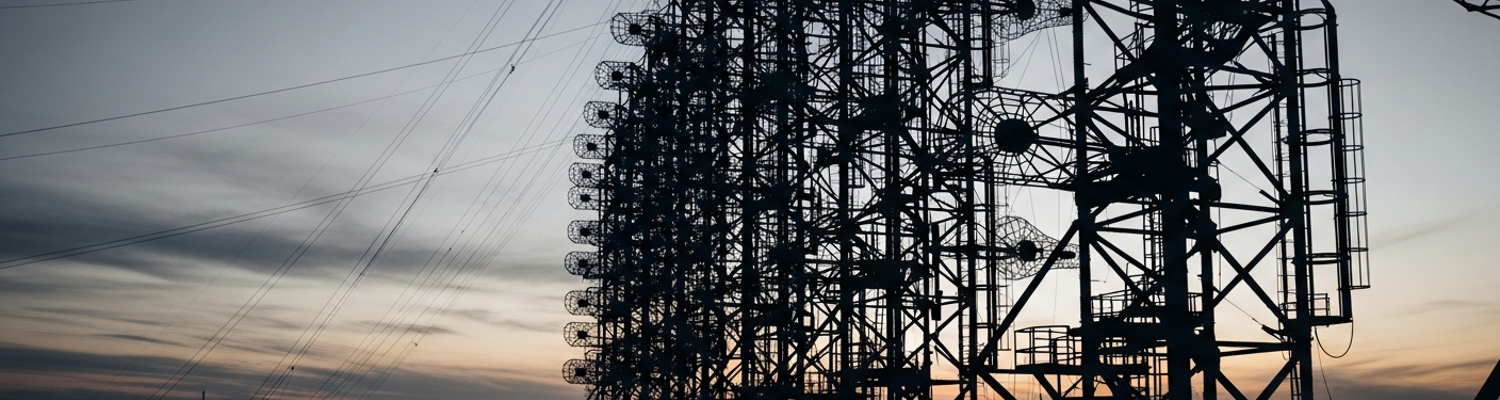

The Soviet intelligence apparatus presented a threat of continental scale. Archival evidence shows the United States Air Force, with its advanced technology and global reach, was a target of the highest priority for compromise by Soviet and Warsaw Pact intelligence services. This was not a distant danger. It was an immediate and pervasive pressure felt at every American installation, particularly the secret listening posts forming the front line of electronic intelligence gathering. From the massive AN/FLR-9 “Elephant Cage” antenna arrays at Misawa Air Base to the radome-crowned peak of Teufelsberg in West Berlin, these facilities were islands of American secrets sitting in a sea of active adversaries. The United States Air Force Security Service, or USAFSS, was created in 1948 with the express mission of intercepting and interpreting military signals, placing its personnel and installations directly in the crosshairs.
Perfection was the only authorized state of being.
In response to this environment, a new security doctrine was imposed across the force. A review of operational directives from the era reveals the rollout of a comprehensive regulatory framework, exemplified by documents in the Air Force Regulation 205 series. These were not guidelines. They were foundational texts for a new security culture. The stated objective was unambiguous: the total prevention of intelligence compromise. This philosophy was born from the high-stakes nature of the SIGINT mission itself, where the loss of a single piece of information, a frequency or a call sign, could unravel entire operations. The goal was to transform sprawling, technically complex bases into hermetically sealed vaults.
The physical and procedural manifestation of this doctrine was a layered system of control. A historian examining the duty rosters and blueprints for a facility like Field Station Berlin would find a fortress designed not just to keep people out, but to aggressively manage every movement within. Personnel entry was governed by multi-tiered checks, beginning with armed guards at the perimeter fence and escalating in intensity as one moved closer to the operational heart of the base. Inside the Sensitive Compartmented Information Facilities, or SCIFs, where raw intelligence was processed, movement was even more constrained. The architecture itself became a security tool. Cipher-locked doors, color-coded badge systems denoting access levels, and strict two-person integrity rules in specific areas were standard. Every person was subject to these internal movement controls, their presence in any given section logged and tracked. Air Force Office of Special Investigations (OSI) agents performed constant counterintelligence functions, briefing personnel on how to spot and report suspicious activity and conducting unannounced intrusion tests.
The theoretical intent behind this structured security framework was the creation of a human and procedural machine incapable of error. Air Force Regulation 205-5 was an attempt to engineer human behavior on a massive scale, standardizing security practices to eliminate the unpredictable variables of individual judgment. This philosophy was built on the absolute enforcement of the need-to-know principle. A security clearance, even at the Top Secret level, was never a blanket authorization. It was merely the prerequisite to be considered for access. The actual authority to view or handle a specific piece of intelligence was granted only when an individual’s duties directly required it. This was the foundation of compartmentalization, a system designed to build firewalls not just between installations, but between individual analysts sitting in the same room. The system treated knowledge as a contagion, to be contained and controlled with clinical precision.
This theory manifested as a rigid architecture of access controls. Within a USAFSS facility, such as the Misawa Security Operations Center in Japan, this was a daily process. Access was stratified. An airman might have a Top Secret clearance, but to enter the SCIF where raw signals intelligence was processed, they required SCI access. This was not a single designation, but a series of additional authorizations tied to specific intelligence sources and methods. An analyst working on Soviet naval communications would be read into that specific program, but would be denied access to the data from an adjacent program monitoring Soviet air defense radar, even if it was being analyzed ten feet away. Each compartment was a sealed world, often identified by its own codeword. Personnel records from the period show that movement between these compartments was strictly logged and audited. Entry into the SCIF itself was a formal procedure, requiring personnel to surrender all personal electronics. Inside, further restrictions often applied, sometimes with color-coded lines on the floor that personnel were forbidden to cross without specific authorization, physically segregating different analytic cells.
To be granted entry into this layered world, personnel underwent an exceptionally invasive vetting process. The primary tool for SCI access was the Special Background Investigation (SBI). The scope of the SBI was exhaustive, typically covering at least the last 10 years of a person’s life. Investigators from the Office of Personnel Management or the Defense Security Service conducted extensive interviews not only with the candidate but also with neighbors, former teachers, and coworkers. They verified employment, checked credit histories, and cross-referenced records with law enforcement agencies. The objective was to uncover any detail, a hidden debt or an undisclosed foreign contact, that could potentially be used by an adversary as leverage for blackmail. At forward-deployed locations like Field Station Berlin on Teufelsberg, movement restrictions were even more severe, reflecting the immediate threat environment. Personnel were sometimes forbidden from using specific public transit lines in West Berlin that passed under East German territory. These vetting procedures and movement controls were designed to ensure that only the most reliable and least vulnerable individuals were allowed near the nation’s most sensitive intelligence.
The perfection demanded by the Air Force’s security doctrine began to show fractures almost immediately upon contact with the physical world. A close review of internal USAFSS assessments from the mid-1960s (per USAFSS Internal Review, Q2 1966, Project CHATTERBOX) reveals a consistent pattern of implementation challenges. These were not high-level strategic failures but an accumulation of mundane deficiencies on the ground. At forward-deployed locations, particularly in the humid, salt-laden air of Southeast Asia, the sophisticated electronic and mechanical hardware of the new security posture proved distressingly fragile. Reports documented frequent failures of newly installed cipher-combination locks on SCIF doors, with delicate internal mechanisms corroding. This forced personnel to leave doors unsecured or resort to makeshift locking procedures that violated the essence of the regulations. The sheer volume of paperwork required to log and track the movement of classified materials and personnel became a crushing burden, leading to cursory entries and pencil-whipped checklists as analysts prioritized the actual intelligence mission over procedural exactitude.
The system was a direct consequence of a security framework designed in sterile administrative environments being deployed into the chaotic conditions of operational bases.
The impracticality of the new regulations manifested as a form of bureaucratic friction that hindered mission-critical operations. Historical records detail instances where the rigid, multi-layered access system became an antagonist to operational agility. At a facility like Field Station Berlin on Teufelsberg, an outpost surrounded by Soviet motorized rifle and tank regiments, speed was essential. Yet, the system was not built for speed. An analyst monitoring Soviet Ground Forces communications might identify a new signal pattern but be unable to consult with a specialist in the next section who analyzed Soviet Air Force traffic because the second analyst was not formally read into the specific ground-warfare compartment. Obtaining even temporary access could take hours of routing paperwork through a security control officer. By that time, the tactical window to exploit the intelligence might have closed. This compartmentalization, designed to build firewalls, often prevented the fusion of related intelligence streams that could have provided a more complete operational picture. The supply chain for security-approved equipment also became a point of failure; a burned-out vacuum tube in a intercept receiver could sideline a collection effort for days while waiting for a replacement from a secure, approved vendor.
The inevitable result was a growing conflict between regulatory adherence and the necessity of accomplishing the intelligence-gathering mission. On-the-ground commanders and senior non-commissioned officers were frequently forced into untenable positions. An operations floor supervisor at Misawa Air Base, faced with a sudden loss of power to a bank of intercept positions during a Soviet naval exercise, had a choice: follow protocol and wait for a cleared electrician to be summoned, or escort a non-cleared but immediately available base electrician into the SCIF under heavy guard to fix the problem instantly. Anecdotal accounts from the period are filled with such pragmatic, technically illicit, workarounds. This created a silent culture of calculated risk, where personnel would bend or break specific security articles to maintain operational tempo, all while hoping that no incident would trigger a formal investigation from the ever-present security service or OSI agents.
The operational tempo within USAFSS listening posts was relentless. Archival records and anecdotal accounts paint a picture of psychological decay. Analysts and linguists, often young and on their first enlistment, were confined for 12-hour shifts inside windowless, climate-controlled SCIFs. Their entire world became the faint crackle of high-frequency signals from Soviet bomber formations or the monotonous drone of Warsaw Pact tactical chatter. This was a unique form of sensory deprivation, punctuated by moments of high-stakes stress. A former analyst from Field Station Berlin described the experience as living in a state of perpetual, low-grade anxiety. This strain was compounded by the nature of the intelligence itself; listening to an adversary conduct nuclear strike drills or rehearse the invasion of Western Europe was a heavy psychological burden. Veteran accounts from Misawa Air Base mention the disorienting effect of rotating shifts that deliberately disrupted circadian rhythms, a measure intended to keep the facility at maximum readiness around the clock.
This was not a healthy environment.
The security apparatus itself became a source of morale corrosion. The constant, pervasive threat of internal breaches, amplified by the OSI, fostered an atmosphere of deep-seated paranoia. Every airman was viewed as a potential weak link, a possible target for recruitment or blackmail by hostile intelligence services. This institutionalized suspicion atomized the social cohesion necessary for effective teamwork. The Two-Person Integrity (TPI) rule, a protocol requiring two authorized individuals to be present for any sensitive task, was a prime example. While logical for tasks like handling cryptographic keys, its application within the SCIF created a culture of mandatory surveillance where colleagues were transformed into chaperones. Trust was no longer a personal bond but a procedural mandate. This was worsened by counterintelligence briefings that actively encouraged personnel to report any unusual behavior or personal struggles of their peers, a hidden debt or a messy divorce, as potential security vulnerabilities. A review of personnel management guidelines from the era shows an intense focus on identifying any personal detail that could be used as leverage, effectively turning the entire force into an adjunct of the security office.
The rigidity of the security regulations, particularly the Air Force 205 series, created a constant state of friction between policy and mission accomplishment that ground down personnel over time. For the highly skilled analysts and technicians inside the wire, the rules often felt arbitrary. The strict compartmentalization, which prevented an analyst working Soviet naval codes from speaking with an expert on Soviet air defense radars in the same room, was a frequent source of intense frustration. It stifled intellectual curiosity and the kind of cross-domain collaboration that often leads to intelligence breakthroughs. This bureaucratic inflexibility communicated a profound lack of trust from the command structure, treating its personnel not as valued experts but as untrustworthy components in a security machine. This sense of being perpetually suspected and constrained, coupled with the pressure of the mission, led to widespread cynicism and burnout.
The intricate machinery of control, exemplified by AFR 205-5, was designed to function with precision. Its purpose was to eliminate human variables, creating a predictable and secure environment. A review of internal security audits from the period, however, indicates this very predictability became a vulnerability. The system’s obsession with procedural compliance created rhythms and patterns that an observant adversary could map. For instance, the mandated two-person integrity procedures for classified document destruction meant that burn bags were collected and transported to base incinerators on a rigid, unvarying schedule. An enemy agent performing simple surveillance on a facility like Karamürsel Air Station in Turkey would not need to penetrate the SCIF; they only needed to observe the predictable exodus of the destruction detail every day at 1630 hours to understand a key operational tempo of the base. The system was designed to defeat a complex, technical assault, but it inadvertently created weaknesses against low-tech, patient observation of its inflexible routines.
The theoretical perfection of AFR 205-5 failed when it encountered the realities of human fallibility and insider access. Counterintelligence case files from the era provide stark evidence of this. The compromise mechanics demonstrated in the case of Army Sergeant Jack Dunlap, who spied for the Soviets from within the National Security Agency, offered a template for failure that was entirely possible within a USAFSS facility. A trusted Non-Commissioned Officer, perhaps a senior administrative clerk with a Top Secret clearance and years of unblemished service, was not a figure the system was designed to suspect. Such an individual, granted broad but shallow access across multiple departments, could exploit the very regulations meant to ensure security. A plausible scenario at a location like Misawa Air Base would involve this NCO using their authority to sign for classified maintenance manuals or operational summaries, claiming a need to cross-reference part numbers or update distribution lists. The paperwork would be perfect. The reason would be plausible. The documents would be taken to a private office, photographed with a miniature camera, and returned to the vault, all within established protocols. The system checked for procedural violations, not for intent. The regulations focused on preventing unauthorized access, but were ill-equipped to handle authorized personnel with malicious intent who knew how to use the bureaucracy as camouflage.
This exposed the central issue of the Air Force’s security framework: the relentless drive to control every variable led to a systemic inability to adapt or to recognize threats that did not fit a predefined pattern. The system was so focused on building higher walls and more complex locks that it failed to adequately watch the people who already held the keys. Over-control led to a dangerous sense of complacency. When security is reduced to a checklist of procedures, it discourages active, critical thought. The guards at the gate, the analysts on the floor, and the security managers themselves were conditioned to trust the process. If an individual had the correct badge and the right signature, their presence was automatically validated. This created a significant blind spot. An individual like Sergeant Dunlap, who was never subjected to a polygraph as a military assignee, could live an extravagantly expensive lifestyle on his spy earnings with no one from security taking notice. The intense focus on external, physical penetration meant that internal, human penetration was a chronically underestimated threat.
The bureaucratic death of Air Force Regulation 205-5 arrived without fanfare in August 1968. There was no grand announcement. Instead, its rescission was a quiet act of administrative housekeeping, a tacit admission that the entire philosophical edifice of absolute, zero-failure security had collapsed under its own weight. An examination of internal correspondence leading up to this decision reveals a command structure inundated with evidence of the regulation’s unworkability. The daily friction between the regulation’s proceduralism and the dynamic needs of front-line intelligence collection had proven unsustainable. Reports from USAFSS units detailed the ceaseless cycle of failing security hardware, the operational delays caused by hyper-compartmentalization, and the illicit workarounds that NCOs and junior officers were forced to invent simply to keep the mission going. The rescission was not a proactive reform but a reactive surrender to the accumulated mass of these inconvenient facts. The regulation was repealed because it had failed to function in the real world.
The capture of the USS Pueblo in January 1968 served as the definitive context for the regulation’s demise. The seizure of the SIGINT vessel by North Korean forces was a security compromise of unprecedented scale. An entire collection platform, along with its crew, its operational manuals, and its vast inventory of cryptographic materials, was delivered intact into the hands of an enemy state. The loss was so complete that post-incident damage assessments concluded it would severely cripple the American SIGINT effort against key targets for years. This disaster occurred entirely outside the conceptual framework of AFR 205-5. The regulation was obsessed with controlling the movement of individual documents and personnel inside a secure perimeter, but it offered no answer for when an adversary simply seized the entire perimeter. The event demonstrated with finality that the fortress security model was an illusion. The enforcement of internal access lists and two-person integrity rules on a land-based SCIF in Japan or Germany was proven to be strategically irrelevant when an entire naval equivalent could be captured in a single afternoon. The quiet rescission of 205-5 months later was an implicit acknowledgment of this strategic blind spot.
The end of AFR 205-5 forced a long-term transformation in Air Force security doctrine, shifting the philosophical foundation from absolute prevention to active risk management. The lessons learned from the Pueblo incident and the daily failures of the 205-series regulations compelled a move away from the brittle ideal of creating an impenetrable system. The new thinking acknowledged that compromise was not only possible but, in some circumstances, probable. Security, therefore, could not be a static set of rules codified in a regulation. It had to become a dynamic process of continuous threat assessment, mitigation, and adaptation. A review of security directives issued in the following years shows a distinct pivot. There was a decreased emphasis on purely procedural compliance and a corresponding increase in active counterintelligence measures. The focus began to shift from checking ID badges at a door to actively investigating the people who carried them. This new doctrine prioritized flexibility and skepticism. It meant empowering local commanders to make risk-based decisions, rather than binding them to an inflexible, one-size-fits-all regulation. It also involved a deeper investment in understanding and countering human-centric threats. The focus expanded from preventing unauthorized access to detecting authorized personnel with malicious intent, a threat profile the old system was poorly equipped to handle. This led to more sophisticated personnel vetting, the wider use of polygraphs for individuals with sensitive access, and a greater emphasis on training all personnel in counterintelligence awareness. The legacy of 1968 was the hard-won understanding that security could not be achieved through a checklist; it required a permanent, adversarial mindset and a resilient structure built to function in a world of inherent risk.