
Forging a New Weapon of Observation
When the American Expeditionary Forces (AEF) entered the static, industrialized warfare of the Western Front in 1917, its commanders confronted a battlefield defined by concealment and fortification. Victory required a precise understanding of an environment obscured by mud, barbed wire, and the unprecedented scale of the conflict. While aerial reconnaissance from the Air Service offered a strategic overview, a significant intelligence gap persisted at the tactical level. To bridge this void, the AEF authorized the formation of specialized photographic sections within the Signal Corps. This decision marked a fundamental shift in how the Army would prosecute ground combat through empirical intelligence.
On July 21, 1917, the Signal Corps received its official mandate to document all facets of American involvement in the war. This directive was initially broad, encompassing propaganda and historical archiving. Yet, a distinct operational reconnaissance function rapidly crystallized out of necessity. The Photographic Subsection of the Signal Corps was born. Unlike their aerial counterparts who produced wide-area mosaic maps of enemy lines for operational planning, the ground-based photographic sections were tasked with obtaining granular, high-resolution images of specific enemy positions. Their mission was to arm company, battalion, and regimental commanders with verifiable data on machine gun nests, mortar emplacements, wire configurations, and the structural details of enemy trenches. This was intelligence for the immediate fight, not the campaign map.
The initial organization was improvised. It began with a handful of officers sent to Europe with General Pershing to observe and learn from British and French photographic methods. There was no established doctrine. The AEF attached small photographic units, often a still photographer, a motion-picture cameraman, and assistants, directly to combat divisions. These teams answered to the division's intelligence officer, the G-2, ensuring their collection efforts were tightly coupled with tactical requirements. The organization expanded quickly, growing from a mere 25 men in August 1917 to over 500 personnel by the Armistice. Initial challenges were severe. The Army possessed few trained combat photographers and lacked the specialized equipment for front-line work. The first processing laboratory was a requisitioned space in Paris, a logistical bottleneck, until a larger, dedicated facility was established at Vincennes in February 1918. This ad-hoc development contrasts sharply with modern military structures, where Intelligence, Surveillance, and Reconnaissance (ISR) capabilities are organic components supported by established doctrine and standardized technology from the outset.
Glass Plates and Chemical Warfare
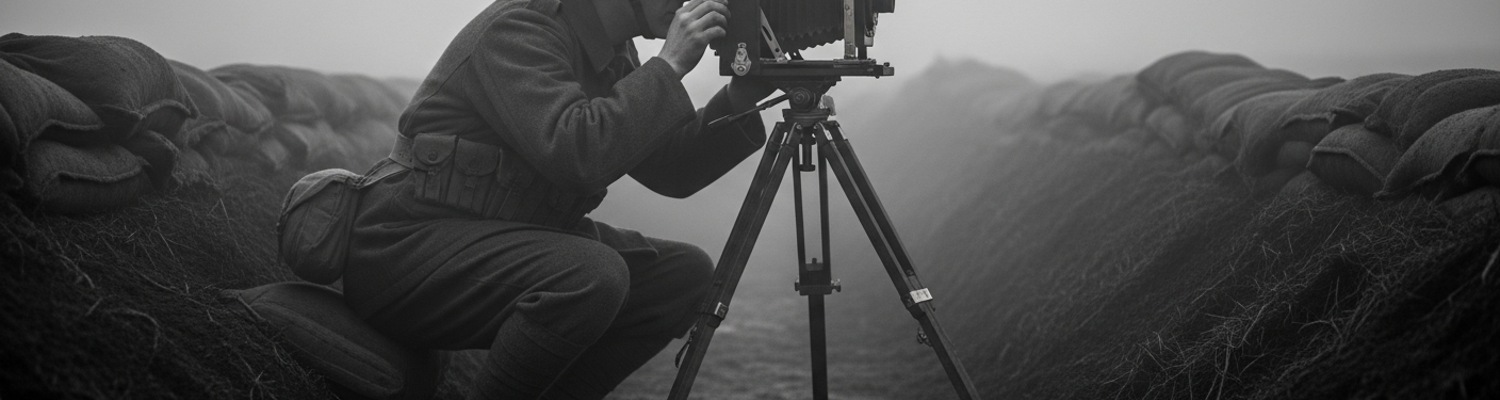
The technology these Signal Corps photographers employed was a world apart from today's networked digital sensors. Their primary instrument was the large-format field camera, particularly robust models like the Graflex 4x5 Rebateable Back Auto or the more portable Kodak 3A Autographic Special. These were heavy, manually operated devices of wood and brass, demanding a sturdy tripod for stable operation. They utilized individual 4x5 inch glass plate negatives, a medium that offered exceptional image resolution. The large surface area of the plate, coated in a silver halide emulsion, could capture immense detail. This detail was the currency of intelligence, revealing elements invisible to the naked eye when examined under magnification.
Operating these cameras was a deliberate, methodical process. The photographer composed and focused the image on a ground-glass screen at the rear of the camera, his head shrouded under a dark cloth to block ambient light. He would then insert a plate holder containing the unexposed negative, remove the protective dark slide, and trigger the mechanical shutter, often using a pneumatic bulb release to minimize vibration. Shutter speeds and aperture settings, controlled by lenses like the Bausch & Lomb Tessar, had to be calculated based on light conditions and the slow sensitivity of the orthochromatic plates. Early motion-picture cameras, like the hand-cranked Bell & Howell 2709, also saw service, but their film was less suited for immediate tactical analysis due to the complex logistics of field development and projection.
Processing the fragile glass plates required a mobile darkroom, typically a light-proofed truck or a secured cellar in a ruined village just behind the front. Here, in cramped, often unsanitary conditions, technicians worked with a precise chemical sequence. They submerged the exposed plates in a developer bath, followed by an acetic acid stop bath, and finally a sodium thiosulfate fixer to make the image permanent. The smell of these chemicals mixed with the ever-present odor of mud and cordite. A nearby shell burst could not only kill the technicians but also vibrate the delicate process, ruining the intelligence. The entire cycle, from exposure to delivering a wet print to a G-2 officer, could take hours. This time lag is a defining difference from today's battlefield, where a squad leader views a live feed from a small unmanned aerial system and receives targeting data in seconds. The WWI photographer produced a single, static, high-resolution frame. The modern soldier accesses a continuous stream of multi-spectral data.
Working Within the Kill Zone
The Signal Corps photographer was a soldier first and a technician second. His work was conducted at the front, often in the lethal expanse of no-man's-land, under the same threats the infantry faced. A typical mission was a photographic patrol. A small team, perhaps just two men, would crawl out in pre-dawn darkness to document a specific sector of the German line. They used trench periscopes, some ingeniously modified with camera mounts, to peer over the parapet without exposing themselves to sniper fire. These periscopic cameras allowed them to aim and shoot from the relative safety of the trench floor. Other common tasks included photographing captured enemy positions to analyze construction techniques and documenting the effects of friendly artillery for battle damage assessment.
To get a three-dimensional understanding of trench networks, photographers would employ stereoscopy. This involved taking two photographs of the same target from slightly different positions, mimicking the separation of human eyes. When viewed through a stereoscope back at headquarters, these paired images merged into a single 3D view, revealing the depth of trenches, the height of obstacles, and other topographical details hidden in a flat image. This technique was invaluable for planning infantry assaults.
The operational environment was brutal. The pervasive mud of the Western Front clogged delicate camera mechanisms and made movement treacherous. Photographers carried dozens of pounds of gear, including the heavy camera, tripod, and boxes of fragile glass plates, through a landscape of craters and tangled wire. Enemy artillery, machine gun fire, and gas attacks were constant dangers. A photographer setting up his tripod presented a stationary target. If a photographer's box of exposed plates shattered on the crawl back to his own lines, the intelligence, and the risk taken to acquire it, was lost forever. This unforgiving reality stands in stark contrast to modern combat camera teams, who operate with lightweight armor, encrypted communications, and established casualty evacuation procedures. The WWI photographer was often isolated, his survival and the survival of his intelligence depending entirely on his own fieldcraft and fortune.
From Plate Negative to Fire Mission
The photographs produced by these ground units were not pictures. They were data points. Back at divisional or regimental headquarters, intelligence officers from the G-2 section would scrutinize the prints on light tables, often using powerful magnifying glasses. The high resolution of the 4x5 plates allowed them to identify the precise firing aperture of a German MG 08/15 machine gun, the location of a camouflaged mortar pit, or the weak points in a wire entanglement. This visual evidence was a revolutionary leap from the often-inaccurate hand-drawn sketches and verbal reports that had previously dominated tactical intelligence.
The impact on planning was direct and measurable. During the AEF's Meuse-Argonne Offensive, ground photography was instrumental in identifying German concrete pillboxes and machine gun nests that were concealed from aerial view by the dense forest canopy. This allowed for targeted artillery preparations that neutralized key threats before the infantry advanced. The images provided clear, undeniable proof of enemy dispositions, helping commanders plan routes for raids and assaults with far greater precision.
Photography's most significant contribution was to the lethality and efficiency of artillery. It provided a concrete method for battle damage assessment. After a barrage, a photographer would document the target area. The resulting images allowed artillery commanders to see the exact impact of their shells, confirming a target's destruction or allowing for precise fire corrections. This created a feedback loop, a primitive but effective version of the modern sensor-to-shooter link, that made artillery fire more economical and deadly. It enabled effective counter-battery fire, as photo-interpreters learned to spot the subtle blast scars and track marks that betrayed the locations of hidden German guns. The WWI commander waited hours for a wet plate print to confirm a kill. A modern joint terminal attack controller watches it happen in real-time on a ruggedized tablet. The fundamental principle, however, remains unchanged: accurate, timely visual intelligence is decisive on the battlefield.