
Tactical Signals Intelligence Collapse
Freezing rain coated the mountain approaches. Axle hubs choked with liquified clay. Switchbacks turned into impassable channels of mud. Temperatures hovered just above freezing before plunging overnight. Exposed telephone wires encased in ice snapped under their own weight. Temporary copper field lines strung along the trees failed. Dense spruce canopies blocked high-frequency radio waves. Granite peaks scattered signals into the upper atmosphere. When examining the historical record, this geography triggered a comprehensive operational intelligence blackout for Lieutenant General Jacob Devers and his Sixth Army Group. His formations pushed toward the Rhine in November 1944. Devers relied on rapid signals intelligence to direct forward thrusts. The German Nineteenth Army under General Friedrich Wiese severed Allied radio access. German units transitioned almost entirely to subterranean landlines. Bletchley Park intercepted next to nothing.
The high-frequency radio bands went dead across the entire front.
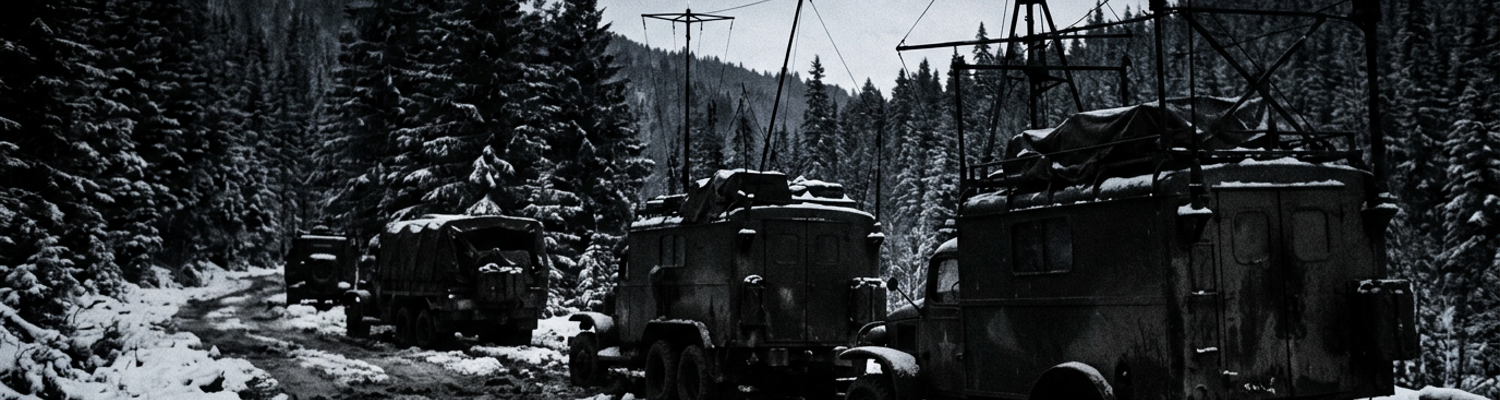
Tactical mobile monitoring units recorded empty airwaves. Allied SCR-299 radio vans sat mired in deep mud kilometers behind the ridge points. They could not achieve line-of-sight reception over the crests. High-level Enigma decrypts slowed to a trickle. German theater commands banned radio transmissions regarding troop transit routes west of the Rhine river plain. Forward signals intelligence units failed to track the reorganization of German defenses ringing the Colmar Pocket. They missed the buildup blocking the Belfort Gap. Technical monitoring teams from the 117th Signal Radio Intelligence Company set up directional antenna arrays on steep western slopes. Granite massifs deflected German divisional communications back eastward into the Rhine valley. German military planners utilized civilian post and telegraph cables running between Mulhouse and Colmar. They bypassed open-air radio channels entirely.
The division staffs possessed no usable tactical intercepts.
Allied tactical intercept operators logged hundreds of hours of basic atmospheric interference. They misinterpreted the lack of traffic as proof that German resistance had broken. German LXIII and LXIV Army Corps used this silent window to funnel infantry regiments into prepared positions across the Vosges foothills. They moved anti-tank guns and heavy artillery without detection. By late November, German defensive sectors along the Belfort approach were fully manned by seasoned combat groups. Not a single Allied radio direction-finder registered their relocation. Devers and his staff assumed the enemy was in full retreat across the Rhine. Missing real-time intercept data degraded combat coordination between Lieutenant General Alexander Patch and his US Seventh Army and General Jean de Lattre de Tassigny and his French First Army. The two armies operated along a split command boundary. This boundary cut through rough mountain passes.
Physical geography severed visual contact.
Neither Allied army could anticipate attacks hitting the seams of their sectors. French First Army tactical detachments used French and captured German equipment. These operated on metric frequencies. American Signal Corps elements utilized standard crystal-controlled SCR-508 and SCR-608 sets on different kilocycle bands. The inability to share immediate German tactical intercepts created a blind spot between Patch's VI Corps near Saint-Die and de Lattre's French II Corps pushing toward Burnhaupt. German armored counterattacks struck the inner boundary. Neither army had received warning from radio intercept monitors. US artillery batteries received no coordinates for incoming German armor. French infantry pushed past their designated flanks into pre-sighted kill zones. They were completely unaware that German assault guns were assembling directly north of their positions.
Mobility Failures of Interception Vans
Archival evidence shows that the 117th Signal Radio Intelligence Company attempted to force heavy communications vehicles up Route Nationale 415. They aimed for the 949-meter crest of the Col du Bonhomme during the third week of November 1944. Built on a modified two-and-a-half-ton Chevrolet K-51 chassis. Each SCR-299 shelter housed BC-312 receivers and BC-610 transmitters. The loaded vehicle weighed over nine thousand pounds. Crews packed them with spare vacuum tubes and heavy equipment chests. These heavy vehicles were engineered for flat highway networks. They were not built for steep secondary logging tracks with switchback grades exceeding sixteen percent. Wet snow froze into black ice along the hairpins west of Plainfaing. Dual rear tires lost traction entirely.
Towing winches snapped under the dead weight of the waterlogged trucks.
Steel chains snapped under severe torque stress. Overstressed transfer cases cracked. Drivers sheared transmission gears trying to rock vehicles out of frozen drainage ditches. Auxiliary trailers carrying heavy PE-95 gasoline generators repeatedly broke their pintle hitches. They jackknifed across narrow road shoulders. By November 22, three separate mobile monitoring vans blocked the primary switchback below the pass. All motorized signal traffic halted behind them. VI Corps headquarters demanded immediate forward deployment of mobile radio direction-finding rigs to observation peaks above one thousand meters. They specifically requested coverage of heights overlooking Sainte-Marie-aux-Mines and the crest lines around Tete des Faux. Tactical VHF intercept systems required an unobstructed line of sight. They needed this positioning to capture German divisional radio nets operating behind eastern mountain walls.
Crews found footpaths covered in wet mud and granite boulders impassable for four-ton chassis.
Signal officers tried stripping out components for man-pack transport. The primary BC-610 transmitters and high-sensitivity receivers formed integrated shock-mounted rack systems. They could not operate without their heavy internal power transformers. The lighter field generators on hand could not generate the two thousand watts required to run the intercept sets. Hand-cranked units and small PE-75 gasoline engines failed to meet the power draw. Radio units sat stranded in deep valleys two hundred to four hundred meters below the ridge lines. Behind those stone massifs high-frequency ground waves scattered into dead space. German battalion and regimental transmitters operating in the plains just beyond the crest stayed entirely undetected by American directional antennae. Listening posts on the valley floors recorded only static and local atmospheric noise.
Vehicular radio systems failed to reach high ground.
Division signal officers ordered linesmen to run temporary W-110 twin-conductor field wire up forested ravines. They needed to link forward observers with valley command posts. Work parties from the 3rd Signal Company strung hundreds of miles of wire across pine branches. They used RL-31 reel carts to lay lines alongside exposed mud firebreaks. German artillery observers positioned on high eastern promontories identified the wire routes through defoliated woods. They zeroed in with 81mm Granatwerfer 34 and 120mm Granatwerfer 42 heavy mortars. Sustained mortar barrages shredded the thin vulcanized rubber insulation. They severed copper conductors every few hundred yards. Tree limbs sheared off by fragmentation bursts collapsed onto the lines. They dragged entire loops under wet snow and freezing slush. Signal Corps repair teams carrying test handsets faced continuous sniper and mortar fire while tracking breaks along exposed slopes. They suffered heavy casualties for every brief hour of restored communication. Shrapnel severed the main tactical landline fourteen distinct times outside Le Bonhomme. The fire control link shut down completely.
Radio Propagation and Dielectric Attenuation
A close review of operational logs indicates that radio interception teams from the 3251st Signal Service Company encountered a total line-of-sight propagation collapse across the Meurthe valley basin. Operating under Sixth Army Group control near Saint-Die. The company deployed specialized direction-finding teams equipped with SCR-506 receiver trucks. Operators struggled to establish reliable reception on frequencies between twenty and eighty megahertz. Radio energy broadcast from forward Allied transmitters degraded before crossing single ridge spurs. Incoming German tactical transmissions faded below receiver noise floors within four kilometers. Technicians attempting to deploy half-wave horizontal dipole antennas between trunk lines discovered massive signal loss. Ground-wave field strengths dropped by more than forty decibels compared to open-terrain benchmarks.
Signal intercept teams recorded zero enemy transmissions for seventy-two consecutive hours.
Multipath reflections bouncing off irregular terrain produced severe phase cancellation. This turned coherent signals into broken carrier hums. Without direct line-of-sight paths over the ridges the 3251st Signal Service Company could not calibrate its high-frequency direction-finding loops. Their SCR-506 goniometers became non-functional across the entire sector. This propagation failure stemmed directly from the dielectric properties of the Vosges conifer canopy under severe winter weather. Wet snow with high liquid water content packed into the dense needles of Norway spruce and silver fir stands. This occurred across elevations between six hundred and one thousand meters. This wet frozen biomass functioned as a lossy dielectric medium. It sat directly in the path of both high-frequency skywaves and VHF ground waves. High relative permittivity in the moisture-saturated snow mantle transformed the continuous canopy into an absorbing sheet.
The high-frequency spectrum turned into dissipated thermal energy.
Frequencies in the thirty to fifty megahertz band used by Allied tactical reconnaissance nets experienced severe attenuation. Rates exceeded twelve decibels per hundred yards of dense timber. Standard vehicular whip antennas lost effective radiation resistance. Snow-laden branches physically touched copper antenna elements. This grounded the emitted currents. Signal units attempted to elevate wire antennas above the tree line using weighted throwing lines. Thick ice accretions repeatedly broke the copper conductors within minutes of hoisting. The forest canopy absorbed radio output before electromagnetic waves cleared the tree line. Steep granite ridges enclosing the mountain passes amplified these electrical losses. They threw electronic and acoustic shadow zones over German forward positions.
German Volksgrenadier regiments defended the reverse slopes of granite crests.
They held positions at Tete des Faux and the peaks west of Sainte-Marie-aux-Mines. They operated low-power tactical sets including five-watt Torn.Fu.b1 and Torn.Fu.f transceivers. These German field sets functioned on battery power at low transmission wattages. They could not penetrate the solid crystalline bedrock of the Vosges massifs. Ridge crests sheared off the high-frequency ground waves. They deflected the radiation skyward. This prevented knife-edge diffraction from bending the signal down into the valley floors where Allied listening stations waited. The physical mass of the granite peaks blocked the sharp acoustic crack of German motor exhausts and battery generators. This denied audio-ranging units any secondary means of locating active transmitters. German Nineteenth Army radio operators intentionally positioned their three-meter ground spikes within narrow stone ravines on the eastern escarpment. They relied on the rock mass behind them to absorb rearward signal radiation. American intercept posts situated less than fifteen hundred meters away on western switchbacks logged absolute silence.
Allied Clearance Bottlenecks and Compartmentation
Archival evidence shows that the US War Department Military Intelligence Division enforced rigid cryptographic compartmentation protocols. These rules excluded French First Army officers from receiving primary signals intelligence. Under security regulations issued directly by the Military Intelligence Division in Washington (Directive 44-A-112). Ultra material and theater-level cryptanalytic decrypts were restricted. Only vetted American and British personnel holding specific indoctrination credentials could view them. Lieutenant General Jacob Devers received regular Special Intelligence summaries at Sixth Army Group headquarters. His staff could not deliver direct decrypts or decrypt source attributions to General Jean de Lattre de Tassigny. They could not share them with his French division commanders.
French general staff officers operated under an intelligence embargo imposed by their own coalition command.
Special Liaison Unit Number 7 received decrypted German communications over secure British typex machines. This American detachment was stationed at French First Army headquarters in Montbeliard. Regulations compelled these liaison officers to sanitize every document. They stripped out intercepted radio frequencies. They removed German call signs. They deleted cryptographic indicators. Liaison officers then rephrased the intelligence as generalized reports. They attributed the data solely to unconfirmed prisoner interrogations or aerial reconnaissance. French tactical planners at the front received heavily watered-down assessments. These reports omitted the exact positions of German armored regiments gathering east of the Belfort Gap. The administrative machinery for clearing intercepted messages created processing lags running between twenty-four and forty-eight hours.
Operational intelligence routinely arrived two days after the battles concluded.
Forward intercept stations logged encrypted German low-level traffic. This included manual field ciphers like the Rasterschlussel 44 and tactical Doppelkasten double Playfair keys used by German Nineteenth Army divisions. Field monitoring teams lacked the mechanical decryption keys and cipher tables to decode these systems in real time. Tactical intercept tapes had to travel by motorcycle courier across snow-clogged passes. They moved from the Vosges forward lines back to the cryptanalytic section in Vittel. Encrypted German Enigma traffic collected along the frontline had to be transmitted to the Government Code and Cypher School at Bletchley Park or Arlington Hall for machine analysis. It passed through bureaucratic review boards. It cleared through War Department intelligence officers. It was re-encoded for transmission back to the Continent.
Forty-eight hours elapsed before decrypted German tactical orders reached front-line army headquarters.
German assault groups from the 198th Infantry Division executed their tactical counterattacks. They shifted artillery batteries. They retreated into reverse-slope positions before the decrypts reached American corps commanders. This division of intelligence was compounded by the complete absence of direct lateral communication channels linking American and French signals detachments in the field. Monitoring teams from the US 117th Signal Radio Intelligence Company and the French 8e Regiment de Transmissions maintained separate intercept posts. They were situated less than fifteen kilometers apart along the front near Saint-Die and Gerardmer. No physical telephone wires linked these national monitoring vans. Direct cross-unit high-frequency radio links were forbidden under US security directives. These directives restricted raw tactical signal coordination between independent national armies. An American intercept team monitoring German 716th Volksgrenadier Division communications could not broadcast raw tactical bearings to adjacent French radio listening posts.
Logistical Breakdown of Alpine Interception
When examining the historical record, sub-zero temperatures across the high passes destroyed the electrical lifeline of forward signals intelligence units within forty-eight hours of deployment. Ambient mountain temperatures plummeted to minus twenty degrees Celsius along the logging trails west of the Col du Bonhomme. Standard six-volt and twelve-volt lead-acid vehicular batteries experienced rapid electrolyte stratification. Catastrophic internal freezing followed. The diluted sulfuric acid solution inside the hard-rubber casings separated. This caused the freezing point of the liquid to rise. Plate separators inside the units assigned to the 117th Signal Radio Intelligence Company burst. Battery terminal voltage dropped from 12.6 volts to under 7.5 volts under minimum load. This starved the sensitive dual-conversion superheterodyne circuitry in BC-342 and BC-348 radio receivers.
The batteries froze solid in their steel racks.
Without steady direct-current inputs receiver local oscillators drifted wildly off target frequencies by upwards of forty kilocycles. This made frequency locking on German field nets impossible. Specialized mobile generator sets fared no better. Two-cylinder Wisconsin and four-cylinder Hercules combustion engines powering PE-75 and PE-95 field generator units locked solid. Low-grade SAE-30 crankcase lubricants congealed into thick non-circulating sludge. Moisture condensed inside the steel fuel tanks during daytime thaws. It ran down into fuel bowls. It froze inside small brass carburetor jets overnight. Mechanics sheared starter hand-cranks attempting manual ignition. Exhaust manifold gaskets cracked under severe thermal shock when hot exhaust gasses hit sub-freezing exterior air. Carbon monoxide seeped directly into insulated monitoring compartments. Technicians had to shut down active listening posts to avoid asphyxiation.
Electronic listening ceased entirely.
This mechanical failure forced Allied division commanders to substitute blind electronic listening with high-casualty frontline infantry reconnaissance patrols. They lost all signals-derived warning of enemy defensive layouts. Major General John Dahlquist of the 36th Infantry Division and Major General Edward Brooks of the US VI Corps ordered combat patrols into the snow-covered pine forests. They sent men between Saint-Die and Sainte-Marie-aux-Mines to manually verify German positions. Infantrymen from the 141st and 142nd Regimental Combat Teams were forced into dense ravines and steep slopes. They lacked preliminary intercept data detailing where enemy machine gun belts and mortar concentrations were oriented. Moving through waist-deep snow drifts across unmapped logging trails. These small patrols had to trigger German defensive fire deliberately. They drew muzzle flashes to pinpoint strongpoints.
Combat patrols went forward into pre-sighted kill zones.
German Volksgrenadier regiments holding reverse-slope log bunkers zeroed their MG 42 machine guns directly onto these designated infiltration gaps. They targeted the approaches with 81mm mortars. Scout detachments suffered casualty rates exceeding forty percent during single nocturnal reconnaissance missions across the Meurthe river headwaters. Dozens of men were killed or wounded merely to confirm the presence of a single German company headquarters. Tactical direction-finders should have tracked this command post by radio emission days earlier. Trench foot and severe hypothermia incapacitated hundreds more infantrymen. They spent nights lying motionless in wet slush within yards of German listening posts because intelligence officers lacked directional radio bearings to guide company thrusts.