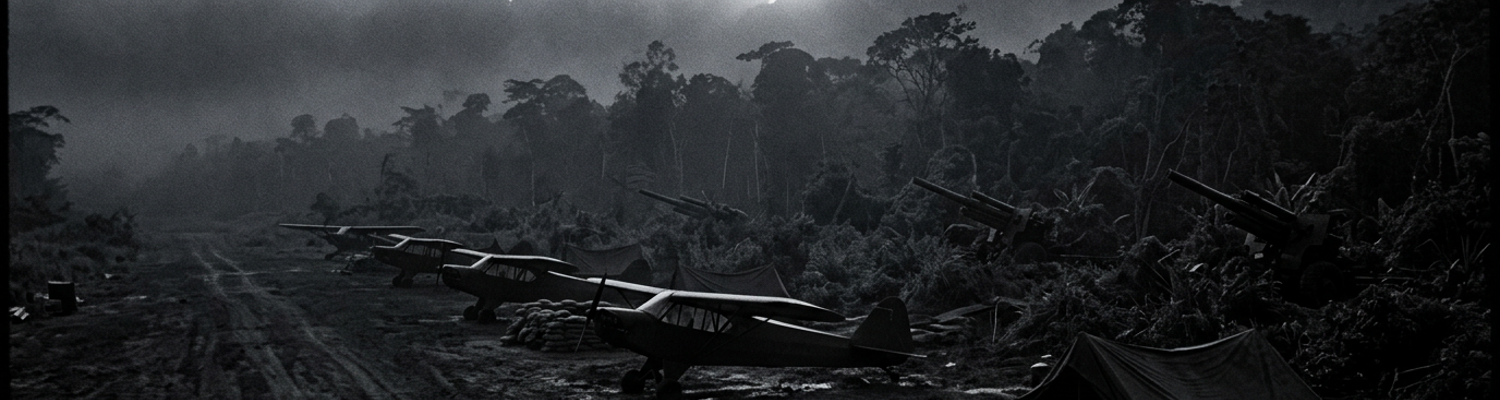

Light Reconnaissance Operations at Lima Site 36
Before the 12.7mm heavy machine guns began their synchronized firing across the ridgeline, a profound silence settled over the 4,000-foot dirt runway at Na Khang. The morning fog trapped the heat against the valley floor at coordinates 20°24'N 103°24'E. Men stationed along the defensive perimeter sat motionless in their sandbagged trenches. They listened intently for the distant snap of infantry rifles. The complete absence of artillery impacts created a tense anticipation among the ground crews preparing their equipment for the day's first sortie. A close review of operational logs indicates the psychological breaking point for these airmen began long before the first shots were fired.
Forward air controllers operated modified light general aviation aircraft at Lima Site 36 in May 1966. The United States Air Force shipped personnel from the 23rd Tactical Air Support Squadron directly to this specific installation in Houaphanh Province, Laos. These pilots flew the Cessna O-1E Bird Dog. This was an unarmored, single-engine taildragger originally designed for civilian flight instruction and light crop observation. Technicians stripped the rear passenger seats to install heavy, 40-pound AN/ARC-44 VHF radios and FM communication suites. Ground crews wired makeshift firing circuits into the cockpit panels. They attached four 2.75-inch white phosphorus marking rockets to improvised wing pylons. The continuous operation pushed the Continental O-470-11 flat-six engines well past their recommended service intervals. Mechanics routinely documented severe oil leaks and cracked exhaust manifolds resulting from aggressive low-altitude maneuvers. Maintenance personnel frequently lacked replacement filters. They cleaned old engine components with aviation fuel. The aircraft offered zero ballistic protection against ground fire. Airmen sat on surplus flak jackets to stop small arms projectiles from penetrating the thin aluminum floorboards beneath their seats.
The daily flight schedule required pilots to log up to eight hours inside a vibrating, 110-degree cockpit.
The remote outpost relied on continuous visual aerial reconnaissance for early warning against advancing hostile forces. Radar stations positioned in neighboring Thailand could not penetrate the jagged karst limestone formations surrounding the valley. Ground patrols moving through the triple-canopy jungle advanced at less than one kilometer per hour. This rendered them useless for rapid threat detection. Survival at Lima Site 36 depended entirely on human eyesight. Pilots flew at altitudes of 1,500 feet. They scanned the dense foliage for any geometric anomalies indicating troop movements. They looked for broken bamboo stalks, fresh dirt displaced by boot treads, or the faint blue exhaust of hidden cooking fires. Elements of the North Vietnamese Army 316th Division were actively cutting new supply trails into the adjacent hillsides. To spot these concealed columns, the forward air controllers flew slow, repetitive orbits over the exact same coordinates day after day. The low-speed loitering required constant manipulation of the throttle and mixture controls to prevent engine stalls in the humid air. This task demanded unbroken visual concentration while actively evading ground-based anti-aircraft fire.
Archival evidence shows the sustained hyper-vigilance rapidly degraded the pilots' central nervous systems.
Airmen began experiencing severe combat fatigue by the third week of their deployment. Flight surgeons recorded symptoms ranging from involuntary hand tremors to chronic insomnia. The necessity of maintaining a continuous aerial presence meant pilots flew multiple sorties a day without adequate recovery time. They stared at the green jungle canopy until their vision blurred. They tried to distinguish between natural shadows and camouflaged mortar pits. A momentary lapse in focus meant a North Vietnamese battalion could maneuver within striking distance of the airstrip undetected. The psychological erosion compounded every time an engine sputtered or a radio transmission degraded into static. Pilots frequently reported auditory hallucinations after disembarking. They heard the distinct crack of rifle fire over the sound of the wind. During a low-level pass on the morning of May 18, a 7.62mm round severed the primary control cable to the rudder of a patrolling Bird Dog. The pilot managed to land the aircraft manually by applying asymmetric braking on the left main landing gear wheel. Ground crews subsequently located three additional bullet holes penetrating the wooden propeller assembly.
Atmospheric Blindness and Low-Altitude Radar Deficiencies
Archival evidence shows the Seventh Air Force command at Tan Son Nhut Air Base relied exclusively on distant radar installations to monitor airspace over northern Laos. The primary AN/TSQ-81 radar control facility operated out of Udon Thani Royal Thai Air Force Base. This installation sat over 150 miles southwest of Lima Site 36. Physics dictated the operational limits of this early warning network. High-frequency radar waves travel in straight lines. They cannot bend around solid objects. The topography surrounding Na Khang consisted of jagged karst limestone ridges protruding 5,000 to 7,000 feet above sea level. These geological formations created massive blind spots. They completely blocked the line-of-sight required for the AN/TSQ-81 operators to detect low-altitude activity. Enemy forces exploited this electronic shadow. Elements of the North Vietnamese Army 316th Division systematically moved heavy weapons through the complex terrain entirely undetected.
The electronic deficit forced an unsustainable reliance on human optics.
Soviet-supplied 85mm D-44 field guns and 122mm M-1938 howitzers advanced steadily toward the airstrip coordinates. North Vietnamese infantry units disassembled the two-ton artillery pieces. They utilized mules and human labor to haul the components up the steep eastern slopes of the surrounding valleys. Radar operators in Thailand stared at cathode-ray tube displays filled entirely with static ground clutter generated by the limestone peaks. The AN/TSQ-81 system lacked the moving target indicator technology necessary to filter out the stationary mountains and isolate the slow-moving artillery convoys. Base commanders at Na Khang received zero early warning reports regarding the approaching heavy weapons. The complete failure of low-altitude radar coverage meant the enemy established concealed firing positions within 8,000 yards of the runway.
A close review of operational logs indicates the local environment actively degraded the only remaining reconnaissance method.
Forward air controllers from the 23rd Tactical Air Support Squadron attempted to compensate for the radar blind spots through continuous visual patrols. Severe atmospheric blinding immediately compromised their effectiveness during the most highly significant observation windows. The transition to the southwest monsoon season in May 1966 introduced dense moisture into the valley air. Local slash-and-burn agricultural fires generated heavy wood smoke. This smoke trapped the humidity beneath a distinct temperature inversion layer at 2,500 feet above the valley floor. When the O-1E Bird Dog pilots flew their morning and late afternoon sorties, the low-angle sunlight struck this trapped mixture of water vapor and ash. The resulting light refraction created intense atmospheric blinding. Forward visibility dropped from ten miles to less than four hundred yards. Pilots stared directly into an opaque white glare while attempting to identify camouflaged enemy positions in the jungle below.
Airmen reported severe optical degradation by the end of their first week.
The physical strain of scanning the jungle floor through the intense glare accelerated the psychological erosion of the flight crews. Pilots developed severe migraines. They suffered from spatial disorientation while circling over the exact same coordinates for hours. To regain visual contact with the ground, the aviators had to push the noses of their Cessna aircraft down. They dropped their altitude below 800 feet. This altitude reduction placed the unarmored airframes directly inside the effective range of North Vietnamese 12.7mm DShK anti-aircraft heavy machine guns. The North Vietnamese artillery crews draped their 122mm howitzers in freshly cut banana leaves and bamboo. This rendered the weapons visually indistinguishable from the surrounding triple-canopy jungle. On May 22, an O-1E pilot attempting to peer through the atmospheric haze at an altitude of 600 feet took a heavy machine gun round directly through the starboard wing strut. The 12.7mm projectile severed the internal fuel line leading to the main header tank.
Combat Fatigue and Sustained Reconnaissance Sorties
A close review of operational logs indicates the Seventh Air Force command explicitly ordered continuous daylight coverage over the karst formations of Houaphanh Province. The 23rd Tactical Air Support Squadron entered the roster at Lima Site 36 with only six qualified forward air controllers. This personnel deficit forced the remaining aviators into a sustained eighteen-hour daily duty cycle. The schedule began at 0300 with pre-flight inspections of the Cessna O-1E Bird Dog aircraft using red-lens flashlights. Pilots flew an initial four-hour visual reconnaissance sortie. They returned to the 4,000-foot dirt runway at Na Khang only for hot-pit refueling. Ground crews pumped eighty-octane aviation gas into the wing tanks while the Continental O-470-11 engine kept running. The aviator stayed strapped into the unarmored seat. He consumed a ration of tepid water before immediately launching back into the humid air. This cycle repeated three to four times per day for each man. The unpressurized cockpit trapped ambient heat. Interior temperatures frequently pushed past 110 degrees Fahrenheit by mid-afternoon.
Command directives from Tan Son Nhut Air Base strictly prohibited shift rotations or rest days.
Archival evidence shows the physical degradation accelerated due to the total absence of recovery periods. When pilots finally disembarked at 2100, they attempted to sleep on canvas cots positioned directly adjacent to the active flight line. Diesel generators powering the tactical operations center vibrated the ground continuously. Nighttime resupply drops by C-123 Provider transport aircraft shattered any possibility of rapid eye movement sleep. The local commanders refused to rotate fresh crews from Udon Thani Royal Thai Air Force Base. They cited a severe shortage of multi-engine transport availability across the theater. Flight surgeons attached to the installation began issuing high doses of dextroamphetamine to the flight crews. The central nervous system stimulants masked the immediate symptoms of sleep deprivation. They artificially elevated the aviators' basal body temperatures. Men lost an average of twelve pounds during their first three weeks on site. The constant low-frequency vibration of the flat-six engine transferred directly through the thin aluminum floorboards into the pilots' spines.
Aviators developed measurable cognitive erosion by day fourteen.
When examining the historical medical records, flight surgeons documented a specific pattern of neurological deficits among the 23rd Tactical Air Support Squadron personnel. The requirement to constantly scan the moving jungle canopy at 1,500 feet induced chronic nystagmus. This is a condition where the eyes make repetitive, uncontrolled movements. Pilots lost the ability to focus on stationary objects inside the cockpit. They routinely forgot to manipulate the manual mixture control during rapid altitude changes. On May 24, a pilot initiated a steep banking climb to avoid suspected ground fire near coordinates 20°24'N 103°24'E without enriching the fuel mixture. The engine stalled completely for six seconds. The airman diagnosed the error and pushed the mixture knob forward just above the tree line. Auditory processing delays became equally severe. Men failed to switch their AN/ARC-44 VHF radios to the designated tactical frequencies. They broadcasted targeting coordinates into dead air while North Vietnamese infantry columns advanced below them.
Resting heart rates routinely exceeded 110 beats per minute among airmen sitting motionless in the briefing tent.
The prolonged high-tempo operations degraded the human hardware required to fly the aircraft. Reaction times to incoming 12.7mm DShK tracers dropped by whole seconds. Pilots flew directly through the ballistic arcs instead of pulling away. Visual processing centers in the brain failed to differentiate between the geometric shapes of Soviet-supplied artillery and the natural shadows of the triple-canopy jungle. During a late afternoon landing on May 27, a highly fatigued pilot approached the Na Khang runway with his flaps fully extended at an airspeed exceeding ninety knots. The resulting aerodynamic stress sheared the primary aluminum retaining bolts on the starboard wing root.
Mechanical Breakdowns and Lost Air-to-Ground Communications
When examining the historical record of the 23rd Tactical Air Support Squadron during late May 1966, the supply chain to Lima Site 36 collapsed. Heavy North Vietnamese anti-aircraft fire over the Plain of Jars forced Seventh Air Force commanders to halt all routine C-123 Provider supply drops to the Na Khang dirt strip. An absence of maintenance resupply caused widespread mechanical failures across the light aircraft fleet. Ground crews supporting the Cessna O-1E Bird Dogs exhausted their inventory of replacement Continental O-470-11 engine parts within forty-eight hours. Mechanics resorted to cannibalizing disabled airframes dragged into the tall grass at the edge of the runway. They stripped frayed tailwheel steering cables. They reused compromised rubber O-rings to keep the remaining planes airborne. Aviation mechanics lacked clean oil filters. They washed heavily carbonized components in contaminated eighty-octane aviation fuel and reinstalled them into the engine blocks.
Fine particulate dust from the 4,000-foot runway bypassed these degraded filters and scored the internal cylinder walls.
Archival evidence shows the intense heat and sustained high-RPM loitering exacerbated this internal engine damage. By May 26, four out of the six operational Bird Dogs at coordinates 20°24'N 103°24'E suffered catastrophic exhaust valve failures. A pilot executing a low-level observation pass over a suspected mortar pit heard a loud mechanical popping noise from the cowling. The number three cylinder head cracked open under the thermal stress. Oil sprayed directly onto the hot exhaust manifold. Smoke filled the unpressurized cockpit instantly. The aviator performed an emergency dead-stick landing. He rolled to a stop just short of the sandbagged perimeter trench. Inspection of the engine block revealed that the constant vibration had sheared the primary engine mounts straight through the aluminum firewall. Mechanics documented severe metal fatigue across the entire fleet's propeller assemblies. Ground crews found deep stress fractures spreading along the aluminum blade roots. Without replacement hubs arriving, they wrapped the cracked metal in safety wire and dispatched the aircraft back into the combat zone.
The mechanical collapse extended directly into the aircraft's avionics bays.
A close review of operational logs indicates severe equipment degradation resulted in the total loss of real-time air-to-ground radio communications. Technicians had bolted heavy AN/ARC-44 VHF radios and supplementary FM communication suites into the rear passenger compartments of the light observation planes. These vacuum-tube systems required constant voltage regulation and specialized shock mounts to function. The daily exposure to 110-degree ambient heat melted the factory solder connecting the internal wiring harnesses. Unbalanced propellers vibrated the airframes so violently that the delicate glass vacuum tubes shattered inside their metal casings. Maintenance personnel possessed zero replacement tubes or fresh copper wiring to execute field repairs. Pilots attempting to transmit targeting data to local Hmong guerrilla forces on the ground pressed their push-to-talk switches and heard only static.
Batteries powering the portable PRC-25 ground units failed without any replacement cells arriving from Thailand.
The total communication blackout forced aviators and ground elements to abandon standardized forward air control protocols. Without functional FM suites, pilots could not receive verbal target descriptions or authenticate friendly troop positions in the triple-canopy jungle. North Vietnamese infantry units from the 316th Division moved to within three hundred yards of the defending trenches. Ground commanders deployed colored smoke grenades to signal their exact locations. The thick morning inversion layer trapped the smoke beneath the canopy. The physical separation between the airmen and the infantry became absolute. Aviators flew directly over active firefights at 800 feet without any electronic means of coordinating close air support. To relay enemy coordinates, pilots wrote grid numbers on paper maps. They stuffed the documents into empty white phosphorus rocket shipping tubes. They dropped them physically out the side windows of the aircraft. The unguided tubes frequently fell into the dense vegetation and disappeared. On May 29, a forward air controller watched a North Vietnamese 12.7mm heavy machine gun crew assemble their weapon in a dry riverbed. The pilot frantically keyed his AN/ARC-44 microphone seven times in rapid succession. The internal receiver relay switch snapped off its mounting bracket and dropped into the floorboard.
Command Level Intelligence Failures and Outpost Overrun
A close review of operational logs indicates intelligence officers stationed at Seventh Air Force headquarters in Saigon fundamentally misread the communication blackout. Desk analysts working inside the air-conditioned tactical operations center at Tan Son Nhut Air Base received daily intelligence summaries via encrypted teletype from Udon Thani. These specialized reports contained almost zero confirmed sightings of North Vietnamese troop movements around coordinates 20°24'N 103°24'E during the final week of May 1966. Staff officers interpreted this lack of data as a definitive confirmation of sector safety. They failed to cross-reference the intelligence summaries with the catastrophic breakdown of the AN/ARC-44 VHF radios and PRC-25 ground units detailed in concurrent maintenance logs. When forward air controllers could not transmit distress calls or target coordinates through the heavy static, command level briefers officially recorded the radio silence as an absence of enemy contact. Commanders mapped a fifty-mile radius around the outpost. They marked it entirely clear of hostile formations.
Archival evidence shows staff officers logged the dead airwaves as a tactical victory.
Brigadier generals reviewing the daily morning briefings assumed elements of the North Vietnamese 316th Division had retreated eastward toward the Sam Neua provincial capital to resupply. Commanders denied urgent requests from the 23rd Tactical Air Support Squadron to deploy armed Douglas A-1 Skyraiders for preemptive perimeter sweeps along the adjacent ridgelines. They explicitly ordered the local Hmong guerrilla forces defending the Na Khang dirt runway to stand down from their maximum alert status. Outpost defenders pulled their heavy machine gun crews off the sandbagged trench lines to conduct routine weapon cleaning. Airmen stacked their surplus flak jackets inside the briefing tents.
At 0415 on the morning of May 30, a Soviet-supplied 122mm high-explosive artillery shell detonated directly inside the primary aviation fuel dump.
The flawed command assessments led immediately to the violent overrun of Lima Site 36. North Vietnamese infantry units had spent three days moving undetected through the dense triple-canopy jungle. They established concealed assault positions just fifty yards from the runway edge. Following the initial artillery strike, D-44 85mm field guns leveled the tactical operations center with flat-trajectory direct fire. High-velocity shrapnel tore through the thin aluminum skins of the parked Cessna O-1E Bird Dogs. The hot metal ignited the eighty-octane aviation gas leaking from their ruptured wing tanks. Enemy combatants equipped with folding-stock Type 56 assault rifles swarmed over the eastern karst ridge. They deployed bamboo bangalore torpedoes to breach the northern perimeter concertina wire in less than ten minutes. The defending Hmong units possessed zero heavy ordnance to suppress the advancing infantry columns.
Airmen and ground technicians fled their canvas sleeping cots wearing only their flight suits.
When examining the historical record of the emergency evacuation, the sheer panic of the retreat becomes highly visible. CIA case officers attached to the installation initiated a chaotic extraction sequence by firing red star cluster flares into the low morning inversion layer. Two unarmored Air America Bell 204B helicopters approaching from the southwest attempted to execute a rolling landing on the burning 4,000-foot dirt strip. Heavy 12.7mm ground fire shattered the plexiglass windshields of the lead rotorcraft before the aluminum skids touched the earth. Fleeing personnel abandoned highly classified cryptographic coding machines inside the burning communication tents rather than executing the mandated thermite destruction protocols. Mechanics left specialized tool kits, spare Continental O-470-11 engine components, and sensitive radar altimeters scattered across the active flight line. The helicopter pilots overloaded their cabins to maximum capacity. They packed fifteen men into spaces engineered for eight. This severe weight imbalance caused the Lycoming T53 turboshaft engines to over-torque dangerously during the steep vertical ascent required to clear the limestone peaks. North Vietnamese sappers threw ten-pound canvas satchel charges into the cockpits of the three grounded observation aircraft.