
Forged for a New Frontier
In 1866, the United States Army remade itself. The massive volunteer forces of the Civil War were demobilized, and the military establishment refocused on two primary missions: occupying the defeated South and controlling the vast territories west of the Mississippi. The Army Reorganization Act, passed on July 28, 1866, was a piece of pragmatic legislation born from this new reality. It authorized the formation of several new regiments, including two cavalry units to be composed entirely of African American enlisted men. These became the 9th and 10th United States Cavalry. For the men who filled their ranks, many of them veterans of the United States Colored Troops, it was a chance for steady pay and a structured life in a nation that still largely denied them civil rights. Their theater of operations would be the immense, arid, and contested expanse of the American West.
The 10th Cavalry Regiment took shape under the watchful eye of Colonel Benjamin Grierson at Fort Leavenworth, Kansas. Grierson, a decorated Union cavalry commander, actively sought the post, staking his professional reputation on the success of the new unit. He faced immediate challenges, struggling to acquire adequate horses, equipment, and even competent white officers, many of whom refused to serve with Black soldiers. The 9th Cavalry organized in New Orleans, Louisiana, under Colonel Edward Hatch, facing similar obstacles. Their initial deployments revealed the harsh nature of their service. The 10th moved to protect construction crews of the Kansas Pacific Railroad, a vital artery of westward expansion. The 9th received a far more difficult assignment in the scorched, bitter landscape of West Texas. There, they confronted not just the formidable Comanche and Kiowa, but also a civilian population deeply hostile to the sight of armed Black men in federal uniforms. These regiments were not a social experiment. They were a military necessity, created to project federal power across a territory the nation was determined to subdue.
Command Chain and Dispatch Integrity
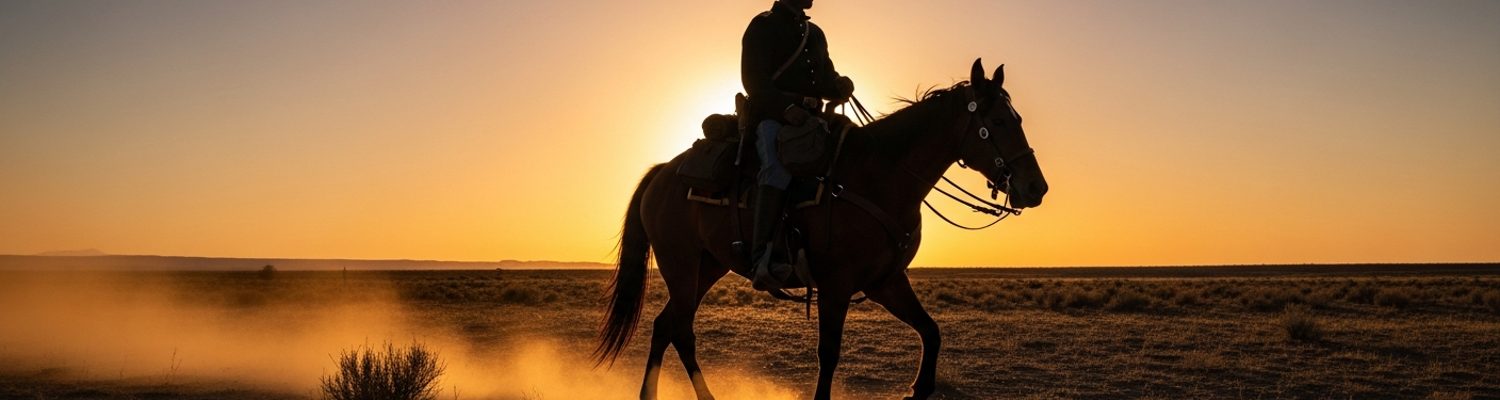
On the Western frontier, command and control was a function of distance and speed. Before the telegraph web fully connected remote outposts like Fort Davis or Fort Sill, operational intelligence traveled at the speed of a horse. The dispatch rider, the military courier, formed the nervous system of frontier strategy. A single rider carrying orders in an oilskin pouch from a regimental commander to a detached troop could initiate an attack, warn of a threat, or call for reinforcements. The failure of that rider to arrive meant isolation, potential annihilation for the receiving unit, and a complete breakdown in the theater commander’s operational design. The Buffalo Soldiers of the 9th and 10th Cavalry quickly established themselves as the Army’s most dependable practitioners of this solitary, high stakes trade.
A courier's mission demanded a complex set of skills. He had to be an expert horseman, capable of managing his mount’s stamina over dozens, sometimes hundreds, of miles of brutal terrain. He needed to be a navigator, reading the subtle folds of the land by day and the star charts by night. He was also a scout, his eyes constantly scanning the horizon for the dust of a war party or the glint of a rifle. Above all, he had to be self reliant and resolute, prepared to fight his way through an ambush or evade capture entirely alone. The information he carried was a prize for any adversary. Its loss could compromise an entire campaign. Generals like Ranald Mackenzie and Nelson A. Miles learned that when a trooper from the 9th or 10th received a dispatch pouch, the message arrived. This hard won reputation for reliability became a cornerstone of operational planning, allowing commanders to disperse their forces across wide areas, confident they could recall or redirect them through the efforts of individual riders traversing hostile ground.
Expeditionary Riders Across the Plains
The combined role of scout and courier is exemplified by the career of Sergeant Emanuel Stance of the 9th Cavalry’s Troop F. On May 20, 1870, Stance led a small patrol out of Fort McKavett, Texas, tasked with finding the perpetrators of a recent raid. Near Kickapoo Springs, he and his nine troopers located a party of Apaches with two young civilian captives. Stance led a charge that scattered the warriors and rescued the children. Shortly after, his patrol discovered a separate group of warriors with a herd of stolen government horses. He attacked again, securing the herd and routing the enemy for a second time. His detailed after action report, written upon his return, documented a patrol that combined tracking, combat, and the recovery of assets. For his decisive leadership, Sergeant Stance was awarded the Medal of Honor, the first given to a Buffalo Soldier during the Indian Wars. His mission profile was a microcosm of the scout and courier’s world: long periods of tense observation punctuated by moments of extreme violence, followed by the critical task of returning with actionable intelligence.
During Victorio’s War in 1879 and 1880, the 9th and 10th Cavalry were the primary military instrument used to hunt the brilliant Apache leader across New Mexico, Texas, and Mexico. Victorio’s band was highly mobile, and the campaign became a vast, deadly contest of intelligence and endurance. Communication between the scattered columns of pursuing cavalry, led by men like Colonel Grierson of the 10th and Colonel Hatch of the 9th, was paramount. Dispatch riders rode exhausted horses across waterless deserts to coordinate the movements of different commands. A trooper might leave Grierson’s column at Eagle Springs with orders for Hatch to swing south and block a mountain pass, a journey of a hundred miles through contested territory. Grierson’s successful defense of the region’s few critical waterholes, a move that severely hampered Victorio’s movements and ultimately drove him into Mexico, was only possible through the effective use of his troopers. They acted as scouts to locate the enemy and as couriers to concentrate his forces at the decisive point. The failure of a single rider in that campaign could have allowed Victorio to slip away, resupply, and continue his devastating raids for months.
Inter-Service Dynamics and Material Realities
The Buffalo Soldier courier operated under a unique set of pressures. Beyond the constant threat posed by Comanche, Kiowa, or Apache warriors, he faced a pervasive and corrosive racism from his own side. Official reports and unofficial accounts document that the 9th and 10th Cavalry were frequently issued substandard equipment. They often received horses that had been rejected by white cavalry regiments, animals deemed too old or infirm for strenuous campaigning. Their barracks were often the last to be repaired, and their requests for new carbines or saddles were frequently delayed by a prejudiced Ordnance Department. In the civilian towns that grew up around the frontier forts, these soldiers were met with suspicion and open violence. A trooper riding into a settlement like San Angelo, Texas, faced as much danger from armed civilians as he did from a war party on the plains.
This institutional prejudice created a complex dynamic of inter-service friction and dependence. The proven competence of the 9th and 10th Cavalry often stood in sharp contrast to the performance of other units. Their high discipline and low desertion rates were noted by inspectors and commanders, sometimes generating resentment from white regiments. Yet this same reliability made them indispensable. The Quartermaster Corps, responsible for the vulnerable wagon trains that were the Army’s logistical lifeblood, depended heavily on Buffalo Soldier detachments for escorts. These escort duties were, in effect, a form of courier service, safeguarding the physical supplies and mail that kept the army functioning. The Paymaster Corps, carrying large sums of cash for troop salaries, would specifically request escorts from the 9th or 10th, trusting their discipline over other units.
The Signal Corps, which later deployed the heliograph system of mirrors for sending flashes of Morse code, still needed couriers. The heliograph required a direct line of sight, good weather, and stationary positions. It was a fixed system, useless in a dust storm, at night, or in the rugged canyons of the Guadalupe Mountains. The Buffalo Soldier was the mobile, all conditions element. He could ride through a blizzard, navigate by feel in the dark, and deliver a message where no signal mirror could reach. He was the vital link that gave frontier commanders true operational flexibility, connecting the static forts and the moving columns into a coherent whole. The integrity of the chain of command, the success of major campaigns, and the lives of hundreds of soldiers often rested on the shoulders of one man, on one horse, riding alone across the frontier.