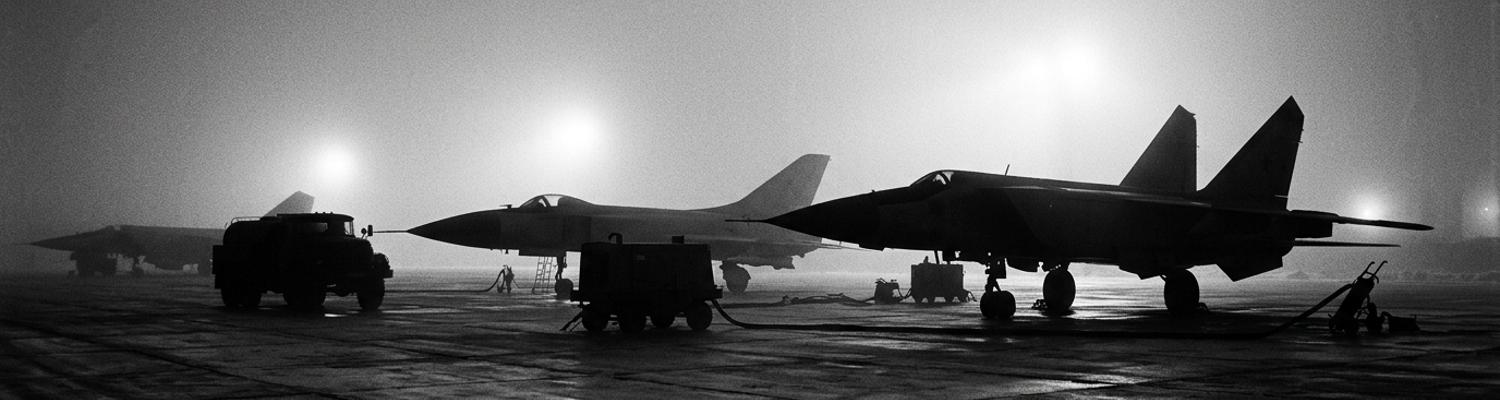

Cold War Alert Readiness at RAF Manston
In 1954, the United States Air Force recorded 2,123 major non-combat flight crashes. These accidents destroyed 1,600 aircraft and killed 718 personnel across peacetime operations. Frontline fighter units led these casualty tallies. They averaged 40 destroyed airframes per 100,000 flying hours. Archival evidence shows that against these safety figures, United States Air Forces in Europe ordered the 406th Fighter-Interceptor Wing to transition into North American F-86D Sabre Dogs. The timeframe was the severe winter of 1954 to 1955. Headquartered at RAF Manston on the northeast tip of the Isle of Thanet in Kent, the wing assigned its three operational flying squadrons (the 512th, 513th, and 514th) to round-the-clock defense duties. Manston sat on an exposed chalk plateau two miles inland from the North Sea coast at 51 degrees north latitude. The base featured a concrete runway built during the Second World War. It measured 9,000 feet long by 750 feet wide. That expanse offered zero protection against arctic winds blowing across the Thames Estuary.
No manual prepared the pilots for the new doctrine.
When examining the operational records from late 1954, the wing abandoned visual daylight dogfighting for an unproven all-weather radar interception doctrine along the English Channel. Previously, fighter squadrons engaged hostile aircraft by sight using six .50-caliber machine guns in tight daytime tactical formations. The F-86D removed guns entirely. It carried twenty-four 2.75-inch Mighty Mouse folding-fin aerial rockets in a ventral tray that lowered beneath the fuselage. Under this new concept, a solitary pilot executed a blind ninety-degree lead-collision intercept in cloud or darkness without visual contact. Sector controllers at RAF ground-controlled interception radar sites tracked high-speed traces over the Channel. They transmitted steering vectors to the airborne cockpit. Once vectored, the pilot operated the AN/APG-36 nose radar while flying the high-performance jet on raw instruments. The Hughes E-4 fire control computer calculated the intercept geometry and automatically fired the rocket battery in a split-second salvo.
Target geometry allowed zero room for correction.
Dense maritime fog banks over the Strait of Dover routinely blinded pilots. Inexperienced aviators trusted glowing amber cathode-ray indicators while flying at 500 knots only a few thousand feet above open sea. A close review of operational logs indicates that ground crews endured punishing conditions to maintain continuous five-minute scramble readiness on exposed concrete alert dispersal pads. Stationed at the western and eastern perimeters of the Manston airfield, these concrete pads lacked hangars, revetment walls, or canvas windbreaks. Winter gales from the North Sea drove sleet across the open airfield. Ambient temperatures dropped below freezing for weeks on end. Readiness protocols required four F-86Ds to sit on constant alert with live rockets armed in their bellies. To maintain precision, mechanics handled safety pins, electrical test harnesses, and frozen airframe fasteners with bare fingers. Standard winter gloves prevented dexterity. Touching bare duralumin skin instantly tore flesh from freezing hands.
Frostbite set in rapidly.
Raw JP-4 aviation kerosene leaked from pressurized couplings during rapid refueling drills. The fuel soaked ground uniforms and stripped the natural oils from human skin within minutes. Inside the control surfaces, condensation in the hydraulic lines froze solid. This locked the retraction jacks of the ventral rocket trays and froze nose-gear steering linkages. Ground starting carts broke down constantly as frost choked their internal pressure regulators. Maintenance crews cleared ice with high-pressure kerosene torches under open skies.
Integration Friction with the British ROTOR Network
Archival evidence shows that when the 406th Fighter-Interceptor Wing began vectoring along the Kentish coast, its electronic systems failed to synchronize with the British air defense infrastructure. The United Kingdom was midway through constructing its hardened ROTOR radar chain. This was a network of subterranean bunkers intended to track incoming Soviet bombers across the North Sea. At subsurface sites like RAF Sandwich and RAF Ash, buried dozens of feet beneath the Thanet chalk, British command personnel monitored air sectors using newly deployed Type 80 search radars and Type 13 height-finders. Electronics inside the American F-86D Sabre Dogs were never wired to assimilate this British ground data. Built around the Hughes E-4 fire control system and the nose-mounted AN/APG-36 radar, the Sabre Dog demanded automated instantaneous vector calculations to execute ninety-degree collision intercepts. ROTOR stations were still operating with incomplete digital tracking lines. RAF teams manually calculated lead times on paper plotting boards and read them over open telephone lines to liaison desks. Resulting conversion delays meant American interceptors consistently arrived at designated patrol coordinates up to three miles behind the actual positions of target aircraft.
Machinery built for distinct doctrines failed to synchronize.
A close review of operational logs indicates that divergent radio spectrum standards crippled coordination between British controllers and American flight crews. United States Air Force F-86D airframes operated exclusively on military Ultra High Frequency channels using the Collins AN/ARC-27 transceiver. They scanned between 225.0 and 399.9 megahertz. In direct contrast, the majority of RAF Ground-Controlled Interception installations throughout the mid-1950s still relied on legacy Very High Frequency equipment. This centered on the TR 1934 and TR 1936 radio families. To communicate across the Channel sectors, underground fighter controllers in Kent routed voice commands through landlines to remote VHF to UHF cross-band rebroadcast huts positioned on coastal headlands. Patch lines crackled with heavy atmospheric interference and introduced transmission delays lasting between two and five seconds. At 500 knots in total cloud cover, an F-86D traveled nearly a thousand feet per second. When the controller finished calling out a heading correction, the pilot had already flown past the intercept geometry.
Cockpits screamed into empty airspace while their fuel reserves drained toward emergency divert status.
When examining the historical record from joint exercises, conditions inside the underground control bunkers degraded the tracking picture even further. At RAF Sandwich, radar operators worked eighty feet below ground inside the three-level R3 reinforced concrete bunker. They monitored ten-inch cathode-ray tube consoles in windowless radar cabins. Heat thrown off by banks of vacuum tubes routinely overwhelmed the crude subterranean ventilation fans of the site. Cabin ambient temperatures pushed above ninety degrees Fahrenheit. Operators sat in near-total darkness, staring through green-phosphor Plan Position Indicator displays at traces that blurred as the tubes heated up. Joint tracking drills involving the 512th, 513th, and 514th Fighter-Interceptor Squadrons exposed persistent display degradation caused by anomalous propagation over the Thames Estuary and radar clutter bouncing off salt spray along the Dover Straits. Controllers could not reliably separate the radar return of an F-86D from coastal surface echoes or heavy cloud returns on their fading screens. Height-finding operators reading the vertical sweeps of Type 13 antennas misread American flight levels by up to four thousand feet.
They assigned Sabre Dog pilots collision paths directly into ocean fog banks without warning.
Thames Estuary Atmospheric Inversions and Radar Ghosts
Archival evidence shows that autumn and winter weather over the Thames Estuary created a persistent atmospheric trap for early radar equipment. Cold maritime air pushing inland from the southern North Sea collided with warmer air masses settling over the Essex marshes and the Kentish chalk bluffs. This interaction formed steep low-altitude temperature inversions that sat locked between six hundred and three thousand feet above sea level. Thick advection fog rolled off the water, saturating the coastal boundary layer with dense moisture and suspended sea salt. The abrupt thermal boundary sheared the local troposphere, bending electromagnetic waves traveling across the estuary into downward arcs through atmospheric ducting. Beams emitted by ground stations like RAF Sandwich and the nose antennas of airborne interceptors refracted violently toward the surface. Radar waves deflected off choppy open water, commercial freighters steaming through the deep channels, and the rusting steel struts of wartime Maunsell Sea Forts standing at Red Sands and Shivering Sands. Reflected echoes traveled back along the inversion ducts with abnormal strength. They coalesced on radar screens into discrete bright blips that mimicked aircraft formations.
Radar screens filled with targets that did not exist.
A close review of operational logs indicates that ground controllers routinely mistook these ducting artifacts for formations of Soviet Tupolev Tu-4 and Tu-16 bombers penetrating the outer approaches of Britain. Klaxons shrieked across the alert dispersal pads at RAF Manston at all hours of the night. Pilots from the 512th, 513th, and 514th Fighter-Interceptor Squadrons sprinted to cold cockpits, strapped into their parachutes, and fired their General Electric J47 turbojets with only minutes on the countdown clock. Interceptors launched straight into blinding advection fog. They lit full afterburners to clear the runway threshold at 150 knots before entering cloud tops that extended into the upper teens. Underground controllers in the Sandwich bunker vectored the solitary pilots toward North Foreland and the mouth of the estuary to cut off contacts showing ground speeds of 400 knots. In the cockpit, pilots threw the switch for the ventral rocket tray and leveled out at low altitude over freezing black water. When they arrived at the designated intercept coordinates, the airspace was completely empty. Sabre Dogs circled through turbulence and rain squalls, chasing ghost returns that skipped across their instruments before vanishing entirely.
Men risked their lives chasing blank air.
When examining the maintenance records from the 406th Maintenance Group, pilots pushed the Hughes E-4 fire control system far past its designed thermal limits trying to confirm whether these contacts were real. The AN/APG-36 radar assembly sat crammed inside the unpressurized nose cone directly above the jet intake. It was encased under a dielectric plastic radome. Inside that sealed space, dozens of miniature vacuum tubes, including 6080 dual triodes and 5654 pentodes, generated severe heat loads during operation. Doctrine instructed pilots to limit full radar power sweeps to brief bursts. Aviators hunting phantom targets across the estuary kept transmitter gain and search pulses active for thirty to forty minutes at a time. The small cooling fans of the nose radome drew in saturated maritime air that could not cool the compact sub-chassis. Internal temperatures inside the electronics bay surged past 160 degrees Fahrenheit. The glass envelopes of the vacuum tubes blistered. Filament pins warped inside their ceramic sockets. Solder joints softened on circuit boards.
Components failed mid-flight.
This filled cockpits with the smell of scorched bakelite and short-circuited wiring. Without nose radar, pilots faced zero-visibility approaches into Manston with blind instruments, relying only on coastal low-frequency radio transmitters while their fuel gauges bounced against reserve stops.
Cockpit Isolation and Single-Pilot Radar Saturation
Archival evidence shows that solitary Sabre Dog aviators encountered crippling vestibular disorientation the moment their canopies locked into the dense cloud banks above the Kent coast. A pilot flying an F-86D operated without a dedicated radar intercept officer in the rear seat. He had to press his face directly into the rubber viewing hood of the Hughes E-4 cathode-ray tube to spot faint electronic targets. That action physically broke his visual scan of the primary flight instruments. The Sperry attitude indicator sat outside the hooded peripheral vision of the pilot. While tilting the AN/APG-36 antenna elevation wheel with his left hand and adjusting receiver gain controls, tiny head movements inside the darkened cockpit provoked intense Coriolis illusions within the middle ear. Fluid shifts in the semicircular canals deceived the brain into sensing an inverted climb while the aircraft actually banked thirty degrees into a descending graveyard spiral. Flight surgeons tracking the 406th Fighter-Interceptor Wing documented repeated instances where aviators emerged from the radar visor after thirty seconds of tracking and suffered the leans so violently they fought their own control sticks to counter non-existent rolls.
Spatial confusion struck pilots before they reached operational ceiling.
A close review of operational logs indicates that instrument flight regimes over the blacked-out waters of the North Sea overwhelmed single-pilot mental processing limits. Below four thousand feet, wartime coastal blackout orders had long ceased. Yet the North Sea at midnight presented total darkness devoid of surface lights, fishing trawlers, or horizon references. Sea water and low cloud ceilings merged without any discernible visual break. In this environment, a pilot flew raw instruments through heavy turbulence while simultaneously managing five separate operational tasks. He maintained level flight with stick and rudder. He tuned the Collins UHF radio to receive vector revisions from British controllers. He calculated closing rates on the Hughes E-4 computer display. He monitored exhaust gas temperatures. He trimmed the horizontal stabilizer. Two-seat interceptors like the Northrop F-89 Scorpion divided these mechanical responsibilities between two men. Flying solo in the Sabre Dog, an aviator experienced immediate sensory saturation within four minutes of entering instrument conditions. Pilots sweated heavily inside rubberized anti-G suits and pressure helmets. They fixated on single dials. They missed rapid altimeter drops until sonic boundary buffet rattled the airframe.
Divided attention pushed pilot heart rates past 160 beats per minute.
When examining the flight safety records from RAF Manston, full-afterburner scrambles into the inversion layer triggered immediate unrecoverable fuel emergencies. The General Electric J47-GE-17 engine burned approximately 800 gallons of JP-4 per hour at military power. Pilots lit the afterburner to punch through thick sea fog. This action escalated fuel consumption to more than 6,000 pounds per hour. An F-86D carried only 435 gallons of internal fuel, supplemented by two 120-gallon external drop tanks that created significant drag. Scrambling off Manston Runway 29 and maintaining afterburner through twelve thousand feet of solid overcast consumed forty percent of the total fuel load before the interceptor leveled off at combat altitude. If ground controllers vectored the pilot on a twenty-minute pursuit of an unidentified radar contact fifty miles offshore, the fuel totalizer reached bingo status almost immediately upon contact acquisition.
Aviators had no margin for tactical delays.
An aborted pass or a radar malfunction left a pilot with barely 600 pounds of JP-4. This was just enough for a single high-speed ground-controlled approach back to Manston. Flameout forced pilots into an unpowered glide, requiring an ejection into forty-degree seawater with a survival window under twelve minutes.
Anglo-American Clearance Protocols and Alert Pad Delays
Archival evidence shows that scrambles from RAF Manston frequently paralyzed at the command level before an engine could fire. Sovereign British airspace defense resided under the legal mandate of RAF Fighter Command. This was exercised through No. 11 Group headquarters at RAF Uxbridge and monitored via underground sector control at RAF Sandwich. United States Air Forces in Europe operated the 406th Fighter-Interceptor Wing under an entirely separate tactical command framework established by Third Air Force at South Ruislip. When British radar tracking boards lit up with unidentified tracks approaching the Thames Estuary, RAF controllers possessed zero statutory authority to scramble American aircraft directly. Every scramble request required the RAF Sector Commander to issue a tactical recommendation to the USAF Wing Operations Center at Manston. American duty officers had to validate the order against their own operational readiness state. Flight crews sat strapped inside cockpits on the open dispersal hardstands while staff officers debated jurisdictional clearance over uncoordinated communications channels. USAF commanders refused to yield scramble release authority to British sector chiefs. Armed F-86D interceptors remained tethered to the ground while unknown radar traces tracked west toward London.
Chain-of-command deadlocks held armed interceptors on the pavement.
A close review of operational logs indicates that cumbersome cross-national telephone verification protocols caused severe launch delays during active scramble calls. Alert orders traveled across civilian General Post Office landlines. These lines physically connected the underground ROTOR bunker at RAF Sandwich with the Manston base operations room. To scramble interceptors, RAF and USAF watchstanders had to verbally exchange two-part challenge-and-response authentication codes selected from physical cryptographic booklets. Thanet winter rains routinely saturated unpressurized underground GPO cable conduits. This produced severe audio interference, line drops, and crosstalk across the Thanet trunk lines. If atmospheric hum or crackling wire shorts caused an operator to mishear a single phonetic letter, joint security directives required hanging up the phone. The operator then called back through a backup exchange at Canterbury and executed the full authentication exchange from the first character. By the time an American duty controller authenticated the call, ran the handwritten scramble slip to the alert dispatcher, and hit the klaxon, six to eight minutes had drained away on an alert schedule that permitted only five.
Six minutes had passed before the pilots heard the scramble horn.
When examining the historical record, conflicting Anglo-American rules of engagement kept armed F-86D interceptors idling on fog-bound taxiways awaiting sector clearance. RAF Fighter Command peacetime directives strictly prohibited opening fire without an absolute visual identification made by the pilot and verified by an Air Ministry political authority. United States Air Force doctrine instructed Sabre Dog aviators to execute radar-lock lead-collision attacks with twenty-four Mighty Mouse rockets in zero-visibility conditions without any visual sighting. While sector controllers at RAF Sandwich argued with Third Air Force liaisons over intercept rules, armed F-86Ds from the 512th, 513th, and 514th Fighter-Interceptor Squadrons sat idling at the Runway 29 holding point in dense advection fog. The General Electric J47-GE-17 turbojet burned JP-4 at twenty gallons per minute just sitting on the asphalt. In the freezing maritime air, stagnant exhaust backpressure caused tailpipe temperatures to creep dangerously close to the 710-degree Celsius operating limit. This threatened the turbine wheels with catastrophic thermal warping.
Idling for fifteen minutes drained nearly 300 gallons of kerosene.
By the time British controllers authorized the Sabre Dogs to take off, the fuel totalizer in the cockpit had dropped below the combat reserve threshold. Pilots were forced to abort the mission and taxi back to the revetments with rocket trays still armed.
Ground Crew Maintenance Under Extreme Winter Conditions
Archival evidence shows that line mechanics of the 406th Maintenance Group endured extreme physical punishment while servicing the Hughes E-4 fire control system on the exposed dispersal hardstands at RAF Manston. Ambient temperatures routinely plummeted into the low twenties during January 1955. Driving sleet and freezing drizzle blew off the Thames Estuary. Maintenance protocols required technicians to open the unheated nose radome and access the compact high-density avionics shelving positioned directly above the engine air intake duct. Within these narrow bays, hundreds of delicate bundle harnesses, miniature Cannon plugs, and ceramic vacuum-tube sockets sat choked with frozen condensation. Issued winter mittens and heavy leather work gloves completely destroyed tactile sensation. It became impossible to handle tiny 4-40 chassis screws, thread safety lockwire, or seat miniature sub-chassis vacuum tubes into their retaining clips. Ground crews stripped off their handgear. They worked directly on sub-zero metal with bare fingers. Flesh adhered instantly to frozen magnesium access doors and zinc-chromate-primed structural ribs. Epidermis ripped off when pulled away. Technicians regularly soaked their numb hands in warm engine oil drained from recently recovered aircraft simply to restore enough motor control to tighten antenna coupling nuts.
Bare flesh tore away on frozen airframe bulkheads.
A close review of operational logs indicates that the salt-saturated maritime atmosphere rolling off the North Sea turned the internal electronics compartments of the F-86D into zones of chronic electrical failure. Winds pushing inland across Pegwell Bay drove dense advection fog across the 750-foot-wide runway at Manston. This blanketed the open alert dispersals in damp sea brine. Neoprene access gaskets, brittle from continuous sub-freezing exposure, shrank and cracked along the upper fuselage access hatches. Microscopic droplets of saline moisture infiltrated the unpressurized radar compartments. They coated the sensitive circuitry of the AN/APG-36 receiver-transmitter with an invisible conductive film. Galvanic corrosion rapidly attacked terminal strips. Copper wiring bundles oxidized into crumbling green verdigris. Cadmium-plated mounting fasteners bound to structural duralumin webs. Within the Hughes E-4 computer chassis, salt bridges formed across the high-voltage contacts of the amplifier racks. This caused severe resistance drops that scrambled steering calculations. Interceptor radar bays frequently threw short circuits during pre-flight continuity checks. Irreplaceable high-frequency transformers burned out and thermal circuit breakers tripped before pilots could taxi out of the holding pads.
Salt deposits shorted out flight computers before the jets reached the taxiways.
When examining the historical record from the 512th, 513th, and 514th Fighter-Interceptor Squadrons, turnaround operations on the alert lines took place under pitch-black visual restrictions dictated by regional defense blackout orders. Base commanders banned floodlights, overhead mercury-vapor lamps, and vehicle headlamps along the perimeter hardstands to prevent coastal visual spotting. Ground personnel guided heavy equipment across rutted ice-coated tarmac using only low-intensity flashlights masked with red cellophane filters. They frequently operated entirely by memory and touch in dense fog. Refueling specialists dragged stiff frozen rubber hoses across the pavement to mate pressurized nozzles with the single-point fueling receptacle on the Sabre Dog fuselage. They pumped volatile JP-4 aviation kerosene at 300 gallons per minute under fifty pounds per square inch of pressure. Defective rubber seals stiffened by coastal frost frequently failed under pumping surge pressures. Atomized JP-4 sprayed over crew uniforms and into open eyes. Static grounding wires snapped in the freezing winds. This created severe risks of static sparks igniting fuel vapor clouds floating low in the heavy fog while auxiliary power units idled just feet away.
High-pressure refueling drills presented constant lethality under these blackout constraints.
Operational Lessons of the 1954 Winter Intercepts
Paper directives changed only after radar components literally burned out on the flight line.
Archival evidence shows that by February 1955, United States Air Forces in Europe and RAF Fighter Command overhauled their joint all-weather intercept handbook to counter the persistent ducting over the Thames Estuary and Pegwell Bay. Field commanders acknowledged that the AN/APG-36 radar systems aboard the F-86D interceptors could not reliably differentiate between low-altitude Soviet bombers and ground clutter refracted by coastal temperature inversions. Technical orders instructed the 512th, 513th, and 514th Fighter-Interceptor Squadrons to restrict transmitter operational sweeps to short thirty-second intervals above 5,000 feet. This prevented the miniature 6080 dual-triode vacuum tubes from overheating inside the unpressurized nose radomes. Ground-controlled interception crews at RAF Sandwich received new plotting rules. They were barred from scrambling alert aircraft against stationary or erratic returns below 3,000 feet unless two separate radar stations confirmed target movement. Technicians retrofitted radar receiver racks with silica-gel desiccant canisters. They mechanically adjusted antenna tilt stops by three degrees upward to clear surface spray off the Dover Straits. Solitary pilots received strict operational instructions to abort blind pursuits and pull out of descents if target blips failed to display consistent Doppler shift signatures within twenty miles of the coast.
A close review of operational logs indicates that the breakdown in scramble times forced an immediate restructuring of Anglo-American air defense communications across southeast England. Third Air Force commanders at South Ruislip negotiated an operational compromise with RAF Fighter Command No. 11 Group. They stripped away the civilian General Post Office telephone links that had delayed alert responses during night alerts. Direct dedicated subterranean landlines were laid between the R3 bunker at RAF Sandwich and the 406th Wing Operations Center at Manston. This bypassed civilian switchboards in Canterbury. Scramble authority was formally decentralized. American alert crews on the dispersal pads no longer waited for jurisdictional sign-offs from base operations officers. An RAF sector controller held delegated authority to trigger the scramble horns in the alert shacks directly via a secure two-wire circuit. Cryptographic verification protocols were reduced to a single pre-briefed phonetic trigger word transmitted over the primary Collins AN/ARC-27 UHF channel. This procedural shift removed four minutes off the alert sequence. Armed Sabre Dogs rolled along Runway 29 before incoming tracks reached the Kent coastline.
Dead time on the telephone had nearly cost them an entire defense sector.
When examining the historical record, flight data compiled by the 406th Maintenance Group across that freezing winter spread rapidly across NATO air commands operating in Northern and Western Europe. Engineers monitoring F-86D deployments in West Germany and Norway utilized Manston mechanical failure logs to redesign airfield ground equipment. They replaced fragile kerosene starting torches with heated air-start carts and installed thermal jackets around hydraulic actuators. Cockpit workload records gathered from solitary pilots suffering spatial disorientation over the North Sea settled an intense doctrine debate within the Pentagon and the British Air Ministry. Technical reports concluded that expecting a single aviator to fly blind on raw instruments while tuning the Hughes E-4 fire control radar and monitoring engine exhaust temperatures pushed human workload limits to complete failure. Air forces shifted priority back toward two-man interceptor platforms like the Gloster Javelin and the McDonnell F-101B Voodoo. These assigned dedicated radar operators to work the electronics. For single-seat airframes, NATO mandated audio-tone target acquisition cues and auto-leveling autopilots. Interceptor squadrons deployed along the Baltic Sea adopted pressurized dehumidification shelters directly on alert pads to halt salt corrosion.