
In late September 1861, the 3rd Brigade of the Army of Occupation, Western Virginia, held a position at Camp Elkwater. This was not a fortress. It was a hastily constructed forward operating base carved into the terrain of Randolph County, an island in hostile geography connected to the outside world by a single, perpetually muddy turnpike.
Inside a command tent, a sergeant consolidated field reports. His task was to complete the brigade’s monthly Provisional Returns for the Quartermaster Department. He was an accountant of things: barrels of salt pork, crates of hard bread, kegs of gunpowder, and sacks of forage. The ink bled slightly on the damp paper as he finalized the columns.
The numbers were a formal declaration of a looming operational crisis.
Archival evidence shows the returns submitted by acting quartermaster Captain John Knowles laid bare the precariousness of the Union position. The brigade, at a strength of 2,500 men, had pushed deep into Confederate territory. Victory gave them ground, but the terrain itself was now the adversary. The supply road from the railhead at Clarksburg was a quagmire. A standard six-mule wagon, capable of hauling over 3,000 pounds on a good road, was lucky to move 1,800 pounds through the muck. The returns documented a cascade of failures: broken axles, shattered wagon tongues, and an unsustainable rate of attrition among draft animals.
Operational logs for September reveal the scale of the problem. The returns predicted shortages across every class of supply. Forage was the most urgent. Each of the brigade’s 600 mules and horses required a daily ration of over 20 pounds of hay and grain. The supply train, however, delivered less than half the required tonnage. Knowles’s report projected that all reserve forage would be exhausted by the third week of October. This development would immobilize the brigade’s entire transportation network. Without mules, there would be no ammunition resupply, no movement of rations, and no way to evacuate the sick and wounded.
The crisis extended to the soldiers. The standard daily ration included salt beef, flour, and beans. While the brigade had a nominal 30-day supply of hard bread and salt meat, the returns noted a significant percentage of the preserved meat was spoiling. Fresh vegetables were nonexistent. The supply of desiccated vegetables, a compressed brick of dried produce, was running low. More concerning were medical stores. With autumn rains came a spike in camp sickness, yet the returns showed less than two weeks' supply of quinine, the essential treatment for malaria. The report for 2,500 men was a mathematical forecast of a force rapidly approaching the point of total consumption.
The brigade’s communication systems were as fragile as its logistics. The U.S. Military Telegraph Corps had strung a single iron wire connecting Camp Elkwater to the district headquarters at Clarksburg. This line followed the same muddy turnpike used by the supply wagons. Crews affixed glass insulators to trees and fence posts, creating a conspicuously exposed communication artery. Confederate partisans did not require sophisticated equipment to exploit this vulnerability. Interception involved climbing a pole, scraping the gutta-percha insulation from the wire, and attaching a portable telegraph sounder to read Morse code traffic. While the Union army under Anson Stager employed a complex route transposition cipher, the pressure for speed often led operators to transmit routine messages in the clear. Reports on ammunition status, forage levels, and unit strength frequently passed along the wire without encryption.
Visual signaling was a public broadcast.
The brigade also relied on the “wig-wag” flag system developed by Major Albert J. Myer. Signal Corps teams occupied high ground, using powerful telescopes to send and receive messages over several miles. Any enemy observer with a comparable telescope and a basic understanding of the protocol could read the signals. This weakness was made acute by the fact that Myer’s own pre-war assistant, Edward Porter Alexander, was now a Confederate signal officer who had trained an entire corps in the exact same system. Confederate intelligence teams became exceptionally proficient at monitoring Union flag stations from concealed overlooks. Even when Union signalmen used Myer’s cipher disk, a small wheel for encrypting messages, Confederates could conduct frequency analysis or simply wait to capture a signalman and his code disk.
These technological weaknesses were compounded by human factors. Specialists were in short supply. The illness or capture of a single operator could sever a link. The Union’s dependence on the Stager cipher, while robust in theory, created single points of failure. A captured codebook or a defecting operator could render months of intercepted traffic readable. For the isolated 3rd Brigade, a cut telegraph wire combined with the frequent fog and rain that rendered flag stations useless meant complete operational silence. Confederate dispatches from the period demonstrate a detailed awareness of Union troop movements and supply shortages, insight gained not from a massive spy network but from patient exploitation of insecure communications.
The collapse of the 3rd Brigade began with a sequence of communication breakdowns. The single iron telegraph wire connecting Camp Elkwater to Clarksburg was the primary point of failure. On October 11th, 1861, a section of this wire went dead. A storm had felled a massive oak tree across the line five miles south of the nearest Union outpost. The brigade command initially assumed partisan activity. A two-man repair crew was dispatched to patrol the line. The mountainous terrain and the danger of ambush turned this into a multi-day operation. It took them three days to locate the downed tree and another full day to clear the wreckage and re-establish a connection. For four days, the brigade was electronically deaf.
With the telegraph down, command fell back to the Myer “wig-wag” system. From a signal station on a ridge overlooking the camp, operators attempted to communicate with a corresponding station fourteen miles north. Archival logs from the northern station (Record Group 111, U.S. Army Signal Corps) document a disastrous misinterpretation on October 13th. An incoming supply convoy had become mired in mud. The Camp Elkwater signalman sent a message intended to be “CONVOY HALTED. AXLES BROKEN. NEED FORAGE.” Due to thick afternoon fog rolling through the valleys, the distant signal was intermittent. The receiving operator, peering through a wet telescope, misread the frantic flag movements. The complex signals for “AXLES BROKEN” were mistaken for the simpler ones for “ARRIVING SOON.” The urgent plea for animal feed was lost entirely.
Headquarters received a message indicating the supply situation was about to be resolved. The reality was that the means of its resolution was itself stranded and consuming its own dwindling forage.
The combined effect of these failures forced the brigade to rely on a mounted courier. A detailed after-action report, a more desperate version of the September provisional returns, was dispatched on October 15th. This document stated plainly that without immediate resupply, the brigade’s transport animals would begin to die of starvation within a week. The courier’s route was a perilous, 120-mile journey. He was forced to travel by night and hide by day, picking his way through unmarked trails. The journey took nearly three weeks. When the mud-spattered rider finally delivered his soaked dispatch pouch to department headquarters in Wheeling, it was November 4th. The information inside was six weeks old. The crisis it predicted was already a historical event.
Correspondence logs from the Department of the Ohio show the dispatch pouch from Camp Elkwater arrived on November 4th, 1861. The information, a prediction of systemic collapse from mid-October, was already three weeks out of date. Departmental clerks, overwhelmed by the administrative demands of a rapidly expanding war, processed the report as a historical data point. The brigade’s status had been marked as stable days prior, a direct result of the garbled “wig-wag” signal of October 13th, logged as “CONVOY ARRIVING SOON.” This optimistic, albeit false, report had neutralized any sense of urgency. The Quartermaster Department in Washington, grappling with supplying an army of hundreds of thousands, viewed the 3rd Brigade’s situation through the distorted lens of outdated summaries. The unit was a single entry among thousands.
The command at Camp Elkwater was left to face its predicament alone. The failure of the mid-October supply convoy was the point of operational failure. The six-mule teams had consumed most of their own forage just to reach their breakdown point. The brigade was now completely isolated. The first heavy snows of early November began to blanket the Alleghenies, turning the impassable mud into frozen, rutted ice and sealing the camp off entirely. The 600 horses and mules, once the brigade’s mobility, were now a liability, requiring over 13,000 pounds of fodder daily that did not exist. Patrols ceased. Reconnaissance ended. The camp, once a forward operating base, had become a 2,500-man prison administered by the Appalachian winter.
The humanitarian crisis inside the camp’s perimeter was swift. With no resupply of rations and preserved meats spoiling, caloric intake dropped below subsistence levels. The onset of scurvy was documented in the post surgeon’s log, with soldiers exhibiting bleeding gums and lethargy. The lack of fresh water sources and the breakdown of sanitary discipline led to widespread outbreaks of dysentery and typhoid fever, known as the “Virginia Quickstep.” Soldiers, too weak to use the designated latrines, contaminated the ground near their tents, creating a breeding ground for disease. The hospital tent was overrun. With the last of the quinine gone, malaria cases progressed unchecked. In the last week of October, the brigade commander made the decision to begin slaughtering the starving transport mules for meat. The stringy, nutrient-poor flesh was not enough to halt the physical deterioration of the men.
Muster rolls for February 1862 reveal a force consumed not by combat, but by starvation and disease. The last of the slaughtered mules had been eaten weeks prior. The men subsisted on spoiled hard bread and a few ounces of salt pork per day. Scurvy was rampant. The surgeon’s logs show an epidemic of dysentery had turned the camp into a biohazard. The intestinal infection spread uncontrollably. With sanitation discipline having collapsed and the frozen ground making new latrines impossible to dig, fecal matter contaminated the area around the tents and then entered the water supply. Malnourished men with weakened immune systems were highly susceptible to the bacteria they ingested from the contaminated food and water.
By February, the Allegheny winter had been brutalizing the trapped brigade for three months. Operational logs from adjacent Union commands note repeated, driving snowstorms and temperatures that remained below freezing for weeks. The soldiers at Camp Elkwater, clad in threadbare wool uniforms and with boots whose leather had cracked and failed, were wholly exposed. Men were documented wrapping their feet in soiled rags. The surgeon’s log documents a sharp increase in cases of severe frostbite. Without adequate shelter or the ability to maintain fires, gangrene became a common secondary diagnosis. A chilling entry from the surgeon describes performing multiple amputations of blackened toes and feet with a simple bone saw, without chloroform or anesthetic. Each amputee became another mouth to feed and a patient requiring care the overwhelmed medical staff could not provide.
The final muster on February 28, 1862, accounted for the cumulative effect of this disaster. Brigade records show an effective fighting strength reduced by over 30 percent. This number does not represent combat losses. It represents a force hollowed out from within. For every man who died, three more were too wracked by fever, dysentery, or malnutrition to stand. Desertion became a symptom of the collapse. Men, often in ones and twos, simply walked away from the camp into the snow-covered mountains, preferring a slim chance of survival over the certainty of dying from disease or starvation. Of a nominal strength of 2,500 men, fewer than 1,700 were accounted for as “present for duty,” and even that number was an optimistic assessment of men who were starving, sick, and freezing.
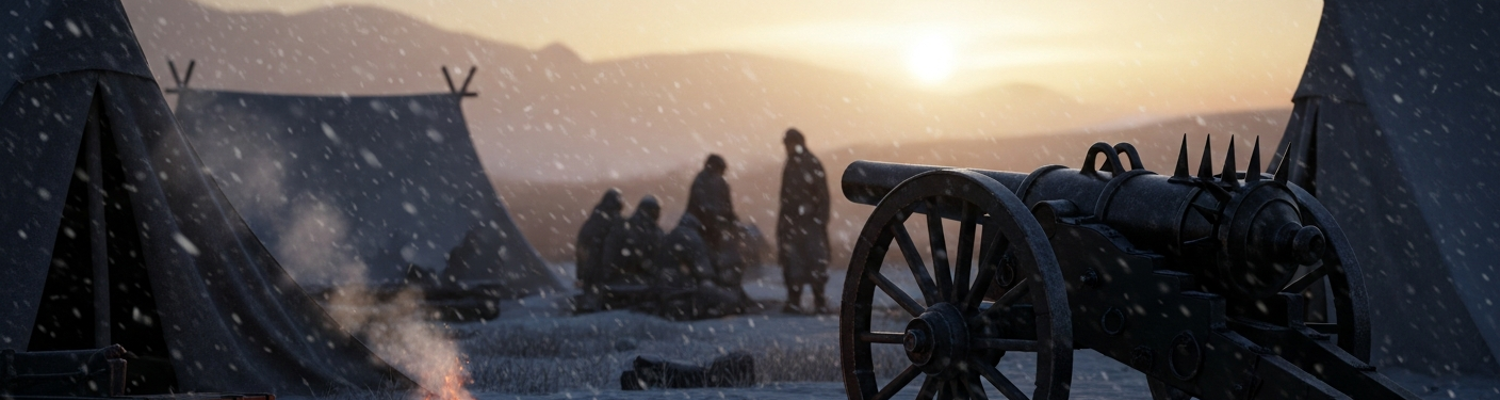
The order to abandon Camp Elkwater, issued on March 3rd, 1862, was an admission of systemic failure. The decision was not tactical. It was humanitarian. The brigade commander recognized that remaining in place meant the complete annihilation of his command. The order was simple: destroy all military articles that could not be carried by men on foot. This included the brigade’s six 12-pounder Napoleon cannons, thousands of rounds of small arms ammunition, hundreds of tents, and all remaining quartermaster and medical supplies. The barrels of the artillery were spiked. Their carriages and limbers were burned. Crates of cartridges were dumped into the camp’s foul latrine pits.
The withdrawal began at dawn on March 5th. Any semblance of military order dissolved within the first hour. The brigade was now a ragged column of emaciated individuals. A post-action review of the route shows the column stretched over four miles along the frozen, rutted surface of the Staunton-Parkersburg Turnpike. Officers lost control of their formations as men fell out, unable to keep the pace. The path of the withdrawal was marked by a trail of abandoned equipment: knapsacks, blanket rolls, and finally, rifles dropped by men too weak to carry their own weight. A thaw had begun, turning the road back into a channel of thick, sucking mud that pulled the cracked boots from the soldiers' feet. The surgeon’s report, filed weeks later, documented that over 200 men were unaccounted for, having collapsed along the route to be captured by Confederate partisans or to die of exposure.
This desperate flight handed a major strategic victory to the Confederacy. The territory abandoned by the 3rd Brigade was the lynchpin of the Union’s defensive posture in the Allegheny highlands. Camp Elkwater, along with the fortified outposts on Cheat Mountain and in the Tygart Valley, controlled the most direct invasion routes into central Western Virginia. These were the positions that Union forces under General Joseph J. Reynolds had successfully defended against attacks by Robert E. Lee the previous autumn. Confederate field reports from the period document the discovery of the abandoned camp with disbelief. Small cavalry patrols found spiked cannons and burned wagons. Within a week, elements of the Confederate Army of the Northwest reoccupied the entire line of fortifications without firing a shot, reclaiming the dominant high ground.
The sudden evaporation of a full brigade threw the Union’s entire regional strategy into chaos. Department commanders were forced to divert two regiments from guarding the critical Baltimore & Ohio Railroad, the main east-west artery for Union troops and supplies, to attempt to form a new defensive line. This exposed the railroad to increased raids by Confederate cavalry. The hard-won gains of 1861, which had secured the region and paved the way for the statehood of West Virginia, were largely erased. A strategic initiative was handed back to the Confederates, forcing the Union into a reactive, defensive posture for the remainder of the 1862 spring campaign.