
Field Manual Doctrine and the Kongju Highway Bridge
The drive gear inside the LeRoi 105 CFM trailer-mounted air compressor stripped its teeth. A sharp metallic screech echoed across the riverbank. Shredded brass shavings spit directly into the crankcase. Air pressure bled down to zero across the heavy rubber pneumatic drill hoses. Without pneumatic power to drive rock drills into the roadbed, combat engineers pounded star drills and pickaxes by hand against aggregate concrete. Temperatures on the asphalt roadway rose past ninety-five degrees Fahrenheit. Soldiers from Company A, 3rd Engineer Combat Battalion worked frantically above the silt-laden Kum River. Exhausted work parties stacked heavy sandbags along the spans. They tamped external charges of Composition C-3 directly over structural girders.
Time was running out.
A close review of operational logs from July 13, 1950, reveals near-total collapse across the American front. Major General William F. Dean ordered the understrength 34th Infantry Regiment to anchor the Kongju defensive sector against the North Korean 4th Infantry Division. Soviet-built T-34-85 medium tanks pushed down the primary highway axis from Chonan. They punched through light infantry roadblocks. Company A received immediate operational orders to drop the multi-span concrete highway bridge at Kongju into the riverbed. North Korean armor was approaching the northern approaches. Lieutenant Colonel David Crawford and his engineer officers treated the crossing as the primary physical barrier preventing hostile armored forces from rolling south into Taejon.
Peacetime manuals dictated every single charge calculation.
Archival evidence shows staff officers planned the mission using standard breaching tables lifted straight from Field Manual 5-25. This was the primary army doctrine for explosives and demolitions (War Department Technical Manual 5-25, 1944 revision). The manual instructed engineers to compute explosive weights using a basic thickness-to-resistance formula. The formula assumed the target consisted of standard American reinforced concrete with modest tensile rebar. Those pre-war formulas were completely flawed for the Korean theater. Japanese colonial engineers built the Kongju highway bridge during the 1930s. They designed the structure to withstand violent seasonal flash floods and heavy military supply trains. Builders poured exceptionally hard river-gravel aggregate. They reinforced it with an extraordinarily dense, multi-layered matrix of heavy structural steel rebar. Field Manual 5-25 calculated charges under the assumption that an external blast would shatter the brittle concrete and snap the light interior reinforcement simultaneously. The doctrine failed to account for Japanese colonial construction standards. The explosive charges placed by Company A were forty to sixty percent too light to shear through the internal steel grid.
At approximately 0400 hours, engineers joined the dual firing circuits and depressed the demolition blasters.
A deafening double detonation shook the southern river bluffs. Water, fractured concrete slabs, and wooden roadway decking flew into the air. Dense gray smoke settled over the Kum River. An intact bridge stood exposed. The explosive energy blew away the exterior concrete casing in ragged chunks. The dense, interwoven rebar web remained completely intact between the supporting piers. Deep craters pitted the surface. The structural steel core held firm. The primary roadway remained solid enough to support advancing North Korean armored columns and combat infantry. Company A scrambled on the southern river bank to gather spare explosives. Enemy reconnaissance patrols opened fire from the northern tree line.
Secondary Charge Placement and Structural Steel Resilience
Rifle bullets from the northern bank cracked against the concrete bridge railing at ankle height.
A review of operational logs indicates Company A exhausted its pre-rigged charge packs during the failed dawn demolition attempt. North Korean riflemen from the 4th Infantry Division moved into concealed positions along the northern river bluffs. They directed continuous Degtyaryov machine gun fire and 7.62mm Mosin-Nagant rifle rounds across the open roadway. Second Lieutenants and noncommissioned officers sprinted back to the southern approach road. They rummaged through the cargo beds of two-and-a-half-ton GMC CCKW trucks and an abandoned weapons carrier. Demolition personnel tore open wooden crates. They grabbed every available block of Composition C-3 alongside loose rectangular blocks of trinitrotoluene. Men wrapped friction tape around twenty-pound assemblies of yellow explosive bricks. They carried the improvised satchels out onto the exposed concrete deck while low-caliber rounds skipped off the roadbed. Soldiers low-crawled across shattered aggregate. They shielded the explosive bundles with their own bodies. Fragments from mortar impacts began landing along the southern pier line.
The initial firing plan followed an obsolete formula.
Archival evidence shows standard United States Army breaching formulas in Field Manual 5-25 rested entirely on pre-Second World War testing. This testing was conducted against standard domestic commercial road spans. American demolition doctrine prescribed cutting-charge factors based on brittle aggregates and light, wide-spaced internal rod reinforcement. Japanese colonial civil engineers designed the Kongju crossing with far higher structural tolerances. They anticipated extreme summer monsoon flooding and heavy Imperial Japanese Army rail and vehicular traffic. Builders poured hard crushed-river-stone concrete around exceptionally dense, overlapping steel reinforcement cages rather than basic structural gridwork. Field Manual 5-25 instructed teams to calculate unconfined external charges using standard material coefficients. The manual completely overlooked the extreme energy dissipation occurring without deep borehole confinement. Breaching that specific Japanese concrete mixture required heavy external sandbag tamping to direct the blast inward. It required cutting-charge values calculated at two to three times the manual baseline.
Engineer leaders realized the concrete deck merely fragmented away from the internal structural skeleton. The bridge was supported entirely by its embedded steel framework. Lieutenant Colonel David Crawford and his demolition sergeants gathered behind the southern abutment. They recomputed the required explosive weights using improvised field mathematics. The revised plan abandoned wide surface breaching in favor of concentrated contact charges. Combat engineers crawled back onto the exposed deck with entrenching tools and sledgehammers. They cleared away jagged aggregate to expose the continuous steel rebar lattice running through the load-bearing girders. Work parties molded pliable Composition C-3 directly against the exposed structural steel bars. They tied the plastic explosive into high-density contact rings with engineer tape. They linked each node with Primacord detonating branches. Additional ten-pound blocks of TNT were stacked flush against the primary tension points. They tamped the explosives beneath rows of heavy wet-mud sandbags.
The second electrical impulse blew the bridge apart at 0715 hours.
The secondary detonation sheared cleanly through the continuous steel rebar webs. The blast collapsed the eighty-foot main southern span into twenty feet of mud and river water. The severed northern piers remained isolated under heavy North Korean small-arms fire.
Improvised Gun Trucks and Armored Heavy Equipment
Doctrine provided zero armor protection for heavy construction machinery operating under direct enemy observation.
Archival evidence shows motor pool personnel from the 3rd Engineer Combat Battalion recognized soft-skinned cabs offered no survivability against 7.62mm light machine gun fire along the river approaches during the retreat toward Taejon. Master sergeants and mechanics took over repair sidings at the Taejon rail yard. They fired up heavy oxyacetylene cutting torches. Teams stripped structural steel from damaged freight cars. They cut apart curved locomotive boiler plates measuring three-quarters of an inch thick alongside high-tensile salvaged railroad rails. Welders clamped and bead-welded these dense rail segments vertically across the radiators, crankcases, and hydraulic lines of Caterpillar D7 crawler tractors. This protected fragile oil pans from shrapnel. Slabs of hardened boiler plate were cut into cab enclosures. Mechanics bolted them directly onto the chassis frames of GMC CCKW two-and-a-half-ton dump trucks. They reinforced the truck suspensions with secondary leaf springs to support the crushing deadweight of the steel skin. They fabricated fully enclosed armored fighting compartments. These completely encased the driver compartments and engine bays.
Standard field manuals never anticipated turning construction plant equipment into frontline fighting vehicles.
A close review of operational logs indicates the battalion motor pool converted these modified vehicles into heavy weapons carriers. They used whatever ordnance could be salvaged from abandoned divisional stockpiles (Ordnance Stock Number 74-B-120). Welders cut holes through the reinforced truck cabs. They installed salvaged M36 ring mounts directly above the passenger seats. They mounted twin M2 .50-caliber heavy machine guns. These air-cooled heavy barrels gave each truck an instantaneous rate of fire exceeding eight hundred rounds per minute. The guns were capable of cutting through scrub brush and light timber along the Kum River floodplain. Technicians secured pairs of 2.36-inch M9A1 bazooka tubes to the external truck fenders using heavy iron u-bolts to defeat enemy light armor and fortified earthen bunkers. Firing leads ran from the rocket base-plates directly through the firewall into dry-cell battery detonator boxes mounted beside the steering column. The vehicle commander could trigger anti-tank rockets from within the safety of the boiler-plate cab.
Unarmored work parties along the water were sitting targets without heavy suppression assets.
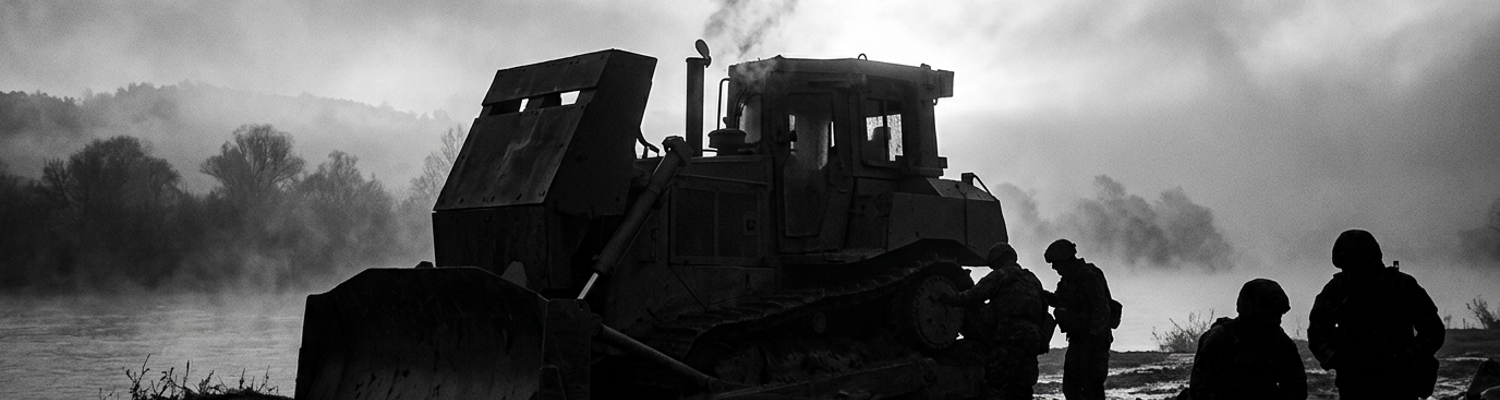
When examining the historical record across the Taepyong-ni and Kongju sectors, these field-expedient gun trucks functioned as dedicated armored assault platforms. They operated right along exposed gravel bars and riverbank dikes. Infantry from the North Korean 4th Division repeatedly slipped reconnaissance squads across shallow summer crossing points under morning fog. They established mortar pits and snipers within small-arms range of American obstacle belts. Caterpillar D7 bulldozers pushed defensive earthen revetments and buried anti-tank mines. They were retrofitted with rail-armored blades and enclosed boiler-plate driver cabs. They took sustained rifle fire that bounced harmlessly off the welded plating. Hostile squads probed the southern dikes. The armored CCKW gun trucks rolled up onto the exposed river levees. Dual fifties opened up on low water depressions. They raked North Korean crossing points with concentrated grazing fire. Gunners fired 2.36-inch high-explosive rockets into fortified tree lines across the Kum. On the afternoon of July 14, an armored D7 bulldozer and one CCKW gun platform eliminated an infiltrating seven-man patrol. The patrol was attempting to cross a sandy ford five hundred yards west of the secondary ferry slip.
Defensive Delay Along the Taipyong-ni Sector
Steel fragments sliced across the exposed sandbars at five-second intervals.
Archival evidence shows the North Korean 3rd Division directed heavy concentrations of 82mm and 120mm mortar fire onto the river crossings around Taipyong-ni early on the morning of July 15. Forward observers from the North Korean 7th and 8th Regiments occupied commanding heights north of the Kum. They used gridded Soviet firing tables to walk high-explosive barrages back and forth across every ford, gravel spit, and ferry slipway. Steel-cased 120mm mortar bombs detonated with high-pressure shock force. They blasted craters six feet deep into the riverbed aggregate. High-velocity casing shards whistled across the water. Water geysers showered the southern dikes with muddy sediment. Fragmentation rounds of 82mm detonated among defensive foxholes dug along the open levee slopes. Gun crews zeroed in on the primary road junction leading south toward Taejon. They dropped steady spreads of delayed-fuse rounds. These blew apart parked jeeps and sheared tree trunks into splinters. Muddy water boiled with churning shrapnel.
Repeated blast shock waves tore straight through the central bridge framework.
A close review of operational logs indicates continuous shrapnel and blast shock waves repeatedly compromised pre-laid demolition cables strung across the bridge superstructure. Work crews from Company B, 3rd Engineer Combat Battalion rigged dual firing systems across the wooden spans and concrete trestles. They utilized heavy rubber-coated demolition leads wired to electric blasting caps and twenty-pound satchel charges. Concave blast waves from near-miss 120mm mortar detonations repeatedly snapped insulated copper wires clean off their anchoring staples. Live leads whipped across the iron framework. Hot shrapnel punctured external charge wrappers. It severed secondary Primacord branch lines. Main stringers were left without continuous circuit continuity. Circuit testing with an M1 galvanometer consistently revealed open circuits and infinite resistance across the firing lines. Combat engineers crawled across exposed steel stringers under direct mortar fire. They spliced ragged cable ends with crimping pliers and black friction tape. Every detonation risked unseating the sensitive electrical caps packed into the primary plastic explosive blocks.
Retreating infantrymen abandoned their crew-served weapons in the river mud.
When examining the historical record of July 16, engineers from the 3rd Engineer Combat Battalion held defensive perimeters. They maintained extraction corridors for retreating elements of the 19th Infantry Regiment. Infiltrating infantry from the North Korean 3rd Division encircled the 19th Infantry forward command post. They cut the primary supply route to the south with machine gun roadblocks. Combat engineers laid aside their picks and demolition reels. They deployed across the southern levee shoulders and irrigation ditches with M1 Garand rifles and tripod-mounted M1919A4 machine guns. Platoon leaders formed an ad-hoc perimeter across the main roadway cut. They laid down continuous grazing fire into dry paddy fields. This suppressed advancing enemy riflemen attempting to envelop the withdrawal route. Company B held this narrow escape corridor open for hours. Dazed, wounded stragglers from the 1st and 2nd Battalions dragged themselves south from the burning riverbank. Engineer squads repeatedly drove off North Korean probes with point-blank carbine volleys and hand grenades. They kept the road open until the final walking wounded reached the southern withdrawal assembly area at Choryong.
The rear-guard detachment evacuated the perimeter at 1530 hours.
Manual Fuse Ignition Under Direct Artillery Fire
Jagged fragmentation tore the firing circuit apart seconds before the plungers went down.
Archival evidence shows North Korean gun crews from the 3rd Division concentrated high-explosive 82mm and 120mm mortar barrages directly onto the Taipyong-ni bridge spans during the night of July 14 and the early morning hours of July 15, 1950. Combat engineers from Company B, 3rd Engineer Combat Battalion installed a standard two-circuit firing setup along the concrete pier caps. They linked eighty-pound satchel charges of Composition C-3 with twin runs of insulated rubber-jacketed WD-1 wire. Heavy steel fragments from incoming mortar rounds ripped through the timber roadway. They shredded the wire sheathing. They cut both the primary and redundant lines at half a dozen points across the northern trestle. The demolition officer depressed the handle on the ten-cap blasting machine. Zero current reached the bridge. An M1 galvanometer connected to the firing terminal showed infinite resistance. The jagged impacts of direct mortar strikes unseated two primary electric blasting caps. They scattered debris across the junction blocks. The entire remote electrical initiation system was rendered inoperative. Enemy spotters adjusted their fire onto the southern abutment.
The command post had no replacement wire.
A close review of operational logs indicates noncommissioned officers from Company B moved forward on their own initiative. They executed an emergency non-electric firing procedure. Soviet 76mm direct-fire shells struck the bridge parapets. Engineer sergeants dropped into the river mud. They scrambled across the exposed southern piers beneath clouds of dense cordite smoke and powdered stone. The men carried M2 fuse lighters and pocket knives. They slid on their bellies along the six-inch steel flanges of the lower stringers. They found the backup branches of M700 safety fuse battered by blast overpressure. Incoming shrapnel nicked the outer protective tar coatings. The sergeants sliced away the damaged lengths. They shortened the burning delay to truncated stubs measuring less than twelve inches. Noncommissioned officers worked under small-arms fire from the opposite bank. They used friction lighters and paper matches to ignite the exposed black powder cores. Sparks spat against the river dampness as the powder trains caught. The engineers had under thirty seconds to scramble backward off the concrete piers. They rolled into the drainage ditch along the southern approach.
Tank treads clattered against gravel on the northern highway.
When examining the historical record, the manual fuse burn reached the non-electric blasting caps just as North Korean T-34-85 tanks from the 105th Armored Division reached the northern bridge ramp. Eight hundred pounds of Composition C-3 detonated simultaneously across the primary load-bearing bents. The shock wave collapsed two full roadway spans fifty feet downward into the Kum River silt. Water and shattered concrete aggregate rose eighty feet into the air. The blast smothered the northern approach in grey silt. A jagged, sixty-foot chasm remained between the severed abutment and the flooded river channel. Soviet-built armor ground to a complete halt at the brink of the gap. They were unable to negotiate the mud banks without bridge-laying equipment. This structural barrier sealed the primary vehicular avenue into Taejon. It prevented North Korean mechanized spearheads from encircling the retreating elements of the 19th Infantry Regiment. Stragglers and rear-guard squads pulled back through secondary ridge lines along the Choryong corridor. They carried their wounded south toward the division staging area at 0630 hours.
Company B reported three men wounded during the withdrawal.