
Castle Bravo Yield and Subterranean Telemetry Vaults
At 06:45 on March 1, 1954. The shockwave struck the command ship USS Mount McKinley. The vessel held a position thirty miles south of the detonation site. Blast pressure blew bridge personnel across the external decking. It rattled internal bulkheads. Flash heat baked the forward paint directly off the steel hull.
The primary containment plan failed in four seconds.
Scientists had predicted a six-megaton yield for the experimental Shrimp thermonuclear device. The device sat on an artificial spit off Namu Island. Runaway fusion in the lithium-7 isotope ignited an unexpected fifteen-megaton blast. This detonation dug a crater two miles across. It obliterated three adjacent landmasses. Joint Task Force 7 operated under Major General Percy Clarkson and Navy Task Group 7.3 commanders. They recognized their diagnostic data sat directly in the kill zone.
JTF-7 scrambled specialized radiological recovery teams. These units moved into reinforced subterranean installations scattered throughout Bikini Atoll. Archival evidence shows these personnel organized under Task Unit 7.1.6. They faced a contaminated lagoon choked with pulverized radioactive coral debris. Scientists designated this material as calcium oxide snow. It blanketed the target islands under fields measuring dozens of roentgens per hour.
Transport helicopters hovered through airborne grit. They dropped recovery personnel onto scorched staging strips. Teams boarded tracked amphibious vehicles to reach buried reinforced-concrete stations. They had to arrive before storm-surge flooding drowned the low-lying access shafts.
Gamma fields climbed faster than the onboard dosimeters could register.
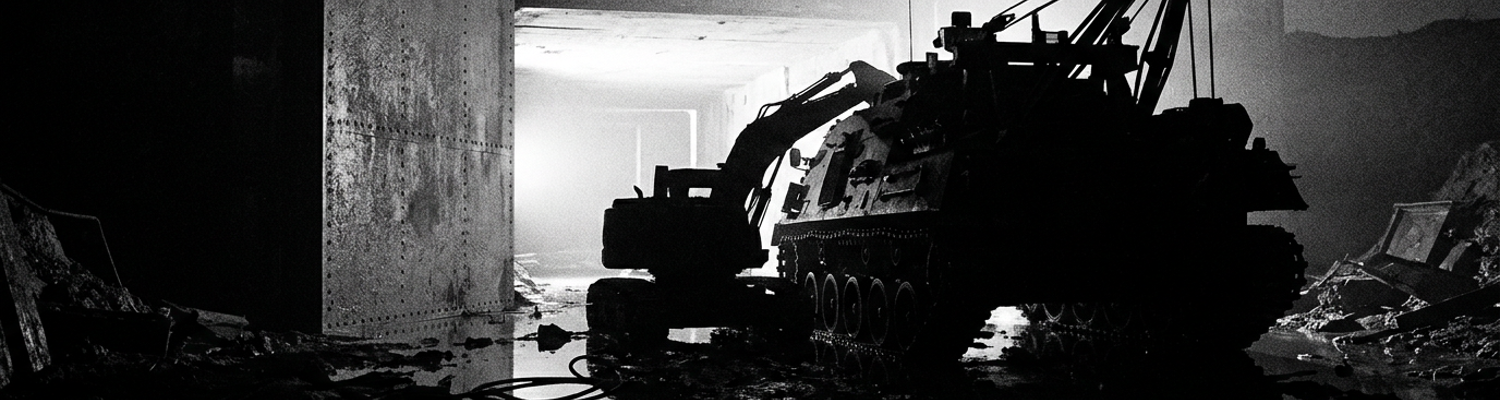
Inside the subterranean instrument galleries. Naval Photographic Center combat cameramen moved quickly. They salvaged physical diagnostic records. Heavy-shielded concrete bunkers housed rows of specialized Mitchell and Fastax high-speed cameras. These bunkers featured three-foot-thick walls and lead-lined steel blast doors. The optical units aligned with collimator ports. They had captured oscilloscope signals and microsecond reactions from the early nanosecond detonation phase. This data traveled through RG-8/U coaxial cable runs before the blast front obliterated the surface towers.
Heat transfer through the bulkheads pushed internal ambient temperatures past operational limits. Secondary gamma radiation seeped through fractured cable conduits and ventilation seals. Exposure to direct ionization threatened to fog the silver halide emulsion on the 35mm Kodak Linagraph Pan film reels. This would turn raw data into blank strips of black acetate.
Cameramen worked by hand-cranked emergency lanterns in total darkness. They wore heavy rubber protective suits. They unbolted optical housings. They severed mechanical drive shafts with bolt cutters. They loaded film magazines into lead-lined transport drums.
Every minute inside the bunker burned through a human radiation allowance.
Radiological Coral Silt and Mechanical System Failures
A close review of operational logs indicates radioactive grit infiltrated subterranean conduit entryways across Station 1341. Seawater pushed by forty-foot waves backed up into the cable runs. This water carried heavy fission fragments from the vaporized reef directly against the chamber bulkheads. Survey meters pegged at their upper scales. They registered field levels exceeding one hundred roentgens per hour inside the narrow accessways.
Naval commanders set hard recovery ceilings of fifteen minutes per run.
Extraction teams breached jammed pneumatic hatch covers using sledgehammers and carbon dioxide torches. Hydraulic lines failed completely. Personnel threw the lead-shielded canisters into awaiting amphibious crafts. They stripped off outer contaminated protective garments on windward beaches. They evacuated by utility boats before high-tide surges washed residual fallout over the island rim.
Medical staff on board the recovery carrier USS Bairoko washed the operators with detergent solutions. They impounded the saturated dosimeters for laboratory analysis.
Mechanical failures cascaded across the recovery grid. Brine and radioactive dust seized hatch bolts. Motorized camera shutters jammed. Lead-acid wet cell batteries inside sealed breathing systems shorted out rapidly. Pulverized coral dust acted as a severe abrasive. It worked its way into the sealed bearings of the extraction winches. The beryllium gears inside the Mitchell camera housings stripped under the friction.
The mechanical tolerances of the recovery equipment failed within twenty minutes of exposure.
Saltwater intrusion compromised the electrical seals on the primary communication lines. Recovery teams relied on hand signals. They used chalk boards to communicate exposure times. The environment degraded the rubber seals on the Scott Air-Pak II breathing apparatuses. Radioactive particulate matter bypassed the primary filters.
Technicians recorded the failure of twelve separate mechanical systems during the first hour of recovery operations.
The AN/PDR-39 radiac survey meters experienced frequent electrical shorts. The high humidity and airborne salt degraded the internal wiring. Operators had to manually dry the circuit boards using chemical desiccants. This process consumed valuable time inside the hot zone.
Tactical Extraction Procedures Inside Contaminated Galleries
Archival logs from Task Group 7.3 confirm recovery crews entered the subterranean complex at Station 1341 under an absolute sixty-second entry window.
Knee-deep brine inside the north cable trench read eighty roentgens per hour on initial approach. Recovery parties from Boat Unit 1 and the radiological safety division pushed through forty yards of submerged gallery piping. They held calibrated radiac survey meters at neck height. Technicians set the ionization chambers to their thousand-roentgen scale. Lower diagnostic settings would instantly overload the needle pickups.
Radiation safety officers used wax grease pencils. They scratched maximum survival durations directly onto the rubber forearms of the boarding teams.
Every movement followed strict exposure limits based on direct field readings. Six minutes at fifty roentgens. Ninety seconds if a pocket dosimeter spiked past one hundred. Suspended coral silt floated in the sloshing bilge. This turned the ambient water into a concentrated beta-gamma source. It bombarded the lead-aproned divers through their vulcanized dive boots.
Rad-safe monitors tracked the exposure clock with stopwatches. They shouted elapsed seconds over the throb of diesel exhaust pumps venting to the ruined reef above.
The air lines collapsed under twelve hundred pounds per square inch of blast pressure.
The primary pneumatic actuators on the eight-inch steel blast door of Vault 2 completely seized. High-pressure copper piping feeding the pneumatic rams cracked at the bulkhead penetrations. Ground shock shifted the entire concrete gallery four inches west on its coral footings. Overpressure drove pulverized limestone into the door tracks. This cemented the sliding seals within their steel slide-channels.
Clearance divers and field mechanics attacked the door frame. They used fifty-ton Blackhawk hydraulic hand pumps. They used wedge bars. They used sixteen-pound copper-beryllium sledgehammers. Saltwater spray coated the operators. They forced chisel points into the warped dog-latch seams.
Three technicians hung their combined body weight onto a six-foot cheater pipe. They slipped it over the manual override lever. The sheared internal drive pins finally snapped. The massive seal broke with an echoing mechanical crack. It dumped two hundred gallons of trapped radioactively saturated lagoon water straight across the inner vault deck.
Film emulsion melts at one hundred and twenty degrees Fahrenheit.
Inside Vault 2 temperatures hovered just below that threshold. Technicians lunged through the breached opening to reach the reinforced data-collection stations. Camera mountings stood bolted to heavy vibration-dampening floor rails. Specialized recovery crews uncoupled two-hundred-pound steel recording canisters. These contained high-speed diagnostic film. They removed them from the primary instrumentation chassis.
These cylindrical containers housed optical records of the detonation stage. They registered surface contamination rates exceeding one hundred and fifty roentgens per hour upon removal. Handlers hauled the canisters out of the flooded vault using hemp rope slings. They passed them hand-to-hand down the narrow corridor to waiting rubber transport rafts anchored at the flooded blast entry.
Decontamination began before the equipment touched the deck of an evacuation craft.
Recovery protocols mandated a three-stage radiological wash line established directly on the exposed tidal reef. Sailors wearing protective air-packs scrubbed each canister exterior with stiff wire brushes. They flushed the metal seams with high-pressure saltwater lines dosed with trisodium phosphate detergent. This first wash stripped away the coarse outer crust of radioactive coral mud. It cut exposure rates down to twenty-five roentgens per hour.
A secondary wash station assembled on a pontoon barge moored fifty yards offshore. It utilized concentrated citric acid solutions. This dissolved bonded fission products from around the canister O-rings and pressure-relief valves. Technicians checked every square inch of the metal housings using side-window Geiger probes. They approved the gear for transit.
Crews secured the sanitized canisters into thick lead transfer casks. They hoisted them aboard the fleet tug USS Lipan for emergency shipment to laboratory darkrooms on Enewetak.
Dosimeter logs recorded twenty-two roentgens of whole-body gamma exposure for the lead recovery diver.
State Department Disclosures Under Naval File 841.30
Classified tactical radiac data migrated into civilian diplomatic channels within seventy-two hours of detonation.
The east-northeast drift of the fallout cloud across two hundred miles of open ocean triggered an immediate paper trail in Washington. Joint Task Force 7 officers initially attempted to manage the radiation surge as an internal fleet matter. They logged whole-body doses up to ninety-eight roentgens among recovery teams entering contaminated bunker networks. Encrypted dispatches sent through naval radio circuits in Kwajalein bypassed standard military chains. They landed directly inside the State Department under file heading 841.30. This designation covered international naval movements and maritime defense incidents.
Cables cataloged how pulverized coral dust settled across eighteen Japanese crewmen aboard the Daigo Fukuryu Maru. This vessel was located eighty miles east of Bikini. The files simultaneously recorded fifty-roentgen exposures absorbed by Navy clearance divers during film recovery at Eneu Island.
Radiac survey sheets attached to file 841.30 exposed acute discrepancies between forecasted blast boundaries and real-world debris fields.
Foggy photographic emulsion plates recovered from subterranean bunkers arrived in Pearl Harbor. They arrived alongside urgent requests from the Far Eastern Affairs bureau for unredacted isotopic breakdown figures.
Dosimetry sheets transformed into foreign policy liabilities.
Archival evidence shows declassified correspondence from early March 1954. It exposed sharp divisions between operational naval commanders and embassy officials in Tokyo. Rear Admiral Frank Hall Brinkley and Atomic Energy Commission representatives urged total suppression of contamination maps. They argued releasing regional radiological data would expose weapons design yields. It would compromise fusion diagnostic methods. It would halt the remaining shots scheduled for Operation Castle.
Ambassador John M. Allison countered with cables addressed to Secretary of State John Foster Dulles. Allison asserted military secrecy was destroying bilateral relations with the Japanese government. Hospital clinics in Yaizu treated irradiated fishermen. Allison reported Japanese doctors lacked treatment protocols. The Navy refused to identify whether the primary fallout component consisted of strontium isotopes. They refused to confirm bichloride fission byproducts. They refused to confirm irradiated reef calcium.
Military staff insisted local exposure rates fell within tolerable wartime training thresholds. Diplomatic liaisons in Washington warned the White House. Withholding radiac surveys of contaminated tuna catches entering Pacific markets threatened to trigger international trade boycotts.
This inter-agency deadlock forced an abrupt overhaul of federal security guidelines governing oceanic weapons testing.
State Department legal officers demanded the Atomic Energy Commission strip operational classification from civilian hazard notices. This was required to avert future foreign ship incursions. On March 21 the National Security Council authorized the immediate expansion of the Bikini-Enewetak maritime danger zone. The zone expanded from fifty thousand square nautical miles to four hundred and forty thousand square nautical miles.
Federal authorities published fixed geographic coordinates through international Notices to Mariners. They stopped circulating them through classified fleet orders. They established permanent long-range aerial radiac tracking sweeps. They used converted WB-29 reconnaissance aircraft from Guam. They required military operators to file automated debris-cloud trajectories directly to civilian air and maritime authorities.
Declassification boards expedited the public release of basic radiological monitoring standards. Naval commanders had to accept external civilian oversight for all subsequent oceanic blast parameters.
Anglo-American Diplomatic Disputes and Pacific Exclusion Zones
London learned of the blast zone expansion from emergency maritime radio telexes. They did not learn it from allied diplomatic cables.
Whitehall officials immediately challenged the unilateral expansion of United States maritime exclusion zones around the Marshall Islands. On March 21. The United States Atomic Energy Commission expanded the designated danger area surrounding Bikini Atoll eightfold. They cordoned off over four hundred and forty thousand square nautical miles of open Pacific waters. They did this without prior North Atlantic Treaty consultation.
Legal advisors inside the Foreign Office notified Prime Minister Winston Churchill. Washington had established an unprecedented peacetime cordon across recognized international sealanes. This threatened the legal doctrine of open ocean navigation.
Senior British civil servants argued an unannounced closure of international waters set a hazardous precedent. Hostile maritime states could exploit this to choke Western merchant shipping in East Asia.
Diplomatic communiques drafted in Whitehall routed to the United States State Department. They pressed American counterparts on the precise statutory basis under international maritime law for intercepting foreign-flag vessels outside territorial seas. British officials stressed Commonwealth trading lines running between Sydney, Suva, and Hong Kong were suddenly subject to arbitrary interception by American radar pickets. Naval dispatch officers in London pointed to merchant itineraries diverted by several hundred nautical miles. They had to skirt the western perimeter of the Marshall archipelago.
High-seas sovereignty had been rewritten by administrative decree.
The British Admiralty initiated urgent bilateral negotiations over safe transit corridors and Royal Navy warship movements in the Pacific. First Sea Lord Sir Rhoderick McGrigor directed staff officers to engage directly with the Office of the Chief of Naval Operations in Washington. They engaged Admiral Robert Carney to resolve operational friction across the Far East Station.
British surface assets routinely crossed oceanic sectors now designated hot by Joint Task Force 7. These included frigates and fleet destroyers moving between Singapore, Australia, and regional training stations. Admiralty planners pushed for pre-cleared surveyed transit paths. This would allow British warships to maintain standard deployment schedules without submitting to American escort screening or ad-hoc radiological checks.
Naval liaisons met in subterranean Pentagon conference rooms to draft coordinating protocols. They hammered out exact geographical coordinates. They established designated communication frequencies. They set radiological clearance margins for British naval vessels.
Operational charts had to account for thermal fallout envelopes. They had to account for drifting surface contamination belts. These belts threatened Royal Navy condenser cooling intakes and seawater desalinization systems. American operational commanders had to share previously restricted weather tracking charts and fallout prediction models with British fleet planners.
Naval vessels required guaranteed passage through thousands of miles of ocean.
The strategic incident prompted formal updates to Anglo-American nuclear sharing protocols and joint test observation standards. British political leadership leveraged the administrative breakdown in the Pacific. They pressed President Dwight D. Eisenhower for direct amendments to the McMahon Act. This act had cut off technical cooperation between the two powers since 1946.
Washington recognized unilateral weapons testing in shared global commons risked fracturing bilateral defense agreements across the Pacific basin. This created momentum for the passage of the Atomic Energy Act of 1954 later that summer.
Under updated technical exchange arrangements both nations drafted formalized bilateral observer agreements. These covered all subsequent oceanic test series. They established permanent berths for British military scientists and senior naval observers on board American command vessels.
Joint technical task groups established shared threshold numbers for radiac exposure. They standardized air-sampling equipment across American and British naval craft. They introduced mandatory multi-week advance notice for any expansion of high-seas danger areas.
American authorities agreed to transfer technical blast-telemetry guidelines directly to British design teams. These teams were working on Operation Mosaic and Operation Grapple. This aligned both nations oceanic radiac monitoring protocols through shared administrative procedures. The Joint Chiefs of Staff and the British Chiefs of Staff Committee managed these procedures directly.
Bilateral monitoring teams arrived at Pearl Harbor under updated security credentials three months later.