
Clandestine Engineering and ABC 1 Staff Agreements
Couriers sprinted through the corridors of the Navy Department with sealed pouches, delivering an urgent seventy two hour deadline that forced an advance logistics unit to crate delicate survey equipment and pack civilian work clothes without delay. Draftspeople, quartermasters, and naval engineers shoved heavy measuring transits, timber stakes, and rolls of drafting paper into unmarked wooden crates while supply clerks hastily sorted plain wool suits and raincoats. This physical rush answered mandates drawn from the secret March 1941 American British Conversations, known as ABC 1, which established contingency planning for forward naval logistics in the United Kingdom prior to formal United States belligerency. Battle of the Atlantic shipping losses were mounting rapidly, and high command planners determined that American destroyers would soon need fully equipped repair bases and fuel stations across the ocean to protect merchant convoys. Because international law and domestic political neutrality barred armed American military personnel from active war zones, technicians scraped official naval stencils off equipment crates, discarded brass uniform buttons, and packed passports listing them as civilian construction advisors.
Passports stamped with civilian credentials allowed the United States Navy Bureau of Yards and Docks to initiate site surveys and planning for forward operating bases in Northern Ireland and Scotland under diplomatic cover. Bureau civil engineers joined forces with civilian architectural specialists from the George A. Fuller Company and the Merritt Chapman and Scott Corporation to inspect overseas anchorages without alerting hostile intelligence networks. These undercover specialists crossed the ocean aboard commercial cargo vessels and flying boats, carrying clearance papers that identified them as technical consultants inspecting commercial maritime facilities. Their physical assessments focused on the River Foyle near Londonderry in Northern Ireland, along with deep Scottish anchorages at Rosneath and Loch Ryan, to see if raw shorelines could handle heavy fuel tank farms, floating repair docks, and supply warehouses. Field teams immediately stepped into freezing winds to drive iron sounding rods and boring augers into coastal soil, charting bedrock depths with thick grease pencils across waterproof canvas maps.
Canvas maps grew smeared and wet as the survey parties trudged across the sodden pastures and peat bogs flanking Lough Foyle in Northern Ireland. The engineers discovered that the saturated Ulster earth lacked solid foundation support near the water, meaning heavy boiler shops and brick barracks would quickly sink into the mud without thousands of timber support piles driven into the underlying clay. Fierce coastal squalls whipped horizontal sleet into their faces as they dragged steel measuring cables between rowboats to check channel clearance, proving that the winding river required massive mechanical dredging before American destroyers and corvettes could reach prospective docks. Surveyors also examined the regional electrical grid and local water supply, finding that existing utilities could not provide the millions of gallons of fresh water or the steady electric wattage required to overhaul combat vessels. Technicians recorded every shortfall in leather bound field notebooks, sketching designs for self contained diesel powerhouses, water filtration tanks, and timber jetties connected to local supply roads.
Roads winding toward the designated base sites at Lisahally, Springtown, and Pennyburn proved too narrow and fragile to support thirty ton supply trucks and tracked cranes. The survey crews corrected their construction blueprints directly on drawing boards in their temporary hotel rooms, designing wide macadam bypasses and thick concrete slab foundations to distribute structural weight across the spongy ground. Senior engineers gathered these detailed architectural drawings and logistical requirement lists into diplomatic pouches for immediate courier flight back to naval bureaus in the United States. Procurement teams in Washington and New York used these ground surveys to place commercial factory orders for Quonset huts, bulldozers, water pipes, electrical transformers, and thousands of structural steel beams. Stevedores at eastern American supply docks began loading these initial building materials into cargo holds, launching the supply chain that would convert Northern Ireland into the primary support hub known as Base One Europe.
Civilian Contractor Cover Along Lough Foyle
Freighters hauled these crated materials across submarine patrolled sea lanes to the commercial quaysides of Belfast and Derry. Contract personnel from American architectural and engineering firms navigated strict customs inspections while covertly shipping heavy earthmoving machinery into Belfast and Derry. Civilian expediters from the George A. Fuller Company and the Merritt Chapman and Scott Corporation managed the port clearance, presenting commercial bills of lading and industrial import permits to local port officers to avoid revealing military construction goals. Customs examiners boarded the freighters to inspect cargo manifests, checking crates labeled as commercial agricultural implements and general engineering gear against strict wartime import declarations. Crane operators swung heavy wire slings into the ship holds, lifting twenty ton diesel bulldozers, tracked draglines, and power trenchers onto the damp granite piers without any standard naval markings. Riggers secured the tractors and trenchers onto flatbed railcars for immediate dispatch west through Northern Ireland.
Railcars rolled across County Londonderry, hauling the newly arrived earthmoving machinery directly into the sodden pastures of Lisahally along the River Foyle. Civilian construction contractors operated in non military attire to erect deep water jetties, repair facilities, and fuel depots at Lisahally along the River Foyle. These American tradesmen and local Irish laborers wore tweed caps, wool mackinaws, and rubber work boots to blend into the commercial landscape while running heavy mechanical plant day and night. Catastrophic autumn downpours quickly turned the green meadows into deep bogs, trapping steel bulldozer tracks in knee deep mud and threatening to halt the schedule. Maintenance crews improvised by laying heavy timber mats and discarded railway ties across the saturated topsoil, creating temporary corduroy roads so earthmovers could clear level ground for workshops without bogging down. Survey crews pounded wooden alignment stakes into the riverbanks to chart the outer boundaries for a series of massive deep water jetties.
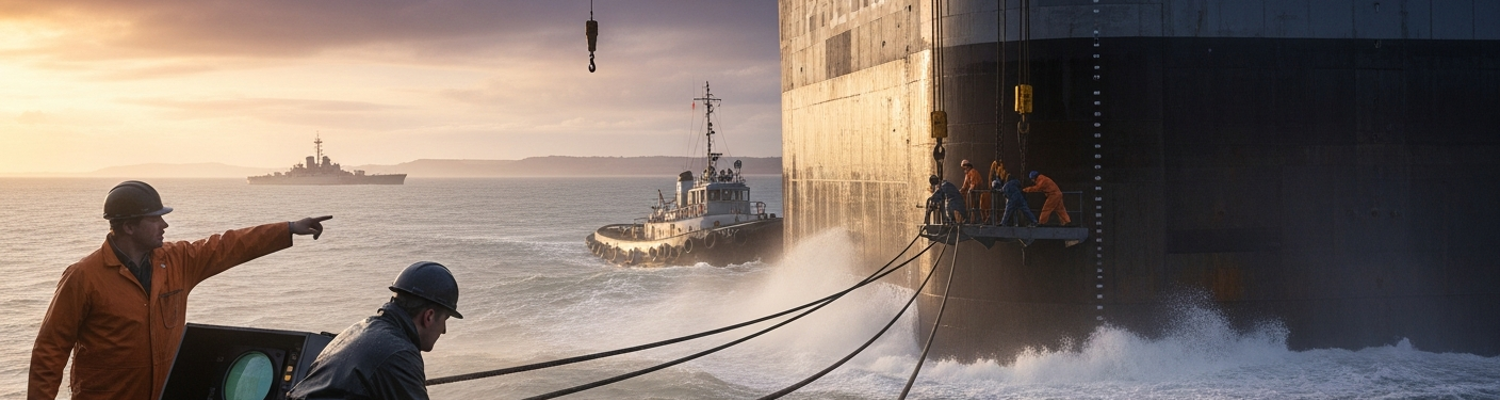
Cranes swung heavy steam hammers over hundred foot timber piles, driving them deep into the riverbed to anchor those planned deep water jetties against the tidal currents of the River Foyle. Riggers aligned heavy timber cross beams over the pilings, bolting thick structural girders together under constant freezing rain to support heavy escort destroyers and fleet tenders. Construction gangs raised machine shops and ordnance repair facilities on the stabilized ground directly behind the waterfront, assembling prefabricated Quonset huts and steel sheds over thick concrete floors. Mechanics inside these shops installed heavy lathes, battery charging racks, and motor overhaul benches to handle damaged convoy escorts coming in from the North Atlantic. Electricians strung heavy insulated cables through the workshops, hooking industrial tools to isolated diesel generators rather than overloading the fragile regional power grid. Pipefitters bolted high capacity discharge pipes along the finished jetty pilings, routing the lines toward excavation pits dug into the nearby slopes.
Bulldozers gouged deep revetments out of the Lisahally hillsides to bury massive fuel depots beneath thick layers of clay and peat. Tank building crews assembled circular steel storage tanks inside these sunken earthen bowls, riveting thick boilerplates together to contain millions of gallons of naval bunker fuel. Ground crews backfilled the excavation pits and rolled fresh strips of green turf across the tank tops, hiding the fuel storage tanks from German reconnaissance aircraft patrolling the Irish coast. Mechanics connected the subterranean tanks to the deep water jetties through underground steel pipes and diesel pumping units capable of delivering thousands of barrels of fuel oil an hour. Inspection teams ran pressurization tests through every foot of fuel line, using handheld grease gauges to detect small pinhole leaks before live bunker oil entered the system. Technicians tightened flange bolts with heavy iron wrenches and stamped inspection approvals into maintenance logs to certify the fuel farm ready for sea operations.
Operation Magnet and Task Force Four Logistics
Task Force Four transports arrived in Northern Irish waters in January 1942 under Operation Magnet to begin drawing bunker oil from the newly certified fuel farm, marking the formal military handover from civilian workers to United States Navy personnel and ground units. Civilian specialists from the George A. Fuller Company and the Merritt Chapman and Scott Corporation surrendered equipment manifests, master keys, and drafting tables to incoming naval officers inside the newly completed administrative huts at Londonderry. Uniformed bluejackets and soldiers shouldered heavy sea bags down slippery gangways, immediately relieving private contractors at sentry gates, power plants, and waterfront workshops. Navy quartermasters established command posts across Derry, Lisahally, and Belfast to log incoming military freight and assign billeting for thousands of arriving troops. Supply officers organized round the clock discharge rosters along the regional waterfronts, instructing cargo vessels to anchor in designated roadsteads and begin hoisting thousands of tons of crated ammunition, marine boilers, and dry provisions onto the granite quays.
Freighters rolled violently against the stone piers as severe North Atlantic winter gales delayed cargo discharge and exposed severe logistical bottlenecks across Northern Irish transport networks. Mooring cables groaned under massive tension, and harbor masters repeatedly suspended winch operations to prevent cargo nets loaded with artillery shells and replacement boiler parts from smashing against ship hulls in fifty knot wind gusts. Waterfront quays quickly became choked with dense piles of waterlogged wooden crates because regional railway systems lacked the rolling stock and uniform track gauges needed to clear the docks. Rail cargo heading toward Derry faced immediate blockages where standard Irish broad gauge tracks met local narrow gauge lines, leaving heavy machinery stranded on open platforms without overhead cranes to transfer the loads. Highway routes offered little relief, as convoys of six wheel drive military trucks crushed the fragile macadam surfacing of inland country roads, churning damp rural lanes into impassable trenches of peat and mud. Convoy commanders halted their transport columns when ten ton supply haulers sank to their axles along the Glenshane Pass, forcing naval logistics officers to reroute vital machinery toward regional rail junctions.
Rail crews assembled at these congested junctions under freezing sleet, using improvised timber ramps and heavy block and tackle rigs to muscle crated diesel engines across incompatible tracks by hand. Navy construction details dumped truckloads of crushed basalt stone into sunken road ruts between the railheads and Base One Europe, packing the rock down with steamrollers to keep emergency supply corridors open. Logistics planners set up dispersal yards across pastureland near Springtown and Pennyburn, spreading heavy canvas tarpaulins over uncrated machine tools to protect polished iron components from pervasive dampness. Electricians strung auxiliary power lines from newly installed diesel generators into these damp staging fields to run industrial hot air blowers through damp sensitive radar and radio crates. Riggers hammered together temporary timber sheds along the Lisahally rail siding, stacking delicate depth charge pistols, sonar transducers, and replacement vacuum tubes inside dry wooden bins away from the driving sleet.
Navy repair technicians worked inside these sheltered bins around the clock to recalibrate damaged instruments and ready overhaul kits for transatlantic escort vessels berthed along the River Foyle. Escort destroyers, corvettes, and coast guard cutters battered by mid ocean torpedo battles and heavy seas warped into the Lisahally jetties with cracked hull plates, salt contaminated feedwater lines, and shattered deck fittings. Machinist mates and shipfitters scrambled over the damaged hulls with pneumatic riveters and oxyacetylene torches, replacing warped armor plate and rebuilding auxiliary bilge pumps directly at the waterside. Fueling details connected thick rubber delivery hoses from the underground storage farm to the warships, pumping thousands of gallons of pre heated bunker oil into empty fuel tanks within hours of docking. Ordnance crews hoisted fresh depth charge patterns onto the stern roller racks, allowing ship captains to sign release certificates and test their steering engines at the Lisahally turn basin. Tugs pulled the lead overhauled destroyer into the main river channel, where its bridge crew rang down full ahead on the engine telegraph and steered north past Lough Foyle toward the open Western Approaches.
Peat Bog Foundations and Power Grid Incompatibility
Exhaust plumes from the departing warship drifted over the river while civil engineers turned back to address severe structural subsidence across the maintenance yards at Pennyburn and Springtown. Saturated Ulster peat bogs beneath the workshops lacked the physical bearing capacity to support thirty ton drill presses, metal shaping lathes, and expansive Nissen hut complexes. Water seeped upward through standard gravel footings under the incessant winter downpours, tilting structural building frames and throwing delicate machine tool drive shafts out of true operational alignment. Engineers stabilized saturated Ulster peat bogs using improvised timber pilings and concrete floating rafts to support heavy workshop machinery and Nissen hut complexes. Construction crews drove stout tree trunks deep through the soft organic moss down to harder subterranean clay before pouring monolithic steel reinforced slabs that distributed massive localized equipment loads across a broad surface area. Continuous pours from diesel concrete mixers created solid, level floors where machinists could safely bolt down precision lathes and heavy grinding tables without the iron foundations sinking into the waterlogged ground.
Lathe motors bolted onto these cured concrete slabs immediately presented a severe technical obstacle when base electricians tried to tap into the regional municipal supply lines. Utility substations around Londonderry supplied alternating current at fifty cycles per second, whereas American shipboard machinery, diagnostic equipment, and shop tools required standard American sixty cycle power. Direct electrical connections caused American electric motors to run sluggishly, overheat within minutes, and burn out internal copper windings due to excessive magnetic core saturation. Technicians installed specialized rotary converters and transformers to reconcile American sixty cycle naval electrical systems with the local British fifty cycle power grid. Heavy motor generator sets hummed continuously inside newly erected brick power stations, absorbing raw fifty cycle current from British utility feeds to spin central shafts that drove sixty cycle alternators. Step down transformers lined the exterior substation yards, dropping regional distribution voltages to the exact levels needed to safely power sensitive naval communication gear, battery charging banks, and high amperage welding equipment across the entire repair yard.
Welding cables ran outward from these converter stations across the stabilized timber and concrete pads, feeding reliable energy into rows of repair bays that operated twenty four hours a day under blackout curtains. Escort destroyers docking along the Lisahally jetties plugged heavy umbilical shore lines directly into this converted power system, allowing engineering crews to shut down marine boilers for descaling while maintaining internal radar, radio, and lighting networks. Radar calibration specialists tested delicate microwave antennas inside Nissen huts that remained rigid and level on their floating concrete rafts despite fierce horizontal winds blowing off Lough Foyle. High output electric blowers powered by the converted electrical grid pumped dry heated air through damp hull compartments, driving out pervasive Irish moisture from delicate sonar transducers and depth charge firing mechanisms. Base workshops maintained steady overhaul cycles without electrical dropouts or foundation shifts, keeping emergency dry docking and repair berths running at peak operational capacity for incoming transatlantic convoys. Riggers wheeled a freshly rewound electric bilge pump motor across the concrete apron to a waiting corvette, bolting the unit onto its engine mountings so the ship could build steam for its next ocean sweep.
Irish Neutrality and Border Intelligence Complexities
Boiler steam hissed through the corvette's freshly mounted pump as the vessel cast off lines to test its steering gear down the River Foyle. Waterway navigation along this lower tidal channel brought outbound warships within direct sight of County Donegal, placing transatlantic convoy operations right against the northern rim of a non belligerent state. Proximity to the border of neutral Ireland created ongoing counterintelligence concerns regarding German observation and potential internments of stranded Allied service members. German diplomats and intelligence officers operating out of the legation in Dublin monitored shipping movements, railway schedules, and troop traffic by gathering reports from informants living along the Donegal coast. Sentry posts and civilian coast watchers situated along the Inishowen peninsula held clear views of every destroyer, tanker, and merchantman entering Lough Foyle, turning routine sea passages into potential sources of tactical leaks to Berlin.
Berlin intelligence networks actively sought information on Allied aircraft movements, forcing aircrews flying coastal anti submarine sweeps out of nearby Lough Erne and Limavady to confront immediate capture whenever mechanical failures or dense fog forced emergency landings across the border. Sentries from the Irish Army routinely impounded stray Allied aircraft and marched surviving flight crews into the Curragh internment camp in County Kildare to preserve the country's strict non belligerent status. Intelligence officers at Base One Europe maintained clandestine evacuation networks with sympathetic local officials to retrieve uninjured flyers before Dublin authorities could catalog their presence. Civilian clothing and forged identity papers were rushed to rural border farms so downed personnel could slip across rural stone fences back into Northern Ireland under cover of darkness. Rescue parties loaded these recovered crews into unmarked utility vans, driving them through rainstorms back to Londonderry billets without alerting local border customs inspectors.
Vans hauling naval munitions and replacement machinery faced similar operational hazards along regional highways that dipped repeatedly across the winding international boundary. Naval logistics officers maintained discrete transit corridors while navigating localized telecommunications and blackout restrictions near the border. Drivers operated under absolute night blackout orders, masking their headlamps with slotted steel plates that cast only faint slits of light onto wet asphalt to prevent German reconnaissance planes from spotting supply columns. Headlamp restrictions turned routine thirty mile trips into exhausting tests of nerve, as heavy six wheel haulers crawled along unlit rural lanes bordered by deep drainage ditches and peat bogs. Military police stationed at remote crossroads used shaded red lanterns to flag down lost trucks, physically redirecting drivers away from unfenced border lanes that led directly into neutral territory.
Telephone communications between these remote checkpoints and the naval command center at Pennyburn posed another severe security challenge. Civilian phone lines traversing border counties were openly vulnerable to eavesdropping, while international telegraph cables passing through neutral switchboards were barred from transmitting encrypted Allied naval traffic. Signal corpsmen bypassed regional commercial telephone exchanges by laying heavily armored landlines directly along railway embankments and burying signal cables deep beneath base drainage ditches. Motorcycle dispatch couriers carried the most sensitive logistical manifests and convoy escort orders by hand, traveling between Lisahally and outlying radar outposts in waterproof oilskin bags. Quartermasters locked these physical courier manifests into steel dispatch safes each morning, verifying that escort replenishment timetables remained completely concealed from observation across the border.
Mid Ocean Escort Force Maintenance at Londonderry
Steel safe doors clicked shut across the Pennyburn administrative office, sealing the incoming vessel timetables before duty officers issued daily berthing orders. Commissioned on February 5, 1942, Londonderry served as the premier terminal repair facility and radio communications hub for the Mid Ocean Escort Force. Antenna towers at the Clooney Park and Rossdowney transmitter stations broadcast enciphered orders to Allied escort commanders across the North Atlantic, directing British, Canadian, and American warships toward designated moorings along the River Foyle. Radio operators inside concrete bunker facilities monitored emergency distress channels twenty four hours a day, logging submarine contacts and guiding scattered convoys through dangerous sea corridors. Harbor pilots met incoming destroyers and corvettes at the mouth of Lough Foyle, steering the vessels past navigational hazards into the deep water moorings at Lisahally. Deckhands caught thrown heaving lines and secured heavy manila hawsers to waterfront bollards, tying off battered warships that had just survived weeks of relentless Atlantic storms.
Machinists boarded these storm damaged vessels within minutes of docking to assess topside wreckage and hull distortion. Base repair units overhauled radar units, depth charge racks, and damaged hulls for allied corvettes and destroyers contesting the Mid Atlantic Gap. Radar technicians unbolted salt caked antenna housings from mast platforms, carrying delicate magnetrons and display scopes into temperature controlled workshops at Pennyburn to repair internal wiring ruined by ocean spray. Shipfitters heated bent steel runners on the stern depth charge tracks with oxyacetylene torches, hammering warped rails back into true alignment so explosive canisters would release cleanly under combat conditions. Welders descended into flooded bilge compartments to replace sheared rivets and cut away buckled shell plating torn open by near miss torpedo detonations or collision damage in heavy seas. Pneumatic crews drove rows of red hot steel rivets through fresh patch plates, sealing outer seams before shipboard engineers began hull air pressure tests.
Engineers initiated dockside pressure tests as soon as rivet heads cooled, pumping compressed air into repaired compartments to verify that hull seams held tight. Machinists inside the Pennyburn mechanical shops manufactured custom bronze bushings and steam valves on heavy lathes, fabricating replacement parts on site when transatlantic supply ships failed to deliver needed spares. Boiler details drained contaminated feed water tanks and scraped hard calcium encrustations off boiler tubes, removing thick mineral deposits that caused steam pipes to rupture under flank speed. Electricians rewired waterlogged generator panels and rewound electric bilge motors inside the Nissen hut repair complex, using sixty cycle rotary converters to test each motor under full operating loads. Riggers hoisted overhauled pumps and auxiliary machinery back into engine rooms using portable gantries, bolting assemblies onto engine beds before connecting high pressure steam lines.
Steam hissed through the newly connected lines as firemen lit off main boilers to conduct dock trials along the Lisahally waterfront. Fueling crews coupled thick four inch rubber hoses to hull intake manifolds, pumping thousands of barrels of pre heated bunker fuel from the underground tank farm into empty fuel bunkers. Ordnance crews loaded fresh depth charge patterns onto the overhauled stern tracks and winched crated ammunition into forward shell lockers, readying each warship for combat in the Mid Atlantic Gap. Quartermasters handed signed readiness manifests to ship captains, verifying that every hull patch, radio circuit, and auxiliary pump met naval operational standards. Harbor tugs pulled the refitted destroyers and corvettes away from the Lisahally quays, turning their bows downstream toward Lough Foyle to escort outbound convoys across the North Atlantic.