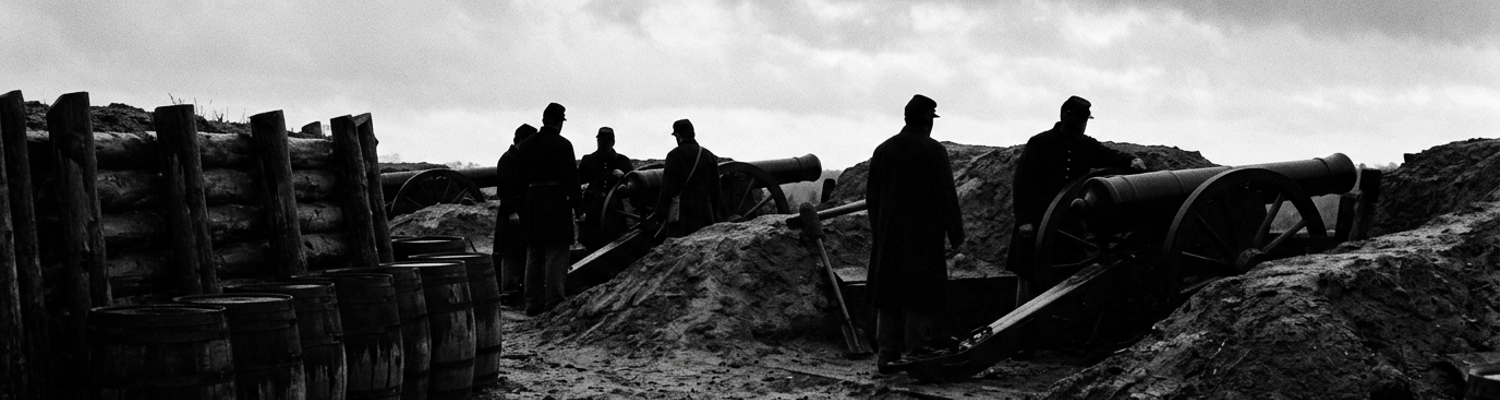

Post-Surrender Munitions Audits in the Powder Magazine
Dispatch riders carrying Brigadier General William Hull's final couriers south toward the Maumee River had their routes cut by Wyandot skirmishers. This severed the last operational courier line to Washington. The Fourth U.S. Infantry was stranded behind closed palisades. Archival evidence shows that by two o'clock on the afternoon of August 16, 1812, American quartermasters were forced down into Fort Detroit's underground masonry powder magazine. They tallied stores that had never seen combat. Below three feet of mortared stone and packed earth, lantern light fell across stacks of untouched white-pine powder kegs. Dry flannel powder bags and unopened ammunition crates filled the space. Ordnance officers worked in thick silence. They listened to the muffled reverberations of British boots marching on the surface ramparts above. Over thirty-eight barrels of black powder sat intact against the damp northern masonry wall. Thousands of paper cartridges prepared for standard-issue .69-caliber Springfield muskets accompanied them. Hull had raised a white bedsheet over the southwest bastion before these subterranean reserves had even been unsealed. Major General Isaac Brock demanded an unreserved inventory of every intact weapon system inside the fort. This transformed the underground bunker into an accounting room while the garrison above stacked their arms under guard.
The subterranean walls amplified the sudden deadening quiet.
Rattling through the magazine's heavy cedar ceiling joists came the drag of British iron across the outer gate timbers. Gun crews drawn from the 41st Regiment of Foot and sailors from the Provincial Marine dragged captured six-pounders and brass howitzers across the ditch bridge. Their iron-rimmed carriage wheels ground into the rough oak planking overhead. A close review of operational logs indicates that the British artillery detachments had already begun cataloging the thirty-three field pieces mounted along Detroit's earthen curtain walls. Captain Matthew Dixon of the Royal Engineers oversaw this process. Nine heavy 24-pounder iron guns sat on the platforms without physical damage to their traversing beds or trunnions. They were fully supplied with solid shot. Beside every gun carriage along the south batteries, canisters and powder horns sat completely undisturbed. Wood timbers groaned under the weight of limbers and caissons entering through the sally port.
Surrender arrived before the artillery fired a single coordinated canister volley.
Subterranean ledger pages from that afternoon detail an unbroken stockpile of infantry ordnance. Ink lines entered on damp foolscap paper (inventory folio 4A) recorded twenty-five hundred stand of arms. Model 1795 muskets and contract rifles were stacked alongside nearly one hundred thousand rounds of prepared small-arms ammunition. Ohio volunteer officers under Lewis Cass and Duncan McArthur were miles away on detached service. Their entire supply depot was transferring to Upper Canada without an engagement on the glacis. Audit tallies verify four hundred rounds of 24-pounder round shot piled adjacent to the rampart ramps. Crates of grape shot and friction tubes had never been distributed to the gun captains. Listed beneath the artillery stores were forty-four hundred pounds of loose powder, eight brass mortars, and seven functional ammunition wagons. British officers signed the final receipts in the magazine's doorway. They noted the date, location, and the transfer of two thousand prisoners of war to the Crown forces.
War Department Operational Directives and Supply Timelines
The collapse of the garrison began months before the first artillery shell struck the parade ground. Archival evidence shows that War Department directives issued between January and June 1812 imposed an unviable operational timeline on the Army of the Northwest. Secretary of War William Eustis drafted invasion plans requiring a rapid advance from Dayton to Detroit. This route spanned two hundred miles of unbroken wilderness. The supply train consisted of heavy Conestoga wagons drawn by oxen. These draft animals required specific forage that did not exist in the Black Swamp region of northwestern Ohio.
Logistics dictated the pace of the entire campaign.
When examining the historical record, quartermaster returns from May 1812 show a severe deficit in entrenching tools and block-and-tackle systems necessary for road construction. Hull's column of two thousand regulars and militia spent weeks hacking a trace road through dense hardwood forests. Rain turned the swamp floor into a morass of standing water and deep mud. Wagons sank to their axles. Draft horses collapsed from foot rot and exhaustion. The daily march rate dropped to less than three miles per day. Eustis expected Hull to reach Detroit, cross the river, and capture Fort Malden before the British could reinforce their garrison. The mathematical certainty of moving heavy artillery through a swamp negated this strategy entirely.
Every mile required corduroy roads built from felled saplings.
A close review of operational logs indicates that the War Department failed to establish forward supply depots along the route. Hull's quartermasters were forced to carry all provisions from their starting point in Ohio. Salted pork and flour barrels consumed the majority of the wagon capacity. This left inadequate space for reserve ammunition or medical stores. By the time the column reached the Maumee River rapids in late June, the men were exhausted and the supply train was severely depleted. The operational timetable dictated by Washington had completely disintegrated (Record Group 107). The army was isolated at the end of a fragile supply line.
Reconnaissance Blindness and the Cuyahoga Packet Loss
Archival evidence shows that the intelligence collapse blinding the Army of the Northwest originated inside the War Office in Washington on June 18, 1812. Congress passed the formal declaration of war that afternoon. Secretary of War William Eustis refused to authorize special relay couriers to warn frontier commanders exposed along the Canadian border. Eustis committed the official war dispatch to the standard civilian postal route through Ohio. The envelope crawled across mud tracks inside leather saddlebags at ordinary commercial transit speeds. Private letters dispatched by British mercantile contacts in New York and Montreal moved along prearranged commercial express lines. These letters reached Upper Canada days ahead of the United States government postal carriers. Lieutenant Colonel Thomas St. George commanded the British garrison at Fort Malden. He possessed verified operational reports confirming open war as early as June 30. Brigadier General William Hull received zero direct dispatches from Washington for two weeks following the declaration.
Ordinary post riders moved at thirty miles a day.
When examining the historical record at the rapids of the Maumee River on June 29, Hull made an administrative decision that unraveled his perimeter security. Facing swollen waterways and draught horses collapsing from foot rot, the general chartered the sixty-ton commercial schooner Cuyahoga Packet. Captain Luther Chapin took aboard thirty disabled infantrymen. Deckhands loaded the medical department supply crates and the private baggage of field officers from the 4th U.S. Infantry. Hull placed two wooden campaign chests into Chapin's cabin. These chests contained complete departmental blueprints, personal letters, and detailed muster rolls recording exact troop numbers. Instructions from Eustis specifying the strategic invasion route into Upper Canada were also packed inside. Chapin weighed anchor on July 1. He slipped down the Maumee into Lake Erie with orders to sail north into the Detroit River channel.
The schooner sailed straight into British cannon batteries.
A close review of operational logs indicates that Canadian lookouts at Amherstburg tracked the Cuyahoga Packet the moment its sails cleared Bois Blanc Island on July 2. Lieutenant Frederic Rolette of the Provincial Marine manned a barge with six armed sailors from the brig General Hunter. Rolette rowed directly across the channel and boarded the civilian vessel without meeting musket fire. Chapin learned of the war declaration only when British cutlasses appeared at his vessel's quarterdeck rail. British prize crews immediately hauled the vessel to the Amherstburg wharves. St. George unsealed Hull's captured chests and laid out the complete American order of battle across his desk. Every soldier's name and every planned river crossing was cataloged into British defensive maps before Hull reached Springwells.
Rolette delivered the captured medical chests and American tactical diagrams to Isaac Brock forty-eight hours later.
Structural Deficiencies of Frontier Masonry Bombproofs
Archival evidence shows that Fort Detroit's subterranean masonry architecture had been built to deflect low-trajectory cannonades. It was not engineered to withstand high-angle vertical plunging fire. Captain Richard Lernoult laid out the original footprint in 1779. The fort's main powder magazine sat barely four feet below the surface of the parade ground. It was contained within a single tier of uncoursed limestone rubble bonded by deteriorating lime mortar. Standard military engineering treatises of the era demanded at least nine to twelve feet of packed soil atop a double-ring brick arch to absorb plunging mortar shot. Detroit possessed neither. Royal Artillery gunners across the river at Sandwich elevated their ordnance on August 15. The kinetic trajectory converted the fort's subterranean spaces into enclosed impact zones. Below ground, fieldstone cellar vaults built for grain storage and salted pork were hastily designated as emergency bunkers. These auxiliary root cellars offered less than thirty inches of compacted clay above unmortared fieldstone retaining walls. Plunging solid shot and fused iron spheres arcing over the fifteen-foot exterior palisade struck the parade ground at steep impact angles. Ground shockwaves drove straight down through the fragile masonry foundations.
The stone fractured under the first sustained battery volley.
A close review of operational logs indicates that the fort's auxiliary subterranean excavations suffered complete structural failure. Concussive loads generated by Royal Artillery 24-pounder shells compromised the integrity of the walls. American engineers had improvised covered ditches and subterranean shelters by bridging dirt trenches with unseasoned white cedar logs and discarded oak floorboards. Work crews threw eighteen inches of loose dirt over these makeshift stringers. They failed to install vertical support struts, center purlins, or iron anchor strapping. British 24-pounder heavy shells detonated along the interior courtyard. The downward air-burst overpressure and ground shocks sheared the green timber caps at the shoulder joints. Splintered cedar beams collapsed directly inward. Tons of dry earth, shattered planks, and fractured stone ballast buried the infantry reserves. One incoming 24-pounder projectile punched directly through the roof of an adjacent timber-and-dirt officers shelter on the morning of August 16. The impact instantly killed Lieutenant Porter Hanks, Second Lieutenant Kenneth Carver, and two enlisted men before bouncing into an adjacent room.
No defensive trench could withstand twenty-four pounds of hurtling iron.
When examining the historical record left by post-surrender engineering surveys, British sappers found the interior retaining walls of the secondary powder vaults displaced several inches outward along their mortar joints. Vibrations from repeated surface detonations had shaken the bonding sand out of the perimeter stone courses. Dry-stacked river stones were left supporting the entire overhead earthen blanket. American quartermasters standing inside the magazine during the noon capitulation noted continuous showers of lime dust. Detached masonry chinking rained onto the cloth powder cartridges with every movement on the surface ramparts. Secondary root cellars along the north curtain wall showed horizontal shearing cracks running the entire length of their unreinforced stone faces. Ground shock from nearby cratering had pushed the lateral earth into the underground living spaces. The fort's underground architecture functioned as a static target rather than a functional bomb shelter. Hull's command staff had zero survivable subterranean positions capable of enduring another four hours of continuous British battery fire. British sapper detachments took possession of the magazine at three o'clock. They logged structural damage to the vault's central load-bearing arch where two twenty-four-pound solid iron balls had excavated craters four feet from the entry bulkhead.
British Sandwich Batteries and River Artillery Trajectories
Cross-river trajectories stripped away the earthworks in less than twenty-four hours.
Archival evidence shows that Major General Isaac Brock assigned Captain Matthew Dixon of the Royal Engineers to survey the eastern shoreline at Sandwich on August 14. Dixon selected a position directly opposite the American public wharf. The river width measured approximately eight hundred and fifty yards. British working parties threw up earthen revetments and timber traversing platforms under darkness behind civilian timber barns and Francois Baby's brick house. Lieutenant Felix Troughton of the Royal Artillery brought up five heavy siege pieces. The inventory included two iron 18-pounders, one 12-pounder, and two 5.5-inch mortars. Twenty-two gunners from the Royal Artillery and Provincial Marine sailors supported the battery. Sighting stakes were driven into the clay bluffs during the early hours of August 15. Canadian militia leveled the screening timber fence at four o'clock that afternoon. The batteries were already aligned with the southwest bastion of Fort Detroit. Gun crews primed their powder horns and hauled up shot without drawing an American counter-battery response.
The river channel measured eight hundred yards of open water.
A close review of operational logs indicates that Captain Dixon calculated firing elevations between eight and twelve degrees for the long guns. The 5.5-inch mortars were elevated at forty-five degrees to loft explosive ordnance over Detroit's exterior defenses. Captain Richard Lernoult's 1779 defensive footprint depended on a twelve-foot dry moat lined with sharpened cedar fraise and twenty-foot earthen parapets. These fortifications were engineered to defeat low-angle grazing fire from infantry assaults or wheeled field artillery approaching across the landward plain. Across the water, Dixon's batteries achieved a steep parabolic arc (elevation data recorded at 11 degrees). Plunging solid shot cleared the outward-facing crest of the American ramparts entirely. The iron descended across the reverse slopes and buried into the open communications trenches behind the banquettes. Fused mortar shells vaulted over the palisade palings to detonate ten to fifteen feet above the interior parade ground. Shrapnel sprayed downward into exposed infantry companies sheltering along the rear retaining bulkheads. The dry moats and exterior timber abatis provided zero protection against projectiles dropping vertically into the interior ditch networks.
Hull's parapets protected only against targets on the landward horizon.
When examining the historical record preserved in British ordnance survey diagrams, Troughton's gunners expended over one hundred and twenty rounds of spherical case shot and round shot between dawn and ten o'clock on August 16. Iron eighteen-pound cannonballs punched through the upper log course of the gatehouse. The impacts crushed interior wooden quarters and drove timber splinters through the field hospital partitions. American artillery officers under Lieutenant John Anderson attempted to bring two 24-pounders to bear from the south battery. The embrasures lacked sufficient traverse angles to hit Dixon's gun pits behind the Sandwich shore without dismounting the carriages from their pintles. Recoil mechanisms jammed as gun captains hauled on wet hemp side-tackles under falling shrapnel. British solid shot skipped off the hard-packed clay surface of the parade ground and struck the rear wall of the subterranean powder magazine entry passage. This severed communications between Hull's headquarters and the operational batteries on the river ramparts.
Subterranean Overcrowding and Command Paralysis Under Fire
Tallow candles flickered out along the cellar floorboards because the oxygen had run out.
Archival evidence shows that over two thousand combatants and civilians were shoehorned into less than three thousand square feet of subterranean trenches and unventilated root cellars. The British bombardment peaked on the morning of August 16. Companies of the 4th U.S. Infantry and detachments of the Michigan Territorial Militia under Colonel Elijah Brush occupied spaces designed exclusively for barrel storage. Approximately one hundred civilian women and children huddled alongside artificers and Ohio volunteer reserves. Ambient August temperatures climbed past one hundred degrees Fahrenheit inside these enclosed dirt vaults. Respiration became labored within thirty minutes of soldiers barring the heavy oak bulkhead doors against falling shrapnel. Men stripped off their wool tunics to wipe vomit and sweat from wounded soldiers lying directly on the damp clay subsoil. Sanitary tubs overflowed into the gravel drainage channels. Waste mixed with pulverized limestone dust that coated the lips and tongues of the huddled noncombatants. Officers trying to force their way down the entry ramps had to climb across packed ranks of civilian refugees. The civilians refused to move into the open parade ground. This created human bottlenecks that completely blocked ordnance parties from hauling cartridge boxes to the gun decks.
Panic below ground mirrored the physical destruction above.
A close review of operational logs indicates that the kinetic destruction of the fort's interior timber buildings rapidly converted shelter spaces into impact zones. Around nine in the morning, a British iron 24-pounder solid shot vaulted Captain Matthew Dixon's river battery. It cleared the southwest traverse and smashed directly through the cedar log ceiling of the officers mess. The heavy iron projectile decapitated Lieutenant Porter Hanks and instantly cut Lieutenant Kenneth Carver in half. The shot caromed across the plank flooring. It killed two privates and severed the leg of an orderly. Splinters measuring eighteen inches in length drove through the interior partition walls. Blood, pulverized bone, and wood debris showered down into the adjoining sunken entries where civilian families crouched in darkness. Screams from the wives and children of the garrison officers echoed through the subterranean vaults. This shattered what little composure remained among Brush's territorial militia. Men dropped their Model 1795 muskets to drag mutilated bodies from the doorway. They slipped on wet clay surfaces stained with gore. Every concussive blast shaking the cedar revetments convinced the sheltered crowds that British artillery had found the exact range of the magazine. Rumors spread that Native allied warriors were scaling the ditch abatis for a general slaughter.
The physical carnage inside the quarters destroyed the operational cohesion of the American command.
When examining the historical record of William Hull's personal conduct during the impact sequence, field reports detail a total collapse of executive functioning. The sixty-year-old brigadier general retreated toward an open embrasure near the parapet. He was deaf to tactical suggestions from subordinate field officers like Lieutenant Colonel James Miller and Captain Josiah Snelling. Hull sat on an empty ammunition chest. He visibly trembled as shrapnel scored the cedar uprights inches above his head. He shoved fistfuls of raw plug tobacco into his mouth. Dark brown juice smeared down his chin, neck, and the gold epaulets of his wool dress coat in an uncontrollable nervous spasm. Civilian panic, coupled with the immediate presence of his own daughter and grandchildren inside the targeted timber structures, locked the general into fixed indecision. Artillery officers begged for permission to return fire with the south battery's 24-pounders. Infantry commanders requested orders to lead a bayonet sortie against Isaac Brock's advancing columns landing at Springwells. Hull gave no responsive operational orders. He dispatched his son, Captain Abraham Hull, through the sally port with a white flag to open surrender negotiations with Brock. He did this without convening a formal council of war or consulting his regimental commanders.
Surrender instructions reached the battery crews before their cannon barrels had warmed to the touch.
Ordnance Surrenders and the Unexpended Powder Reserves
British tally clerks entered the subterranean works with dry ledger books while the artillery platforms outside remained fully loaded.
Archival evidence shows that Captain Matthew Dixon of the Royal Engineers began compiling the artillery surrender inventory at Fort Detroit before the American garrison had even cleared the outer ditch. His handwritten return cataloged thirty-three brass and iron ordnance pieces delivered directly to British hands. There was no mechanical sabotage, spiked touchholes, or cracked trunnions. Mounted across the perimeter earthen banquettes were nine 24-pounder iron guns, eight 12-pounders, five 9-pounders, three 6-pounders, two 4-pounders, and one 3-pounder. Two howitzers and three brass mortars completed the inventory. Field inspections completed by Lieutenant Felix Troughton confirmed that retreating American crews failed to drive iron rat-tail files into the touchholes or wedge stone shot down the bores. Traversing pintles, white-oak carriage cheeks, elevating screws, and iron axle trees were entirely functional. On the riverfront bastions, the 24-pounders rested securely on undamaged timber recoil races. Each battery station was fully equipped with intact ladles, rammers, sponges, and wormers laid across nearby ammunition racks.
Not a single gun carriage had been burned.
A close review of operational logs indicates that the physical prize waiting beneath the parade ground dwarfed the cannon line in pure tactical value. Descending into the central masonry magazine, British ordnance officers found nearly four hundred barrels of viable black gunpowder stacked floor-to-ceiling behind heavy cedar doors. Four hundred wooden kegs contained approximately forty thousand pounds of dry, uncompromised saltpeter, charcoal, and sulfur mixtures. These kegs sat in stacked tiers, completely insulated from the explosive cross-river shelling that had battered the upper works. Moisture seals on the white-pine casks remained undisturbed. They showed zero dampness, rot, or water saturation. Beside these bulk powder stores rested tens of thousands of pre-rolled flannel cartridges and paper musket packets assembled by the Fourth U.S. Infantry. These were ready for immediate distribution to field batteries and frontline infantry platoons. Brock gained enough artillery propellant to sustain British frontier operations for months without requesting supply shipments from Montreal.
Two full years of frontier combat supply shifted allegiance in under an hour.
When examining the historical record of the capitulation proceedings, British quartermasters methodically cross-referenced these munitions against American transport assets. Lieutenant Colonel Robert Nichol verified seven functional ammunition wagons and forty-four hundred pounds of loose canister shot parked along the covered way behind the south curtain. Twenty-five hundred stands of small arms, consisting primarily of Springfield Model 1795 muskets with bright barrels and intact flintlock actions, were transferred directly into British arms wagons parked outside the west gate. British artificers tested the flash pans and mainsprings of the captured muskets. They found them clean, dry, and greased with tallow. Every ordnance piece, down to the leather hand-cartridge pouches and iron lintstocks abandoned beside the parapets, was signed over on Brock's receipt sheets (Ordnance Receipt No. 88) without the loss of a single linchpin.
Static Bastion Architecture and 1812 Frontier Doctrine
Archival evidence shows that Fort Detroit was engineered according to eighteenth-century frontier doctrine rather than nineteenth-century combined-arms siege principles. Erected in 1779 as Fort Lernoult, the installation relied on square earthen bastions, a dry moat, and a perimeter palisade of sharpened cedar logs measuring fourteen feet high. This static timber-and-earth footprint was designed specifically to resist small-arms assaults and light field guns lacking limber mobility. By August 1812, British strategy on the Detroit River had integrated Royal Navy combat vessels with shore-based siege artillery. This rendered fixed wooden enclosures tactically obsolete. The Provincial Marine deployed the sixteen-gun brig Queen Charlotte and the ten-gun schooner General Hunter into the river channel. They asserted total maritime control over the water approaches between Amherstburg and Springwells. These warships swept the riverbanks with carronades and long guns. They shielded British troop movements from American shore batteries. Detroit's landward-facing bastions possessed fixed gun embrasures that could not be reoriented quickly enough to engage moving naval targets or counter the cross-river fire from Sandwich.
Wood pickets could not stop naval broadsides.
When examining the historical record of the hours preceding the surrender, operational reports detail a complete absence of exterior infantry sorties or offensive counterbattery maneuvers across the river. Across the eight-hundred-yard channel at Sandwich, Captain Matthew Dixon's five-gun battery fired without facing a single American bayonet assault or diversionary raid. Hull commanded over five hundred combat-ready regulars of the 4th U.S. Infantry alongside twelve hundred Ohio and Michigan militia. He kept these units pinned inside the compound. Subordinate officers, including Lieutenant Colonel James Miller and Captain Josiah Snelling, repeatedly urged the general to dispatch bateaux loaded with infantry across the river under cover of darkness to spike Dixon's iron 18-pounders. Hull rejected every tactical proposal to strike the enemy works. Field logs show that flat-bottomed supply craft sat idle along the Detroit wharf. American riflemen remained confined behind the timber fraise. Their Model 1795 flintlocks were loaded but they were ordered not to return skirmish fire across the water.
Eight hundred yards of open river remained completely uncontested.
A close review of operational logs indicates that static fortifications without active offensive sortie capability inevitably fell victim to deliberate battery placement. Royal Artillery gun crews under Lieutenant Felix Troughton operated in open fields behind Baby's Point. They adjusted their powder charges and elevation screws without interference from American patrols. Hull's 24-pounder garrison guns were mounted on rigid traversing platforms with horizontal traverse arcs limited to less than sixty degrees. When British working parties broke ground on the Sandwich earthworks on August 14, American artillery officers could not bring sufficient iron to bear on the construction sites. An aggressive counter-maneuver by two companies of the 4th Infantry could have overwhelmed the Canadian militia digging Dixon's gun pits before the British guns were unlimbered. Hull chose complete inertia. He surrendered the exterior operational space to Isaac Brock's landing force of thirty-three officers, three hundred and ninety-seven regulars, and six hundred allied warriors at Springwells without firing an exterior volley.
By ten o'clock, Brock's columns advanced along the river road in clear view of four loaded twelve-pounders that never received the order to fire.