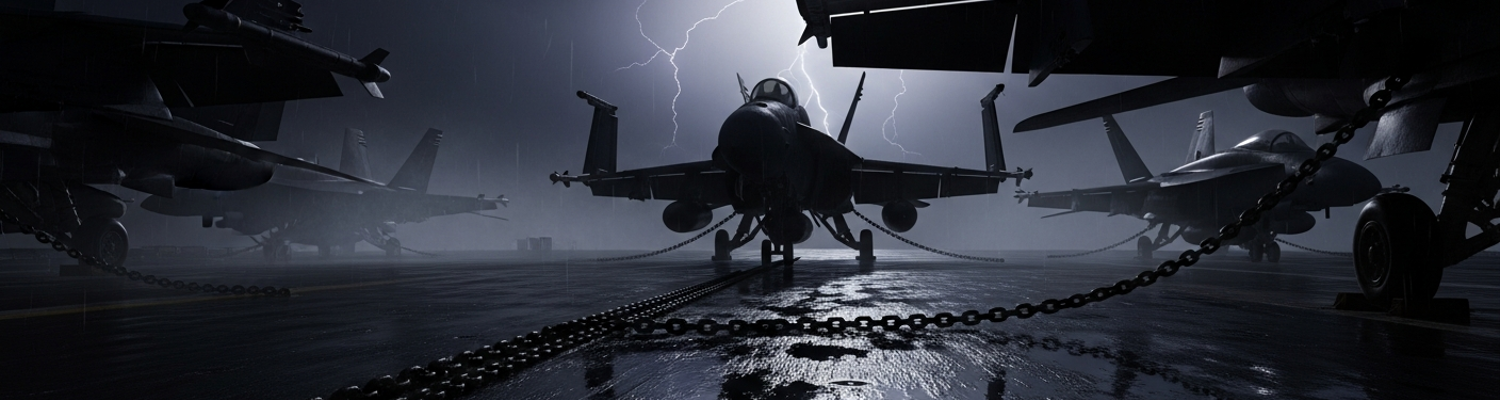

The night of November 1, 1999 was moonless over San Clemente Island. Off the coast of California, the island's rugged terrain served as a proving ground for the nation’s most specialized military units. On this particular night, a Marine Expeditionary Unit’s Force Reconnaissance platoon was deep inside the training area. Their mission was straightforward. Infiltrate, identify, and notionally destroy a simulated hostile radar and anti-aircraft site designated Objective Vulture. The entire operational concept was predicated on the seamless integration of sea, land, and air power. The plan depended on the immediate availability of air cover from Carrier Air Wing Nine (CVW-9), embarked on the USS John C. Stennis (CVN-74) steaming somewhere over the horizon.
The ground element initiated their mission under the assumption that F/A-18 Hornets would be on station, ready to provide immediate close air support if the team was compromised. Planners had also tasked EA-6B Prowlers with electronic warfare support, intended to jam enemy sensors during the infiltration and extraction. Onboard the Stennis, however, the capacity to meet these commitments was degrading. The ship was wrestling with persistent issues following a six-month maintenance availability that had ended in April 1999. These problems would later manifest in a grounding incident on November 30, when the carrier ingested enough silt in San Diego's turning basin to clog its reactor cooling intakes, forcing an emergency shutdown of its nuclear propulsion plants. In the weeks leading to that event, the ship’s material condition and the strain on its crew made generating the required flight sorties exceptionally difficult. The air wing, despite its readiness on paper, was tethered to a carrier platform that was not fully cooperative. On the night of November 1, the planned air support never materialized. The sky remained blind.
On the island, the operators were alone.
The withdrawal of air cover erased their primary contingency plan. Their mission capabilities were instantly reduced to what they carried. This is the tactical condition known as relying on limited organic fire. For a small reconnaissance team, this meant their firepower was comprised of their 5.56mm M4 carbines, a few M203 40mm grenade launchers, and a single lightweight 60mm mortar tube. The maximum effective range of their heaviest weapon was a few thousand meters, a stark contrast to the miles of standoff distance an F/A-18 could provide. Without eyes in the sky, the team lost all aerial reconnaissance, their ability to see over the next ridge, and the capacity to strike targets beyond their immediate line of sight. Every shadow could now hold a threat that they would have to overcome with only their own rifles and grenades. The simulated exercise had become a lesson in isolation.
The chain of events that led to the November 1999 incident for the USS Stennis can be traced back to a specific component failure weeks earlier. A close review of operational logs shows that on October 29, 1999, the carrier battle group was engaged in underway replenishment operations. This was a standard procedure, essential for maintaining the operational tempo required for the work-up schedule leading into Fleet Firing Exercise (FEEETEX) 00-1. The process involves ships steaming in close formation while heavy fuel lines are passed between them. For the Stennis, a Nimitz-class carrier with a displacement of over 100,000 tons and a capacity for nearly three million gallons of aviation fuel, these replenishments were the lifeblood of its air wing.
It was during the replenishment on the 29th that the mechanical heart of the carrier’s air operations failed. The primary transfer pump for the JP-5 aviation fuel system experienced a sudden and severe loss of pressure. Archival analysis of similar incidents suggests this was not a simple leak; it was a mechanical seizure. Within the pump’s complex machinery, a series of high-tolerance impellers, bearings, and seals designed to move thousands of gallons of fuel per minute, a critical component failed. This could have been a bearing overheating and seizing its shaft, or an impeller shattering under the immense hydraulic load. The result was immediate. The high-volume flow of JP-5 needed to fill the carrier’s vast storage tanks ceased, bringing the entire multi-million-gallon transfer to an emergency halt.
A Nimitz-class carrier’s JP-5 system is a complex network of storage tanks, service tanks, and transfer pumps designed to both receive fuel and distribute it to the flight deck at a rate sufficient to sustain a high sortie rate. The seizure of the primary pump effectively disabled this system’s ability to take on fuel at the required volume. While backup pumps existed, they were not designed for the sustained, high-capacity demands of a full underway replenishment. Command decision-makers were faced with a stark choice: abort the replenishment and attempt repairs, or continue with a severely degraded capability. The operation was halted.
This single mechanical failure left the USS Stennis in a dangerous position. The carrier was forced to break away from the replenishment oiler with its JP-5 tanks at approximately 28 percent of total capacity, well below the 40 percent minimum required for sustained combat operations. A typical air wing can burn through tens of thousands of gallons of fuel in a single day of high-tempo flight operations. With the primary means of refueling out of commission, the Stennis was left with only the fuel already in its tanks. The ship’s ability to generate sorties for the upcoming exercise was now severely constrained, tied directly to a dwindling supply of aviation fuel. The pump failure on October 29th was the first link in a chain that would leave a team of operators on San Clemente Island completely alone.
The failure of the JP-5 pump on October 29th was the physical manifestation of a bureaucratic breakdown that had been developing for months. A review of the period’s logistics records points to a two-month-long procurement impasse between Naval Air Systems Command (NAVAIR) and Naval Supply Systems Command (NAVSUP). These two organizations existed in a state of mandated codependence. NAVAIR, headquartered at Patuxent River, Maryland, held the ultimate technical authority for naval aviation systems. Its engineers were responsible for the design and performance specifications of every piece of hardware on a carrier related to flight operations. NAVSUP was the Navy’s global logistician, the enterprise tasked with purchasing, warehousing, and distributing the millions of parts required to keep the fleet operational. NAVAIR dictated what was needed; NAVSUP was responsible for getting it there. The system relied on their seamless interaction, but in the late summer and early fall of 1999, that process had ground to a halt.
At the heart of the dispute were the specialized replacement parts for the primary JP-5 transfer pumps used aboard Nimitz-class carriers. Following an engineering review of several minor pump failures across the fleet, NAVAIR’s Propulsion and Power Engineering department (AIR-4.4) had issued a new technical directive. This directive specified a newly designed, high-tolerance impeller assembly and an accompanying set of cryogenically treated bearings intended to increase the pump’s mean time between failures. The problem was not technical, but financial and procedural. NAVSUP’s Weapons Systems Support (WSS) office, which managed the procurement of these specific items, balked at the directive. Their models, based on years of cost and reliability data for the existing components, flagged the new parts as a high-cost, low-volume order from a new, non-standard supplier. From NAVSUP’s perspective, there was insufficient justification to overhaul the existing supply chain for what they assessed as an incremental, unproven benefit.
The impasse was absolute.
NAVAIR refused to certify the older components for use, citing safety and operational readiness concerns. NAVSUP, in turn, refused to issue a purchase order for the new components without a more rigorous cost-benefit analysis that fit its global procurement strategy. For two months, the formal requests and disapprovals cycled between NAVAIR’s engineering desks in Maryland and NAVSUP’s procurement offices in Pennsylvania.
This bureaucratic deadlock had direct consequences for the fleet. Because the dispute was never resolved, the new, NAVAIR-mandated pump components were never assigned a National Stock Number (NSN). They did not exist in the federal logistics system. Consequently, no order was ever placed with the manufacturer. No units were procured, and none were forward-deployed to the key supply depots that service the Pacific Fleet, such as those at Naval Air Station North Island. When the Stennis’s engineering department submitted their urgent CASREP (Casualty Report) on October 29th for the specific impeller assembly required by the new NAVAIR directive, the supply system simply returned an error. The part did not exist. There was nothing in the warehouses in San Diego, or anywhere else, to send. The ship’s technicians were fully capable of the repair, but they were paralyzed, waiting for a component that was stranded in a bureaucratic void between two command headquarters thousands of miles away.
The breakdown on October 29th was not a sudden event. A close review of the USS Stennis’s own maintenance logs from the spring and summer of 1999 reveals a ship’s engineering department aware of the JP-5 system’s declining health. The carrier had completed a six-month maintenance availability in April 1999, but records indicate the primary aviation fuel transfer pumps were not a priority. Throughout the subsequent work-up cycle, the ship’s V-4 division, the Aviation Boatswain’s Mates responsible for aviation fuels, filed multiple reports flagging performance from the primary transfer pump. These were not yet casualty reports, but warnings. Logs from the ship’s Maintenance and Material Management (3-M) system detailed persistent, low-level vibration anomalies and intermittent pressure fluctuations during routine internal fuel transfers. The technicians noted that the pump’s seals were weeping at a rate that exceeded technical specifications, requiring more frequent wipedowns and creating a persistent hazard in the pump room. These were the classic symptoms of a system operating under advanced wear and nearing the end of its service life.
These ship-specific warnings existed within a broader, fleet-wide context of known equipment deficiencies. By 1999, the pump model in question had been in service aboard Nimitz-class carriers for well over a decade, and NAVSEA had been collecting data on its performance for years. An internal reliability analysis circulating within the naval aviation logistics community that year showed a clear trend. The mean time between failures for the primary JP-5 transfer pumps had been decreasing steadily for the previous 36 months across the entire carrier fleet. Engineering assessments pointed to premature bearing and impeller fatigue, especially on ships with high operational tempos. The data was unambiguous, indicating that the probability of a major failure, like the one the Stennis would eventually experience, was increasing with every operational hour.
The data was unambiguous.
These warnings, both from the ship’s own engineers and from fleet-wide analysis, were not adequately addressed. The decision-making process was paralyzed by a confluence of competing priorities and logistical failure. During the formal maintenance period which ended in April, the JP-5 pump overhaul was listed as a desirable but deferrable work item. It was ultimately pushed aside in favor of more immediate repairs to the ship’s catapults and arresting gear, systems without which flight operations were impossible. This was a calculated risk, a trade-off between a potential future failure and a definite current need. Once the carrier returned to sea, the aggressive training schedule leading into FEEETEX 00-1 left no room in the operational calendar for the multi-day, cold-work maintenance required to tear down and rebuild a primary fuel pump. The final element preventing any action was the inter-command procurement impasse that had left the required, newly specified replacement parts without a stock number and completely unavailable to the fleet. The ship’s leadership was caught in a trap; they were aware of the system’s degradation but were denied both the time and the material to correct it before deployment.
The mechanical failure of the JP-5 pump aboard the USS Stennis created an immediate and severe operational gap. A Nimitz-class carrier is designed for sustained, high-tempo flight operations. This fuel reserve is calculated to support continuous sorties for over two weeks before replenishment. The abrupt loss of the primary transfer pump meant the ship could not take on more fuel, effectively starting a countdown clock on its combat effectiveness. The carrier’s existing fuel load, now critically low, had to be rationed with extreme prejudice. Every launch of an F/A-18 Hornet, an aircraft that can consume over 4,000 pounds of fuel per hour on a typical mission, became a major strategic decision. The aggressive multi-day flight schedule for FEEETEX 00-1 was now an impossibility. The ship’s core function, projecting air power, was disabled not by enemy action, but by a single point of failure in its own machinery.
This fuel crisis translated directly into an inability to sustain even the most basic defensive and offensive air missions. The two pillars of carrier air power, Combat Air Patrol (CAP) and Close Air Support (CAS), were rendered untenable. A typical CAP station requires multiple aircraft to maintain a continuous presence, cycling on and off station for hours at a time, creating a protective screen around the battle group. Legacy F/A-18 Hornets of that era could remain airborne for roughly 1.5 to 2.2 hours on internal fuel alone. Maintaining a 24-hour, two-aircraft CAP would consume a prohibitive amount of the Stennis's dwindling reserves. The same constraints applied to CAS. The entire premise of the exercise on San Clemente Island was that air power was an on-call weapon, ready to intervene instantly. With the carrier forced into a strict fuel conservation posture, the command could not risk launching aircraft and having them loiter on station, burning precious fuel while waiting for a potential call for support.
The air wing was grounded by spreadsheets and fuel calculations.
The crisis aboard the Stennis was not an isolated incident but a symptom of systemic vulnerabilities that had been developing in naval logistics for years. The end of the Cold War ushered in an era of the “peace dividend,” a political concept that saw military budgets reduced across the board. Military spending dropped by a third from its Cold War levels, and the Navy, finding itself without a major peer adversary at sea, began to decommission vast portions of its maintenance and support infrastructure. Eighteen destroyer and submarine tenders were reduced to just two by the end of the 1990s. This drawdown was accompanied by a philosophical shift toward “just-in-time” logistics, a model borrowed from the corporate world that prioritized efficiency and cost savings over maintaining large, forward-deployed stockpiles of spare parts. This system was brittle. It assumed a frictionless supply chain, but the procurement impasse between NAVAIR and NAVSUP over the new pump components demonstrated that bureaucratic conflict could be just as paralyzing as a physical shortage. The Navy of the late 1990s was increasingly a “big ship Navy” that looked powerful on paper but was hollowed out by a decade of budget cuts and logistical streamlining that left it unable to absorb the shock of a single, critical component failure.