Full Calendar
THIS DAY IN U.S. MILITARY HISTORY • OCTOBER 30 1944 U.S. Navy World War II

Kamikaze Strikes Batter Task Group 38.4 off Samar

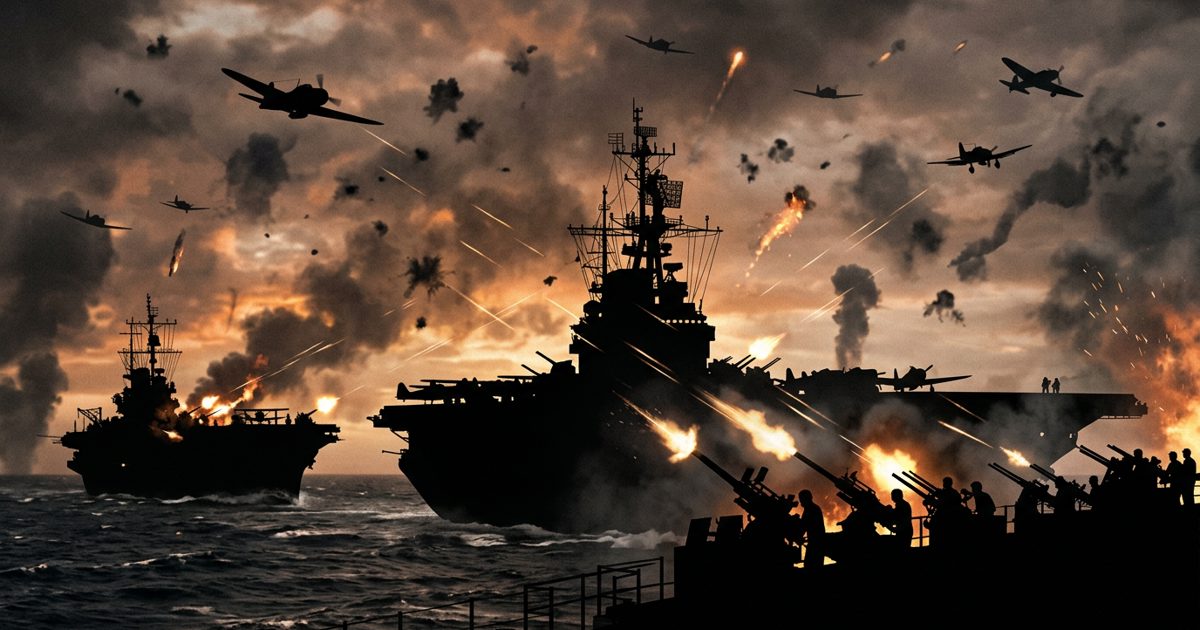
Japanese suicide planes struck carriers USS Franklin and USS Belleau Wood east of the Philippines, testing American damage control teams.
Kamikaze Strikes Batter Task Group 38.4 off Samar

Japanese strike planes plunged through scattered clouds east of Samar on October 30, 1944, diving directly toward the flight decks of Task Group 38.4. Rear Admiral Ralph E. Davison commanded the carrier formation, which had spent days launching air strikes to support General Douglas MacArthur's beachhead at Leyte. Fleet carrier USS Franklin and light carrier USS Belleau Wood sailed in formation when enemy fighters evaded the combat air patrol. Lookout spotters screamed warnings as gunners opened fire with five-inch batteries and automatic weapons, filling the midday sky with flak bursts.

Flak shredded one incoming fighter, but a second Mitsubishi Zero slammed through Franklin's flight deck and exploded into the gallery deck below. Blast waves ignited aviation fuel lines, tore through crew spaces, and killed 56 sailors while wounding 60 others. Seconds later, another Japanese plane dropped an armor-piercing bomb that narrowly missed Franklin before banking sharply toward Belleau Wood. That aircraft crashed directly into the light carrier's aft flight deck, detonating fueled F6F Hellcats and killing 92 men while burning ammunition lockers.

Sailors rushed into choking smoke with fire hoses and foam nozzles, jettisoning live ordnance over the side to prevent catastrophic magazine detonations. Damage control parties contained the blazes on both ships within hours, allowing Franklin to recover her airborne fighter squadrons before dusk fell. Both carriers survived the fiery onslaught and steamed under their own power to the fleet anchorage at Ulithi for emergency repairs. Industrial shipyards at Bremerton and San Francisco later rebuilt the damaged flight decks, returning both warships to Pacific combat operations the following spring.

CHRONOLOGICAL RECORD

October 30 Across U.S. Military History

8 Verified Events
1775 Continental Navy Landmark Event • American Revolutionary War

Continental Congress Authorizes Two Additional Warships

Delegates in Philadelphia expanded the fledgling colonial fleet on October 30, 1775, by authorizing the purchase and outfitting of two armed merchantmen carrying up to 20 and 36 guns. Congress also appointed four new members to the Naval Committee to oversee procurement. The resolution produced the warships Alfred, Columbus, Cabot, and Andrew Doria.

1781 U.S. Army • American Revolutionary War

New York Militia Routs Raiders at West Canada Creek

Colonel Marinus Willett led 400 New York militiamen and 60 Oneida allies across snow and mud to intercept retreating British raiders on October 30, 1781. American forces caught the enemy rear guard along West Canada Creek and killed notorious Loyalist captain Walter Butler. The skirmish scattered the raiders and concluded major frontier fighting in the Mohawk Valley.

1799 U.S. Navy Landmark Event • Early Republic

Chaplain William Balch Receives First Naval Commission

Reverend William Balch received his commission on October 30, 1799, becoming the first chaplain in the United States Navy. Navy leadership assigned him to the frigate USS Chesapeake during the Quasi-War with France. Balch conducted divine services, cared for the sick and wounded, and established the foundation of the Navy Chaplain Corps.

1941 U.S. Navy • World War II

Tanker USS Salinas Survives Atlantic Torpedo Attack

German submarine U-106 ambushed the fleet replenishment oiler USS Salinas about 700 miles east of Newfoundland on October 30, 1941. Two torpedoes struck the tanker, tearing open her hull, but damage control parties contained the flooding. Salinas maintained steam and safely reached port without losing a single crewman.

1950 U.S. Army Landmark Event • Korean War

Eighth Cavalry Regiment Holds Perimeter at Unsan

Chinese forces launched massive nighttime assaults against the 8th Cavalry Regiment at Unsan on October 30, 1950. Corporal Tibor Rubin manned a machine gun at the southern perimeter after three previous gunners fell, firing through continuous assaults for 24 hours. Rubin exhausted his ammunition, delayed the enemy encirclement, and allowed retreating American units to withdraw.

1953 Joint Landmark Event • Cold War

President Eisenhower Approves New Look Defense Strategy

President Dwight D. Eisenhower signed National Security Council Directive 162/2 on October 30, 1953, formalizing the New Look national security doctrine. The policy prioritized strategic nuclear deterrence and long-range airpower over costly standing conventional armies to maintain sustainable defense budgets. The directive shaped American force structures and Cold War defense planning for a decade.

1980 U.S. Air Force • Cold War

Extender Tanker Completes First In-Flight Refueling Test

Pilots at Edwards Air Force Base successfully conducted the first aerial refueling trials of the McDonnell Douglas KC-10 Extender on October 30, 1980. The new tanker hooked up 48 times with a Lockheed C-5 Galaxy during a five-hour flight, transferring 3,600 pounds of fuel. The milestone cleared the airframe for production as a global mobility asset.

1991 U.S. Air Force • Modern Era

Pave Hawk Crew Ditches During Atlantic Storm Rescue

Crew members of the 106th Rescue Wing flying HH-60G Pave Hawk helicopter Jolly 110 ran out of fuel during an Atlantic rescue mission on October 30, 1991. Pilot Major David Ruvola hovered over 80-foot waves while his crew bailed out into the raging sea. Coast Guard cutter Tamaroa braved extreme seas to pull four airmen to safety.

MEDAL OF HONOR ACTION 1944

Private Wilburn Ross Holds the Line at St. Jacques

German mountain troops assaulted the battered perimeter of Company G, 30th Infantry Regiment, near St. Jacques, France, on October 30, 1944. Artillery barrages and infantry charges had already reduced the American company from 88 riflemen to just 33 survivors. Private Wilburn K. Ross picked up his light machine gun and carried it ten yards in front of his company's foremost foxholes. Ross dug in on the exposed slope and opened rapid fire into the oncoming assault waves, absorbing the initial shock of the German counterattack.

Grenadiers crawled within four yards of Ross's position and hurled stick grenades, but he refused to abandon his weapon. Riflemen crept forward to feed fresh ammunition belts into his machine gun as he broke seven separate counterattacks across five hours of close combat. Ross killed or wounded at least 58 German soldiers and expended his final rounds before reinforcements arrived to secure the ridge. Army officials awarded Ross the Medal of Honor for saving his company from total destruction.