Full Calendar
THIS DAY IN U.S. MILITARY HISTORY • OCTOBER 29 1863 U.S. Army Civil War

Night Fight at Wauhatchie Secures the Chattanooga Cracker Line

Union infantry repels a midnight Confederate ambush in Lookout Valley to break the rebel siege of Chattanooga in 1863.
Night Fight at Wauhatchie Secures the Chattanooga Cracker Line

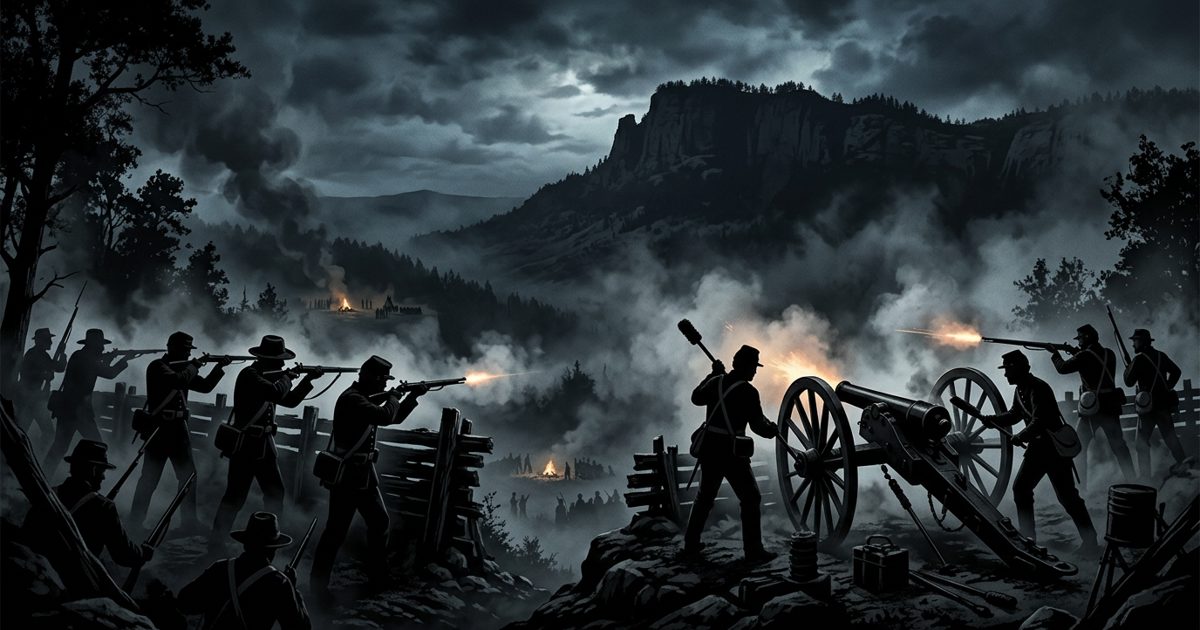
General James Longstreet ordered Brigadier General Micah Jenkins to launch a midnight assault against isolated Union positions at Wauhatchie Station on October 29, 1863. General Braxton Bragg sought to sever the newly established Cracker Line, a critical river and road corridor engineered to bring rations and munitions to the starving Union Army of the Cumberland inside besieged Chattanooga. Brigadier General John W. Geary commanded roughly 1,500 soldiers from the XII Corps guarding the roadway and supply park against superior attacking numbers. Geary quickly formed his regiments into a rigid defensive arc anchored by four field pieces of Knap's Pennsylvania Battery. Musket flashes cut through dense fog and pitch blackness as South Carolina riflemen repeatedly surged toward the Union perimeter.

Artillerymen poured double-shotted canister into the advancing enemy ranks, stalling repeated rebel charges across broken timber and marshy ravines. Major General Joseph Hooker heard the roar of cannons three miles away at Brown's Ferry and immediately dispatched reinforcements from the XI Corps under Brigadier General Adolph von Steinwehr. Union soldiers from the 73rd Ohio and 33rd Massachusetts launched an aggressive bayonet charge uphill to clear Confederate blocking forces along the adjacent ridge. Rebel defenders under Brigadier General Evander Law broke under the counterattack, exposing the flank of the primary Confederate assault column.

Jenkins recognized his imminent encirclement and ordered a general retreat back toward Lookout Mountain shortly before dawn. Union forces tallied 78 dead, 327 wounded, and 15 missing, while inflicting more than 400 casualties upon the retreating Confederate brigades. Steamboats and wagon trains laden with hardtack, salt pork, and artillery shells rolled unhindered into Chattanooga later that day. Grant consolidated his supply base and stockpiled heavy artillery, creating the operational springboard for the breakout at Lookout Mountain and Missionary Ridge four weeks later.

CHRONOLOGICAL RECORD

October 29 Across U.S. Military History

8 Verified Events
1814 U.S. Navy Landmark Event • War of 1812

Robert Fulton Launches First Steam Warship Demologos

Shipwrights launched Demologos at Adam and Noah Brown's shipyard in New York on October 29, 1814. Robert Fulton designed the revolutionary catamaran vessel with a protected central paddle wheel and five-foot-thick timber bulwarks to break the British naval blockade. Naval engineers completed the 2,475-ton floating steam battery as the first steam-powered warship constructed for military naval service.

1861 U.S. Navy • Civil War

Massive Union Expedition Departs for Port Royal

Flag Officer Samuel Du Pont led seventy-seven naval warships and army transports out of Hampton Roads, Virginia, on October 29, 1861. Troops under Brigadier General Thomas W. Sherman embarked aboard the flotilla to seize Port Royal Sound, South Carolina, for an Atlantic coaling station. Naval planners assembled the largest American fleet organized to that date to enforce the southern naval blockade.

1870 U.S. Navy • Post-Civil War Era

Gunboat USS Saginaw Wrecks at Ocean Island

Navigators aboard the side-wheel gunboat USS Saginaw struck a coral reef off Ocean Island in the Pacific on October 29, 1870. Sailors salvaged rations and tools before the pounding surf broke the hull apart, stranding ninety-three men on the remote atoll. Volunteers prepared an open ship's gig for an audacious 1,500-mile voyage to the Hawaiian Islands to summon rescue.

1940 U.S. Army Landmark Event • World War II Era

First Peacetime Selective Service Lottery Commences

Secretary of War Henry L. Stimson drew the first registration capsule from a ten-gallon glass fishbowl in Washington on October 29, 1940. Number 158 marked the historic opening of the first peacetime military draft in the history of the United States. Military officials used the lottery system to induct hundreds of thousands of citizen-soldiers before American entry into World War II.

1944 U.S. Army Landmark Event • World War II

Nisei Soldiers Charge Suicide Hill in the Vosges

Infantrymen of the 442nd Regimental Combat Team launched desperate frontal assaults near Biffontaine, France, on October 29, 1944, to rescue the trapped Lost Battalion. Private George Sakato and Private Barney Hajiro made separate solo charges under ferocious machine-gun fire, earning Medals of Honor for eliminating enemy nests. Riflemen endured severe casualties over steep wooded slopes to break the German cordon.

1950 U.S. Air Force • Korean War

C-47 Transports Begin Aeromedical Flights from Sinanju

Pilots flying C-47 Skytrains commenced aeromedical evacuation missions from newly captured Sinanju Airfield in North Korea on October 29, 1950. Air Force crews operated out of the forward airstrip along the Chongchon River, establishing the northernmost airfield utilized by Far East Air Forces transport aircraft. Aviators evacuated wounded United Nations infantrymen directly to surgical field hospitals in southern staging zones.

1968 U.S. Navy • Vietnam War

Joint Flotilla Strikes Lon Bo De River Strongholds

Patrol boats joined tank landing ship USS Washoe County and cutter USCGC Wachusett in an aggressive surprise assault along South Vietnam's Lon Bo De River on October 29, 1968. American and South Vietnamese units coordinated heavy gunfire and aerial Skyraider strikes across five hours of intense riverine fighting. Sailors destroyed 242 enemy watercraft and demolished 167 fortified logistics structures during the sweep.

2012 U.S. Navy • Modern Era

Amphibious Ships Deploy to Support Hurricane Sandy Relief

Warships USS Wasp, USS San Antonio, and USS Carter Hall got underway from Norfolk on October 29, 2012, for disaster relief. Marines of the 26th Marine Expeditionary Unit embarked with heavy-lift helicopters and landing craft as Hurricane Sandy slammed the East Coast. Naval crews provided immediate offshore staging to clear wreckage, restore power, and assist civilian authorities.

MILITARY AVIATION 1980

Rocket-Assisted Hercules Crashes in Operation Credible Sport Test

Engineers at Lockheed and the United States Air Force developed a radically modified transport plane to execute a second rescue attempt during the Iran hostage crisis. Operation Credible Sport transformed a standard C-130 Hercules into a short-takeoff-and-landing aircraft equipped with thirty solid-propellant rocket motors mounted to its fuselage. Planners intended to land the heavily retrofitted airframe inside a soccer stadium in downtown Tehran, load the 52 American hostages, and blast back into the sky using upward and forward thrusters. Test pilots conducted a full-profile demonstration flight at Wagner Field in Florida on October 29, 1980.

Rockets designed to halt the aircraft during touchdown ignited prematurely while the cargo plane was still drifting several feet above the runway. Sudden loss of forward airspeed caused the transport to drop abruptly onto the paved strip, breaking the starboard wing and igniting an intense structural fire. Crash crews extinguished the flames and rescued all crew members without a single loss of life. Air Force officials scrapped the ambitious modification concept days later when diplomatic negotiations eliminated the requirement for a stadium extraction.