
Design Limits of Bainbridge-Class Hull Architecture
Telegraph lines running into Cavite snapped during the predawn hours, isolating Lieutenant Dudley Wright Knox and the First Torpedo Flotilla without direct orders as his five destroyers patrolled the Mindoro Strait. Contaminated feedwater flooded the engine room when condenser tube packings failed under the pressure of twenty-pound vacuum pumps aboard USS Decatur, fouling the boilers with brackish water. Gunners on the forward deck simultaneously discovered that brine had corroded the firing pins and jammed the slide mechanisms on the primary three-inch rapid-fire guns. Knox resolved to maintain his interception vector toward the Palawan passage on his own authority, suspecting foreign colliers were moving fuel toward Russian warships transiting East Asian waters. Naval planners in Washington had never intended these ships for such an assignment, having settled on a 420-ton standard displacement design intended strictly for short-range coastal defense and fleet screening rather than extended overseas colonial service.
Boiler rooms deep within the destroyers bore the brunt of overseas operations, housing an installation of four coal-fired Thornycroft water-tube boilers engineered for high burst speed at the expense of metallurgical durability. Navy designers had selected these lightweight water-tube units so the 250-foot destroyers could generate eight thousand horsepower and achieve brief sprints near twenty-eight knots against an enemy battle line. Continuous cruising through equatorial humidity instead caused the thin-walled boiler tubes to blister and warp under fluctuating steam pressures. Firemen stoking the furnaces with dirty regional coal faced firebox backdrafts and choking soot accumulations that fouled the exhaust uptakes. Machinists inside Decatur fought rising bilge water and falling pressure gauges by knocking scale from hot pipes and driving tapered steel plugs into ruptured boiler tubes.
Steam pressure dropped further at 0630 hours when Decatur plowed directly into heavy seas outside the island passages, triggering structural strains throughout the hull. Weight overruns and hull stress resulting from raised forecastle designs operating in open-ocean swells immediately threatened the structural integrity of the ship bow. Naval architects had added this elevated forecastle deck during the drafting process to improve seaworthiness and elevate the forward three-inch gun mount above green water, but the modification piled excessive deadweight onto a fragile, light-scantling hull. Twisting torque from rising waves sheared rivets along the forward frames, opening narrow seam gaps in the outer plating and flooding the forward storage compartments. Salt water washed through the distorted hull seams, soaking three-inch shell cases and coating gun components in gritty brine.
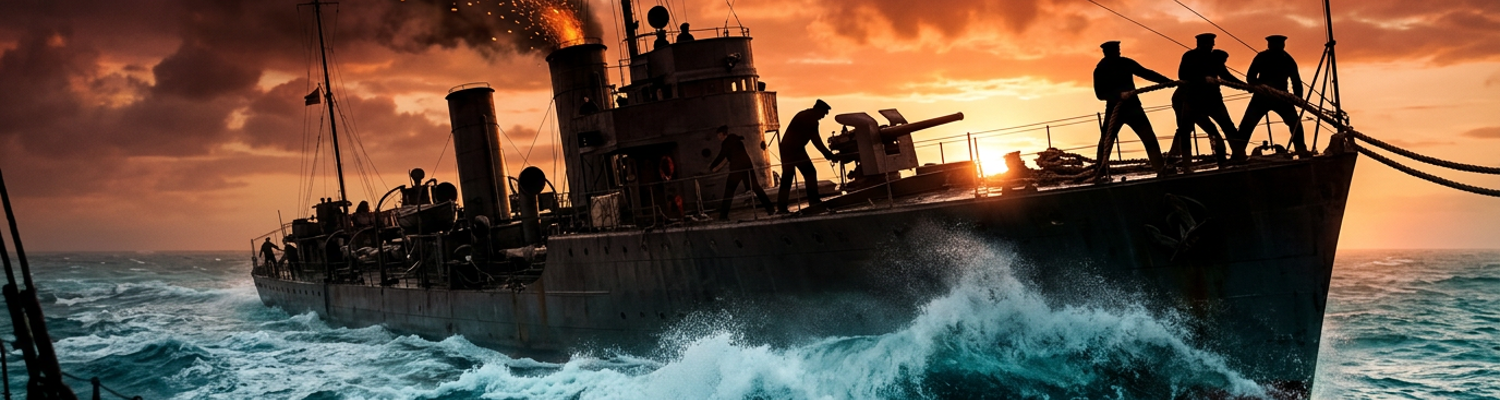
Gunners on the forecastle used mallets and heavy grease to hammer free the seized breech mechanism of the forward three-inch gun as Decatur closed on a plume of coal smoke on the southern horizon at 0715 hours. Lieutenant Dudley Wright Knox ordered his four trailing destroyers, Barry, Chauncey, Dale, and Bainbridge, into a line abreast formation to intercept the unidentified vessel before it slipped beyond Philippine territorial boundaries. Black smoke billowed from Decatur four tall funnels as stanchions groaned under the impact of twenty-foot swells hammering the overstressed forecastle. Engineers coaxed eighteen knots from the patched boilers, even as salt-crusted condenser pumps vibrated violently against their bedplates and threatened to shear their mounting bolts. Knox kept the rangefinder trained on the distant coal freighter, clearing Decatur forward battery for an immediate warning shot the moment the ship crossed within three nautical miles.
Boiler Breakdown in Tropical Archipelago Salinity
Gunners mates slammed a three-inch shell into the forward breech while the bridge telegraph signaled for maximum boiler revolutions to close the remaining sea distance. Engineers opened the main throttle valves, drawing feedwater from supply tanks that were increasingly fouled with seawater from leaking condenser packings. High salinity Philippine waters entering the propulsion system caused rapid tube blistering and scale accumulation in the Thornycroft boiler arrays, coating the narrow water tubes in a dense layer of mineral crust. Heat from the coal fires could not pass through this heavy accumulation of salt and minerals, causing the dry steel tube surfaces to overheat and soften. Thin walled pipes bulged under the high internal steam pressure, developing swollen blisters that threatened to split open and flood the fireboxes with boiling water. Water tenders monitored the erratic pressure needles on the brass gauges, using hand pumps to feed chemical treatments into the tanks while stokers piled regional coal into the glowing furnaces.
Fireroom temperatures exceeded 135 degrees Fahrenheit as the four Thornycroft boilers radiated relentless heat into the unventilated compartments below the waterline. Sustained littoral patrols in the Lingayen Gulf and Luzon Strait trapped the firemen in these metal spaces for hours as the destroyer tracked merchant ship traffic through equatorial waters. Ventilation cowls on the upper deck gathered humid sea air, but the blowers only circulated warm vapor that did nothing to cool the glowing furnace fronts. Men stripped to cotton trousers shoveling coal and dragging ash buckets across iron floor plates found the metal hot enough to scorch leather boot soles. Firemen repeatedly collapsed on the steel grates from heat prostration, forcing petty officers to haul limp bodies up the escape ladders so salt water buckets could be dumped over their chests on the open deck. Relief crews picked up the discarded shovels and worked the fireboxes without interruption, maintaining the fires so Decatur could maintain nineteen knots in pursuit of the distant smoke plume.
Steam lines shuddered under this continuous high boiler pressure, blowing out woven asbestos gaskets along the main piping connections with sharp, violent cracks. Frequent blown steam gaskets became a constant emergency during the 1905 neutrality watch as Knox kept his flotilla running at emergency speeds to enforce maritime cordon boundaries. High pressure vapor hissed through the damaged flange joints, filling the engine spaces with clouds of scalding steam that obscured the water level sight glasses and pressure dials. Machinists covered their faces with wet rags, using heavy wrenches and emergency clamps to cinch down the leaking pipe joints while live steam blistered their arms. Water tenders bypassed the damaged steam lines and adjusted the feed manifolds, stabilizing boiler pressure at two hundred pounds per square inch as the hull surged forward through the swells. Knox braced against the bridge railing and raised his signal flag toward the forward gun mount, waiting for the coal freighter to pass the three mile mark before ordering his gunners to drop a solid shot across its bow.
Condenser Failures and Reciprocating Engine Strain
Gunners tracked the approaching coal freighter past the three mile mark with their fingers on the firing trigger, but a sudden loss of vacuum in the condenser room shook the deck and threw the gun off target. Engineers below decks discovered that porous copper alloy condenser tubes were leaking salt water directly into the closed boiler feedwater circuits under high suction pressure. These thin metal tubes had corroded from continuous exposure to warm Philippine seawater, developing microscopic holes and seam cracks along their cooling surfaces. Salt water pumped through the cooling jackets pushed straight through the porous alloy walls, contaminating thousands of gallons of pure distilled steam return water with heavy ocean brine. Salinity readings at the hotwell rose instantly to dangerous concentrations, carrying dissolved salts straight back toward the Thornycroft boilers. Water tenders fought to isolate the leaking condenser sections with bypass valves, but the rapid influx of seawater degraded boiler efficiency within minutes and forced Decatur speed downward.
Steam flowing from the contaminated boilers into the vertical triple expansion reciprocating steam engines produced severe main bearing vibration and journal wear across both engine beds. High pressure steam carried moisture and mineral particles directly into the cylinders, causing uneven stroke resistance that hammered the heavy crankshafts against their mountings. Main bearings shook so violently that mounting bolts backed out of their baseplates, while the rotating crank journals ground hard against the brass bearing shells. Friction tore microscopic flakes of bronze and steel from the contact points, scoring deep grooves along the polished surface of every shaft. Machinists ran between the thrashing crossheads with grease guns and tallow pots, attempting to cool the glowing metal before the bearings melted and welded the engines in place. Lieutenant Knox felt the entire destroyer shudder under his boots on the bridge, watching his tactical lead over the coal ship vanish as the port engine began to knock and drag.
Cylinder lubricating oil emulsification in the contaminated feedwater created a greasy, foaming lather that ruined the remaining engine lubrication and forced immediate emergency shutdowns. Heavy mineral oils injected into the steam chests combined with the boiling salt water, churning into a thick yellow sludge that choked the internal oil lines and stripped the cylinder walls of protective film. Piston rings began to scrape bare cast iron inside the valve chests, threatening to seize the engines completely if steam pressure remained applied to the pistons. Chief Machinist James Walsh shouted through the engine room voice tube, warning Lieutenant Knox that continuing the pursuit would wreck both propulsion shafts beyond local repair. Knox dropped his signal flag, ordered the main throttles closed, and watched Decatur coast to a dead stop in the water. Smoke drifted away from Decatur four stacks as destroyers Barry and Chauncey surged past on either beam, taking over the interception run while Knox crew scrambled with wrenches to pull the condenser inspection covers.
Improvised Field Engineering During Neutrality Interdictions
Condenser inspection plates clattered onto the iron deck plates as Chief Machinist Walsh directed his gang into the opened heat exchanger chambers. Salt crystals crusted across dozens of split cooling tubes, prompting the crew to install jury rigged condenser bypass systems and rerouted sea cock plumbing fabricated during the Russian Baltic Fleet transit. Flotilla mechanics had originally devised these pipe loops weeks earlier when tracking foreign battle groups through East Asian waters, bypassing clogged tube clusters to dump ruined vapor overboard rather than allowing brine to flood the hotwell. Stokers dragged threaded iron pipe sections across the vibrating compartment, bolting modified bypass valves directly into the hull sea chests to draw clean sea suction away from damaged internal lines. Lead gaskets cut from discarded packing sheets sealed the rough pipe flanges against the intake pressure, allowing circulating pumps to push ocean water through functioning tubes without spilling brine into the main feed circuit. Water tenders cracked the rerouted sea valves open with long socket bars, watching pressure gauges rise as raw seawater swept through the modified discharge lines.
Machinist ratings pulled battered sheets of scrap copper from repair lockers to correct severe mechanical slack throughout the propulsion gear. Men clamped thick metal plates into portable bench vises, turning improvised copper shims by hand to stabilize worn drive components underway while the hull rolled heavily in the ocean swells. Hand files and scrapers shaved down the soft metal stock until each custom spacer matched the clearance between the scored crank journals and loose bearing caps. Mechanics slid these hand trimmed wedges into the vibrating gaps beneath the connecting rods, taking up fractions of an inch of dangerous play that threatened to tear the main shafts loose from their bedplates. Engine oilers packed heavy tallow around the seated copper inserts, tightening down the cap studs with sledgehammer strikes against heavy box wrenches until the violent knocking subsided into an even mechanical rhythm. Lieutenant Knox listened through the bridge voice tube as the port engine picked up revolutions, feeling the deck vibration smooth out as the improvised shims held the thrashing steel linkage firmly in place.
Bilge water sloshed across the lowest frames of Decatur, threatening to drown the crank pits as hot runoff from the bypass lines pooled below the floorboards. Engineering watches maintained continuous round the clock bilge bailing and valve grinding under tropical conditions to keep the destroyer operational in the stifling ocean air. Coal dust and heavy cylinder sludge choked the mechanical bilge strainers every twenty minutes, forcing firemen to haul dirty seawater out of the double bottoms with five gallon canvas buckets passed hand to hand up the narrow iron ladders. Relief machinists worked beside the bucket lines in compartment air exceeding 120 degrees, using carborundum paste and hand levers to grind pitted steam valve seats smooth against their cast brass housings. Sweat poured off the men onto the hot iron casings, but they rotated the grinding tools back and forth across every scarred disk until the metal faces formed a steam tight seal against high boiler pressures. Knox observed the first steady jets of clear discharge water spraying from the hull scuppers as Decatur regained twelve knots, turning his bow back on the interception course set by Barry and Chauncey.
Corrosion Failures of Deck Armament Mechanisms
Decatur bow cut through the churning wakes of Barry and Chauncey, throwing seawater across the low forward deck as the ship worked up to pursuit speed. Seawater pooled immediately around the pivot rings of the deck mounted three inch rapid fire guns, where rapid evaporation under the tropical sun left thick white mineral deposits over every moving surface. Severe salt crusting seizing the interrupted screw breeches of deck mounted three inch guns occurred within hours of entering the open strait, locking the heavy steel blocks firmly inside the breech rings. Gunners mates slammed heavy lead mallets against the operating levers to break the dried salt crust, prying the jammed screw threads loose millimeter by millimeter. Metal shavings peeled off the corroded locking lugs as the crews forced the breeches open to inspect the firing chambers before Decatur pulled within range of the foreign collier. Gun captain Miller swung the opened breech block outward on its carrier hinge and ordered his men to ram a brass dummy shell into the chamber to test the operating cycle under combat speed.
Cartridge cases jammed tight inside the rifled bores during these firing tests because cartridge case extractor failures and ejector spring fouling crippled the weapons during rough coastal patrols. Thin steel extractor claws failed to grip the rims of the brass cases because grit and dried ocean salt packed into the extractor recesses behind the barrel face. Ejector springs beneath the breech trays lost their mechanical recoil when ocean spray washed away their factory lubricants and left gritty mineral sludge in the housings. Sailors had to run long ash wood ramrods down the muzzle from the open forecastle, hammering the stuck cartridge cases backward through the breech while ocean swells swept across their boots. Knox watched the struggling gunners from the bridge wing, realizing that his forward battery could not deliver sustained rapid fire if the distant steamer resisted boarding. Lieutenant Knox sent two gunners mates below to the armory locker to collect cleaning wire, paraffin solvent, and spare spring coils to rebuild the damaged ejector linkages on the exposed deck.
Gunners returned to the forecastle carrying buckets of tallow and thick boiler lubricant to shield the sensitive steel assemblies from the continuous ocean spray. Application of improvised heavy grease packs to protect rapid fire mounts from continuous sea spray became the only practical defense against the corrosive Philippine atmosphere during high speed patrols. Gunners mates slathered this dense mixture of animal tallow and heavy cylinder grease across the interrupted screw threads, the extractor pivots, and the exposed recoil slide pathways. Strips of oiled sailmaker canvas were then wrapped tightly around the greased breech blocks and lashed down with marline twine to seal out blowing ocean foam until the moment of contact. Grease squeezed through the canvas seams as gunners worked the breech levers back and forth by hand, forcing the protective paste into every recessed screw slot and spring housing. Knox verified through his brass telescope that Barry and Chauncey had turned to pin the coal freighter against the coastal shallows, prompting him to order the forward gun crew to cast off the protective canvas bindings and train the greased three inch gun directly onto the target.
Obsolescence of Reciprocating Craft in Fleet Reports
Gunner Miller wrenched the traverse wheel to lock the three inch gun barrel directly onto the coal freighter pilothouse just as the foreign captain reversed his engines and blew a steam whistle in surrender near the Palawan reefs. Knox dispatched an armed boarding party in a pulling boat to seize the collier cargo manifests, but the sustained high speed pursuit through open ocean swells delivered the final blow to his flotilla collapsing propulsion machinery. Main engine connecting rods banged violently against scored crankpins, blistered boiler tubes cracked under renewed layers of salt scale, and contaminated feedwater fouled every remaining bearing circuit aboard Decatur. Sister destroyers Barry and Chauncey also began venting live steam past their ruined piston rod packings, forcing Knox to reduce the squadron return speed to six knots to prevent total engine seizures on the open water. Cavite Navy Yard shipwrights directed Chauncey, Dale, and Decatur into the repair berths on December 5, 1905, placing all three destroyers in reserve status for extensive machinery maintenance and boiler overhauls. Dockyard machinists stripped the propulsion casings and discovered that heat, hull vibration, and salt laden steam had warped the cylinder valve chests, stripped the brass bearing sleeves, and cracked the primary reciprocating drive rods beyond local repair capabilities.
Asiatic Fleet staff officers collected the physical inspection logs from these opened engine casings and drafted urgent technical reports for the Navy Department in Washington. These dispatches documented the logistical impossibility of maintaining coal fired torpedo craft in distant colonial cordons without an unsustainable drain on regional naval resources. Hand stoked furnaces demanded constant heavy labor that exhausted fireroom crews in tropical heat, while low grade regional coal choked the narrow water tube draft flues with dense soot after only thirty hours of sustained steaming. The small destroyers carried barely enough bunker fuel for brief coastal runs, requiring a continuous screen of supply colliers and repair tenders that the Asiatic Fleet could not maintain across hundreds of miles of Philippine coastline. Porous copper condenser tubing leaked seawater into the boilers so rapidly that base distilling ships could not manufacture replacement fresh water fast enough to offset the contamination. Fleet commanders warned Washington that fragile four hundred ton coastal craft could never provide reliable neutrality patrols or screen capital ships when everyday salt exposure and engine friction destroyed their propulsion systems during routine operations.
Bureau of Steam Engineering planners examined the damaged parts and fleet reports arriving from Manila to overhaul future American warship specifications. Naval authorities recognized that reciprocating steam engines could not withstand the continuous mechanical stress, high revolutions, and corrosive moisture inherent to overseas naval duty. Naval policy shifted toward larger oil fired steam turbine destroyers starting with subsequent construction programs authorized by the federal government. Continuous flow steam turbines replaced reciprocating piston assemblies, eliminating the thrashing rods, unbalanced crankshafts, and heavy journal bearings that had shaken the Bainbridge class apart in Philippine waters. Liquid petroleum fuel replaced coal bunkers, allowing automated fuel pumps to spray oil directly into boiler furnaces without requiring exhausted firemen to shovel tons of fuel in stifling compartments. Shipyards immediately laid down larger seven hundred ton and thousand ton hulls fitted with high flare forecastles, expansive fuel oil tanks, and enclosed turbine rooms, officially ending the construction of coal fired reciprocating torpedo craft for frontline fleet operations.