
Opening Naval Operations in the Korean Conflict
Infantrymen stumbled southward along rutted dirt roads under scorching summer heat, collapsing from physical exhaustion and severe dehydration after days of relentless retreat. Rifle companies ran entirely out of drinking water, food rations, clean bandages, and anti-tank ammunition while carrying wounded soldiers on improvised stretchers made from canvas shelter halves and tree branches. Troops drank contaminated water from roadside drainage ditches and rice paddies, causing widespread dysentery that rapidly depleted combat effectiveness across the front lines. North Korean ground forces overran Seoul in late June 1950, threatening to push allied forces into the sea. South Korean and American units fell back toward provisional defense lines around Taejon and the Naktong River, unable to halt the enemy armor and motorized infantry columns rolling southward. Allied military leaders in Tokyo recognized that these shattered ground units would collapse completely unless offshore warships intervened immediately to strike the enemy supply lines feeding the southern offensive.
Admiral C. Turner Joy, the Commander Naval Forces Far East, improvised Task Group 96.5 to interdict coastal supply routes along the Sea of Japan. American naval strength in the western Pacific had dropped dramatically following post-World War II demobilization, leaving Joy with only a handful of combat-ready surface ships to patrol thousands of miles of hostile coastline. Joy combined the American anti-aircraft light cruiser USS Juneau with British Royal Navy vessels, including the light cruiser HMS Jamaica and the frigate HMS Black Swan. Communications officers on these allied vessels had to quickly harmonize signal books, radio frequencies, and tactical coordination procedures that their crews had never practiced together during peacetime drills. Sailors aboard USS Juneau unbolted ammunition hoists, inspected gun directors, and plotted shallow coastal waterways to prepare the ship for direct shore fire missions.
Gunners and fire-control technicians faced dangerous operational conditions along the eastern shoreline of Korea, where steep mountain ridges dropped straight into the surf. North Korean logistical units depended on a single railroad and a narrow gravel roadway pinned against the sea beneath these granite cliffs to move fuel drums, artillery rounds, and replacement troops southward. Naval gunfire offered the allied command an effective weapon to collapse railroad tunnels, shatter bridges, and destroy truck convoys that retreating ground artillery could no longer reach. Mechanical breakdowns added to the crew physical misery as auxiliary steam pipes leaked and ventilation blowers failed inside the sweltering engine spaces during sustained high-speed runs. Lookouts on the bridge wings stood continuous four-hour watches with heavy optical binoculars, straining to spot coastal traffic through dense fog and driving rain.
Warships of Task Group 96.5 pushed northward past the thirty-seventh parallel on July 1, 1950, tracking potential coastal targets along the rocky shoreline near Chumunjin. Radio operators monitored urgent encrypted dispatches from Washington and London, where senior government officials viewed this small naval sweep as a critical test of United Nations resolve against Soviet-backed aggression. Diplomats and cabinet members in western capitals needed immediate physical resistance on the battlefield to convince nervous international allies that the United Nations could protect South Korea from total conquest. Lookouts aboard USS Juneau pierced the early morning mist on July 2 and sighted four North Korean motor torpedo boats escorting ten loaded ammunition trawlers southward along the beach. Captain Jesse C. Sowell ordered the cruiser to battle stations, ringing alarm bells throughout every compartment and swinging the twin five-inch gun mounts toward the approaching enemy vessels.
Formation of Combined Task Group 96.5
Gunners tracked the approaching vessels through optical rangefinders as signalmen flashed carbon-arc searchlights across the gray water, drawing the nearby British warships into a coordinated firing line. The light cruiser USS Juneau integrated with Royal Navy cruiser HMS Jamaica and frigate HMS Black Swan into a combined strike group, placing American firepower alongside British naval assets for the first time since World War II. Captain Jesse C. Sowell maintained tactical command from Juneau bridge, directing HMS Jamaica to take station on his starboard quarter while HMS Black Swan guarded the rear against potential submarine or coastal attacks. British lookouts matched Juneau bearing markers instantly, swinging Jamaica six-inch guns and Black Swan twin four-inch mounts toward the approaching North Korean vessels as all three crews secured watertight battle hatches. Politicians in London and Washington had authorized this joint operational structure within hours of the North Korean invasion, recognizing that immediate Anglo-American solidarity in Asian waters would send an unmistakable warning to Soviet Premier Joseph Stalin in Moscow. Cabinet ministers viewed the tactical merger of these three warships as a vital diplomatic maneuver to preserve the special partnership between Britain and the United States while demonstrating collective Western resolve under the newly formed United Nations framework.
Radio technicians turned this high-level political mandate into practical tactical cooperation by overcoming severe communication barriers between the two navies. Naval coordination depended on improvised coalition radio frequencies and visual signal protocols between American and British bridge teams, who lacked shared peacetime encryption systems and standardized tactical codebooks. Communications officers patched together high-frequency voice circuits on shared tactical bands, enabling bridge watchstanders to relay compass headings, vessel speeds, and radar plots using plain English commands over crackling static. Heat built up rapidly inside the cramped radio shacks as vacuum tubes glowed white-hot and cooling fans struggled against the humid summer air, forcing operators to constantly retune unstable radio transmitters by hand. Quartermasters supplemented these fragile radio circuits with colorful flag hoists and focused Aldis signal lamps, clicking shutter levers rapidly to confirm target allocations before gun directors opened fire. Dispatches detailing these improvised communication procedures traveled back to the Admiralty in London and the Pentagon in Washington, where military planners realized that United Nations coalition warfare would require permanent standardized signaling procedures across all member nations.
Telegraph machines in Washington clattered with updates as Juneau, Jamaica, and Black Swan tested these makeshift procedures under actual combat conditions, closing the distance to the enemy convoy at twenty knots. Salt spray lashed the open bridge wings as Captain Sowell aligned his cruiser alongside the British vessels to ensure unobstructed fields of fire for every gun mount. British and American gunners monitored their radar scopes as four North Korean motor torpedo boats detached from the supply trawlers and accelerated to make a daylight torpedo attack against the allied formation. State Department officials and British Foreign Office diplomats followed the impending clash with intense anxiety, knowing that a decisive defeat or a catastrophic friendly-fire incident would shatter Western public confidence in the United Nations intervention. Lookouts on the bridge wings called out rapid range decreases as the hostile craft closed to eleven thousand yards across the calm water. Gun crews loaded armor-piercing and high-explosive shells into the open handling rooms beneath the decks, standing ready to execute Sowell coordinated firing order.
Tactical Engagement off Chumonchin Chan
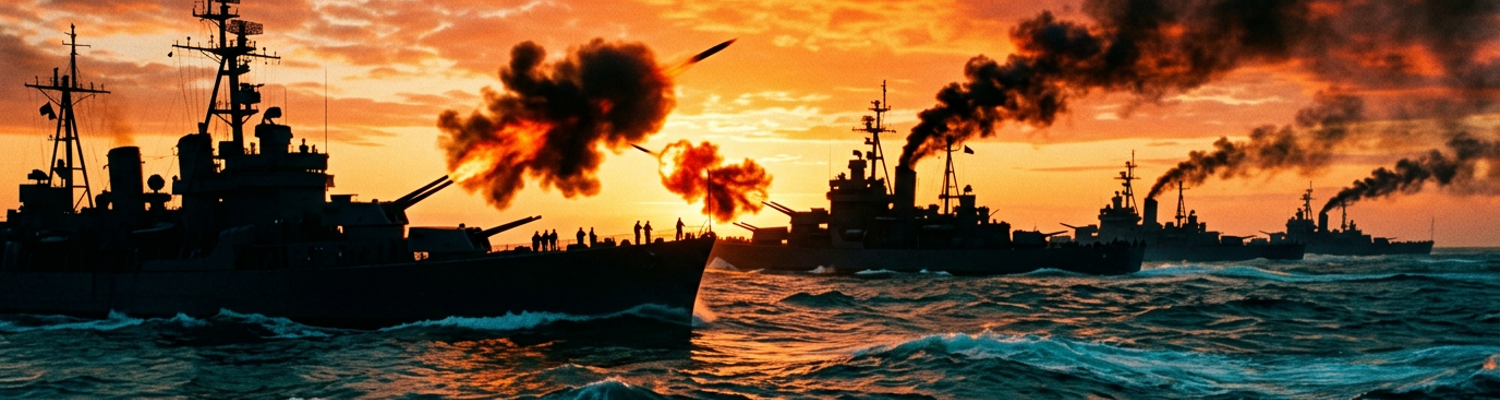
Captain Jesse C. Sowell transmitted the open-fire command through pulsating blinker lights as Task Group 96.5 intercepted four Soviet-supplied North Korean G-5 motor torpedo boats and two gunboats escorting ten ammunition trawlers at dawn on July 2, 1950. North Korean commanders reacted aggressively to the allied presence, turning their light duralumin hulls away from the coastline to execute a coordinated daylight torpedo strike against the cruisers. Aviation engines inside the four G-5 boats roared to life, driving the small attack craft across the morning swells at speeds exceeding thirty knots. Allied fire-control directors tracked the accelerating targets through optical lenses while calculating rapid range reductions, wind velocities, and ship headings. Loaders aboard USS Juneau and HMS Jamaica thrust fixed ammunition and powder charges into open breeches, slamming the levers shut as the enemy formation closed to eleven thousand yards. Gunners locked onto the lead torpedo boat and discharged their forward turrets, filling the humid morning air with massive muzzle blasts and choking cordite smoke.
Geysers of white water erupted around the charging North Korean vessels as the cruisers walked rapid salvo fire across the waves. Six-inch armor-piercing and high-explosive shells from HMS Jamaica tore directly through the unarmored hull of the lead torpedo craft, detonating its fuel tanks and lifting the vessel out of the water in a violent blast. A fifteen-minute gunnery engagement destroyed three torpedo boats and both gunboats before the vessels closed within torpedo release distance. American five-inch projectiles from Juneau burst continuously overhead, showering the light craft with sharp steel fragments that shattered wooden bulkheads and severed rudder control cables. North Korean sailors fired back with machine guns, but the small-caliber bullets fell into the water thousands of yards short of the allied warships. Smoke and burning oil blanketed the surface as the fourth torpedo boat abandoned the fight, banking hard to port to seek shelter along the rocky shoreline.
Lookouts aboard USS Juneau swung their binoculars toward the remaining coastal targets, pointing out the ten abandoned ammunition trawlers drifting into the surf. Captain Sowell ordered his main and secondary batteries to shift fire immediately to eliminate the logistical supply line feeding the North Korean ground offensive. Five-inch and four-inch high-explosive shells struck the wooden hulls of the supply boats, igniting stockpiles of mortar rounds and small arms ammunition in violent secondary explosions. Shockwaves from the detonating cargo struck the sheer granite cliffs, collapsing nearby roadway embankments and scattering burning debris across the narrow coastal route. British gunners aboard HMS Black Swan swept the shoreline with four-inch fire to prevent surviving North Korean troops from salvaging any remaining weapons or fuel barrels. Fires consumed the wreckage along the beach within minutes, leaving the entire coastal convoy shattered and sinking beneath dark columns of smoke.
Sailors in Juneau communication compartment decoded urgent status reports from the allied vessels, confirming zero casualties and no structural damage across Task Group 96.5. Signalmen flashed confirmation lanterns to Jamaica and Black Swan, directing the formation to reassemble into a defensive cruising line. Tactical plotters cleared the engagement charts and recorded the exact coordinates of the sunken vessels to verify that the enemy naval threat along the eastern coast had been neutralized. Officers drafted encrypted combat reports detailing the destruction of the enemy flotilla and transmitted the findings directly to Vice Admiral C. Turner Joy in Tokyo. Dispatch runners carried the incoming teletype transcripts into allied command rooms, where military and political leaders prepared to broadcast the naval victory across western capitals. Allied warships swung their rudders southward, patrolling the open sea while watchstanders cleaned spent brass casings from the gun decks.
Radar Fire Control and Gunnery Superiority
Brass casings tumbling down disposal chutes confirmed the sheer volume of fire Juneau gunners had hurled into the enemy flotilla. USS Juneau deployed radar-directed five-inch dual-purpose batteries to track and eliminate high-speed wooden torpedo craft that closed from the Korean coast. Fire control technicians locked Juneau Mark 37 directors onto the small wooden targets, feeding continuous range and bearing data into electromechanical analog computers below deck. These computers calculated precise lead angles, instantly training the twin gun mounts to correct for rolling sea swells and vessel maneuvers. High-explosive shells with proximity fuzes detonated automatically as they passed near the fast-moving boats, tearing through plywood hulls with metal shrapnel and cutting off the enemy counterattack before it could develop. Navigating officers recorded that this automated fire control system neutralized the speed advantage of North Korean mosquito craft within minutes of the opening salvo.
HMS Jamaica delivered coordinated six-inch surface broadsides, neutralizing remaining armed escorts and dispersing the supply trawler convoy across the coastal shallows. Royal Navy gunners tracked the fleeing support vessels through optical director sights, dropping heavy high-explosive shells directly among the wooden supply craft and setting their cargo holds ablaze. Secondary explosions from concealed ammunition caches blew hulls apart and sent burning timber flying into the shoreline rocks, forcing surviving crews to beach their vessels. Watchstanders on Juneau monitored Jamaica falling shells, confirming that the British cruiser had eliminated the protective escort screen without sustaining a single hit in return. British officers signaled across the formation that the combined bombardment had broken the enemy supply line and eliminated North Korea small coastal surface navy in one sweep. Captain Jesse Sowell verified the destruction through his binoculars and radioed regional headquarters that the sea approaches to the eastern peninsula were completely cleared of hostile craft.
Teleprinters at the Pentagon clattered with Sowell action report within hours, altering military assessments of the Korean crisis across the highest levels of the United States government. President Harry S. Truman seized upon the naval victory to demonstrate to congressional leaders that United Nations forces possessed decisive technological superiority over Soviet-equipped adversaries. Defense officials presented the gunnery logs to the National Security Council as proof that modern radar fire control could neutralize shoreline threats and safeguard subsequent amphibious landings. Diplomats in the State Department shared the engagement summary with allied embassies in Washington, using the British and American triumph to persuade wavering nations to contribute ground and naval forces to the collective defense effort. State Department officials argued that absolute naval dominance along the Korean coast would allow the coalition to bottle up enemy ground forces and land reinforcements at will. Cabinet secretaries in Washington concluded that the battle provided the exact political momentum needed to accelerate military assistance to South Korea without risking a wider war with the Soviet Union.
Politicians in London utilized those American strategic conclusions and the battle dispatches to convince the British Cabinet that joint operations under unified command were technically sound and diplomatically essential. British diplomats forwarded the combat logs to Commonwealth allies, urging Australia, Canada, and New Zealand to commit their own warships to the growing United Nations fleet. Intelligence analysts in the British Foreign Office noted that the total destruction of the Soviet-built torpedo boats sent a chilling signal to Premier Joseph Stalin in Moscow regarding the vulnerability of North Korean supply routes. Soviet military advisers in Pyongyang halted planned coastal amphibious thrusts toward Pusan, recognizing that allied radar-directed naval guns completely controlled the waters around the peninsula. General Douglas MacArthur capitalized on this undisputed maritime freedom by ordering the Seventh Fleet to seal off the remaining eastern transport corridors and prepare offshore bombardments against enemy rail hubs. Allied task group commanders shifted their ships into permanent blockade positions along the thirty-eighth parallel, anchoring the naval cordon that would starve northern front-line divisions of seaborne reinforcements.
Consolidation of United Nations Littoral Supremacy
Warships establishing the blockade cordon along the thirty-eighth parallel encountered empty waters because the engagement eliminated the offensive surface combat capability of the Korean People Navy for the remainder of the war. North Korean naval authorities never managed to rebuild or rearm their coastal squadrons, leaving Soviet advisers in Pyongyang without any naval assets to challenge allied surface vessels. Coastal defense commanders scrambled to deploy obsolete field artillery pieces along high bluffs, but these static gun positions proved ineffective against mobile cruisers maneuvering beyond shore battery range. Sailors aboard USS Juneau and HMS Jamaica patrolled within sight of the beaches, hammering exposed railway tracks, road junctions, and supply depots with continuous five-inch and six-inch gunfire. North Korean infantry columns marching southward along the narrow coastal highway scattered into mountain ravines to escape the relentless bombardment, losing transport trucks and vital equipment that their high command could not replace.
Cargo vessels exploited this total lack of enemy coastal opposition to steam southward toward Pusan without escort screens, as allied sea control along the eastern Korean coast secured unrestricted maritime logistics for ground forces and future amphibious landings. Dockworkers in Pusan unloaded hundreds of heavy Sherman tanks, thousands of artillery shells, and millions of field rations directly from merchant hulls to bolster the exhausted soldiers defending the perimeter. Eighth Army commanders who had faced critical supply shortages just days earlier suddenly received steady shipments of fresh blood plasma, clean bandages, and high-velocity anti-tank rockets. General Walton Walker deployed these arriving munitions along the Naktong River defense line, using the unbroken stream of seaborne supplies to blunt North Korean armored assaults. Tactical plotters in Tokyo recognized that absolute control over the eastern littoral eliminated the threat of enemy maritime encirclement and guaranteed uninterrupted staging grounds for deep strikes into the enemy rear.
General Douglas MacArthur seized upon these secured staging grounds to plan an audacious counterstroke deep behind North Korean lines at the port of Inchon. Naval planners calculated that the complete destruction of North Korean torpedo craft allowed allied amphibious task forces to assemble, transport, and land entire infantry divisions directly into hostile shallows without fear of naval ambushes. Telegraph wires carried these operational plans to the Joint Chiefs of Staff in Washington, where defense officials realized that Juneau tactical victory had created the strategic foundation for reversing the entire war. President Harry S. Truman presented the combat reports to congressional leaders, pointing to uncontested naval supremacy as concrete evidence that the United Nations could defend South Korea without committing American troops to an endless defensive retreat. State Department diplomats forwarded the battle analyses to allied embassies, convincing hesitant European governments that the coalition controlled the seas and could safely deploy ground forces into the theater.
Cruisers and destroyers from Great Britain, Australia, and Canada sailed into Korean waters to expand the coastal blockade into an impenetrable ring of naval firepower. Foreign Office diplomats informed American officials that this multinational fleet would guard every sea lane leading to the peninsula, shutting down any covert Soviet attempts to resupply North Korea by water. Intelligence officers in Moscow warned Premier Joseph Stalin that deploying Soviet naval vessels into the area risked open confrontation against an entrenched, technologically superior coalition fleet. Soviet leaders abandoned their contingency plans for maritime intervention, ordering their naval forces in Vladivostok to remain strictly confined to base. Captain Jesse C. Sowell steered USS Juneau back along the eastern coastline to resume shore bombardment missions, locking the cruiser guns onto enemy coastal rail lines while allied transport columns steamed freely across the open sea.
Validation of the United Nations Maritime Blockade
Artillery shells from Juneau main batteries shattered North Korean coastal rail ties, proving to allied and hostile governments alike that the United States Navy could close every sea approach to the embattled peninsula. President Harry S. Truman had proclaimed an official naval blockade of the Korean coast on June 30, but international law required nations to enforce a blockade with actual warships rather than paper declarations. The naval action provided operational legitimacy to this declared maritime blockade by demonstrating that allied task groups held the firepower to stop hostile shipping in contested waters. State Department lawyers in Washington reviewed the battle dispatches and verified that the destruction of North Korean combat craft fulfilled the strict legal standards of international maritime law. Diplomats dispatched copies of Juneau action reports to foreign ministries across Europe and Latin America to confirm that the allied blockade was fully active, legally binding, and physically capable of intercepting foreign vessels.
Ambassadors studying those verified combat dispatches informed the United Nations Security Council that allied warships were already enforcing international mandates on the high seas. The combined engagement provided immediate military reinforcement to United Nations Security Council Resolutions 83 and 84 by transforming written international directives into physical naval control. Resolution 83 had called upon member states to furnish military assistance to help South Korea repel the armed attack, while Resolution 84 authorized the creation of a unified military command under American leadership with permission to fly the United Nations flag. Representatives from Britain, France, and other allied nations cited the successful joint operation between Juneau, Jamaica, and Black Swan as living proof that coalition forces could fight together under a single operational banner. American delegate Warren Austin presented the naval victory to the Security Council chamber as undeniable evidence that free nations could enforce international law through swift collective armed action.
Freighters operating throughout East Asia cancelled scheduled cargo runs to northern ports once the Security Council confirmed that allied warships possessed the firepower and authority to seize unauthorized vessels. Insurance syndicates in London cancelled war-risk coverage for commercial ships entering Korean coastal waters, leaving North Korea completely cut off from private seaborne commerce. Soviet merchant captains docked at Vladivostok received direct orders from the Kremlin to cancel fuel, coal, and ammunition deliveries intended for coastal offloading near Wonsan and Hungnam. General Douglas MacArthur used the collapse of enemy maritime trade to coordinate joint aerial and naval patrols, sealing off the Yellow Sea on the west and the Sea of Japan on the east. Allied destroyers intercepted and boarded suspicious fishing junks and coastal lighters, confiscating contraband military goods and detaining suspected infiltrators attempting to bypass the naval screen.
Sailors aboard Juneau and Jamaica inventoried captured cargo manifests on the pitching decks of intercepted coastal craft, confirming that North Korean seaborne supply traffic had ground to a complete halt. Vice Admiral C. Turner Joy expanded the operational boundaries of Task Group 96.5 to include continuous interdiction of shoreline transportation routes along the entire eastern coast. Weapons officers aboard Juneau replenished five-inch ammunition magazines from offshore supply tenders, taking on thousands of additional rounds to sustain continuous fire missions against inland communication lines. Captain Sowell shifted his cruiser north toward the coastal railway bridges near Kangnung, aligning the ship gun directors to destroy remaining enemy supply depots along the water edge.
Soviet Strategic Restraint and Diplomatic Repercussions
Steel shells from Juneau forward guns shattered the Kangnung railway bridges and ignited the waterfront supply depots, sending dense smoke billowing over the coastline while Soviet military advisers monitored the bombardment from nearby observation posts. Soviet signal officers immediately transmitted urgent coded reports through landlines to Vladivostok and the Kremlin, warning that Western warships maintained total tactical control over the coastal waters. Allied dominance on the Korean littoral dissuaded Joseph Stalin from committing Soviet naval units to contest the Sea of Japan. Premier Stalin understood that any attempt to challenge American and British naval power with Soviet ships would immediately escalate the regional conflict into a global confrontation. Soviet strategic planners recognized that the Soviet Pacific Fleet lacked the aircraft carriers and radar-guided fire control systems needed to survive against modern Western strike groups. General Staff officers in Moscow drafted urgent operational directives to keep their Pacific Fleet warships moored safely inside protected territorial waters.
Moscow restricted Soviet fleet movements to defensive harbor patrols around Vladivostok and Port Arthur to prevent a direct naval war with the United States. Soviet naval commanders cancelled planned coastal escort missions and ordered heavy cruisers and destroyers to stay tethered to their berths under camouflage nets. Harbor defense batteries near Vladivostok maintained continuous readiness against potential allied air strikes, but surface vessels received strict orders to turn away from any contact with American or British task forces. Soviet submarine commanders operating out of Far East bases received clear instructions to remain within home defensive zones and avoid laying offensive minefields in international shipping lanes. Kremlin leaders feared that a single accidental engagement between a Soviet submarine and an allied cruiser would force President Truman to expand the war directly against Soviet territory. Soviet fleet officers secured their warships behind heavy harbor boom nets and canceled all deep-sea patrol sweeps.
Cryptanalysts in Washington decoded those defensive Soviet naval signals and relayed the findings directly to the Pentagon. President Harry S. Truman and his military advisers realized that the naval action off Chumunjin had effectively neutralized the threat of open Soviet maritime intervention in the Pacific. State Department officials used this verified Soviet withdrawal to reassure nervous European allies that supporting the United Nations mission would not ignite a wider conflict with the Soviet bloc. British diplomats in Washington coordinated with American defense planners to accelerate the dispatch of additional Commonwealth warships into Korean waters, knowing their supply lines would remain safe from hostile surface attacks. Western leaders concluded that firm naval action at the opening of the conflict had successfully contained the fighting to the Korean peninsula itself. State Department envoys shared these intelligence assessments with United Nations ambassadors to solidify international political support for the coalition effort.
Task Group 96.5 capitalized on this diplomatic and strategic breathing room by launching intensified coastal raids along the entire eastern shoreline. Carrier strike groups from the Seventh Fleet moved closer to the mainland without deploying extensive defensive screens against potential Soviet surface threats. Merchant convoys carrying heavy artillery and jet fuel steamed freely through the Sea of Japan along direct shipping lanes, cutting transit times to the Pusan perimeter by several days. Task Group 96.5 maintained its aggressive gunnery sweeps along the shoreline, destroying North Korean rail tunnels and coastal bridges without encountering hostile vessels. Captain Jesse C. Sowell steered USS Juneau toward newly targeted railway junctions north of Kangnung, bringing the cruiser five-inch guns into alignment for another coordinated shore bombardment.
North Korean Propaganda and the USS Baltimore Myth
Artillery barrages from Juneau main battery pounded the Kangnung tracks into shattered rubble while North Korean political cadres scrambled to conceal the complete annihilation of their coastal flotilla. North Korean naval headquarters had lost three of its four attacking motor torpedo boats and both armed gunboats within minutes, leaving the regime without a single surface warship along the eastern coast. Pyongyang leaders faced an embarrassing military disaster that threatened to undermine troop morale during their southward ground drive toward the Naktong River. State propagandists quickly invented a false battle report to project an image of military strength to citizens and foreign backers. Radio stations across North Korea interrupted regular programming to announce a miraculous victory over an invading imperialist task force off Chumunjin.
Pyongyang fabricated a state victory myth asserting its motor torpedo boats sank the heavy cruiser USS Baltimore during the battle. Political officers claimed that the wooden-hulled craft had outmaneuvered the allied warships and delivered fatal torpedo strikes against the American capital ship before escaping unharmed into coastal coves. Communist Party newspapers printed front-page stories celebrating the crew of Torpedo Boat 21 for vanquishing the cruiser, transforming an utter tactical catastrophe into a major domestic success. Commissars read these bulletins aloud to exhausted front-line soldiers in combat trenches, using the fictional triumph to boost fighting spirit and counter rumors of Western naval supremacy. Party leaders organized public parades in major northern cities, where speakers rallied industrial workers to increase production in honor of the naval crews who supposedly destroyed the Baltimore.
Intelligence officers at the Pentagon shattered this propaganda narrative by examining actual vessel deployments across the Pacific. The cruiser USS Baltimore was inactive in the United States Pacific Reserve Fleet in Bremerton, Washington, and never deployed to Korean waters. American naval technicians had decommissioned the heavy cruiser after World War II, mothballing the hull with protective coatings and deactivated machinery thousands of miles from Asia. Tactical plotters in Tokyo confirmed that Task Group 96.5 contained only Juneau, Jamaica, and Black Swan, none of which sustained damage during the brief dawn clash. Diplomats in Washington distributed these verified fleet rosters to international news agencies to expose the northern claims as outright fabrications.
Soviet military officials in Vladivostok recognized the deception immediately, warning the Kremlin that North Korean naval forces had in fact suffered a catastrophic defeat. Soviet diplomats in Moscow declined to repeat the Baltimore fiction in United Nations debates, refusing to defend an obvious falsehood that Western delegates could easily disprove. Pyongyang nonetheless preserved the fabricated naval clash for domestic indoctrination, later installing Torpedo Boat 21 in the Victorious Fatherland Liberation War Museum as the heroic vessel that destroyed an American cruiser. Allied commanders capitalized on the actual military outcome, recognizing that no hostile surface vessels remained to challenge United Nations maritime operations. Captain Jesse C. Sowell steered Juneau along the eastern shoreline without fear of enemy torpedo boats, unleashing five-inch broadsides against North Korean supply tunnels and coastal rail junctions.