
Rearguard Abandonment on Koh Tang
Radio operators aboard the guided missile destroyer USS Henry B. Wilson logged the first alarming discrepancy in combat head counts hours after clearing the gun line. Company clerks checking survivor rosters against pre-assault embarkation lists discovered that three Marines were unaccounted for following the hasty night withdrawal. Lance Corporal Joseph Hargrove, Private First Class Gary Hall, and Private Danny Marshall had vanished from the battalion records without anyone seeing them board a transport helicopter or an evacuation vessel. Officers in the ship combat information center cross-checked flight manifests from every operational aircraft, but none of the documents listed the three machine gunners. Company clerks finalized their tallies and reported to the bridge that ground combat personnel remained on Koh Tang while the fleet steamed away from the operational theater.
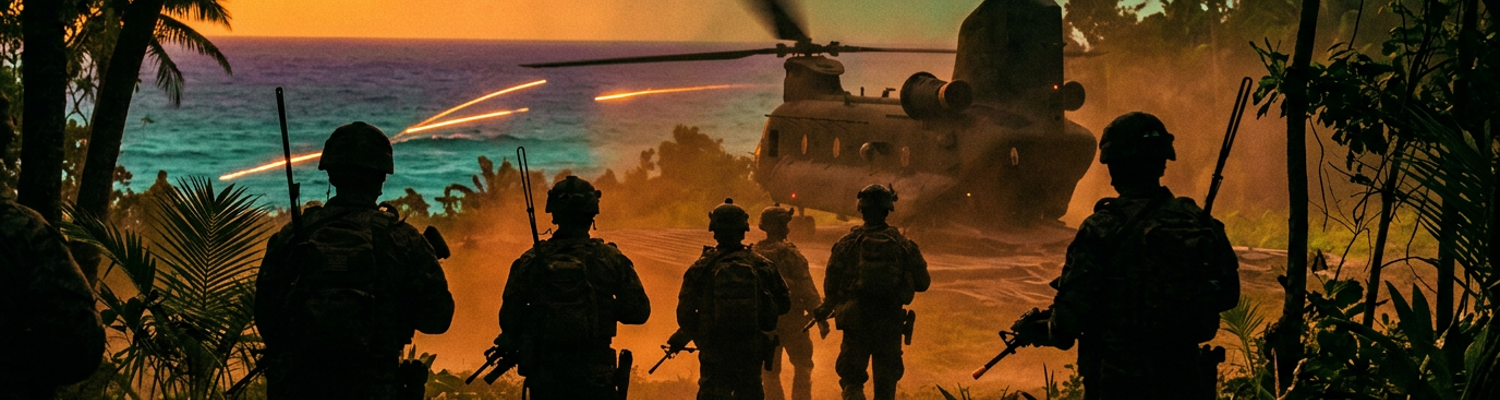
Fleet commanders steaming away from the island had failed to realize that infantrymen on the beachhead had collapsed their defensive lines under intense Khmer Rouge mortar and machine-gun fire during a frantic evacuation. Air Force knife-tail CH-53 helicopters flew through direct automatic fire and exploding rocket-propelled grenades to plant their rear ramps into the breaking surf in pitch darkness. Churning rotor blades kicked up heavy sprays of ocean water and sand that blinded the wounded troops crawling across the exposed beach. Crew chiefs pulled exhausted riflemen across the cargo decks under heavy direct fire, unable to verify passenger manifests amidst the loud engine noise and constant concussions. Helicopter pilots lifted their damaged aircraft off the sand under point-blank enemy fire, forcing the remaining perimeter units into scattered infantry pockets near the jungle tree line.
Infantry pockets near the jungle tree line prompted crewmen aboard an open wooden gig from the destroyer USS Henry B. Wilson to steer directly into the breaking surf. Direct small-arms fire struck the boat repeatedly in pitch darkness as sailors hauled soaked, exhausted riflemen over the gunwales and transported them back toward the waiting ship. Lance Corporal Joseph Hargrove, Private First Class Gary Hall, and Private Danny Marshall remained stationed farther inland at an isolated machine-gun bunker guarding the right flank of the perimeter. Orders to collapse the lines and pull back to the water line never reached their bunker because field telephone wires were severed and radio gear failed under the bombardment. The three abandoned Marines continued firing their machine gun into the jungle to protect the evacuation corridor, unaware that the gig and the helicopters had already pulled away into the ocean.
Ocean swells carried the destroyer USS Henry B. Wilson alongside the rest of the flotilla as the American task group withdrew toward Thailand, leaving the three Marines stranded behind enemy lines. Officers on the bridge learned of the catastrophic omission only after company sergeants completed the delayed head count and reported the empty bunks to the captain. Command personnel in the combat information center confirmed that Hargrove, Hall, and Marshall had no operational radios, no night-vision equipment, and only their individual ammunition belts remaining. Military commanders in Hawaii and Washington evaluated options to launch an emergency amphibious return assault, but senior leaders canceled all rescue plans because of high operational risks and political constraints. Lance Corporal Hargrove, Private First Class Hall, and Private Marshall remained isolated on the island, facing the entire Khmer Rouge garrison without naval gunfire support or medical evacuation.
Autopsy of Tactical Disconnects
Evacuation failures and gunfire support delays led investigators examining battalion rosters to trace the abandonment of those three riflemen directly to the absence of any shared tracking system between the services. The catastrophic omission of a unified personnel accounting protocol between Air Force helicopter crews and ground forces created blind spots that no officer caught during the chaotic boarding. Marine company clerks held paper rosters on clipboards while Air Force crew chiefs counted helmets by eye inside the noisy, smoke-filled cargo bays. Helicopter pilots reported rough totals over their radios to airborne controllers without matching individual names to specific aircraft. Ground commanders assumed the aircrews were logging every soldier who stepped onto the loading ramps, while the flight crews believed the Marine sergeants were maintaining the master head counts on the beach. This complete lack of a joint tracking checklist allowed the three machine gunners to slip completely out of the tactical picture before the last transport cleared the surf.
Surf conditions and chaotic boarding tallies overwhelmed the teletype machines aboard the command ships, which struggled to relay these confused evacuation numbers across the ten-thousand-mile strategic loop back to Washington. The Joint Chiefs of Staff post-action report later identified crippling transmission delays that slowed every critical message bouncing between field radios, satellite relays, and Pentagon receiving terminals. Encrypted teletype messages took over ninety minutes to crawl through relay stations in Thailand, the Philippines, and Hawaii before reaching the National Military Command Center. Tactical commanders in the Gulf of Thailand needed split-second decisions on whether to hold the beach or authorize follow-up rescue flights, but their requests sat in electronic queues across multiple military networks. National leaders in the capital read field reports describing combat actions that had already ended hours earlier, causing planners to make critical choices using expired battlefield data.
Battlefield data delays forced radio operators processing these outdated reports to transmit simultaneous and contradictory operational guidance originating from the White House Situation Room and command headquarters in Hawaii. Aides in the White House Situation Room sent orders demanding an immediate halt to all offensive actions because the merchant crew of the Mayaguez had already been released unharmed. Admiral Noel Gayler and his staff at headquarters simultaneously issued combat directives urging aggressive air cover and sustained pressure against the island defenses. Task force commanders aboard USS Coral Sea and the surrounding warships received these opposing directives over the same communication lines within minutes of each other. Ship captains and air wing leaders debated which authority took precedence while combat operations deteriorated into hesitation across the entire strike group.
Combat hesitation across the strike group prompted flotilla commanders to respond to the paralyzing command crossfire by ordering a complete disengagement and steaming their ships west toward the Thai coast. Flight leaders grounded their remaining serviceable helicopters at U-Tapao air base rather than launching a sweep back over the contested jungle canopy. Naval gunners secured their main turrets and ceased all shore bombardments, closing down the only fire support that could have shielded a recovery effort on the eastern beach. Staff officers filed the contradictory message logs into classified folders while company clerks finished their delayed survivor counts in shipboard offices. Marine sentries locked the flight deck hatches on the amphibious assault vessels, sealing the withdrawal and leaving the empty machine-gun bunker on Koh Tang behind the task force.
Cipher Machines and White House Communications
Task force sentries clamped steel dogging levers shut on those flight deck hatches while communications technicians below deck fed urgent withdrawal traffic into cryptographic units. These cipher machines converted sensitive combat transmissions into coded electric pulses, routing data over secure teletype lines that linked President Gerald Ford directly to Seventh Fleet surface vessels in the Gulf of Thailand. Radio operators watched the motorized rotors inside the gray metal cabinets turn and clatter as the system printed real-time updates onto long rolls of paper tape. Specialists from the White House Communications Agency had installed these encrypted circuits across naval command centers to give executive leaders instantaneous access to the operational theater. Presidential aides and military assistants leaned over the receiving terminals in Washington, reading incoming shipboard dispatches seconds after gunners secured their turrets.
Gunners securing their turrets allowed President Gerald Ford and his civilian national security advisers to use these direct teletype lines to send minute tactical instructions that completely bypassed intermediate theater commanders. Transmissions flashed straight from the Situation Room to warship bridges, cutting regional task group commanders out of the operational loop. This electronic shortcut generated intense operational friction throughout the naval hierarchy because senior admirals in Hawaii struggled to determine what orders their own forward ships were executing. Civilian officials in the capital debated individual flight profiles, specific ordnance selections, and perimeter adjustments, dictating ground-level tactics to captains maneuvering in hostile waters. Flag officers along the traditional chain of command discovered new strike directives or sudden halts only after surface vessels had already altered heading or gunners had already checked fire.
Gunners checking fire added to the confusion for destroyer captains attempting to coordinate the chaotic offshore movements, who faced overlapping, contradictory directives arriving across these same compromised channels. Warship commanders received firing coordinates from local air controllers only to have incoming White House messages countermand the bombardment in favor of diplomatic posturing. Ships assigned to screen the transport helicopters adjusted their boiler speeds and radar sweeps according to instructions typed by defense aides who had never seen the reefs of Koh Tang. Cryptographers in shipboard communication centers worked continuously to tear perforated tapes from the machines, trying to log incoming civilian inquiries while urgent distress calls from ground teams went unanswered on tactical frequencies. High volumes of executive queries tied up vital radio bandwidth, preventing frontline commanders from sorting out missing personnel lists before the task force steamed beyond rescue range.
Rescue range limitations and operational friction across Seventh Fleet Task Force 73 were captured by microphones inside the White House Situation Room, preserving real-time audio logs and teleconference records that tracked combat execution minute by minute. These preserved recordings captured civilian leaders questioning naval captains over crackling telephone patches, demanding immediate damage assessments while smoke still hung over the landing zones. Staff aides scribbled details from these conversations onto legal pads as commanders aboard the support vessels reported conflicting helicopter arrival times and fluctuating troop counts. Archivists subsequently indexed these sound reels alongside bundles of punched teletype paper, documenting how White House personnel had directed individual unit maneuvers from the opposite side of the globe. Naval clerks on the returning warships secured their cryptographic rotors and filed the contradictory message sheets, locking away the paper records of the tactical intervention as the fleet steamed toward Thailand.
Radio Latency and Signal Bottlenecks
Warships bound for Thailand carried radio consoles that had buckled under severe high-frequency propagation signal attenuation and bandwidth choke points between the fleet, U-Tapao Royal Thai Air Base, and the tactical assault elements. Atmospheric heat, humidity, and solar radiation over the Gulf of Thailand distorted high-frequency radio waves, warping voice transmissions into undecipherable bursts of static. Air Force dispatchers at U-Tapao struggled to broadcast flight coordination updates and fuel status reports, but the narrow high-frequency spectrum quickly jammed under the sheer volume of competing priority traffic. High-powered naval transmitters aboard command ships routinely drowned out lower-wattage signals from the Thai air base, cutting dispatchers off from inbound helicopter flights. Technicians on watch rotated tuning dials across secondary channel assignments, but every alternate frequency ran into the same atmospheric fading across the open sea. Fleet commanders and air coordinators lost continuous voice contact during the critical morning hours when transport helicopters made their initial approaches into heavy enemy anti-aircraft fire.
Anti-aircraft fire forced commanders on the airborne battle staff circling Koh Tang in an EC-130 aircraft to attempt to direct fire support for the burning helicopters, but they faced delays of up to forty-five minutes for critical operational status messages. Naval gunfire control officers aboard the destroyers USS Harold E. Holt and USS Henry B. Wilson needed clear grid coordinates and target verification before firing their five-inch guns toward the tree line. Airborne controllers had to write down distress calls from isolated landing zones, encode the tactical reports by hand, and wait in crowded radio queues to relay the text across degraded shipboard channels. Enemy machine-gun crews and mortar squads shifted positions into fresh jungle trenches long before those forty-five-minute message queues cleared the radio airwaves. Destroyer captains checked their fire or dropped high-explosive rounds onto empty sandbars, unable to confirm whether friendly Marines were sheltering mere yards from the targeted bunkers. Gunfire support officers repeatedly asked for fresh spotter corrections, but their inquiries sat unread in electronic message backlogs while fighting intensified along the landing beaches.
Landing beaches pinned down Marines who attempted to establish their own firing links to offshore ships, but the failure of squad-level backpack transceivers to penetrate the dense jungle canopy and overcome corrosive saltwater exposure wrecked their tactical coordination. Saltwater flooded through worn rubber seals and corroded internal wiring assemblies the moment radio operators dropped from helicopter ramps into chest-deep ocean swells. Lithium battery packs short-circuited in the corrosive brine, leaving squad leaders holding dead plastic handsets on open sand exposed to heavy rifle fire. Sets that survived the surf faced an impenetrable wall of dense tropical hardwoods and vine canopies, which smothered line-of-sight signals before they could travel three hundred yards. Whip antennas snapped against low-hanging branches or directed weak radio energy straight into moisture-saturated vegetation rather than reaching the circling command aircraft. Rifle company commanders lost all electronic contact with their forward squads, forcing platoon sergeants to run through enemy crossfire to deliver verbal orders across the fragmented beachhead.
Beachhead communications failures forced pilots flying OV-10 Bronco observation aircraft to swoop low over the tree line to bridge this gap by searching for colored Marine signal smoke. Dense jungle foliage and rising black smoke from burning helicopter fuselages hid friendly ground markers from the cockpit view. Airborne flight leaders radioed warnings across secondary command channels that forward air controllers could no longer distinguish Marine foxholes from Khmer Rouge gun emplacements. Strike flight commanders responded by diverting incoming A-7 Corsair attack jets away from the island perimeters to prevent friendly-fire casualties along the tree line. Marine squad leaders withdrew their remaining riflemen back toward the high-tide surf line, digging shallow fighting scrapes into the wet sand with their entrenching tools.
Beachhead Assaults and Incompatible Tactical Radios
Entrenching tools hit coral and wet sand while heavy machine-gun bullets and rocket-propelled grenades snapped overhead from concealed bunkers inside the treeline. Those shallow scrapes offered little shelter from the devastating ambush that had already wrecked the initial assault waves on both sides of the island. On Western Beach, Air Force CH-53 helicopter Knife 21 landed its twenty Marines under intense crossfire before enemy rounds destroyed an engine, forcing the pilot to struggle out over the water and ditch one mile offshore. A second transport, Knife 22, attempted to touch down beside the tree line, but heavy machine-gun fire punctured its fuel tanks and shattered internal systems, forcing the crew to abort the insertion and limp toward the Thai mainland before crash-landing on the coast. Across the narrow island on Eastern Beach, entrenched Khmer Rouge gunners met CH-53 Knife 31 with a barrage of rocket-propelled grenades that ignited the helicopter fuel sponson and blew apart the forward cockpit, sending the aircraft crashing into the surf fifty meters from shore.
Shore crashes prompted Marine radio operators crouching in the water and sand to immediately grab their tactical transceivers to alert inbound strike flights and coordinate fire on the enemy treeline. These riflemen discovered that their squad-level backpack radios operated exclusively on VHF-FM frequency bands, whereas Air Force CH-53 helicopters and orbiting jet fighters used UHF systems. Pre-mission planners had failed to establish coordinated radio channel assignments between the two service branches, completely preventing ground Marines and Air Force pilots from achieving direct tactical voice contact. Flight crews banking over the smoke could neither hear the distress calls from the surf nor broadcast warning messages about newly spotted machine-gun positions to the troops below. Marine squad leaders shouted across the open sand without any means of telling approaching pilots that the landing zones remained swept by interlocking heavy weapons fire.
Weapon fire forced radio operators on the ground to break through the communications silence by routing immediate close air support requests through an airborne HC-130 King forward air control aircraft orbiting miles offshore. Crew members inside this high-flying aircraft operated multi-band equipment capable of bridging the tactical gap between Marine backpack radios and Air Force flight channels. Airborne controllers transcribed coordinates dictated over crackling survival transceivers, verified the positions against hand-drawn island maps, and then switched frequencies to pass the targeting data to orbiting A-7 Corsair attack jets. This forced relay through an offshore intermediary inserted agonizing minutes of delay into every air support request while Khmer Rouge heavy machine guns continued raking the exposed beachheads without interruption. Pinned infantrymen watched enemy gun crews reload their weapons and shift firing pits while the airborne radio network processed the coordinates miles away over open water.
Water relays finally allowed American attack pilots to swoop over Koh Tang to drop high-explosive ordnance and fire twenty-millimeter cannons, but the lack of direct ground contact created constant hazards for the pinned riflemen. Marine platoon commanders tried to mark their frontline traces by throwing colored smoke grenades, but the heavy sea breeze blew the colored clouds across enemy bunkers and obscured the target areas. Attack jets pulled out of diving runs or jettisoned bombs far into the jungle canopy because pilots could not verify friendly positions without direct voice guidance from the beach. Shrapnel and knocked-down tree limbs rained across the shallow Marine fighting scrapes whenever aircraft guns struck close to the waterline. Marine commanders pulled their men even tighter against the surf line, conserving ammunition and bracing for continued mortar barrages as the afternoon heat intensified over the severed beachheads.
Extraction Orders and Close Air Support Scrambles
Beachheads took more damage as shrapnel from incoming mortar rounds struck the wet sand just as diplomatic confirmation of the SS Mayaguez crew release near Kampong Som reached Washington, triggering immediate White House directives to halt offensive fire. President Gerald Ford and his national security advisors learned that a Cambodian fishing boat had delivered the American crew unharmed to the guided missile destroyer USS Henry B. Wilson, prompting administration officials to assume that the combat crisis had concluded. White House staff members quickly transmitted orders down the chain of command demanding an immediate stop to all aggressive actions against Khmer Rouge forces. Pacific command headquarters in Hawaii attempted to impose these sudden political instructions onto the tactical theater, but rifle companies on both Koh Tang beachheads were still locked in violent combat against machine gun nests and mortar emplacements. Marine platoon leaders on the shoreline could not simply break contact with hostile forces who were pressing forward from thirty yards away, producing a severe operational contradiction between executive ceasefire announcements in Washington and literal physical survival on the island.
Survival on the island became more precarious when radio controllers in orbiting command aircraft immediately broadcast these presidential ceasefire instructions across tactical flight channels, throwing close air support operations into widespread disarray. The repeated cancellation and resumption of tactical air strikes by Corsair and Phantom aircraft caused operational confusion over beachhead perimeters throughout the afternoon. Attack pilots rolled their aircraft into diving bombing runs over active Khmer Rouge bunker complexes only to hear abrupt abort transmissions over their headsets, forcing them to pull up sharply toward open water with heavy ordnance still secured to their wings. Airborne forward air controllers then received frantic distress messages from pinned ground units begging for suppression fire, prompting flight leaders to reverse the abort orders and clear the jets back into the combat zone minutes later. This constant starting and stopping of attack profiles burned up jet fuel reserves and left Marine riflemen guessing whether incoming engine sounds signaled overhead protection or another sudden withdrawal, providing enemy gunners ample time to reposition their weapons.
Weapons repositioning by the enemy prompted commanders at regional air headquarters to attempt to break this tactical stalemate by deploying an extreme shock weapon to suppress the Khmer Rouge gun positions and blast a landing zone out of the jungle. The unannounced tactical detonation of a massive BLU-82 Daisy Cutter bomb severed residual ground communications and disoriented friendly defensive lines across the narrow island. Rolled from the rear cargo ramp of a C-130 transport at six thousand feet, the massive bomb detonated just above the tree canopy, releasing an overpressure blast wave that sheared mature hardwood trees off at their trunks and created a wide clearing across the interior ridge. Concussion waves struck the Marine perimeters along the waterline, knocking riflemen off their feet, rupturing eardrums, and filling foxholes with shattered tree limbs and choking gray dust. The physical violence of the atmospheric shockwave destroyed delicate whip antennas and shorted out the internal circuitry of the remaining backpack radios, leaving ground commanders cut off from circling aircraft and from their own isolated squads.
Squad isolation required Marine officers to drag stunned riflemen back to their firing positions through the heavy smoke and falling debris to rebuild a cohesive perimeter before enemy counterattacks could exploit the blast. Platoon sergeants used visual hand gestures through the dust because ruptured eardrums and dead tactical transceivers prevented any normal voice or radio communication between foxholes. Squad leaders distributed their last magazines of rifle ammunition and loaded machine-gun belts by hand while watching the shattered tree line for movement. Forward air controllers overhead circled low over the rising smoke column, frantically attempting to reestablish radio contact with ground teams who no longer answered call signs. Navy and Air Force transport helicopters held in loose holding patterns miles out to sea, waiting for an extraction signal through static-filled channels while darkness began to gather over the Gulf of Thailand.
Congress and Joint Communications Reforms
Darkness over the Gulf of Thailand covered the withdrawal as helicopter crews shut down their smoking turbine engines on carrier decks and mainland runways, delivering wounded Marines to field doctors while military headquarters tallied forty-one dead across the operation. The heavy loss of American lives and the chaotic radio failures reached Capitol Hill within days, sparking intense political scrutiny. The House Committee on International Relations launched an official investigation into command breakdowns and flawed intelligence handling during the Koh Tang operation, demanding radio logs, flight manifests, and internal memoranda from the Pentagon. Investigators questioned defense officials about why planners sent assault troops onto Koh Tang under the false assumption that the island held only twenty lightly armed irregulars, when Cambodian defenders actually manned fortified machine-gun bunkers with rocket launchers. Committee staff members uncovered critical breakdowns where naval intelligence officers failed to route updated reconnaissance reports to Marine assault planners before the helicopters departed Thailand. The final congressional report condemned senior military leaders and civilian officials for poor intelligence coordination, reckless assumptions, and an overcentralized command structure that bypassed local commanders while failing to give front-line troops accurate threat estimates.
Threat estimates and fractured radio transcripts prompted Pentagon communications engineers to establish clear Department of Defense requirements for dedicated multi-service tactical satellite communications. Defense planners recognized that ground troops, naval task forces, and combat aircraft could no longer depend on fragile high-frequency channels and mismatched tactical transceivers during joint operations. These technical mandates prompted the rapid acceleration of the Defense Satellite Communications System II program, pushing military contractors to speed up the manufacturing and orbital deployment of advanced satellites. Engineers designed these advanced spacecraft to carry high-capacity super-high-frequency transponders capable of handling voice, teletype, and automated digital data across thousands of miles of open ocean. Fleet commanders and air base dispatchers installed standardized satellite terminals on warship superstructures, mobile ground vehicles, and airborne command posts to guarantee uninterrupted links during combat. Spacecraft technicians at Cape Canaveral prepped additional satellites on Titan III launch vehicles, ensuring that tactical commanders could maintain common channels above regional battlefields without relying on vulnerable relay planes.
Relay planes and upgraded satellite relays alone could not solve the deep organizational rivalries that legislators on Capitol Hill recognized had divided the armed services on Koh Tang. Lawmakers used the tactical and joint interoperability failures at Koh Tang as foundational case studies and early legislative justification for the Goldwater-Nichols Department of Defense Reorganization Act. Congressional staff members cited the disaster alongside later joint operational breakdowns in Iran and Grenada, showing how separate service chains of command paralyzed combat execution. Military analysts demonstrated to Congress that the absence of a unified theater commander allowed individual services to plan the assault in isolation, creating uncoordinated radio frequencies, incompatible tactical procedures, and disastrous head counts. The Goldwater-Nichols Act dismantled these isolated service fiefdoms by legally empowering unified combatant commanders, elevating the Chairman of the Joint Chiefs of Staff, and mandating joint training and interoperable communications equipment across all military branches. Defense officials rewrote joint operational doctrine around these legal reforms, establishing joint task force commands that required every aircraft, warship, and ground squad to operate under a single unified commander with shared radio networks.