Full Calendar
THIS DAY IN U.S. MILITARY HISTORY • NOVEMBER 2 1943 U.S. Navy World War II

Battle of Empress Augusta Bay Crushes Japanese Fleet

Rear Admiral Aaron S. Merrill directs cruiser gunfire and destroyer torpedo attacks off Bougainville to safeguard Allied beachheads.
Battle of Empress Augusta Bay Crushes Japanese Fleet

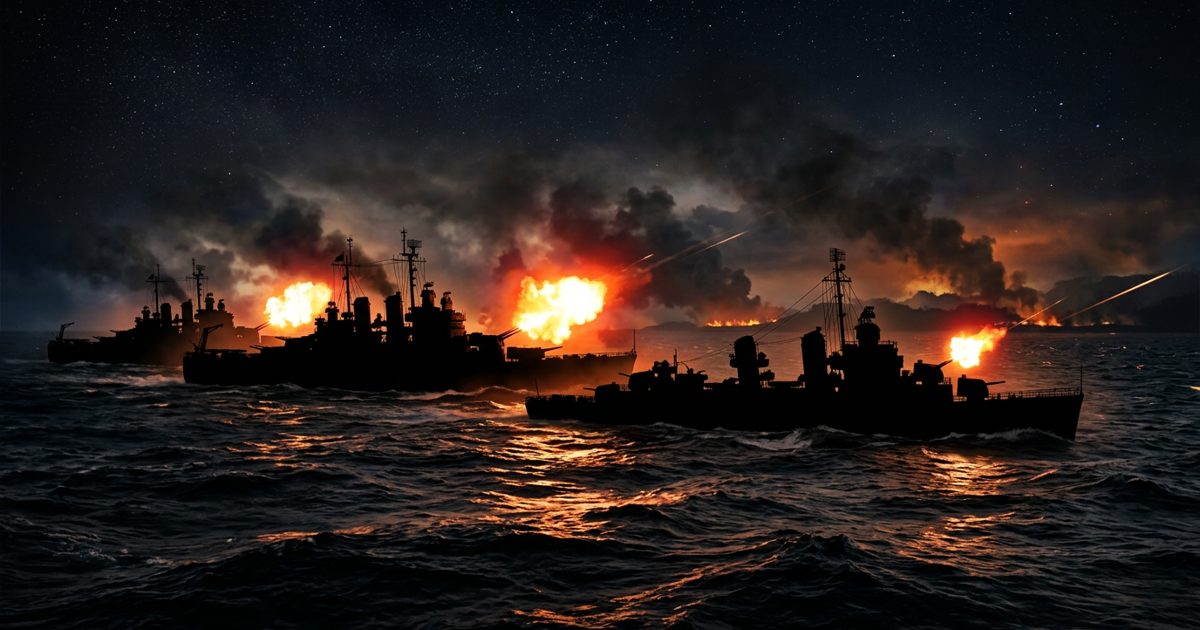
Radar operators aboard the light cruiser USS Montpelier tracked contacts northwest of Empress Augusta Bay during the early morning hours off Bougainville. Rear Admiral Aaron S. Merrill commanded Task Force 39, comprising four light cruisers and eight destroyers, maneuvering to intercept an incoming Japanese surface force. Rear Admiral Sentaro Omori led two heavy cruisers, two light cruisers, and six destroyers dispatched from Rabaul to bombard the newly established Allied beachhead at Cape Torokina. Merrill aligned his cruisers in column to maximize rapid radar-directed gunfire, while Captain Arleigh Burke led forward destroyer divisions to deliver torpedo strikes against the approaching Japanese formation.

Guns from the American cruiser line opened fire with continuous six-inch salvos directed by SG surface search and fire-control radar. Salvos struck the Japanese light cruiser Sendai, setting heavy fires that disabled the flagship and illuminated subsequent targets for USS Cleveland, Columbia, Denver, and Montpelier. Japanese maneuvers under sudden fire produced confusion, resulting in a collision between the heavy cruiser Myoko and the destroyer Hatsukaze. American destroyers closed the range to press torpedo and gun attacks, sinking Hatsukaze and damaging several accompanying vessels.

Daylight ended the engagement as Omori withdrew the remainder of his fleet toward Rabaul, leaving Sendai and Hatsukaze behind. Task Force 39 preserved the Allied beachhead without losing a vessel, sustaining repairable damage to the light cruiser Denver and destroyers Foote, Spence, and Thatcher. Allied carrier strikes against Buka airfields later that morning helped shield the returning warships from aerial counterstrikes. The surface action confirmed the effectiveness of American radar fire control during night naval combat and secured the perimeter for the 3rd Marine Division at Bougainville.

CHRONOLOGICAL RECORD

November 2 Across U.S. Military History

9 Verified Events
1775 Continental Navy Landmark Event • American Revolution

Continental Congress Expands Naval Committee Operations

Delegates in Philadelphia empower the Naval Committee to agree with officers and seamen to man and command four armed vessels authorized for the Continental fleet. The resolution also allocates one hundred thousand dollars to procure vessels and establishes prize share regulations, creating the administrative apparatus for early American naval warfare.

1783 Continental Army Landmark Event • American Revolution

Washington Issues Farewell Orders to the Armies

General George Washington issues his formal farewell orders to the Continental Army from his headquarters at Rockingham near Rocky Hill, New Jersey. The address commends his citizen soldiers for eight years of steadfast service, urges dedication to the federal union, and prepares the army for peacetime discharge.

1861 U.S. Army • American Civil War

Lincoln Relieves General Fremont in Missouri

President Abraham Lincoln issues orders relieving Major General John C. Fremont from command of the Department of the West at Springfield, Missouri. Major General David Hunter assumes temporary departmental command following severe administrative conflict and disputes over Fremont unauthorized emancipation proclamation.

1863 U.S. Army • American Civil War

Union Expeditionary Forces Occupy Brazos Island

Troops under Major General Nathaniel P. Banks land along the lower Texas coast and occupy Brazos Island near the mouth of the Rio Grande. The amphibious landing establishes a permanent federal staging post intended to disrupt Confederate cotton exports through neutral Mexican territory.

1899 U.S. Navy • Philippine-American War

Protected Cruiser Charleston Wrecked on Camiguin Reef

Navigators aboard the protected cruiser USS Charleston strike an uncharted coral reef off Camiguin Island north of Luzon during operations supporting ground troops. Crewmen abandon the wrecked warship without loss of life and establish camp on the island until the gunboat USS Helena arrives to rescue them.

1943 U.S. Army Air Forces • World War II

Major Wilkins Attacks Japanese Shipping at Rabaul

Bombers of the 89th Bombardment Squadron strike Japanese vessels in Simpson Harbor at Rabaul during a low-level B-25 Mitchell assault. Major Raymond H. Wilkins destroys two enemy vessels and intentionally draws heavy antiaircraft fire away from his formation before crashing into the water, earning the Medal of Honor posthumously.

1950 U.S. Army Landmark Event • Korean War

Eighth Cavalry Makes Desperate Stand at Unsan

Soldiers of the 8th Cavalry Regiment face encirclement near Unsan when three divisions of the Chinese People's Volunteer Army launch a sudden night assault. The regiment's 3rd Battalion maintains a determined perimeter defense that stalls the breakthrough while neighboring units establish rear defensive positions.

1968 U.S. Navy • Vietnam War

Riverine Forces Launch Operation Search Turn

Patrol craft and assault boats of Task Force 194 enter the Cai San and Rach Gia canals to initiate Operation Search Turn in the Mekong Delta. The sweep establishes the first waterway interdiction barrier under the SEA LORDS strategy to cut off Viet Cong infiltration routes from Cambodia.

1983 U.S. Army Landmark Event • Cold War

Combat Operations Conclude for Operation Urgent Fury

Commanders in Grenada declare active combat operations successfully concluded following eight days of joint maneuvering by Army Rangers, paratroopers, and Marines during Operation Urgent Fury. The secured island transitions from hostile assault missions to stabilization and peacekeeping operations alongside regional Caribbean forces.

MEDAL OF HONOR ACTION 1944

Second Lieutenant Robert E. Femoyer Navigates Damaged Flying Fortress

Flak bursts struck the B-17 Flying Fortress of the 711th Bombardment Squadron during a daylight bombing raid against synthetic oil refineries near Merseburg, Germany. Three antiaircraft shells detonated directly against the fuselage, wounding navigator Second Lieutenant Robert E. Femoyer with severe fragments in his back and side. The bomber dropped out of formation with failing controls, flying alone across hostile territory while exposed to enemy defenses. Femoyer collapsed to the cabin floor bleeding heavily, but he refused morphine injections from crewmates to keep his thinking clear.

Maps and navigation tables were held up by crewmen so Femoyer could read instruments while propped against the cabin bulkhead. The wounded officer calculated heading adjustments, guiding the crippled bomber around known antiaircraft concentrations for more than two hours. His precision plotting carried the aircraft safely over occupied Europe and across the English Channel toward the home airfield at Rattlesden. Femoyer accepted a sedative only after the aircraft reached friendly territory, succumbing to his wounds shortly after touchdown.