Full Calendar
THIS DAY IN U.S. MILITARY HISTORY • NOVEMBER 3 1967 U.S. Army Vietnam War

Battle of Dak To Ignites in the Central Highlands

Soldiers of the 4th Infantry Division clash with entrenched North Vietnamese forces across the rugged jungle ridgelines of Kon Tum Province.
Battle of Dak To Ignites in the Central Highlands

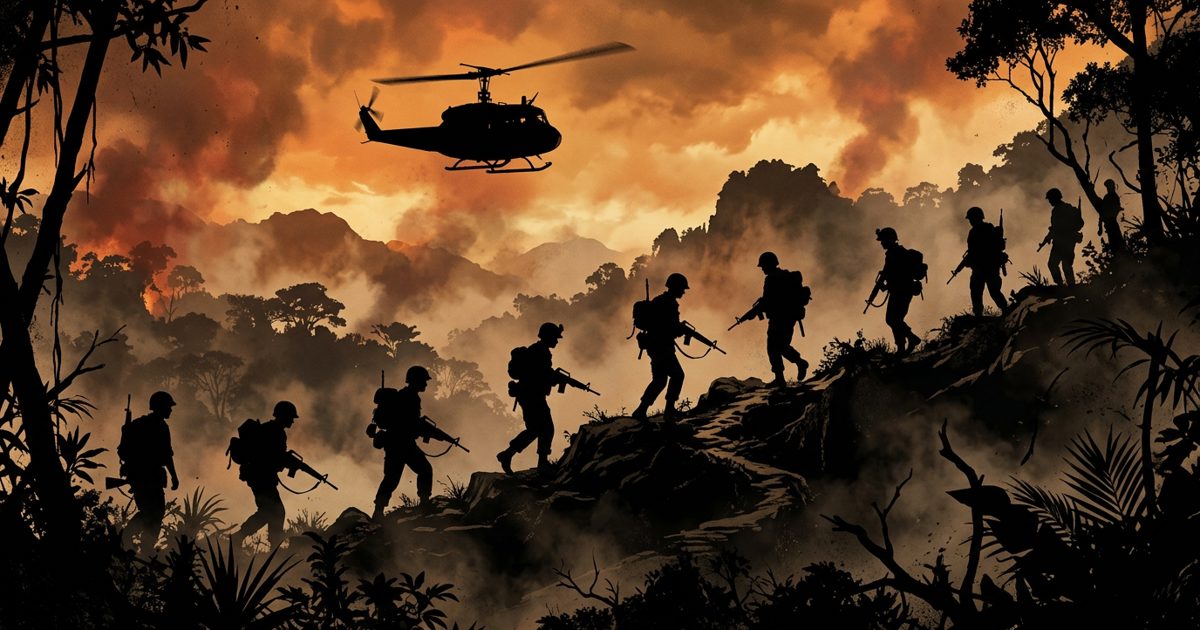
Patrols from the 3rd Battalion, 12th Infantry Regiment pressed up the jagged terrain of Hill 1338 near Dak To on November 3, 1967. Bravo Company encountered entrenched positions manned by soldiers of the North Vietnamese 32nd Regiment hiding under dense triple-canopy jungle. Enemy machine gunners opened fire from camouflaged earthen bunkers, pinning down the lead American platoon along the ridgeline. Heavy artillery batteries and tactical strike aircraft quickly dropped ordnance across opposing slopes to suppress enemy fire. American reinforcements established forward fire support bases to counter massed North Vietnamese divisions operating across the tri-border plateau.

Artillerymen at these new mountain bases coordinated fire support alongside the 173rd Airborne Brigade as additional North Vietnamese regiments joined the engagement. Military commanders recognized that four North Vietnamese Army regiments intended to draw American forces away from major coastal cities toward the Cambodian border. General William Westmoreland committed sixteen thousand American soldiers into the surrounding hills under Operation MacArthur to engage the hostile formations. Combat engineers blasted emergency landing zones through thick bamboo thickets so helicopters could evacuate wounded soldiers and deliver ammunition stockpiles.

Helicopter crews maintained supply corridors through heavy ground fire while tactical aircraft struck fortified enemy positions throughout the three-week campaign. Ground forces systematically cleared hilltop bunkers using direct rifle fire, satchel charges, and supporting artillery. North Vietnamese units eventually broke contact and withdrew across the border into sanctuaries in Laos and Cambodia by late November. American forces retained control over the Dak To valley after suffering 376 killed and 1,441 wounded during the protracted fighting.

CHRONOLOGICAL RECORD

November 3 Across U.S. Military History

8 Verified Events
1783 Continental Army Landmark Event • American Revolutionary War

Continental Army Officially Disbands at Newburgh

General George Washington ordered the disbandment of the Continental Army following congressional resolutions and the ratification of the Treaty of Paris on November 3, 1783. Soldiers stationed at the New Windsor cantonment in New York returned home after eight years of conflict. Small garrisons remained active only at West Point and Fort Pitt to guard public military stores.

1813 U.S. Army • War of 1812

General Coffee Defeats Red Sticks at Tallushatchee

Brigadier General John Coffee led one thousand mounted Tennessee militia dragoons to surround Red Stick Creek warriors at Tallushatchee on November 3, 1813. Decoy companies drew defenders into an open encirclement where American rifle fire overwhelmed the village defenses. General Andrew Jackson subsequently advanced his army south from Fort Strother to continue operations across the Mississippi Territory.

1853 U.S. Navy • Antebellum Era

USS Constitution Intercepts Slave Ship Gambrill

Sailors aboard the frigate USS Constitution intercepted and boarded the American schooner H.N. Gambrill off the coast of West Africa on November 3, 1853. Boarding parties found empty holds fitted out specifically for transporting captives to slave markets in Cuba. Naval officers seized the vessel as the final operational capture in the service history of the venerable frigate.

1863 U.S. Army • Civil War

Union Rear Guard Fights at Bayou Bourbeux

Soldiers of Confederate Brigadier General Thomas Green struck an isolated Union rear guard encamped along Bayou Bourbeux on November 3, 1863. First Lieutenant William Marland led a countercharge with his section of the 2nd Massachusetts Battery after cavalry support fell back. Marland successfully brought off his field artillery pieces and later received the Medal of Honor for his conduct.

1942 U.S. Marine Corps Landmark Event • World War II

Marines Launch Koli Point Action on Guadalcanal

Marines from the 7th Marine Regiment deployed east of the primary perimeter at Koli Point on November 3, 1942, to intercept advancing Japanese forces. Lieutenant Colonel Herman Hanneken coordinated infantry companies and artillery to isolate enemy units attempting to reinforce positions near Henderson Field. Marine defenses contained repeated Japanese assaults over the ensuing nine days.

1943 U.S. Navy Landmark Event • World War II

Pearl Harbor Salvage Crews Refloat USS Oklahoma

Shipyard salvage crews refloated the battleship USS Oklahoma in Pearl Harbor on November 3, 1943, completing months of righting operations. Engineers operated twenty-one shore-mounted electric winches and pumped water continuously from the hull. Workers cleared the harbor berth before towing the ship into Dry Dock Number Two for stripping and structural assessment.

1944 U.S. Army • World War II

Sergeant Mower Earns Medal of Honor on Leyte

Sergeant Charles E. Mower assumed command of his infantry squad near Capoocan on Leyte on November 3, 1944, after his squad leader was killed. Wounded while crossing a stream under machine gun fire, Mower stood exposed in the water to direct riflemen against enemy bunkers. His direction eliminated two hostile positions before he was killed, earning him the Medal of Honor.

1950 U.S. Air Force • Korean War

Fifth Air Force Covers Chongchon River Withdrawal

Fighter-bombers of the Fifth Air Force flew close air support missions across northwest Korea on November 3, 1950. American pilots struck advancing Chinese infantry formations to shield United Nations forces pulling back toward the Chongchon River. Aerial strikes disrupted enemy roadblocks and allowed ground units to establish defensible perimeter lines south of the river.

WEAPONS AND TECHNOLOGY 1943

Eighth Air Force Unveils H2X Radar Blind Bombing Over Wilhelmshaven

Technicians equipped twelve B-17 bombers with experimental H2X radar sets developed by the Massachusetts Institute of Technology Radiation Laboratory before the European winter campaign. Operators relied on the microwave radar system to identify coastlines and waterways through dense overcast. Commanders deployed eleven of these pathfinder aircraft on November 3, 1943, to lead 539 heavy bombers against naval shipyards at Wilhelmshaven, Germany. Thick cloud decks completely obscured the target, preventing conventional visual sighting through Norden bombsights. Pathfinder navigators watched cathode-ray radar displays to position the bomber stream directly over the port.

Pathfinder crews dropped colored target-marker smoke bombs through the clouds, signaling trailing formations to release over one thousand tons of high explosives and incendiaries. Escorting P-38 Lightnings accompanied the bombers along the route, limiting operational losses to seven aircraft against enemy interceptors. Post-strike reconnaissance confirmed extensive damage across naval dry docks and submarine slips despite zero ground visibility during the run. Execution of the raid demonstrated that American strategic bombers could maintain a daylight bombing campaign through adverse European winter weather.