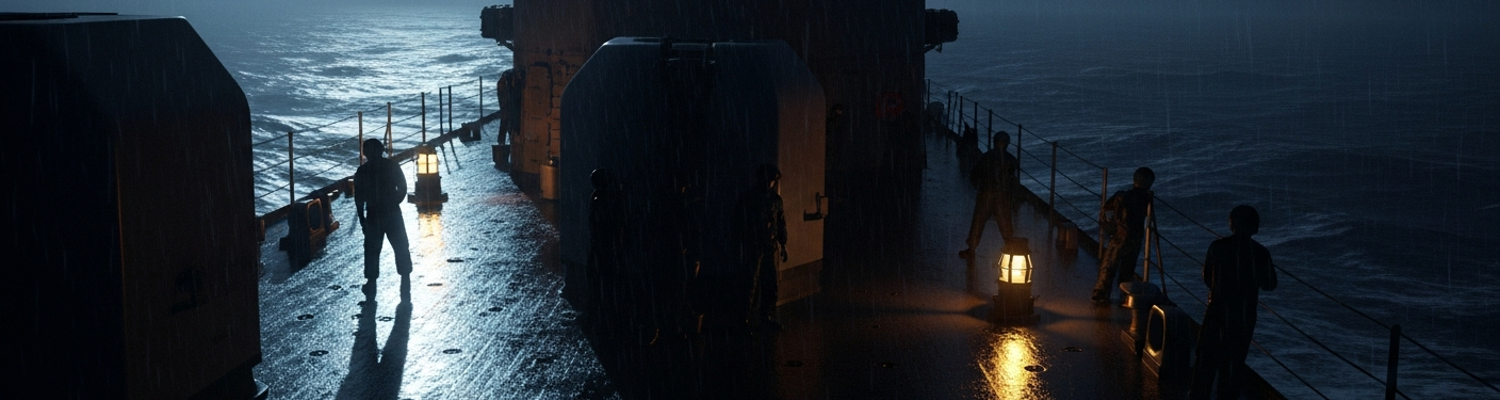

USS O'Bannon Aegean Surveillance Mission
04:31 local time, December 27, 1995. The American destroyer USS O'Bannon (DD-987) carved a routine search pattern through the eastern Aegean Sea at coordinates 37°03’N, 27°09’E. A product of a bygone conflict, the O'Bannon was a Spruance-class destroyer, one of the large, quiet hulls designed for anti-submarine warfare against the Soviet Union. By the mid-1990s, these 9,200-ton vessels, driven by four General Electric LM2500 gas turbines, were aging but remained essential platforms. Their spacious design had allowed for upgrades, including a 61-cell Vertical Launch System and, for this mission, the AN/SLQ-32(V)2 electronic warfare suite. The ship was a Cold War platform, its crew of roughly 340 sailors now executing missions far removed from the open-ocean threat the vessel was built to counter.
Their mission was electronic intelligence. ELINT.
Operational logs from this period indicate the O'Bannon was conducting a standard surveillance mission in a historically contested maritime space between two NATO allies, Greece and Turkey. Tensions were exceptionally high. Two days prior, a Turkish cargo ship ran aground on the disputed Imia/Kardak islets, a pair of uninhabited rocks claimed by both nations. The incident escalated rapidly, with Athens and Ankara making aggressive statements and maneuvering naval forces. The O'Bannon’s task was to patrol international waters and use its AN/SLQ-32 system, known as the "Slick-32," to intercept and analyze electronic emissions from both sides. Inside the windowless Signals Exploitation Space, Cryptologic Technicians monitored the electronic order of battle, identifying the operating characteristics of air-search radars and fire-control systems to build an intelligence picture for the U.S. Sixth Fleet.
This type of operation was a signature of the post-Cold War U.S. Navy. The 1992 "From the Sea" strategic document had pivoted the Navy’s focus from global confrontation to power projection in littoral regions. Naval forces were now instruments for regional stability and crisis response. This high operational tempo, however, occurred against a backdrop of shrinking fleets and tightening budgets. Ships like the O'Bannon, commissioned in 1979, were deployed longer with fewer resources for maintenance. Naval records from the 1990s (NARA Record Group 38) show a consistent pattern of deferred upkeep and an increasing reliance on crew ingenuity to keep aging systems running. The O'Bannon was a direct reflection of this: a capable warship whose 1970s-era systems were under constant strain.
Maritime Militia Electronic Signature Detection
System logs from the O'Bannon’s AN/SLQ-32(V)2 suite reveal the first sign of trouble was not a clear threat, but an electronic mess. The technicians on watch were accustomed to the Aegean’s dense but predictable electronic environment. They expected the emissions of Greek and Turkish naval assets, the specific pulse repetition frequencies of a Thomson-CSF TRS-3001 Triton G radar or the signature of a Signaal DA08 air search radar. The system's threat library was built for this. Instead, starting around 02:00 local time, their consoles began showing dozens of strange emitters. These were not military-grade signals. They were weaker, erratic, and used commercial X-band and S-band frequencies associated with civilian marine radars. Their behavior was the problem. A standard fishing vessel broadcasts a consistent signal. These contacts were intermittent, their transmissions seemingly coordinated, creating a wash of low-grade electronic noise that degraded the AN/SLQ-32’s ability to discriminate between targets. The operators faced a screen full of phantoms, a digital clutter that made identifying a genuine threat signature like trying to hear a whisper in a factory.
Their electronic vision was becoming dangerously blurred.
Post-incident intelligence analysis would identify these emitters as belonging to a newly designated formation: the Aegean Maritime Militia. This was not a formal naval reserve. It was a state-sponsored but deniable force of civilian vessels, primarily fishing trawlers and coastal cargo haulers, crewed by nationalist volunteers. Their primary weapon was ambiguity. By operating with civilian-grade equipment in a quasi-military manner, they exploited the rules of engagement and created a classification dilemma. The O'Bannon’s crew had no file for this. This force was activated after the Imia/Kardak incident to swarm the disputed islets, assert a physical presence, and screen the movements of official Turkish naval units operating behind them. Their numbers and erratic electronic behavior created a mobile shield of interference.
The tactical problem was compounded by the physical threat this electronic screen was designed to hide. While the militia’s trawlers created electronic chaos, they also provided cover for numerous small, fast attack craft. Archival analysis points to the use of vessels analogous to rigid-hulled inflatable boats (RHIBs) and small patrol craft under 20 meters in length. These boats presented a minimal radar cross-section, making them difficult for the O'Bannon’s AN/SPS-55 surface-search radar to detect in the littoral environment. Their electronic signatures were negligible. The militia trawlers acted as a mothership and refueling network for these smaller craft, allowing them to operate in coordinated packs. For the 9,200-ton destroyer, built to track Soviet submarines, this presented an asymmetric nightmare. The threat was no longer a single warship with a powerful radar, but a swarm of small, fast, and ambiguous contacts emerging from a fog of electronic noise.
High-Speed Craft Uncoordinated Attack
The attack began without a specific precursor. At 04:47 local time, the tactical displays in the Combat Information Center (CIC) erupted. Logs from the AN/SPS-55 surface search radar show more than two dozen contacts, previously masked by the trawlers, detaching and accelerating toward the destroyer from multiple bearings. Their speed, over 40 knots, and their chaotic vectors of approach created an immediate saturation of the CIC’s plotting teams. The ship’s crew, trained to counter the structured attacks of a Soviet naval group, was confronted with a problem for which no clear procedure existed. The assault was deliberately formless. Its primary goal was to overload the O'Bannon’s decision-making cycle, presenting the Tactical Action Officer (TAO) with too many potential threats to track, classify, and prioritize.
A swarm.
The seemingly uncoordinated nature of the assault was its most effective feature. Tactical reconstruction shows the boats did not operate in classic echelons. Small groups of two or three craft made high-speed, slashing runs from different quadrants, forcing the O'Bannon’s sensor operators and weapons crews to constantly shift their attention. This tactic directly exploited the limitations of a Spruance-class destroyer. The ship’s main 5-inch/54 caliber Mark 45 gun could only engage one or two surface targets at a time, its tracking speed insufficient to keep pace with multiple, fast-moving craft. The ship’s two Phalanx CIWS mounts, designed for last-ditch defense against missiles, had limited effectiveness against surface swarms. Their firing arcs were constrained by the ship’s own superstructure, and their magazines, holding approximately 1,550 rounds each, could be depleted rapidly. The attack was not uncoordinated; it was decentralized, a fluid assault designed to bypass the ship’s centralized, methodical defensive systems.
Intelligence identified the attacking force as over twenty high-speed craft, a mix of RHIBs and militarized civilian go-fast boats. They were not sophisticated warships. Their light armaments were a mix of Warsaw Pact and Western systems, primarily pintle-mounted 12.7mm DShK heavy machine guns and RPG-7 anti-tank grenade launchers. While incapable of sinking the destroyer, this ordnance was suited for a mission-kill. A single RPG hit could disable a sensor like the AN/SPG-60 fire-control radar or shred a communications array. The machine-gun fire was aimed at clearing the destroyer’s weather decks, preventing crew from manning the two .50 caliber machine gun mounts, the ship’s only flexible, human-directed defensive weapons. The boats used the larger, slow-moving militia trawlers as a mobile picket screen, darting out from behind them to attack before retreating into their radar shadow.
Broadband ECM Jamming Effectiveness
Technical review of the electronic event shows the jamming did not originate from military-grade hardware. Analysis points to the deployment of crude but powerful spark-gap jammers. These devices, sometimes referred to in reports by the designation "Trawler-Band Noise Emitter," were little more than repurposed high-voltage transformers and magnetrons scavenged from commercial marine radars. Bolted to the decks of the fishing trawlers and powered by their auxiliary generators, these emitters were electronically simple. They lacked any deception programming. Their function was to generate a massive amount of raw radio-frequency energy, a torrent of unstructured noise blasted across a wide swath of the S-band and X-band frequencies. These are the primary operating bands for most naval radars and, importantly, the bands monitored by the AN/SLQ-32 system. The militia trawlers, positioned in a rough arc 10 to 15 nautical miles from the O'Bannon, activated these devices in a coordinated fashion, creating a wall of electromagnetic interference.
This was electronic warfare reduced to its crudest form.
The effect on the USS O'Bannon’s AN/SLQ-32(V)2 was immediate and total. The passive listening suite, designed to detect faint electronic signatures, was instantly overwhelmed. Shipboard logs from the Cryptologic Technicians describe how their panoramic frequency displays, moments before filled with discrete signals, were instantly rendered into a single, saturated block of light. The system’s automatic gain control (AGC) circuits, attempting to compensate, drove receiver sensitivity down to its lowest setting. This effectively deafened the entire suite. The technicians were suddenly blind to the very emissions they were sent to monitor. The precise pulse repetition interval of a Turkish frigate’s fire control radar was now completely buried under a mountain of meaningless noise. Initial troubleshooting was futile. The operators attempted to apply frequency filters, but the jamming was not targeted at a specific frequency they could notch out. It was a broadband barrage that covered the system’s entire operational spectrum.
This electronic blackout had catastrophic tactical consequences. The O'Bannon’s command team in the CIC lost their primary source of long-range, passive situational awareness. With the SLQ-32 neutralized, the destroyer was electronically blind beyond the range of its own active sensors. The Tactical Action Officer could no longer receive passive warnings that an opposing vessel had activated a fire-control radar, a key indicator of an imminent attack. The ship was forced to rely entirely on its own active radar systems, primarily the AN/SPS-55 surface-search radar. This shift carried two significant penalties. First, it restricted the ship’s awareness to line-of-sight, which is hampered in a littoral environment. Second, activating its own powerful radar turned the O'Bannon from a silent listener into a loud electronic beacon, broadcasting its exact location to any hostile force.
ELINT Tactical Blind Spot Creation
Internal communication logs and after-action reports reveal the jamming and swarm attack created an immediate breakdown in the ship’s internal command structure. The Combat Information Center, designed for a methodical process of detection, tracking, and engagement, was shattered. The Tactical Action Officer (TAO) was suddenly inundated with dozens of high-speed surface contacts inside the ship’s final defensive perimeter. The system of data links and sound-powered telephones began to disintegrate. RPG-7 impacts on the superstructure severed key data and power conduits, causing intermittent failures in the consoles used by radar operators. Even the ship’s hardened, power-independent sound-powered telephone circuits became unreliable. The sheer volume of frantic cross-talk on vital circuits like the Captain’s Battle Circuit (JA) rendered them nearly useless. Strict circuit discipline evaporated in the chaos.
The electronic isolation was absolute.
This internal paralysis was compounded by the severing of the destroyer’s connection to all higher fleet assets. The primary lifeline for a deployed vessel is its satellite communications (SATCOM) suite. On the O'Bannon, this consisted of several AN/WSC-3 "Whiskey-3" transceivers, their OE-82 dish antennas housed in vulnerable radomes on the superstructure. These antennas were priority targets. Damage analysis indicates at least two RPGs and sustained 12.7mm machine gun fire were directed at the SATCOM arrays within the first ninety seconds. The fiberglass radomes offered no protection. The antennas and their tracking motors were shredded. This single act had an outsized effect, instantly cutting the ship’s access to secure voice and data networks. The flow of intelligence and orders ceased. The ship’s long-range High Frequency (HF) antennas, tall whip-like structures, were also systematically destroyed. The O'Bannon went from being a networked sensor to a completely isolated unit.
The result was the instantaneous creation of a profound tactical blind spot. With the AN/SLQ-32 offline, the TAO’s only remaining tool for situational awareness was the ship’s own active radar. Naval doctrine from the period highlights the extreme danger of this choice. Activating a powerful surface-search radar turns a vessel into a loud electronic beacon. The O'Bannon’s captain faced an impossible dilemma: remain electronically silent and be physically blind to the closing swarm, or activate the radar and advertise his ship’s exact position to any and all hostile forces in the Aegean. This blind spot was not merely a technical failure; it was a tactical and doctrinal collapse. The ship and its crew were trained to counter sophisticated Soviet warships in the open ocean, not a swarm of low-tech, asymmetric threats in a contested littoral zone.
SLQ-32 Compartment Troubleshooting Efforts
The total failure of the AN/SLQ-32(V)2 sent a specific shockwave through the ship’s technical crews. The initial response fell to the Cryptologic Technicians on watch. Their first actions were a frantic, disciplined, but ultimately futile series of software resets. They attempted to apply filters and reboot processors, but the system wasn't malfunctioning; it was being overpowered. Aboard a Spruance-class destroyer, the physical hardware for the SLQ-32 was not located with the operators. The call for hands-on repair went out over the maintenance circuits to the Electronics Technicians (ETs).
This was their world now.
A senior ET, likely a First or Second Class Petty Officer, led a small team into the bowels of the ship. Their destination: the SLQ-32 equipment room, one of the most cramped and inhospitable spaces on the vessel. Spruance-class layouts show these compartments were not designed for easy access. They were tight, packed with racks of humming 1970s-era electronics, and intensely hot. The team, a Cryptologic Warfare Officer providing oversight, a senior ET, and one or two junior technicians, squeezed into a space barely large enough for one person to work, surrounded by the thrum of machinery and the violent lurching of the hull. The sensory environment was an assault: the smell of ozone from stressed components, the whine of cooling fans, and the deafening announcements from the ship-wide 1MC speaker just outside the hatch.
The troubleshooting process was a desperate race. The senior ET directed the effort. First step: verify power. A technician used a multimeter to check voltages at the main power distribution panel, his hands braced against the bulkhead. With power confirmed, the team moved to diagnosing the signal path. This involved physically disconnecting and testing individual components. It was a painstaking process. A junior technician, the smallest member of the team, contorted his body to reach behind the racks, using specialized tools to unseat and reseat the dozens of printed circuit boards. The Cryptologic Warfare Officer, wedged into a corner, was in constant communication with the TAO in CIC, relaying grim updates. The system’s built-in test equipment had likely been fried by the overwhelming RF energy. They were working blind, relying on basic electrical theory and a tactile familiarity with the aging hardware. Analysis of similar electronic failures suggests the most probable point of failure would be a primary RF amplifier assembly (part number A3A1), a component cooked by the sheer energy of the jamming attack.
Improvised Antenna Repairs Manual Analysis
The troubleshooting inside the SLQ-32 equipment room proved fruitless. The focus of the technical teams shifted to the source of the signal chain: the ship’s external antennas. The sustained 12.7mm machine gun fire had shredded the vulnerable arrays. The large OE-82 antennas for the AN/WSC-3 SATCOM system were mangled. Multiple AS-2537/SR whip antennas were snapped. A decision was made by the ship’s Damage Control Assistant to dispatch a repair party to the weather decks.
This was a near-suicidal task.
The team, two ETs and a Damage Controlman, would have to work in the open, exposed to sporadic fire from the circling craft. Standard shipboard repair kits (Allowance Parts List APL-65B) from the period show they were equipped with basic tools, replacement coaxial cable, connector crimpers, and self-vulcanizing tape. Their objective was not a permanent fix but a desperate improvisation: to bypass destroyed sections of antenna cable and attach a functional lead directly to any surviving element of an antenna, creating a crude receiver to feed back to the operators below.
Work was done in near-total darkness, punctuated by gunfire. A compounding factor was the state of the ship's lighting. Spruance-class electrical schematics show that primary power conduits are routed along main passageways, the exact areas targeted by RPG fire. The explosions severed main power cables, causing cascading failures. Emergency battle lanterns provided the only reliable light. On the exposed decks, the repair team worked by the narrow beams of headlamps, their vision restricted to a tiny circle of frantic activity. This intermittent lighting made the delicate task of stripping coaxial cable and seating tiny connector pins almost impossible on a violently maneuvering platform. Below decks, the situation was similar. The windowless Signals Exploitation Space lost its overhead lighting, plunging the technicians into a gloomy environment illuminated by the weak glow of a few emergency lanterns.
Below decks, the electronic hunt became primitive. With the AN/SLQ-32’s processors inert, the cryptologic team was forced to revert to manual analysis. Technical manuals for a destroyer of this era confirm the presence of general-purpose electronic test equipment. Bypassing the SLQ-32 entirely, the technicians ran the newly repaired antenna feed directly into a portable spectrum analyzer, likely a Tektronix 492P. Instead of a clean display showing identified threats, a senior Cryptologic Technician watched a raw representation of the RF spectrum on a small cathode-ray tube screen. His job was no longer to identify a specific enemy radar, but to find the raw energy of the jamming signals. Under the flickering emergency lights, he manually tuned the analyzer’s frequency dial through the X and S bands, looking for the massive, sustained spike in the noise floor. The goal was to use this setup as a direction-finding tool. By having the topside team physically orient their jury-rigged antenna, the technician at the analyzer could watch for the peak amplitude of the jamming signal, providing the bridge with a rough bearing to the source of the electronic assault.
Re-establishing Coherent Tactical Picture
The first breakthrough came not from a system reboot, but from a regression to older technology. The jury-rigged antenna feed, bypassing the inert AN/SLQ-32, was plugged directly into the portable Tektronix spectrum analyzer. A senior Cryptologic Technician, hunched over the small display under the glow of a battle lantern, manually swept the frequency range. By having the exposed topside team pivot their makeshift antenna, the technician below could watch the raw noise floor on his screen. When the amplitude of the jamming signal peaked, he had a line of bearing. It was a single, imprecise vector.
But it was the first piece of actionable intelligence the ship had generated in over an hour.
This bearing was relayed by sound-powered telephone to the Combat Information Center, providing the Tactical Action Officer with a direction to the source of the electronic assault. The TAO made a high-risk decision, a significant departure from standard procedure. Instead of broadcasting in a wide, 360-degree sweep, he ordered the operator of the AN/SPS-55 surface-search radar to concentrate all of the system’s power into a single, narrow sector, aimed directly down the bearing provided by the cryptology team. This focused beam of radar energy, more powerful than the omnidirectional jamming, was able to "burn through" the interference. The effect was immediate. The SPS-55 radar display, previously awash in clutter, resolved into several large, distinct, and slow-moving contacts. These were the militia trawlers. For the first time, the command team could put a precise location and range to the electronic threat that had blinded them.
This new information allowed the O'Bannon to transition from a purely defensive posture. With the jamming trawlers identified on radar, the TAO had legitimate targets for the ship’s main armament. A fire control solution was calculated using data from the AN/SPS-55, and the forward 5-inch/54 caliber Mark 45 gun mount was brought to bear. The decision was not to sink the trawlers, but to disrupt their function. The first high-explosive shells were deliberately aimed not at the hulls, but just ahead of their bows. The trawler captains, faced with 70-pound shells landing within meters of their vessels, were forced to break formation. As they scattered, the coordinated nature of the broadband jamming wall collapsed. The solid block of interference on the SLQ-32 displays began to flicker and break apart. In the Signals Exploitation Space, technicians saw the first ghost of a military-grade radar signal reappear on their screens. Simultaneously, the attack craft, now stripped of their electronic cover and the radar shadow of the larger trawlers, became far more visible to the O'Bannon’s Phalanx CIWS and SPS-55 radars. The crew had regained the initiative, leveraging a single line of bearing from an improvised antenna to systematically dismantle the complex, asymmetric attack.